
CHINA TELECOM(601728)

Search documents
中国电信(601728.SH):电信服务增值税税目适用范围调整 将对公司收入和利润产生影响
智通财经网· 2026-02-01 09:09
Core Viewpoint - The adjustment in the VAT tax category for telecommunications services in China will impact the revenue and profit of China Telecom, as the VAT rate will increase from 6% to 9% starting January 1, 2026 [1] Group 1: Tax Policy Changes - The Ministry of Finance and the State Taxation Administration of China announced that from January 1, 2026, the tax category for services such as mobile data, SMS, MMS, and internet broadband access will change from value-added telecommunications services to basic telecommunications services [1] - The corresponding VAT rate for these services will increase from 6% to 9% [1] Group 2: Company Strategy - China Telecom will fully implement its cloud transformation strategy, focusing on building technology-driven enterprises [1] - The company aims to accelerate its AI initiatives and develop an integrated intelligent cloud service model that combines computing power, platforms, data, models, and applications [1] - The strategic focus is on fostering new growth drivers, enhancing quality, reducing costs, and improving efficiency to promote high-quality development [1]
中国电信公布国际专利申请:“业务控制方法、装置、设备、介质和产品”
Sou Hu Cai Jing· 2026-01-30 23:00
Core Viewpoint - China Telecom has filed an international patent application for a "business control method, device, equipment, medium, and product," with the application number PCT/CN2025/109872, set to be published internationally on January 29, 2026 [1] Group 1: Patent Application - The patent application is part of China Telecom's ongoing innovation efforts [1] - This marks the 23rd international patent application filed by China Telecom this year, representing a 61.67% decrease compared to the same period last year [1] Group 2: R&D Investment - In the first half of 2025, China Telecom invested 4.782 billion yuan in research and development, which is a year-on-year increase of 2.65% [1]


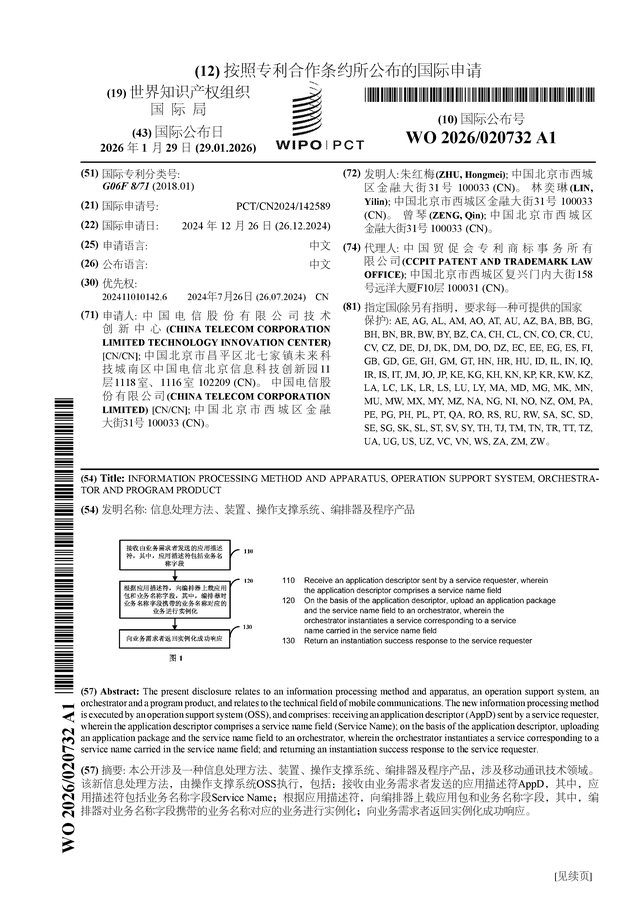
中国电信公布国际专利申请:“信息处理方法、装置、操作支撑系统、编排器及程序产品”
Sou Hu Cai Jing· 2026-01-30 23:00
Group 1 - The core point of the article is that China Telecom has filed an international patent application for a technology related to information processing, with the application number PCT/CN2024/142589 and a publication date set for January 29, 2026 [1] Group 2 - China Telecom has announced a total of 23 international patent applications this year, which represents a decrease of 61.67% compared to the same period last year [3] - In the first half of 2025, China Telecom invested 4.782 billion yuan in research and development, showing a year-on-year increase of 2.65% [3]
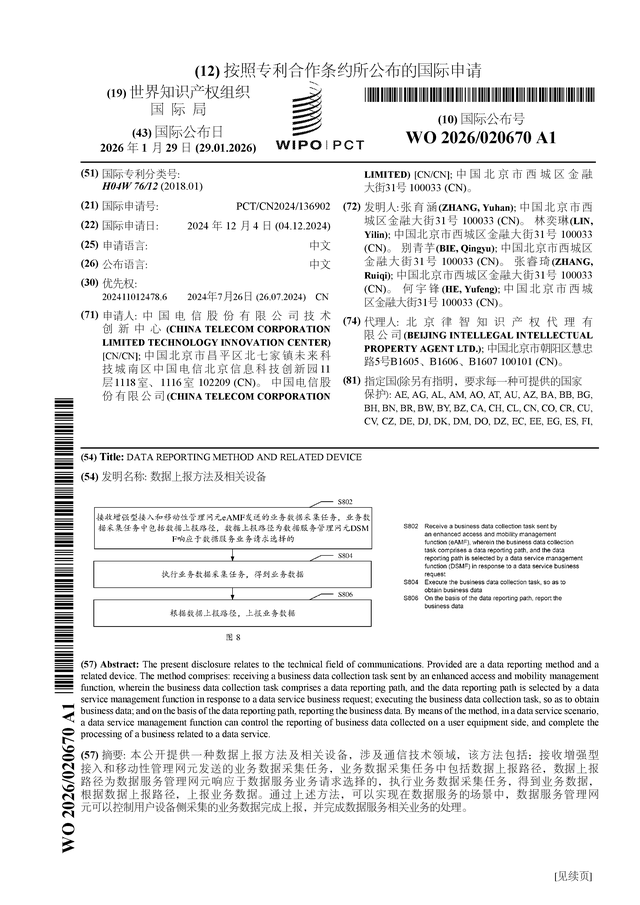
中国电信公布国际专利申请:“数据上报方法及相关设备”
Sou Hu Cai Jing· 2026-01-30 22:54
Group 1 - The core point of the article is that China Telecom has filed an international patent application for a "data reporting method and related equipment," with the application number PCT/CN2024/136902, and the international publication date set for January 29, 2026 [1] Group 2 - China Telecom has announced a total of 23 international patent applications this year, representing a decrease of 61.67% compared to the same period last year [3] - In the first half of 2025, China Telecom invested 4.782 billion yuan in research and development, which is a year-on-year increase of 2.65% [3]
总量向好、增收乏力 通信业仍处转型阵痛期
Zhong Guo Jing Ying Bao· 2026-01-30 19:33
Core Insights - The Chinese telecommunications industry is at a crossroads as the 2025 statistics reveal a mixed performance, with total telecom business volume growing by 9.1% year-on-year, significantly outpacing GDP growth by 4.1 percentage points, contributing positively to economic growth [2] - However, telecom business revenue growth has declined to only 0.7% in 2025, a drop of 2.5 percentage points from 2024, indicating a trend of stagnation in revenue growth despite overall market improvements [3][4] Group 1: Industry Performance - By the end of 2025, the number of 5G base stations reached 4.838 million, accounting for 37.6% of mobile phone base stations, with an average of 34.4 5G base stations per 10,000 people, exceeding the "14th Five-Year Plan" target [2] - The number of mobile phone users in China reached 1.827 billion, with a penetration rate of 130 devices per 100 people, surpassing the global average by 22.5 percentage points [2] - The number of 5G mobile phone users reached 1.204 billion, with a net increase of 190 million users, representing over 65.9% of total mobile phone users, which is 2.1 times the global average [2] Group 2: Revenue Trends - Telecom business revenue for 2025 was 1.75 trillion yuan, with a growth rate of only 0.7%, down from 3.2% in 2024, and significantly lower than the 6.2% and 8% growth rates in 2023 and 2022, respectively [3][4] - Traditional business revenues, including mobile data and voice services, are declining due to competition from OTT services and pricing pressures, with traditional business revenue down by 0.5% in 2025 [4] Group 3: Emerging Business Growth - New emerging businesses, including cloud computing, big data, and IoT, accounted for 25.7% of telecom industry revenue in 2025, growing by 4.7% year-on-year and contributing 1.2 percentage points to overall revenue growth [6] - Big data business revenue grew by 69.2% year-on-year, driven by demand from enterprise clients for data governance and intelligent applications [6] - The number of IoT terminal users reached 2.888 billion, significantly exceeding the number of mobile phone users, indicating a shift from low-value connections to revenue-generating opportunities [7] Group 4: Transition Challenges - The growth rate of cloud computing revenue slowed to 2.9% in 2025, a significant drop from nearly 30% in 2023, highlighting challenges in the sector [8] - Operators face difficulties in the cloud business due to pricing structures and competition from major cloud providers, which limits their market share in high-end cloud services [9] - Continued investment in data centers and computing networks is squeezing profit margins for operators, with China Mobile's computing network investment reaching 37.3 billion yuan in 2025 [9] Group 5: Future Outlook - The ability of emerging businesses to transition from volume growth to high-quality monetization will depend on the industry's execution in building capabilities, ecosystem cooperation, and capital efficiency [10] - If operators can effectively integrate network advantages with computing services into scalable products, emerging businesses may become a sustainable profit driver for the telecommunications industry [10]




山西省政府与中国电信集团签署战略合作框架协议
Xin Lang Cai Jing· 2026-01-30 11:20
Core Viewpoint - The meeting between Shanxi provincial leaders and China Telecom's executives focuses on promoting the integration of the real economy and digital economy, as well as the development of "Artificial Intelligence+" industry applications [1] Group 1 - Shanxi provincial leaders, including Secretary Tang Dengjie and Governor Lu Dongliang, met with China Telecom Group Chairman Ke Ruiwen to discuss collaboration [1] - A strategic cooperation framework agreement was signed between the two parties, represented by Vice Governor Wang Haizhou and China Telecom's Vice General Manager Huang Zhiyong [1]
江西省政协委员建议加速人工智能与实体经济融合
Zhong Guo Xin Wen Wang· 2026-01-30 10:57
Group 1 - The core viewpoint emphasizes the need for Jiangxi to open up demonstration public application scenarios in intelligent manufacturing and low-altitude economy to accelerate the integration of artificial intelligence with the real economy [1][3] - Jiangxi Telecom, as a central enterprise in Jiangxi, is committed to driving industrial upgrades through digital innovation and supporting the development of new productive forces in Jiangxi [1][3] Group 2 - Jiangxi Telecom has been actively transforming traditional data centers into artificial intelligence data centers, creating a new pattern of computing power supply that is leading in scale and environmentally friendly across Jiangxi [3] - In 2024, Jiangxi Telecom plans to establish the first large-scale intelligent computing hub in Jiangxi, the Poyang Lake Intelligent Computing Center, and deploy the "Xiangran" computing scheduling platform, which is one of the top ten super projects of central enterprises in 2022 [3] - In 2026, Jiangxi Telecom will establish an artificial intelligence research institute focusing on computing power, models, and application scenarios, supporting the development of a distinctive "AI+" industrial ecosystem in Jiangxi [3] - During the 14th Five-Year Plan period, Jiangxi Telecom will increase investment and cooperation in computing power infrastructure, industrial digitalization, "AI+", and low-altitude economy to promote high-quality economic and social development in Jiangxi [3]

瑞银将中国电信A股评级下调至中性,目标价6.40元人民币
Xin Lang Cai Jing· 2026-01-30 00:33
Group 1 - UBS downgraded China Telecom's A-share rating to Neutral with a target price of 6.40 RMB [1]
瑞银将中国电信A股评级下调至中性,目标价6.40元人民币。
Xin Lang Cai Jing· 2026-01-29 23:41
Group 1 - UBS downgraded China Telecom's A-share rating to Neutral with a target price of 6.40 RMB [1]
2025年末5G基站达483.8万个
Zheng Quan Ri Bao Zhi Sheng· 2026-01-29 17:10
Core Insights - The Ministry of Industry and Information Technology released the "2025 Communication Industry Statistical Bulletin," indicating stable growth in China's communication industry, with ongoing optimization of industrial structure and a significant increase in user scale, particularly in 5G and gigabit infrastructure deployment [1] User Growth - By the end of 2025, the number of 5G mobile phone users is projected to reach 1.204 billion, accounting for 65.9% of total mobile phone users, an increase of 9.2 percentage points from the end of 2024 [1] - Fixed broadband access users are expected to total 691 million, with a net increase of 20.99 million in 2025. Among these, users with access speeds of 1000 Mbps or higher will reach 238 million, representing 34.5% of total users, up 3.6 percentage points from 2024 [1] Network Infrastructure Development - The number of 5G base stations is anticipated to reach 4.838 million by the end of 2025, with a net increase of 588,000 from 2024, making up 37.6% of total mobile base stations, an increase of 4 percentage points [2] - The total length of newly built optical cable lines in 2025 is projected to be 2.113 million kilometers, bringing the national total to 74.99 million kilometers. The number of 10G PON ports capable of gigabit network services is expected to reach 31.62 million, with a net increase of 3.419 million [2] Computing Power Integration - The three major telecom operators are transitioning their computing power layout from "broad coverage" to "deep integration," with the number of service data center racks reaching 938,000 by the end of 2025, an increase of 108,000 from 2024 [2] - The integration of computing and networking is expected to enhance the precision of computing power distribution across various industries and scenarios, leading to a unified national computing power network [3] Industry Digitalization - The ongoing integration of computing and networking is driving deeper digitalization across industries, characterized by active mobile data traffic consumption and extensive industry application integration [3] - The industrial internet has achieved coverage across 41 industrial categories, becoming a key driver for digital transformation and intelligent upgrades across various sectors [3] Technological Advancements - The integration of computing and networking is breaking down barriers between cloud computing and communication networks, embedding computing capabilities into the network layer for more efficient and customized services [4] - Continuous optimization of network infrastructure is expected to embed computing-network integration into new application scenarios and service models, providing users with diverse and innovative value [4]