
Zhejiang Huace Film and TV (300133)

Search documents
华策影视涨2.03%,成交额3.59亿元,主力资金净流入1258.42万元
Xin Lang Cai Jing· 2025-11-18 03:39
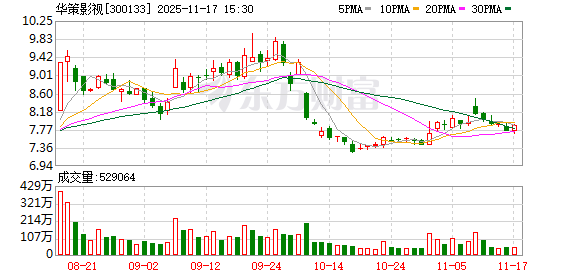
Core Viewpoint - Huace Film & TV has shown a positive stock performance with a year-to-date increase of 11.73%, despite a recent decline over the past 60 days [1][2] Financial Performance - For the period from January to September 2025, Huace Film & TV reported a revenue of 1.041 billion yuan, representing a year-on-year growth of 16.62%, and a net profit attributable to shareholders of 175 million yuan, which is a 5.35% increase compared to the previous year [2] - The company has distributed a total of 682 million yuan in dividends since its A-share listing, with 180 million yuan distributed over the last three years [2] Stock Market Activity - As of November 18, Huace Film & TV's stock price was 8.03 yuan per share, with a trading volume of 359 million yuan and a turnover rate of 2.82%, leading to a total market capitalization of 15.163 billion yuan [1] - The stock has appeared on the "Dragon and Tiger List" once this year, with a net purchase of 262 million yuan on August 18 [1] Shareholder Information - As of November 10, the number of shareholders for Huace Film & TV increased to 73,600, a rise of 3.71% from the previous period, while the average circulating shares per person decreased by 4.25% to 21,910 shares [2] - The top ten circulating shareholders include Hong Kong Central Clearing Limited and Southern CSI 1000 ETF, with the former increasing its holdings by 4.12 million shares [3]

华策影视11月17日获融资买入5866.80万元,融资余额9.50亿元
Xin Lang Cai Jing· 2025-11-18 01:31
Core Viewpoint - Huace Film & TV experienced a stock price increase of 1.81% on November 17, with a trading volume of 413 million yuan, indicating positive market sentiment towards the company [1]. Financing Summary - On November 17, Huace Film & TV had a financing buy-in amount of 58.67 million yuan and a financing repayment of 61.93 million yuan, resulting in a net financing outflow of 3.26 million yuan [1]. - The total financing and securities balance for Huace Film & TV reached 955 million yuan, with the financing balance accounting for 6.41% of the circulating market value, indicating a high level compared to the past year [1]. - The company had a securities lending repayment of 3,100 shares and a securities lending sell-out of 2,500 shares, with a sell-out amount of 19,700 yuan based on the closing price [1]. Company Overview - Zhejiang Huace Film & TV Co., Ltd. was established on October 25, 2005, and listed on October 26, 2010. The company specializes in cultural and film content provision, operation, and strategic industry layout [2]. - The main business revenue composition includes: 45.59% from TV drama production and distribution, 20.70% from TV drama copyright distribution, 10.02% from agency business, 7.15% from computing power business, 5.54% from film sales, and other segments [2]. - As of November 10, the number of shareholders for Huace Film & TV was 73,600, an increase of 3.71% from the previous period, while the average circulating shares per person decreased by 4.25% [2]. Financial Performance - For the period from January to September 2025, Huace Film & TV achieved an operating income of 1.041 billion yuan, representing a year-on-year growth of 16.62%, and a net profit attributable to the parent company of 175 million yuan, reflecting a year-on-year increase of 5.35% [2]. - The company has distributed a total of 682 million yuan in dividends since its A-share listing, with 180 million yuan distributed over the past three years [3]. Institutional Holdings - As of September 30, 2025, Hong Kong Central Clearing Limited was the sixth-largest circulating shareholder of Huace Film & TV, holding 19.29 million shares, an increase of 4.12 million shares from the previous period [3]. - The Southern CSI 1000 ETF (512100) was the tenth-largest circulating shareholder, holding 12.17 million shares, a decrease of 144,100 shares from the previous period [3].
上市公司集体撤离电视剧,主投主控成过去时
3 6 Ke· 2025-11-18 01:09
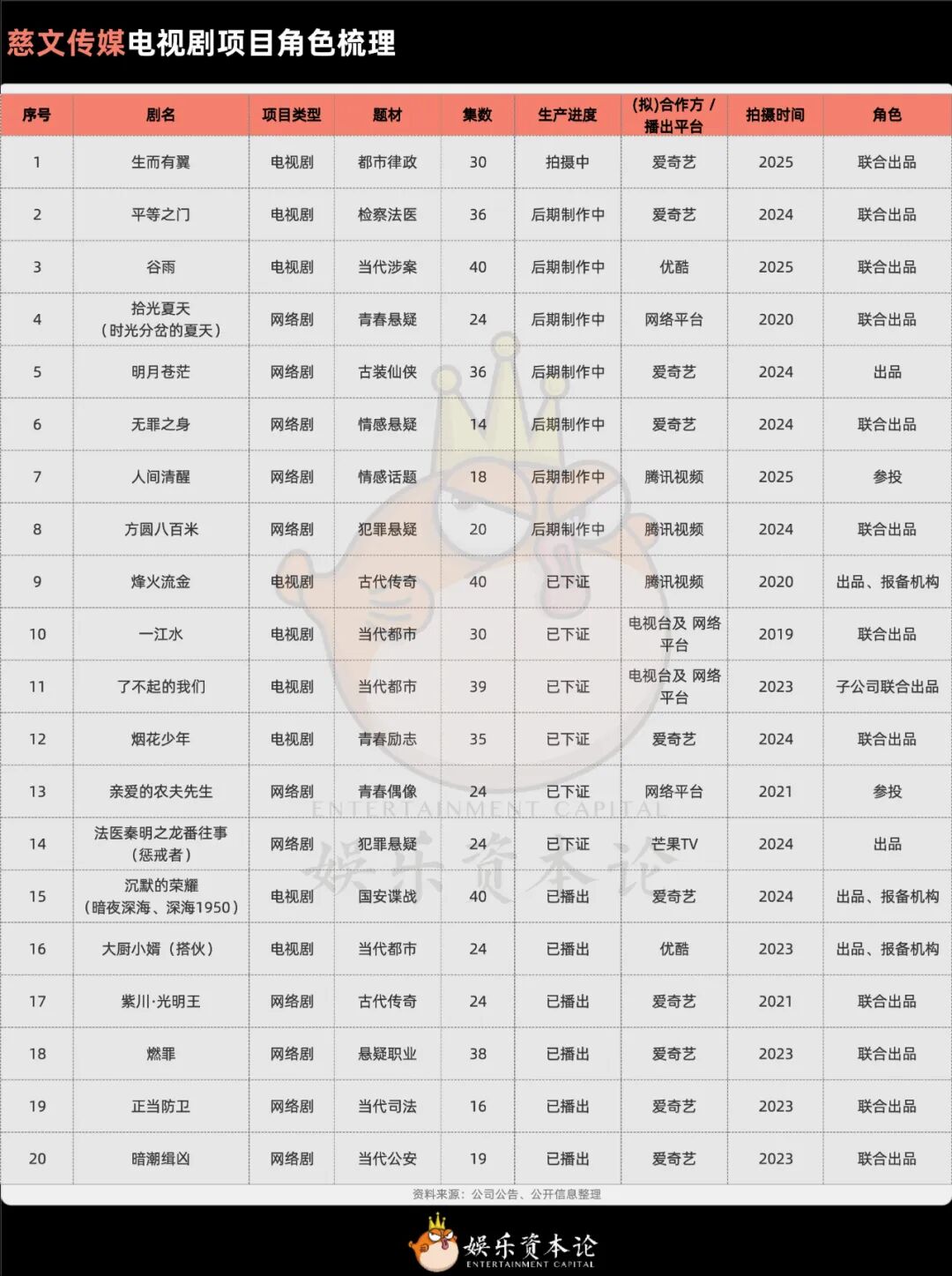
Core Viewpoint - The trend in the television industry indicates that listed companies are shifting from a "main investment and control" role to a model that emphasizes external project investment, often utilizing a "funding" approach to mitigate risks associated with project development [1][4]. Group 1: Industry Trends - The phenomenon of listed companies reducing their project development and focusing on external investments can be traced back to 2020, with a notable increase in such projects starting from 2023 [2]. - Companies like Ciwen Media are increasingly participating in projects as co-producers or investors rather than as primary producers, especially for projects starting in 2025 [2][4]. - The rise of the "funding" model is linked to the shift from copyright dramas to customized dramas, which are becoming the focal point for development in the industry [4][14]. Group 2: Financial Implications - The funding model allows companies to enhance their liquidity and financial security while still obtaining the title of "co-producer" [4]. - Companies are experiencing a significant increase in asset turnover rates, with examples like Zhongguang Tianze showing a rise from 0.49 in 2024 to 0.65 in 2025 H1 [11]. - The financial performance of companies like Zhongguang Tianze has improved, with reported investment income from "capital-preserving" film and television projects reaching 980,000 yuan in 2024 and 1.94 million yuan in the first half of 2025 [10]. Group 3: Project Development Models - The development of television dramas is categorized into three models: copyright dramas, self-produced dramas, and customized dramas, with the latter gaining prominence [4][5]. - The funding model operates by securing a customized contract, allowing the main team to negotiate funding with external investors after project approval [5][6]. - The typical funding share ranges from 20% to 40%, with the first phase of settlement usually paying 50% of the agreed price, allowing external funds to gradually exit [6][9]. Group 4: Market Dynamics - The decline in the share of copyright dramas has led to a concentration of resources among a few major productions, pushing smaller companies to adopt safer customized drama strategies [18]. - The profit margins for customized dramas are significantly lower, ranging from 10% to 15%, compared to 30% to 50% for copyright dramas, leading to a withdrawal of purely financial investors from the market [18][24]. - The industry is collectively seeking stability and certainty, with companies prioritizing risk control and maintaining influence through funding investments [24].


华策影视:战略投资智谱华章并保持密切联系
Zheng Quan Ri Bao· 2025-11-17 11:49
(文章来源:证券日报) 证券日报网讯华策影视11月17日在互动平台回答投资者提问时表示,公司战略投资智谱华章,并保持密 切联系。公司算力业务客户均签署有保密协议。 ...
华策影视:公司继续推行长短剧联动、精品短剧竖屏短剧共同发展的市场策略
Zheng Quan Ri Bao Zhi Sheng· 2025-11-17 11:45
Core Viewpoint - The company is actively promoting a market strategy that integrates both long and short dramas, focusing on the development of high-quality short dramas to enhance production capacity and market presence [1] Group 1: Company Strategy - The company continues to implement a strategy of linking long and short dramas, as well as developing high-quality short dramas in vertical screen format [1] - The production capacity for short dramas has been rapidly increased, with a monthly output now reaching 20 episodes [1] Group 2: Performance Metrics - Several high-quality short dramas released this year, such as "In the Name of Love," "Next is Happiness," and "Dear Enemy," have each garnered over 200 million views [1]
华策影视:公司经营正常
Zheng Quan Ri Bao Wang· 2025-11-17 11:41
证券日报网讯华策影视(300133)11月17日在互动平台回答投资者提问时表示,公司经营正常。股价受 多因素影响,请注意投资风险。 ...
华策影视:截至9月19日股东户数71776户
Zheng Quan Ri Bao Wang· 2025-11-17 11:12
证券日报网讯华策影视(300133)11月17日在互动平台回答投资者提问时表示,截至2025年9月19日, 公司总股东户数为71776户。 ...
华策影视短剧月产能提升至20部
Bei Jing Shang Bao· 2025-11-17 08:44
北京商报讯(记者 卢扬 实习记者 华卓玛)11月17日,华策影视在投资者互动平台回答投资者称,公司 继续推行长短剧联动、精品短剧竖屏短剧共同发展的市场策略,通过提高自身短剧产量、参投短剧公司 以及项目对投等方式快速提升短剧产能,月产能已提升到20部。今年以来上线的《以爱之名》《下一 任,是幸福》《亲爱的宿敌》等精品短剧,播放均超2亿。 ...
影视院线板块11月12日跌2.6%,幸福蓝海领跌,主力资金净流出7.28亿元
Zheng Xing Xing Ye Ri Bao· 2025-11-12 08:49
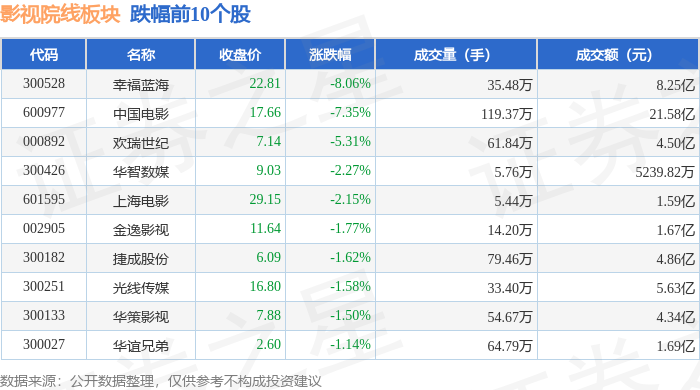
Market Overview - The film and cinema sector experienced a decline of 2.6% on November 12, with Happiness Blue Sea leading the drop [1] - The Shanghai Composite Index closed at 4000.14, down 0.07%, while the Shenzhen Component Index closed at 13240.62, down 0.36% [1] Individual Stock Performance - Happiness Blue Sea (300528) closed at 22.81, down 8.06% with a trading volume of 354,800 shares and a transaction value of 825 million [1] - China Film (600977) closed at 17.66, down 7.35% with a trading volume of 1,193,700 shares and a transaction value of 2.158 billion [1] - Huayi Brothers (300027) closed at 2.60, down 1.14% with a trading volume of 647,900 shares and a transaction value of 1.69 billion [1] Capital Flow Analysis - The film and cinema sector saw a net outflow of 728 million from institutional investors, while retail investors had a net inflow of 675 million [1] - The table indicates that retail investors contributed positively to the capital flow despite the overall decline in the sector [2] Detailed Capital Flow for Selected Stocks - ST Tianze (603721) had a net inflow of 821,000 from institutional investors, while retail investors had a net outflow of 82,500 [2] - Beijing Culture (000802) saw a net inflow of 480,500 from institutional investors, with a slight outflow from retail investors [2] - Huayi Brothers (300027) experienced a net outflow of 7.028 million from institutional investors, but a net inflow of 4.322 million from retail investors [2]



2026年传媒年度策略:十五五启幕AI赋能媒介与内容新叙事
Huaxin Securities· 2025-11-11 12:02
Group 1 - The report emphasizes the transition into the AI era, highlighting the need for media and content industries to adapt to new user demands and leverage AI for growth opportunities [3][4][5] - The cultural media sector is positioned for growth due to two main variables: the initiation of the 14th Five-Year Plan and the empowerment of AI technology, which is shifting from market-driven to policy-driven [4][7] - State-owned enterprises are expected to play a crucial role in the cultural media sector, with companies like Oriental Pearl and Mango TV being highlighted as key players benefiting from AI integration [6][11] Group 2 - The report outlines the performance of the cinema sector, noting that while 2025 saw some challenges, the upcoming 2026 year is expected to bring new content supply and potential growth [30][31] - The digital marketing and e-commerce sectors are experiencing a transformation driven by AI, with significant growth projected in the smart marketing space, expected to reach 1.49 trillion yuan by 2026 [55] - The gaming industry is highlighted as needing to focus on high-quality content production, with companies like miHoYo and Lilith Games being noted for their successful titles, indicating a shift towards content-driven gaming experiences [58][59] Group 3 - The report discusses the importance of long and short video platforms, with significant user engagement noted, particularly in the short video segment, which has reached 1.129 billion monthly active users [36][37] - The audio content market is projected to grow significantly, with the long audio market expected to reach 649.77 billion yuan by 2026, indicating a shift in consumer preferences towards immersive audio experiences [40] - Companies like Bilibili and Xiaohongshu are expanding into audio content, which is expected to drive new user engagement and revenue streams [40][42] Group 4 - The report identifies key companies to watch in the cultural media sector, including state-owned enterprises and digital marketing firms, emphasizing their strategic importance in the evolving landscape [11][12] - The cinema sector is expected to see a rebound in 2026, with new film releases anticipated to drive box office performance, particularly following a low base effect from 2025 [30][31] - The gaming sector is under pressure to innovate and produce high-quality content, with a focus on new product launches and the integration of AI technologies to enhance user experiences [58][59]


