Maxwell(300751)

Search documents
广发证券:太空算力远期市场空间广阔 太阳翼或为最优通胀环节
智通财经网· 2026-01-20 08:43
Group 1 - The core viewpoint is that the industry has a vast long-term market space due to the active layout of space computing by China and the US, combined with the cost and performance advantages of space computing itself [3][4] - Space computing is transitioning from a "ground-based calculation" model to a "space-based calculation" model, allowing for direct data processing in space [1][3] Group 2 - Space computing has operational cost advantages, with a significant focus on marginal energy costs, which are the core factor in overall operational expenses [2] - For example, a single space-based 40MW computing cluster can operate for 10 years at a total cost of $8.2 million, saving approximately $159 million compared to traditional computing clusters, with over $130 million saved in marginal energy costs [2] Group 3 - The demand for solar wings is expected to increase due to the expansion of power and area requirements driven by space computing, leading to the adoption of flexible technology routes [4] - Flexible solar wings can achieve a weight reduction of 20%-40%, a storage volume reduction of over 60%, and improved performance, making them a key component in the power system [4] Group 4 - Investment recommendations include focusing on companies related to space photovoltaics, such as: - Maiwei Co., Ltd. (300751.SZ), which is expected to become a core equipment supplier for space computing photovoltaic segments [5] - Gaomei Co., Ltd. (688556.SH), which aligns with the cost reduction route for space photovoltaics [5] - Jiejia Weichuang (300724.SZ), which is positioned to benefit from the expansion of flexible solar wings in the space computing sector [5]



未知机构:中泰机械太空光伏大有可为卫星太阳翼空间电站打开成长空间-20260120
未知机构· 2026-01-20 02:25
Summary of Conference Call Notes Industry Overview - The focus is on the space photovoltaic industry, particularly satellite solar wings and space power stations, which are expected to open up significant growth opportunities [1] - Satellite solar wings are identified as the core energy system for satellites, ensuring power supply [1] Key Insights and Arguments - The growth of the satellite industry is linked to an increase in the number of satellites and the area of solar wings, making solar wings a critical component in commercial space ventures [1] - Elon Musk has shifted from using relatively mature and inexpensive crystalline silicon solutions to more advanced P-type HJT (Heterojunction Technology) batteries that are radiation-resistant, lightweight, and more adaptable [1] - Musk plans to deploy 100GW of solar-powered AI satellites annually, indicating a vast market potential [1] - Space solar power stations are anticipated to create additional growth opportunities, as they can bypass atmospheric interference and achieve high-efficiency solar energy generation [1] - Countries like the United States, China (with the Daily Project), and Japan have initiated space photovoltaic power station plans, which are expected to further stimulate demand in the space photovoltaic sector [1] Additional Important Points - Recommendations for investment focus on specific companies: - **Maiwei Co., Ltd.**: Recognized as the first domestic equipment manufacturer contacted by SpaceX, specializing in customized HJT equipment for space photovoltaics, with expectations for large-scale supply [2] - **Yujing Co., Ltd.**: Concentrates on crystalline silicon and UTG (Ultra-Thin Glass) glass slicing, currently undergoing factory audits by SpaceX [2]

未知机构:天风电新太空能源SpaceX主线看好设备先行0120-20260120
未知机构· 2026-01-20 02:10
Summary of Conference Call Notes Industry Overview - The focus is on the solar energy sector, particularly the developments related to companies T and S, which are planning to expand their photovoltaic production capacity [1][1]. Key Points and Arguments 1. **Separate Teams for Production Planning**: Companies T and S are operating as independent teams to plan their photovoltaic production capacity, with T taking the lead and S expected to follow before the Spring Festival [1]. 2. **Technology Pathways**: Company S is pursuing a space technology route using P-type HJT (Heterojunction Technology), while Company T is focusing on ground applications, likely utilizing TOPCon technology due to patent considerations [1]. 3. **Super Factory Plans**: Company T is considering the establishment of a 10GW integrated super factory, with an initial phase potentially reaching 1GW and a long-term capacity target of 50GW [1]. 4. **Capacity Planning**: The combined capacity planning for T and S is approaching 100GW, with T targeting 50GW for ground applications and S aiming for 40GW for space applications, which exceeds initial expectations [1]. 5. **Ongoing Factory Audits**: The factory audit for Company T is just the first round, with potential for additional rounds, indicating that the equipment sector will undergo repeated trading activities [1]. 6. **Systematic Revaluation**: The planning by T and S is seen as exceeding expectations, suggesting that the equipment sector will experience a systematic revaluation beyond just marginal changes from factory audits [1]. Additional Insights - **Investment Recommendations**: The focus is on companies with high value and good market positioning within the solar equipment sector, specifically recommending: - High-value segments: Silicon wafers and battery equipment, with strong endorsements for Liancheng CNC and Laplace, as well as Aotewi, which has a presence in silicon, battery, and module equipment [3]. - Well-positioned segments: Slicing machines and reduction furnaces, with key recommendations for Gaoce Co. and Shuangliang Energy [3]. - **Potential of Space Technology**: The most promising outlook remains with companies like Maiwei Co., which are focused on defining space technology routes that hold the highest value and imaginative potential [2].
光伏设备行业点评:商业航天星辰大海,太空光伏设备迎增长机遇
Shenwan Hongyuan Securities· 2026-01-19 13:42
Investment Rating - The report rates the commercial aerospace and photovoltaic equipment industry as "Overweight" [4]. Core Insights - The commercial aerospace sector is entering a new phase characterized by large-scale deployment and capability upgrades, leading to increased demand for space photovoltaic systems. The application for over 200,000 satellites in China marks a transition from "thousands" to "tens of thousands" and even "millions" of satellites, indicating a super cycle in satellite manufacturing and launching over the next decade, which will drive long-term, large-scale demand for satellite energy systems, specifically space photovoltaics [4]. - The extreme conditions in space (high radiation, large temperature differences, vacuum) necessitate stringent requirements, leading to continuous iterations in space photovoltaic technology. The current mature solution is gallium arsenide (GaAs) multi-junction cells, which have high conversion efficiency (generally exceeding 30%) and good radiation resistance, but are extremely expensive and have limited production capacity. The short to medium-term scalable path is the HJT (Heterojunction) battery, which is more cost-effective for mass production despite lower absolute efficiency and radiation resistance compared to GaAs. Long-term potential directions include perovskite and tandem batteries, which have high theoretical efficiency limits and lightweight properties, but face challenges in long-term stability [4]. - Key equipment suppliers to focus on include Maiwei Co., Ltd. (HJT production line equipment), High Measurement Co., Ltd. (integrated slicing and processing services), Aotwei (module string welding equipment), and others. Battery module manufacturers include Yunda Co., Ltd. (collaborating on perovskite technology applications) and Trina Solar [4]. Summary by Sections Industry Overview - The commercial aerospace market in China is expected to expand significantly due to the submission of over 200,000 satellite constellation applications, which will stimulate demand across multiple segments including satellite manufacturing and rocket launching [2]. Technology Development - The report highlights the transition from traditional satellite power supply units to essential energy infrastructure for future space economies, driven by advancements in space computing and AI data centers powered by space photovoltaics [4]. Key Companies and Valuations - The report provides a valuation table for key companies in the industry, including Maiwei Co., Ltd. with a market cap of 66.5 billion and projected net profits for 2026 of 970 million, and others like Aotwei and High Measurement with varying financial forecasts [5].



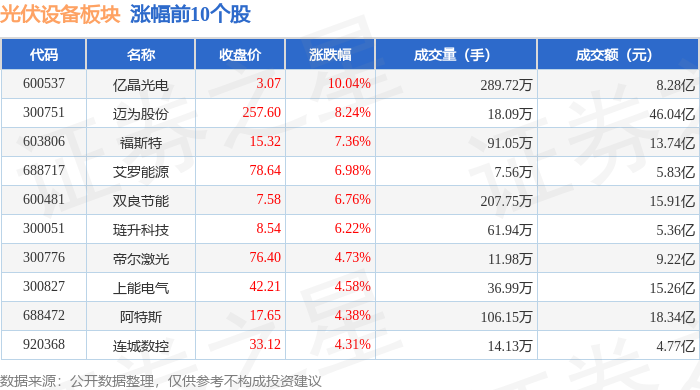
光伏设备板块1月19日涨0.55%,亿晶光电领涨,主力资金净流入9.04亿元
Zheng Xing Xing Ye Ri Bao· 2026-01-19 08:58
Core Insights - The photovoltaic equipment sector experienced a 0.55% increase on January 19, with Yichin Optoelectronics leading the gains [1] - The Shanghai Composite Index closed at 4114.0, up 0.29%, while the Shenzhen Component Index closed at 14294.05, up 0.09% [1] Stock Performance - Yichin Optoelectronics (600537) closed at 3.07, up 10.04%, with a trading volume of 2.8972 million shares and a transaction value of 828 million [1] - Maiwei Co., Ltd. (300751) closed at 257.60, up 8.24%, with a trading volume of 180,900 shares and a transaction value of 4.604 billion [1] - Foster (603806) closed at 15.32, up 7.36%, with a trading volume of 910,500 shares and a transaction value of 1.374 billion [1] - Other notable performers include Airo Energy (688717) up 6.98%, Shuangliang Energy (600481) up 6.76%, and Bansheng Technology (300051) up 6.22% [1] Capital Flow - The photovoltaic equipment sector saw a net inflow of 904 million from main funds, while retail investors experienced a net outflow of 573 million [2] - The main funds' net inflow for Sunshine Power (300274) was 598 million, while retail investors had a net outflow of 347 million [3] - Maiwei Co., Ltd. (300751) had a main fund net inflow of 425 million, but retail investors saw a net outflow of 414 million [3] - Foster (603806) recorded a main fund net inflow of 234 million, with retail investors experiencing a net outflow of 186 million [3]


20cm速递|六部门发文规范动力电池回收!泰胜风能涨13.19%,创业板新能源ETF华夏(159368)回调0.26%
Mei Ri Jing Ji Xin Wen· 2026-01-19 06:35
Group 1 - The A-share market experienced fluctuations on January 19, with the ChiNext New Energy ETF Huaxia (159368) slightly declining by 0.26% in the afternoon [1] - Notable stock performances included Taisheng Wind Power rising by 13.19%, Maiwei Co. increasing by 9.61%, Yingjie Electric gaining 8.07%, and Dier Laser up by 4.91% [1] - The ChiNext New Energy ETF Huaxia (159368) has seen a net inflow of over 51 million yuan in the past five days, with a trading volume of 99.48 million yuan, making it the largest in its category [1] Group 2 - On January 16, six departments, including the Ministry of Industry and Information Technology and the National Development and Reform Commission, released a temporary management measure for the recycling and comprehensive utilization of used power batteries for new energy vehicles, effective from April 1, 2026 [1] - The core of the new regulation emphasizes a "vehicle-battery integrated scrapping" system, aiming to establish a management system covering "all channels, all chains, and all life cycles" and to introduce a "digital identity" for power batteries [1] - According to research institutions, it is estimated that by 2030, the amount of used power batteries generated in China will exceed 1 million tons, highlighting the need for a structured recycling system [1] Group 3 - The ChiNext New Energy ETF Huaxia (159368) is the largest ETF fund tracking the ChiNext New Energy Index, which includes various sectors such as batteries and photovoltaics [2] - The fund has high elasticity, with a potential increase of up to 20%, and the lowest fee rate, with a combined management and custody fee of only 0.2% [2] - As of December 30, 2025, the fund's scale is projected to reach 676 million yuan, with an average daily trading volume of 70.75 million yuan over the past month [2]

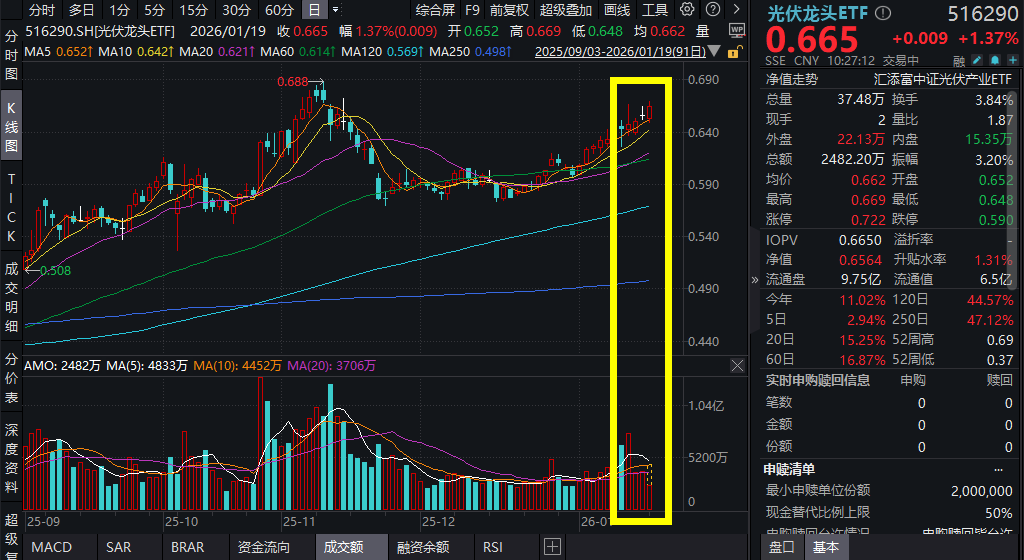
钧达股份3000万元投资抢滩太空光伏! 特变电工涨超7%,光伏龙头ETF(516290)爆量涨超1%冲击四连阳!2026年最强电新主线确定了?
Xin Lang Cai Jing· 2026-01-19 03:01
Core Viewpoint - The A-share market experienced fluctuations with the photovoltaic leader ETF (516290) seeing a significant increase of 1.37%, with a trading volume exceeding 30 million yuan, marking a four-day consecutive rise in daily performance [1]. Group 1: Market Performance - The photovoltaic leader ETF (516290) showed mixed performance among its constituent stocks, with TBEA rising over 7%, Maiwei Co. and Chint Electric increasing over 5%, while Longi Green Energy and Jiejia Weichuang experienced pullbacks [3]. - The top ten constituent stocks of the photovoltaic leader ETF include TBEA, which rose by 7.07%, and TCL Technology, which increased by 2.90%, while Longi Green Energy fell by 2.24% [4]. Group 2: Industry Developments - Junda Co. announced a 30 million yuan investment in Shanghai Xingyi Chip Energy Technology Co., aiming to leverage opportunities in the low-orbit satellite networking and space computing industry, enhancing capabilities in photovoltaic industrialization and perovskite technology [5]. - Space photovoltaic energy is highlighted as a strategic solution for commercial space and high-end applications, with the potential to supply energy to satellites and space stations, marking a pivotal moment for the industry [5]. Group 3: Future Outlook - Huaxi Securities emphasizes that photovoltaic technology is the only viable energy solution in space, with advantages over traditional fossil fuels and nuclear energy, making it suitable for extreme environments [5]. - According to CITIC Securities, the space photovoltaic market is expected to reach a trillion yuan scale, with satellite launches projected to increase from 5,000 to 50,000 between 2025 and 2040, driving demand for photovoltaic batteries from 0.024 GW to 1.8 GW [5]. - Guojin Securities expresses strong confidence in "space photovoltaic" becoming a dominant theme in the energy sector through 2026, driven by surging demand and the urgency for resource competition [6].




再Call太空钙钛矿-重视Space-X产业链
2026-01-19 02:29
Summary of Conference Call on Perovskite Solar Cells and Space Industry Industry Overview - The focus is on the perovskite solar cell industry, particularly its application in space technology and its potential to replace traditional gallium arsenide solar cells in low Earth orbit satellites [1][3][5]. Key Insights and Arguments - **Expansion of Perovskite Applications**: It is anticipated that from 2026 to 2027, perovskite technology will transition from ground applications to space applications, becoming a major investment theme [1][3]. - **Cost Reduction**: The cost of perovskite solar cells for space applications is significantly lower, with prices expected to drop from at least 200,000 yuan per square meter for gallium arsenide to between 10,000 to 20,000 yuan per square meter for perovskite [1][5]. - **Market Demand**: The demand for low-cost solar cells in the low Earth orbit satellite market is increasing, driven by the need for cost control in commercial space ventures [1][5]. - **Domestic Competitiveness**: Shanghai Port Bay has successfully launched pure single-junction space components into low Earth orbit, demonstrating the competitiveness of domestic components in the space application field [2][5]. Future Projections - **Ground Perovskite Development**: The bidding volume for ground perovskite solar cells is expected to exceed 3 to 4 GW in 2026, indicating a significant improvement from 2025 [1][3]. - **Technological Advancements**: The industry is moving from the initial development phase (0 to 1) to a more advanced stage (0.8), with improvements in large-area, high-efficiency, and stability issues being gradually resolved [3][4]. Equipment and Supplier Recommendations - **Key Equipment Suppliers**: The report recommends focusing on companies such as Maiwei Co., Ltd., and also highlights Otovi, Jiejia Weichuang, and High Measurement Co., Ltd. as companies to watch [1][4]. - **Potential Market Opportunities**: If SpaceX adopts P-type heterojunction technology, there will be increased demand for heterojunction equipment, crystalline silicon thin-film equipment, and related components, benefiting domestic suppliers [4][5]. Additional Important Points - **Catalytic Effects**: T Company's ground photovoltaic projects may also provide potential catalytic effects in the market [4]. - **Long-term Recommendations**: The report suggests a long-term investment in Shanghai Port Bay and Maiwei Co., Ltd., while also advising attention to other mentioned companies [4].

国家电网“十五五”投资4万亿元,固态电池近期催化密集落地



GOLDEN SUN SECURITIES· 2026-01-18 06:32
Investment Rating - The report indicates a positive outlook for the power equipment industry, particularly in the renewable energy sector, with significant investments and technological advancements expected to drive growth [1][2][4]. Core Insights - The report highlights that the State Grid's investment during the "14th Five-Year Plan" period is projected to reach 4 trillion yuan, marking a 40% increase compared to the previous plan [2]. - The report emphasizes the stability in polysilicon prices and the continuous rise in battery component prices, with N-type battery prices increasing to 0.40 yuan per watt [15][16]. - The report identifies three key areas of focus: supply-side reform leading to price increases in the industry chain, long-term growth opportunities from new technologies, and industrialization opportunities from perovskite GW-level layouts [16]. Summary by Sections 1. New Energy Generation 1.1 Photovoltaics - Polysilicon prices remain stable, while battery component prices are on the rise, with N-type battery prices reaching an average of 0.40 yuan per watt [15]. - The report notes that leading component companies are responding to industry self-discipline by raising component prices, with distributed sales prices reaching 0.72 yuan per watt [15][16]. - Key companies to watch include Tongwei Co., GCL-Poly, LONGi Green Energy, JA Solar, and Trina Solar [16]. 1.2 Wind Power & Grid - The UK AR7 offshore wind auction results exceeded expectations, with a total scale of approximately 8.4GW, validating the upward trend in European offshore wind [17]. - The State Grid's investment is expected to enhance transmission capacity significantly, addressing bottlenecks in renewable energy delivery [18]. - Companies to focus on include Goldwind, Yunda Wind Power, Mingyang Smart Energy, and Sany Heavy Energy [18]. 1.3 Hydrogen & Energy Storage - By 2025, the production and sales of fuel cell vehicles in China are projected to reach 7,797 units, reflecting a 44% year-on-year increase [20]. - The report anticipates that new energy storage installations will reach 58.6GW/175.3GWh by 2025, with significant growth expected in the energy storage sector [21]. - Key players in the hydrogen sector include Shuangliang Energy, Huadian Heavy Industries, and Shenghui Technology [20]. 2. New Energy Vehicles - Solid-state batteries are gaining traction, with several automakers making progress towards mass production by 2026 [29]. - Companies such as BYD, Changan Automobile, and Chery are expected to achieve significant milestones in solid-state battery technology [29]. - The report suggests monitoring companies like Xiamen Tungsten, Hailiang Co., and Nanjing Advanced Lithium Battery [29]. 3. Industry Trends - The report notes a 0.4% increase in the new energy equipment sector from January 12 to January 16, 2026, with a cumulative increase of 5.3% since the beginning of the year [12]. - The photovoltaic equipment sector saw a 3.52% increase, while the wind power equipment sector experienced a decline of 1.28% during the same period [13].
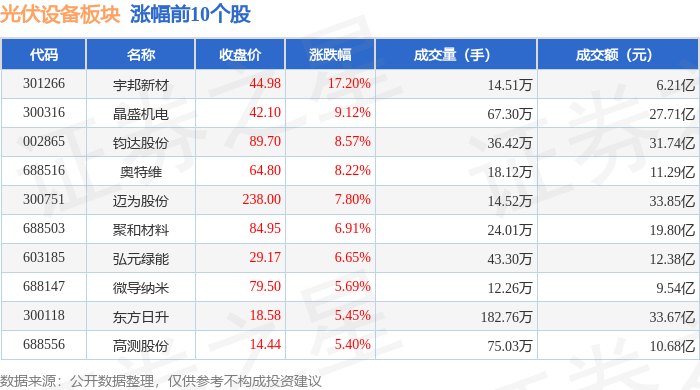
光伏设备板块1月16日涨2.09%,宇邦新材领涨,主力资金净流入26.99亿元
Zheng Xing Xing Ye Ri Bao· 2026-01-16 08:56
Core Viewpoint - The photovoltaic equipment sector experienced a significant increase, with a 2.09% rise on January 16, led by Yubang New Materials, while the overall market indices showed slight declines [1]. Group 1: Market Performance - The Shanghai Composite Index closed at 4101.91, down 0.26%, and the Shenzhen Component Index closed at 14281.08, down 0.18% [1]. - Yubang New Materials led the gains in the photovoltaic equipment sector with a closing price of 44.98, reflecting a 17.20% increase [1]. - Other notable performers included Jing Sheng Mechanical and Electrical with a 9.12% increase, and Jun Da Co., which rose by 8.57% [1]. Group 2: Trading Volume and Value - Yubang New Materials had a trading volume of 145,100 shares, resulting in a transaction value of 621 million yuan [1]. - Jing Sheng Mechanical and Electrical recorded a trading volume of 673,000 shares with a transaction value of 2.771 billion yuan [1]. - Jun Da Co. had a trading volume of 364,200 shares, leading to a transaction value of 3.174 billion yuan [1]. Group 3: Capital Flow - The photovoltaic equipment sector saw a net inflow of 2.699 billion yuan from main funds, while retail funds experienced a net outflow of 1.645 billion yuan [2]. - Major stocks like Yangguang Electric Power and Maiwei Co. had significant net inflows from main funds, indicating strong institutional interest [3]. - Conversely, stocks like Yijingsheng Electric and Aerospace Mechanical experienced notable net outflows from retail investors, suggesting a shift in sentiment [2][3].