
Hunan Yuneng New Energy Battery Material (301358)

Search documents
光伏锂电出口退税新政出台 一季度产能释放“淡季不淡”
2 1 Shi Ji Jing Ji Bao Dao· 2026-01-12 14:40
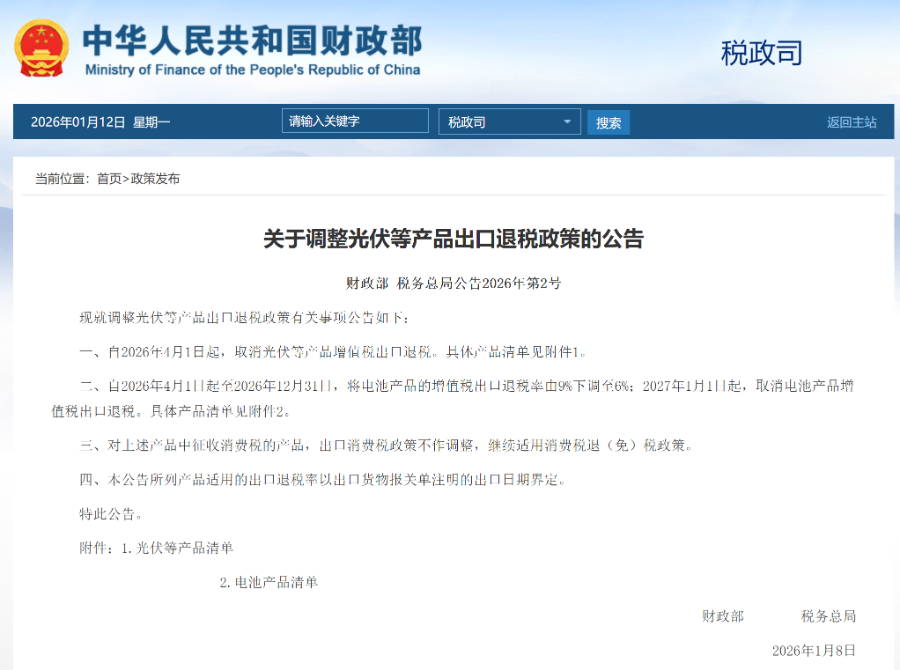
Core Viewpoint - The recent announcement by the Ministry of Finance and the State Taxation Administration to cancel export VAT rebates for photovoltaic and battery products is seen as a significant measure in the "anti-involution" actions within the new energy sectors, aimed at addressing the industry's profitability issues and promoting higher value-added products [5][6][8]. Industry Overview - The new energy photovoltaic and lithium battery industries have been facing challenges due to mismatched supply and demand and intense price competition, leading to weak profitability across the sector [3]. - Since 2025, there have been ongoing calls within the lithium battery sector to resist vicious competition, control capacity growth, and enhance technological innovation [3]. Policy Changes - Starting from April 1, 2026, the export VAT rebate for photovoltaic products will be canceled, and the rebate rate for battery products will be reduced from 9% to 6% until the end of 2026, after which it will be completely eliminated [1][5]. - The Ministry of Industry and Information Technology and other regulatory bodies have proposed 20 measures to regulate industry competition, including tightening approvals for low-capacity projects and establishing a cost-based price monitoring mechanism [4]. Market Reactions - Following the announcement, the stock performance of key players in the lithium battery sector showed significant volatility, with leading companies like CATL experiencing declines, while some photovoltaic companies saw substantial gains [1]. - The cancellation of export VAT rebates is expected to lead to an increase in the cost and price of Chinese photovoltaic components in overseas markets, which may help clear out low-end production capacity [8]. Price Trends - The prices of lithium carbonate futures have surged to over 160,000 yuan per ton, compared to 60,000 yuan per ton in June 2025, indicating a significant recovery in the battery materials market [6]. - The demand for upstream materials remains strong, with companies reporting full production capacity and no immediate adjustments in order volumes from downstream clients [7]. Future Outlook - The upcoming policy changes are anticipated to drive a surge in orders for photovoltaic components before the new VAT regulations take effect, although this demand may be temporary [7]. - Long-term, the cancellation of export VAT rebates is expected to facilitate industry consolidation and price normalization, benefiting the overall market structure [8].




光伏锂电出口退税将取消 ,有代理商称现货5分钟被抢光
2 1 Shi Ji Jing Ji Bao Dao· 2026-01-12 14:28
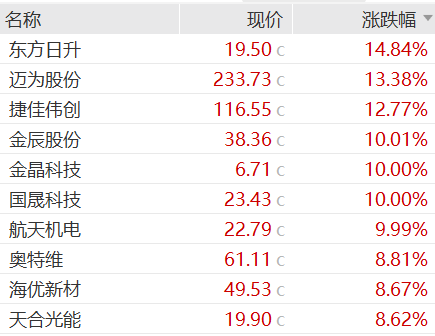
Core Viewpoint - The recent changes in export tax policies for photovoltaic and lithium battery products are seen as a significant move to combat excessive competition and improve profitability in the renewable energy sectors [4][8][9]. Group 1: Market Performance - On January 12, the opening saw fluctuations in the new energy photovoltaic and lithium battery sectors, with notable divergences in individual stock performances [1]. - Leading lithium battery company CATL (宁德时代) saw its H-shares drop by 3% and A-shares decline by over 4%, while companies like Deyang Nano (德方纳米) and Hunan Youneng (湖南裕能) experienced mixed results [1]. - In the photovoltaic sector, companies such as Maiwei (迈为股份) and Jiejia Weichuang (捷佳伟创) surged over 10%, while Trina Solar (天合光能) and Haiyou New Materials (海优新材) rose over 8% [1]. Group 2: Export Tax Policy Changes - Starting April 1, 2026, the export tax rebate for photovoltaic products will be eliminated, and the rebate rate for battery products will be reduced from 9% to 6% until the end of 2026, after which it will be completely removed [2]. - This policy change is part of a broader "anti-involution" initiative aimed at addressing the supply-demand mismatch and intense price competition that have weakened profitability in the photovoltaic and lithium battery industries [4][5][8]. Group 3: Industry Response and Measures - Since 2025, there have been ongoing calls within the lithium battery sector to resist harmful competition and control capacity growth, with various industry meetings held to discuss these issues [7]. - The Ministry of Industry and Information Technology has organized discussions with leading battery companies to establish measures for regulating competition and ensuring sustainable growth [7]. - A total of 20 measures were proposed, including monitoring production capacity and implementing penalties for non-compliant companies, which may affect financing and tax rebates [8]. Group 4: Market Dynamics and Future Outlook - Despite the seasonal downturn typically seen in the first quarter, demand for power and energy storage batteries remains strong, with companies reporting full order books and saturated production capacity [11]. - The anticipated increase in costs due to the export tax policy is prompting overseas buyers to adjust their purchasing schedules, potentially leading to a robust first quarter for lithium battery sales [11][12]. - Analysts predict that the cancellation of export tax rebates will ultimately raise the costs and prices of Chinese photovoltaic components in overseas markets, which could help clear out excess capacity and stabilize prices in the long run [13].
光伏锂电出口退税将取消 ,有代理商称现货5分钟被抢光
21世纪经济报道· 2026-01-12 14:21
Core Viewpoint - The article discusses the recent fluctuations in the new energy photovoltaic and lithium battery sectors, highlighting the impact of changes in export tax policies on these industries and the ongoing "anti-involution" actions aimed at stabilizing prices and production capacity [1][5][6]. Summary by Sections Market Performance - On January 12, the lithium battery leader CATL saw its H-shares drop by 3% and A-shares fall over 4%, while companies like Deyang Nano and Hunan Yueneng experienced mixed results with increases and decreases in their stock prices [1]. Export Tax Policy Changes - The Ministry of Finance announced that starting April 1, 2026, the export VAT refund for photovoltaic products will be canceled, and the VAT refund rate for battery products will be reduced from 9% to 6% until the end of 2026, after which it will be completely eliminated [2][3]. Industry Response and Actions - The lithium battery and photovoltaic industries have been facing challenges due to mismatched supply and demand and intense price competition, leading to a series of "anti-involution" initiatives aimed at expanding demand, adjusting prices, and controlling production capacity [3][5]. - Since 2025, there have been calls within the lithium battery sector to resist vicious competition and control the disorderly growth of production capacity, with various companies announcing price adjustments to stabilize the market [5][6]. Price Trends and Market Dynamics - Despite the seasonal downturn typically seen in the first quarter, the demand for power and energy storage batteries remains strong, with companies reporting sufficient orders and saturated production capacity [8]. - The export tax policy changes are expected to lead to an increase in battery prices, as overseas buyers adjust their purchasing strategies to avoid higher costs after the policy takes effect [8][10]. Future Outlook - Analysts predict that the cancellation of export tax refunds will increase the costs and prices of Chinese photovoltaic components in overseas markets, which may lead to industry consolidation and a return to more rational pricing in the long term [7][10].
湖南裕能股价连续4天下跌累计跌幅8.47%,方正富邦基金旗下1只基金持2.97万股,浮亏损失17.05万元
Xin Lang Cai Jing· 2026-01-12 07:48
1月12日,湖南裕能跌2.37%,截至发稿,报62.08元/股,成交17.74亿元,换手率7.38%,总市值472.31 亿元。湖南裕能股价已经连续4天下跌,区间累计跌幅8.47%。 资料显示,湖南裕能新能源电池材料股份有限公司位于湖南省湘潭市雨湖区鹤岭镇日丽路18号,成立日 期2016年6月23日,上市日期2023年2月9日,公司主营业务涉及公司是国内主要的锂离子电池正极材料 供应商,专注于锂离子电池正极材料研发、生产和销售。公司的主要产品包括磷酸铁锂、三元材料等锂 离子电池正极材料,目前以磷酸铁锂为主,主要应用于动力电池、储能电池等锂离子电池的制造,最终应用 于新能源汽车、储能领域等。主营业务收入构成为:磷酸盐正极材料98.04%,其他(补充)1.96%。 从基金十大重仓股角度 数据显示,方正富邦基金旗下1只基金重仓湖南裕能。方正富邦致盛混合A(020424)三季度持有股数 2.97万股,占基金净值比例为5.29%,位居第一大重仓股。根据测算,今日浮亏损失约4.48万元。连续4 天下跌期间浮亏损失17.05万元。 方正富邦致盛混合A(020424)基金经理为汤戈。 截至发稿,汤戈累计任职时间4年161天, ...
2025年磷酸铁锂市场盘点:名义产能653万吨,总产量增长61.5%,月产量突破40万吨
鑫椤储能· 2026-01-08 06:31
Core Viewpoint - The production of lithium iron phosphate (LFP) is projected to reach 3.915 million tons by 2025, representing a year-on-year growth of 61.5% [1] Monthly Production Trends - In 2025, LFP production is expected to show a steady increase throughout the year, with monthly outputs of 200,000 to 300,000 tons from January to May, 300,000 to 400,000 tons from June to October, and exceeding 400,000 tons in November and December [3] Capacity Analysis - By the end of 2025, nominal LFP production capacity is expected to reach 6.53 million tons, an increase of 950,000 tons from 5.58 million tons at the end of 2024. However, significant idle capacity exists due to high costs, outdated equipment, lack of technology, and insufficient funding [5] - The nominal production capacity of companies capable of mass production will total 5.7235 million tons, up 742,500 tons from 4.981 million tons in 2024 [5] Company Market Share - Hunan Youneng leads the market with approximately 30% share, while other companies hold less than 10%. The second tier includes Wanrun New Energy, Defang Nano, Fulian Shenghua, Youshan Technology, Longpan Lithium Source, and Guoxuan High-Tech, each with market shares between 5% and 10% [8] - The third tier consists of Taifeng Xianxing, Anda Technology, GCL-Poly Energy, Dingsheng Technology, Jintang Times, Rongtong High-Tech, Wanhu Chemical, and Sichuan Langsheng, each with market shares exceeding 2% [8] Production Growth Rates - Among the top 20 companies, Zhongchu Innovation's 100,000-ton production line is expected to fully release in 2025, with a staggering growth rate of 1578%. Other companies like Bangpu Recycling and Wanhu Chemical also show growth rates exceeding 200%, while Anda Technology, GCL-Poly Energy, and Fulian Shenghua exceed 100% [9] Process Technology - The phosphate iron process accounts for 82.1% of production, followed by ferrous oxalate, ferric nitrate, iron red, and hydrothermal methods. The latter three processes have the potential to transition from niche to mainstream as they have already achieved mass production of high-pressure solid products [11]



湖南裕能(301358) - 中信建投证券股份有限公司关于湖南裕能新能源电池材料股份有限公司2025年定期现场检查报告
2026-01-07 10:22
中信建投证券股份有限公司 关于湖南裕能新能源电池材料股份有限公司 2025 年定期现场检查报告 | 保荐人名称:中信建投证券股份有限公司 上市公司简称:湖南裕能 | | | | | --- | --- | --- | --- | | 保荐代表人姓名:张帅 联系电话:010-56051435 | | | | | 保荐代表人姓名:胡德波 联系电话:010-65608237 | | | | | 现场检查人员姓名:张帅,胡德波 | | | | | 年度 现场检查对应期间:2025 | | | | | 现场检查时间:2025 年 月 日-12 月 日 12 24 25 | | | | | 一、现场检查事项 现场检查意见 | | | | | (一)公司治理 | 是 | 否 | 不适用 | | 现场检查手段:查阅公司章程、公司治理的相关规章制度,并查阅公司相关的三会会议资料 | | | | | 及信息披露文件,访谈管理层 | | | | | 1.公司章程和公司治理制度是否完备、合规 | 是 | | | | 2.公司章程和股东会、董事会规则是否得到有效执行 | 是 | | | | 3.股东会、董事会会议记录是否完整,时间、地 ...
GGII:2025年国内电池产业链投资扩产总结
高工锂电· 2026-01-07 10:11
Core Viewpoint - The article suggests that 2026 is expected to mark the beginning of a new healthy and orderly development cycle for China's lithium battery new energy industry [3][19]. Investment Overview - In 2025, over 282 public investment projects related to the lithium battery industry chain in China are anticipated, with a total investment exceeding 820 billion yuan, representing a year-on-year growth of over 74% [4]. - The investment projects are primarily concentrated in East and Central China, with regions like Fujian, Shandong, and Jiangsu leading in lithium battery and material manufacturing due to their rich chemical resources and strategic enterprise layouts [6]. Regional Distribution - The Southwest region, particularly Sichuan, is expected to dominate the investment in lithium battery positive materials, accounting for 59% of the projects, with a significant production capacity of over 350 GWh [11]. - Negative materials investment is more evenly distributed, with North and Northwest China favored due to lower electricity costs [11]. - The electrolyte projects are mainly concentrated in East China, benefiting from a robust industrial chain and proximity to downstream markets [11]. Overseas Expansion - Chinese lithium battery companies are increasingly focusing on overseas markets, with significant investments in Thailand, Spain, and Portugal, driven by favorable geopolitical conditions and local demand [7]. - Notable projects include the establishment of a zero-carbon AI super factory in Portugal and a joint venture factory in Spain by CATL and Stellantis [7]. Solid-State and Sodium Battery Development - In 2025, solid-state battery projects are expected to be concentrated in East China, with planned capacities of 74 GWh and total investments of 28 billion yuan [15]. - The sodium battery sector is projected to see significant growth, with planned capacities of 81 GWh and total investments of 32.2 billion yuan, primarily in the Southwest region [15]. Market Outlook - The lithium new energy industry is emerging from a challenging period characterized by supply-demand imbalances and declining prices, with positive signals indicating a recovery starting in 2025 [18]. - The demand for solid-state batteries and sodium batteries is expected to accelerate, with the latter projected to achieve a 100% increase in shipments by 2026 [19].




湖南裕能股价跌5.02%,易方达基金旗下1只基金位居十大流通股东,持有855.2万股浮亏损失2907.68万元
Xin Lang Cai Jing· 2026-01-07 05:22
Core Viewpoint - Hunan YN Energy experienced a 5.02% decline in stock price, trading at 64.39 yuan per share, with a market capitalization of 48.988 billion yuan as of January 7 [1] Company Overview - Hunan YN Energy New Energy Battery Materials Co., Ltd. is a major supplier of lithium-ion battery cathode materials in China, focusing on research, production, and sales of these materials [1] - The company was established on June 23, 2016, and went public on February 9, 2023 [1] - Main products include lithium iron phosphate and ternary materials, primarily used in power batteries and energy storage batteries for electric vehicles and energy storage applications [1] - Revenue composition: 98.04% from phosphate cathode materials and 1.96% from other sources [1] Shareholder Insights - E Fund's Chuangye ETF (159915) is among the top ten circulating shareholders of Hunan YN Energy, having reduced its holdings by 1.349 million shares in Q3, now holding 8.552 million shares, representing 2.21% of circulating shares [2] - Estimated floating loss for E Fund's Chuangye ETF today is approximately 29.0768 million yuan [2] Fund Performance - E Fund's Chuangye ETF (159915) has a total asset size of 110.2 billion yuan, with a year-to-date return of 3.64% and a one-year return of 67.29% [2] - The fund has been managed by Cheng Xi and Liu Shurong, with Cheng having a tenure of 9 years and 248 days, and Liu having a tenure of 8 years and 176 days [3] Fund Holdings - E Fund's Yibai Intelligent Quantitative Strategy Mixed A (005437) holds 37,700 shares of Hunan YN Energy, making it the second-largest holding in the fund, with an estimated floating loss of about 128,200 yuan [4] - The fund has a total asset size of 303 million yuan, with a year-to-date return of 2.5% and a one-year return of 62.34% [4] Fund Management - The fund is managed by Yin Ming and Liu Yang, with Yin having a tenure of 4 years and 295 days, and Liu having a tenure of 127 days [5]
碳酸锂涨停,铁锂提价,六氟停产
高工锂电· 2026-01-06 10:47
Group 1 - The core viewpoint of the article highlights the recent price increase of lithium iron phosphate (LFP) and the underlying uncertainties in the supply chain, particularly regarding the transmission of lithium carbonate prices to battery manufacturers [2][3] - Two LFP companies confirmed price hikes for downstream customers, with one company indicating an increase of approximately 1500 to 2000 yuan/ton for major clients, while most other customers accepted a processing fee increase of 1000 yuan/ton [2] - The article discusses the significant fluctuations in lithium carbonate futures, with the main contract closing at 137,940 yuan/ton on January 6, indicating a need for better alignment between upstream procurement and downstream pricing mechanisms [3][4] Group 2 - The term "point pricing" has become prevalent in negotiations, where a pricing window is established for both parties to agree on a specific point in time to set the price based on futures contracts [4][5] - Material companies are pushing for a higher proportion of customer-supplied lithium carbonate and shifting the pricing anchor from spot prices to futures-linked pricing to mitigate risks associated with price fluctuations [5] - Recent announcements from major companies indicate a simultaneous trend of production cuts and expansions, with several LFP manufacturers announcing reductions in production while also planning significant capacity expansions [9][10] Group 3 - Tianqi Lithium announced a reduction in its planned production of electrolyte and battery recycling projects due to changes in market conditions, adjusting its total investment to not exceed 600 million yuan [6][7] - The article notes that while short-term supply constraints and maintenance are occurring, there are also long-term capacity expansion plans in the pipeline, indicating a complex market dynamic [8] - The simultaneous occurrence of production cuts and expansion plans raises questions about whether price increases can translate into profit recovery, emphasizing the importance of navigating price risks and ensuring that processing fees are elevated before new capacities come online [11][12]


2.73亿主力资金净流入,磷化工概念涨3.34%
Zheng Quan Shi Bao Wang· 2026-01-06 09:13
Group 1 - The phosphorus chemical concept index rose by 3.34%, ranking 6th among concept sectors, with 53 stocks increasing in value, including Chengxing Co. and Jinpu Titanium Industry reaching the daily limit [1] - Notable gainers in the phosphorus chemical sector included Zhongwei Co. (up 9.41%), Xingfa Group (up 8.89%), and Qingshuiyuan (up 8.62%) [1] - The sector saw a net inflow of 273 million yuan from main funds, with 34 stocks receiving net inflows, and 8 stocks exceeding 50 million yuan in net inflow [2] Group 2 - The leading stocks in terms of net inflow ratio included Jinpu Titanium Industry (34.44%), Chengxing Co. (22.97%), and Sichuan Meifeng (17.26%) [3] - The top net inflow stock was Huayou Cobalt, with a net inflow of 549 million yuan, followed by Hunan Youneng (396 million yuan) and Yuegui Co. (163 million yuan) [2] - The overall market performance showed a mixed trend, with some stocks like Hongyuan Pharmaceutical and Taihe Technology experiencing declines of 4.44% and 3.38% respectively [6]


