Blackstone(BX)

Search documents
8家公司,54位亿万富豪:揭秘美国顶级“造富工厂”
3 6 Ke· 2026-01-09 12:33
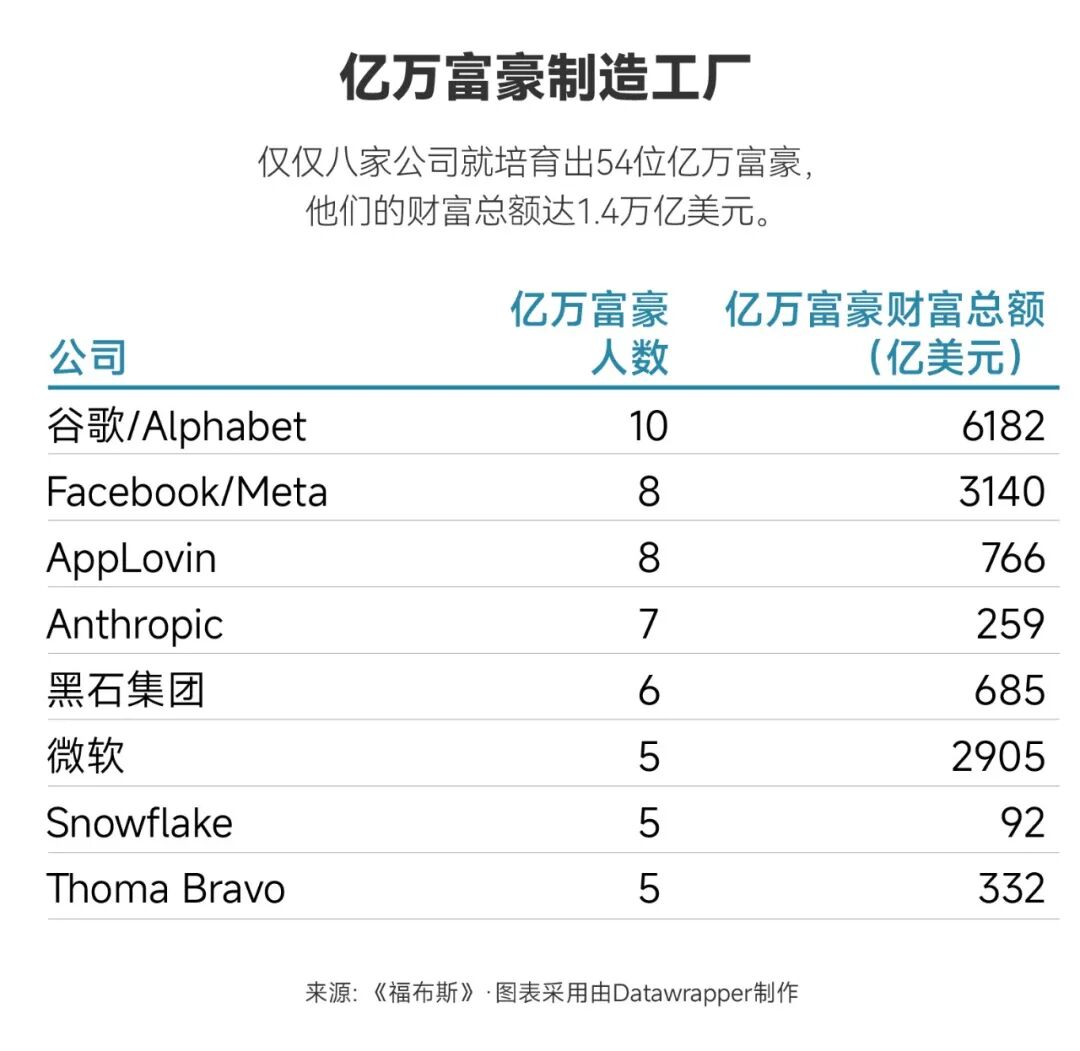
Core Insights - Anthropic, an AI startup, is preparing to launch its Claude 4 chatbot in January 2025, aiming to compete with products like ChatGPT and Gemini while seeking over $60 billion in funding, making it one of the highest-valued AI companies globally [1][2] - The rise of billionaires in the tech industry is largely attributed to companies like Google, Meta, Microsoft, and emerging firms like Anthropic and AppLovin, which have seen significant stock price increases driven by investor enthusiasm for AI [2][3] - Alphabet, Google's parent company, has created the most billionaires, totaling 10 individuals with a combined wealth exceeding $600 billion [4][6] Company Summaries - **Anthropic**: Founded by former OpenAI employees, Anthropic has quickly entered the AI race with its chatbot Claude, achieving a valuation of $60 billion by early 2025 and creating seven billionaires among its founders [16] - **AppLovin**: This digital advertising company has produced eight billionaires since its NASDAQ listing in 2021, with its stock price increasing over 1000% since then, reaching a market cap close to $250 billion [2][14] - **Google/Alphabet**: The company has generated 10 billionaires, including co-founders Larry Page and Sergey Brin, with a total wealth of $618.2 billion among them [8][10] - **Meta**: Facebook's parent company has created eight billionaires, including Mark Zuckerberg, with a total wealth of $314 billion [12] - **Microsoft**: The tech giant has five billionaires, including Bill Gates and Steve Ballmer, with a combined wealth of $290.5 billion [19][21] - **Blackstone**: This investment firm has produced six billionaires, with a total wealth of $68.5 billion [17] - **Snowflake**: The cloud services company has five billionaires, with a total wealth of $9.2 billion [22] - **Thoma Bravo**: This investment firm has also created five billionaires, with a total wealth of $33.2 billion [24]





Trump Just Sent Blackstone Stock Plunging Below Key Support Levels. How Should You Play BX Here?
Yahoo Finance· 2026-01-08 20:36
Core Viewpoint - Blackstone's stock is under pressure following President Trump's announcement of a potential ban on institutional investors purchasing residential properties, which could negatively impact the company's earnings outlook [1][5]. Group 1: Impact of Trump's Announcement - Trump's plan to bar institutional investors from buying residential properties is expected to tame soaring prices and could significantly restrict Blackstone's ability to invest in a key growth area [1][4]. - The company has made substantial investments in residential real estate, including $6 billion for Home Partners of America in 2021 and $3.5 billion for Tricon Residential [3]. - This ban could undermine Blackstone's rental income and long-term appreciation strategies, indicating increased regulatory risks for large investment firms [4]. Group 2: Current Stock Performance - Blackstone's stock has already declined approximately 18% from its 52-week high, reflecting investor concerns over the potential impact of the proposed ban [2]. Group 3: Long-term Outlook - Despite the challenges posed by the potential ban, Blackstone's diversified portfolio across private equity, credit, real estate, and infrastructure remains attractive, mitigating risks from any single segment [6]. - The firm benefits from ongoing trends in alternative asset management, with continued capital allocation from institutions and high-net-worth investors [7]. - Blackstone offers a 3.34% dividend yield, enhancing its appeal for income-focused investors [7].
3 things Trump did in 24 hours to show that he’s in control of American business
Fortune· 2026-01-08 18:41
Market Interventions - President Trump has initiated three significant state interventions in various markets, indicating a shift from traditional Republican laissez-faire policies to more direct control over economic activities [2][3] - The interventions include a ban on large institutional investors from purchasing single-family homes, a cap on executive compensation in the defense sector, and control over Venezuelan oil proceeds [5][9][16] Housing Market - Trump announced a ban on "large institutional investors," such as private equity firms and real estate trusts, from buying single-family homes, emphasizing that "people live in homes, not corporations" [5] - Following the announcement, stocks of institutional investors like Blackstone and Invitation Homes dropped by 6%, with American Homes 4 Rent experiencing trading halts due to volatility [6] - Institutional investors currently own only 2% of the housing stock, but their presence is concentrated in cities like Atlanta and Jacksonville [7] Defense Sector - Trump expressed frustration with the slow pace of weapons production and announced a cap on executive compensation at major defense contractors at $5 million annually, contrasting with typical CEO salaries of $18 million to $25 million [9][10] - An executive order formalized this policy, restricting how defense contractors can use profits and compensating executives, including barring stock buybacks and dividends for underperforming firms [11] - This move has raised concerns about the legal implications and the potential expropriation of decision-making power from shareholders to the state [12][14] Venezuelan Oil Control - Following the arrest of Venezuela's president, Trump announced U.S. control over approximately 50 million barrels of Venezuelan crude oil, valued at around $3.5 billion, with proceeds to be used exclusively for American-made goods [16][17] - This arrangement creates a "closed-loop" system that prioritizes American manufacturing over market-driven decisions, marking a significant shift towards managed trade [18] - The administration's approach reflects a broader trend of dictating market outcomes, including home purchases and executive pay, rather than allowing market forces to operate freely [19]



Is Blackstone stock at risk after Trump's residential housing threat?
Invezz· 2026-01-08 12:13
Core Viewpoint - Blackstone's stock price experienced a significant decline following a warning from Donald Trump regarding the prohibition of institutional investors from purchasing residential properties, dropping to a low of $147 [1] Company Summary - Blackstone's stock price fell sharply as a direct reaction to the political statement made by Donald Trump, indicating potential regulatory changes that could impact institutional investment in the residential real estate market [1]

高官集体“懵圈”!特朗普再出“乱拳”,分析师锐评其像民主党人
Jin Shi Shu Ju· 2026-01-08 10:07
Group 1 - Trump's proposal to ban large institutional investors from purchasing single-family homes aims to address housing affordability issues, which are a significant concern for voters ahead of the midterm elections [3][4] - The housing market is currently facing a severe shortage of available homes, high mortgage rates, and historically high prices, contributing to public frustration with the economy [3] - The stock prices of real estate companies, such as Blackstone, fell sharply by 5.6% following Trump's announcement, indicating market reaction to the proposed policy [3] Group 2 - Trump's statements regarding defense contractors suggest a shift towards more progressive economic policies, as he criticized these companies for profiting from government contracts while rewarding shareholders instead of benefiting the public [4] - The defense sector experienced significant stock declines in response to Trump's demands for contractors to stop dividends and stock buybacks, as well as to limit executive compensation [4][5] - Investors are unsettled by the sudden and unexpected nature of Trump's policy announcements, which have historically led to significant market impacts [5]
杰富瑞将黑石集团目标价下调至185美元
Ge Long Hui· 2026-01-08 06:46
Group 1 - Jefferies has lowered the target price for Blackstone Group from $187 to $185 [1]
特朗普:禁止囤房!
Zhong Guo Jing Ying Bao· 2026-01-08 05:39
Core Viewpoint - The U.S. President Trump announced immediate measures to prohibit large institutional investors from purchasing more single-family homes to address the issue of housing affordability, particularly for young Americans [1]. Group 1: Policy Announcement - Trump plans to request Congress to legislate this policy aimed at preventing large investors from acquiring single-family homes [1]. - The discussion on housing and affordability will take place at the upcoming Davos Forum [1]. Group 2: Market Impact - Following Trump's announcement, shares of residential investment firms, including Blackstone Inc., experienced a decline of approximately 10% [1]. - Blackstone is identified as the largest private equity apartment owner in the U.S., with over 230,000 apartments in its portfolio [1]. Group 3: Industry Dynamics - Over the past decade, private equity firms, real estate investment trusts, and other large institutional investors have accumulated significant portfolios of single-family rental homes, which some believe have reduced housing supply for potential homeowners and increased home prices [1]. - A warning from Redfin's chief economist suggests that banning large investors may only lead to medium or small investors replacing them, rather than facilitating home purchases by individual buyers [2].
欧美股市、虚拟币、热门大宗集体大跳水!
Zheng Quan Shi Bao Wang· 2026-01-08 04:16
Core Viewpoint - The U.S. stock market experienced a significant decline, influenced by President Trump's announcement to prohibit large institutional investors from purchasing single-family homes, raising concerns about the housing market and economic slowdown [1][2][3]. Group 1: Stock Market Performance - The U.S. stock market saw most indices decline, with the Dow Jones dropping nearly 1% and the S&P 1500 residential construction index falling by up to 2.2% [1]. - Blackstone's stock plummeted by as much as 9.3%, while major banks like JPMorgan, Goldman Sachs, and Citigroup also experienced declines [2]. - The overall sentiment in the market was negative, with significant drops in energy stocks, including ExxonMobil and Chevron [3]. Group 2: Housing Market Impact - President Trump's proposed measures aim to make housing more affordable for Americans by restricting institutional investors from buying single-family homes, which he claims has made homeownership increasingly unattainable for many, especially young people [2]. - Analysts express skepticism about the actual impact of the ban on housing prices, noting that institutional investors hold a relatively small share of the overall market [3]. Group 3: Economic Indicators - The U.S. private sector added 41,000 jobs in December, which was below the market's expectations of approximately 50,000 [5]. - Mortgage rates decreased from 6.32% to 6.25%, the lowest since September 2024, but this decline did not stimulate mortgage demand, as applications fell by 9.7% during the holiday period [4].


特朗普说将禁止机构投资者购买更多单户住宅
Xin Lang Cai Jing· 2026-01-08 03:00
Core Viewpoint - President Trump announced measures to prohibit large institutional investors from purchasing single-family homes to address the issue of housing affordability for many Americans [1][3]. Group 1: Policy Announcement - Trump stated he will seek legislation from Congress regarding this policy [2][4]. - He emphasized that people should live in homes, not businesses, and plans to discuss housing and affordability at the upcoming Davos Forum [2][4]. Group 2: Impact on Housing Market - Following Trump's announcement, shares of residential investment firms, including Blackstone Inc., experienced a decline of approximately 10% [2][4]. - The ongoing high inflation and rising unemployment rates in the U.S. have intensified the affordability crisis, making it a focal point for voters and policymakers [2][4].
突发,特朗普整顿美国房地产,禁止机构买房,高房价将暴跌
3 6 Ke· 2026-01-08 00:50
Core Viewpoint - President Trump aims to prohibit large institutional investors from purchasing single-family homes to alleviate housing affordability issues for ordinary families, which has sparked significant market and public attention [1]. Group 1: Impact on Institutional Investors - Major institutional investors' stock prices have dropped significantly, with Blackstone Inc. (BX) representing the "institutional home buying" sector [3]. - The proposed policy directly impacts BX's core investment model by restricting asset acquisition, damaging exit expectations, and necessitating a reevaluation of valuation models [4]. - The policy could disrupt BX's long-term cash flow from single-family rentals (SFR) and challenge the logic of real estate allocation [5][6]. Group 2: Market Reactions and Concerns - Homebuilders like Toll Brothers (TOL) and KB Home (KBH) also experienced stock declines due to market fears of increased demand uncertainty if institutional investors are restricted [7][8]. - The market is concerned that the logic behind rising home prices may be interrupted, leading to a preemptive pricing adjustment in the stock market [9]. Group 3: Long-term Implications - The policy could be a short-term negative but may not be detrimental in the long run, as builders profit from turnover rates rather than continuous price increases [10]. - If the policy is enacted, it may lead to a decrease in competition for ordinary buyers, improving housing affordability and potentially increasing transaction volumes [11][12]. - The reduction of cash buyers could shift the market dynamics towards owner-occupiers and mortgage-dependent buyers, benefiting companies like Rocket Companies (RKT) by enhancing mortgage penetration rates [12][14]. Group 4: Benefits for Rocket Companies (RKT) - The policy is expected to improve housing affordability, leading to a recovery in home buying demand and an increase in mortgage loan volumes, which are crucial for RKT's revenue [12][13]. - As cash buyers decrease, the market will likely see a rise in transactions led by self-occupiers, enhancing the overall mortgage market and benefiting RKT in the long term [12][14].