Alphabet(GOOGL)

Search documents
万亿外资巨头调仓!贝莱德调仓曝光:增持英伟达、苹果、微软等
Sou Hu Cai Jing· 2026-02-21 02:14
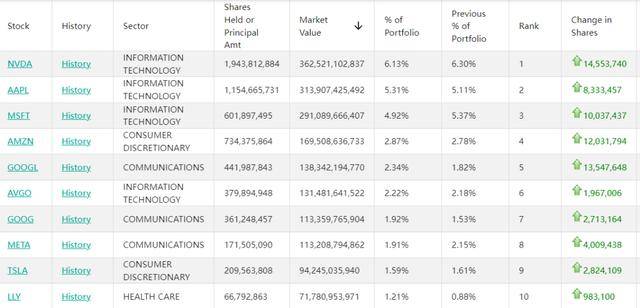
Core Insights - BlackRock, a major asset management firm, reported a total portfolio value of $5.92 trillion for Q4 2025, reflecting a 3.67% quarter-over-quarter increase [1] - The firm added 247 new stocks to its portfolio while liquidating 165 stocks during the same period [1] - The top ten holdings accounted for 30.41% of the total portfolio value [1] Group 1: Major Stock Movements - The top five stocks purchased by BlackRock included Google-A, Google-C, Eli Lilly, Micron, and Apple [1] - The top five stocks sold were SPDR S&P 500 ETF CALL, ServiceNow, MicroStrategy, AT&T, and Kellanova [1] Group 2: Technology Sector Focus - BlackRock's top ten holdings are heavily weighted in technology, including Nvidia, Apple, Microsoft, Amazon, Google-A, Broadcom, Google-C, Meta, Tesla, and Eli Lilly [2] - Nvidia saw a 0.75% increase in shares held, totaling approximately 1.94 billion shares valued at about $362.52 billion, making it the largest holding at 6.13% of the portfolio [2][4] - Apple shares increased by 0.73%, with approximately 1.15 billion shares valued at about $313.91 billion, representing 5.31% of the portfolio [2][4] - Microsoft holdings increased by 1.70%, totaling around 601.90 million shares valued at approximately $291.09 billion, accounting for 4.92% of the portfolio [2][4] - Amazon's holdings rose by 1.67%, with about 734.38 million shares valued at approximately $169.51 billion, making up 2.87% of the portfolio [2][4] Group 3: New Investments in Materials and Chemicals - BlackRock has diversified into new materials and chemicals, with new positions in Solstice Advanced Materials valued at approximately $838 million and Qnity Electronics valued at around $1.3 billion [6] - In the electric vehicle sector, BlackRock significantly increased its holdings in NIO and Xpeng, while slightly reducing its position in Li Auto [6] - NIO shares were increased by 337,590 to 5.58 million shares, reflecting a 153% increase in holdings valued at approximately $2.85 million [6] - Xpeng shares were increased by 77,980 to 2.87 million shares, with a total value of approximately $5.82 million [6] - Li Auto shares were reduced by 61,400 to 826,200 shares, with a total value of approximately $1.40 million [6]


美股科技股拉升,谷歌涨超4%
2 1 Shi Ji Jing Ji Bao Dao· 2026-02-21 01:45
美国大型科技股多数上涨,万得美国科技七巨头指数上涨1.57%,谷歌涨超4%。消息面上,当地时间2 月19日,谷歌发布最新基础大模型Gemini 3.1 Pro。相比去年11月发布的Gemini 3 Pro,新模型推理性能 直接翻倍。奈飞、亚马逊涨超2%,苹果、英伟达、Meta涨超1%。 周五(2月20日),欧美股市全线收涨,道指涨0.47%,标普500指数涨0.69%,纳指涨0.9%。 (文章来源:21世纪经济报道) ...

Alphabet Stock Climbs as Friday's Trump Tariff Ruling Lifts Digital-Advertising Shares
Investopedia· 2026-02-20 23:35
Core Insights - The Supreme Court's ruling against most of President Trump's tariffs has positively impacted digital advertising stocks, including Alphabet, Pinterest, and Meta, leading to significant gains in their share prices [1][1][1] Digital Advertising Impact - Digital advertisers are expected to benefit from the easing of tariffs, as clients may redirect refunds into increased advertising spending, according to marketing research firm EMARKETER [1][1] - Shares of Pinterest rose by 6%, while Alphabet's stock climbed by 4%, marking them among the best performers on the S&P 500 and Nasdaq [1][1] - Companies like Snap and Pinterest have faced challenges due to reduced ad spending from retail clients affected by higher costs from tariffs, with both stocks losing approximately half their value over the past year [1][1] Competitive Landscape - Meta and Alphabet have reported strong ad sales and have not experienced the same level of pressure as Pinterest, which has a higher proportion of large retail clients [1][1] - Analysts at Bank of America noted that Pinterest may have lost market share to larger competitors, while companies like Meta are investing in AI-enhanced advertising to mitigate tariff-related challenges [1][1]

After the Pause, the Magnificent 7 Stocks Look Ready to Lead Again
ZACKS· 2026-02-20 23:25
Core Viewpoint - The market is experiencing a rotation where value stocks, cyclicals, and international markets are gaining traction while mega-cap technology stocks have pulled back, a common occurrence during bull markets [1][12]. Group 1: Market Dynamics - The Magnificent 7 stocks have traded sideways to modestly lower since last November due to concerns over AI overinvestment and valuation multiples, yet their fundamental positioning remains strong [2][12]. - AI is not the sole growth driver for these companies; they are also central to long-term trends in cloud computing, digital advertising, e-commerce, and more, with AI acting as an accelerator rather than a primary driver [3][12]. Group 2: Cloud Computing Strength - Companies like Amazon, Alphabet, and Microsoft are seeing a re-acceleration in cloud computing growth, driven by strong demand for AI-related compute capacity, with hyperscalers reporting sold-out capacity [5][6]. - Valuations for these companies have become more reasonable following recent market consolidation, making them attractive for investors seeking exposure to AI infrastructure [7][12]. Group 3: Individual Company Insights - Meta Platforms is highlighted for its compelling valuation, trading at less than 22x earnings with projected long-term earnings growth of around 20%, while also benefiting from AI-driven improvements [9]. - Nvidia remains a key player in the AI infrastructure space, trading at mid-20s on forward earnings with a PEG ratio near 0.5, indicating strong growth relative to valuation [10]. - Apple has maintained a stable position without aggressive AI infrastructure spending, showing renewed strength in iPhone demand and a rapidly expanding services segment, indicating resilience in its ecosystem [11]. Group 4: Future Outlook - The recent trading pattern of the Magnificent 7 suggests a healthy consolidation rather than a breakdown, with expectations that mega-cap technology may reassert leadership as cloud demand and AI adoption continue to grow [12][13]. - The long-term competitive positioning of these dominant companies remains intact, suggesting they are well-positioned to lead future market advances if the broader bull market persists [14].




Tech Stocks Surge as Supreme Court Overturns Tariffs Despite Economic Growth Miss
Stock Market News· 2026-02-20 22:07
The U.S. stock market experienced a day of significant volatility and divergent performance on Friday, February 20, 2026. Investors navigated a complex landscape defined by a landmark Supreme Court ruling on trade policy, a disappointing reading on economic growth, and mounting geopolitical tensions. While technology and growth-oriented sectors found a second wind, the broader market remained tethered by concerns over a cooling economy and sticky inflation.Market Index Performance RecapAs of the closing bel ...


Stock Market Today, Feb. 20: Alphabet Jumps as Gemini Rollout Bolsters $185B AI Buildout
Yahoo Finance· 2026-02-20 22:06
Alphabet (NASDAQ:GOOGL), a provider of internet-related services and products, including search, advertising, and cloud computing, closed Friday at $314.98, up 4.01%. The stock moved higher as investors responded to a fresh Gemini AI enterprise rollout and an Asia commerce partnership, while watching how AI-driven cloud demand and heavy capex plans shape future profitability. The company’s Trading volume reached 51.9 million shares, which stands roughly 38% above compared with its three-month average of 37 ...
Stocks Rise, Bonds Fall After Tariff Ruling | Closing Bell
Youtube· 2026-02-20 21:50
Market Overview - The market reaction to the Supreme Court ruling against Liberation Day tariffs was relatively muted, indicating ongoing investor uncertainty [2][4]. - The Dow Jones Industrial Average ended the day up by about 0.5%, while the S&P 500 increased by approximately 0.7% [7]. - The Russell 2000, which includes small-cap stocks, finished unchanged, reflecting a divergence in market performance [8]. Sector Performance - The communications services sector was the biggest gainer, up by about 2.7%, driven by Alphabet [9]. - Energy and healthcare sectors were the only ones to finish in the red, with energy down about 0.7% and healthcare down about 0.3% [10]. - Overall, 334 names in the S&P 500 saw gains, with 169 declining [8]. Individual Stock Highlights - FDX (Comfort Systems) was the top gainer in the S&P 500, hitting an all-time high with a gain of about 6.5% [11]. - General Electric also reached an all-time high, closing up about 2.5% [13]. - Alphabet was the top gainer in the NASDAQ 100, increasing by about 4%, as the company explores new markets for its AI chips [15]. Company-Specific News - Blue Owl shares fell by 4% due to concerns over liquidity in private credit, following the restriction of withdrawals from one of its funds [17]. - Wal-Mart's stock decreased by 1.5% after a recommendation cut from HSBC, despite solid fourth-quarter results [20]. - CoreWeave shares dropped by 8% amid fears regarding financing for a $4 billion data project [22].



2月21日美股成交额前20:据传英伟达接近向OpenAI投资300亿美元
Xin Lang Cai Jing· 2026-02-20 21:41
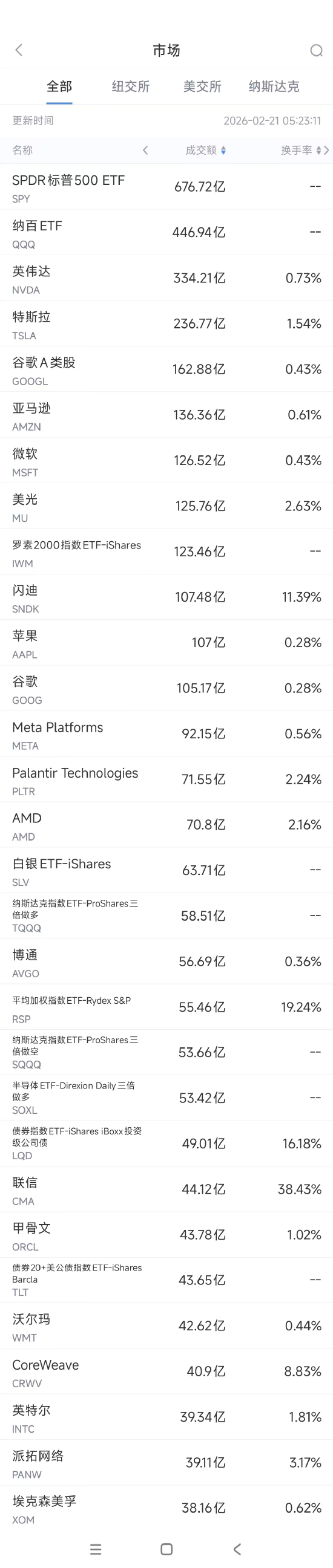
Group 1: Nvidia - Nvidia's stock rose by 1.02%, with a trading volume of $33.421 billion. The company is reportedly close to investing $30 billion in OpenAI as part of a long-anticipated funding round, with previous reports indicating an investment of $20 billion in this round [1][10] - This investment will replace a previously planned larger agreement, which was initially reported to be up to $100 billion but was stalled due to CEO Jensen Huang's private criticisms of OpenAI [10] Group 2: Tesla - Tesla's stock increased by 0.03%, with a trading volume of $23.677 billion. A federal judge upheld a $243 million judgment against Tesla related to a fatal 2019 accident involving a Model S equipped with the Autopilot system [10][11] - Analyst Baird upgraded Tesla's stock rating to "outperform" with a target price of $548, noting that recent quarterly performances have not deterred investor focus on Tesla's future [11] Group 3: Google - Google's Class A shares rose by 4.08%, with a trading volume of $16.288 billion. The company is exploring new ways to expand its AI chip market to better compete with Nvidia [10][12] - Google's chips are gaining wider adoption for AI workloads, but the company faces challenges such as manufacturing partner capacity constraints and limited interest from cloud computing competitors [12] Group 4: Amazon - Amazon's stock increased by 2.59%, with a trading volume of $13.636 billion. Morgan Stanley maintains Amazon as a preferred stock, believing its cloud services and retail business are undervalued beneficiaries of generative AI [12] - Analysts noted that Amazon's current stock price corresponds to a 19x GAAP EPS for 2027, with an implied forward growth rate of about 20%, and a 40% discount compared to peers on a PEG basis [12][3] Group 5: Micron and SanDisk - Micron's stock rose by 2.59%, with a trading volume of $12.576 billion, as the storage sector saw a general increase [13] - SanDisk's stock increased by 4.65%, with a trading volume of $10.748 billion [14] Group 6: Meta Platforms - Meta Platforms' stock rose by 1.69%, with a trading volume of $9.215 billion. The company has reduced the stock option grants for most employees by about 5%, following a previous reduction of 10% the prior year [14] - The compensation structure for Meta employees includes base salary, annual bonuses, and equity refreshers, with the company aiming to maintain competitive compensation [14] Group 7: Oracle and CoreWeave - Oracle's stock fell by 5.40%, with a trading volume of $4.378 billion, marking a cumulative decline of 7.5% for the week and over 23% year-to-date [14] - CoreWeave's stock dropped by 8.12%, with a trading volume of $4.09 billion. The CEO disclosed the sale of shares valued at approximately $7.72 million [14][15]


X @The Wall Street Journal
The Wall Street Journal· 2026-02-20 21:34
A former Google employee accused of stealing trade secrets related to the company’s Pixel phones was indicted Thursday, adding to cases highlighting the security threats companies face in an era of rapidly evolving technology https://t.co/FCvvn1390s ...
EasyMarkets易信:“AI资本风暴”
Sou Hu Cai Jing· 2026-02-20 21:00
Group 1 - The core viewpoint is that global tech giants are entering a new wave of investment in artificial intelligence infrastructure, with annual capital expenditures reaching historical highs. Companies are focusing their funds on data center expansion, high-performance chip procurement, and cloud computing platform upgrades to rapidly expand computing resources in response to the growing demand for generative AI [1][5]. Group 2 - Companies like Amazon, Alphabet, Microsoft, and Meta have identified AI as a core strategic direction and significantly increased their capital expenditure budgets. Some companies are even expanding debt financing to support long-term construction plans, leading to a simultaneous expansion of their balance sheets [5]. - Nvidia has emerged as a key beneficiary in this round of computing power upgrades, while Apple is adopting a more cautious approach by collaborating with external technology partners to enhance its AI capabilities and reduce the pressure of one-time heavy asset investments [5]. - Despite the market's general recognition of AI's long-term potential, investors remain cautious about the pace of return realization. Current revenue growth from AI-related activities has not yet matched the massive scale of capital expenditures, and future profitability will require time to validate [5]. Group 3 - In terms of regional competition, Europe is strengthening its local computing power infrastructure and data compliance systems to enhance its autonomy in the global AI landscape. Local companies like Mistral AI are accelerating financing expansions, and semiconductor equipment leader ASML is actively participating in related layouts [6]. - However, there remains a significant gap in overall funding scale compared to US tech giants. The trend of centralized computing resources may further exacerbate industry differentiation in the coming years [6]. Group 4 - This capital race in AI is fundamentally a dual test of technological innovation and capital efficiency. In the short term, large-scale investments will continue to support the prosperity of the industry chain and increase volatility in related tech assets. However, in the medium to long term, the true determinants of winning will be commercial capabilities and cost control levels [6]. - Investors need to assess the degree of valuation and risk matching while focusing on growth opportunities [6].