
Micron Technology(MU)

Search documents
英伟达(NVDA.US)稳居第一!贝莱德Q4仍重仓科技巨头,新建仓指向材料与特种化学品
智通财经网· 2026-02-13 10:13
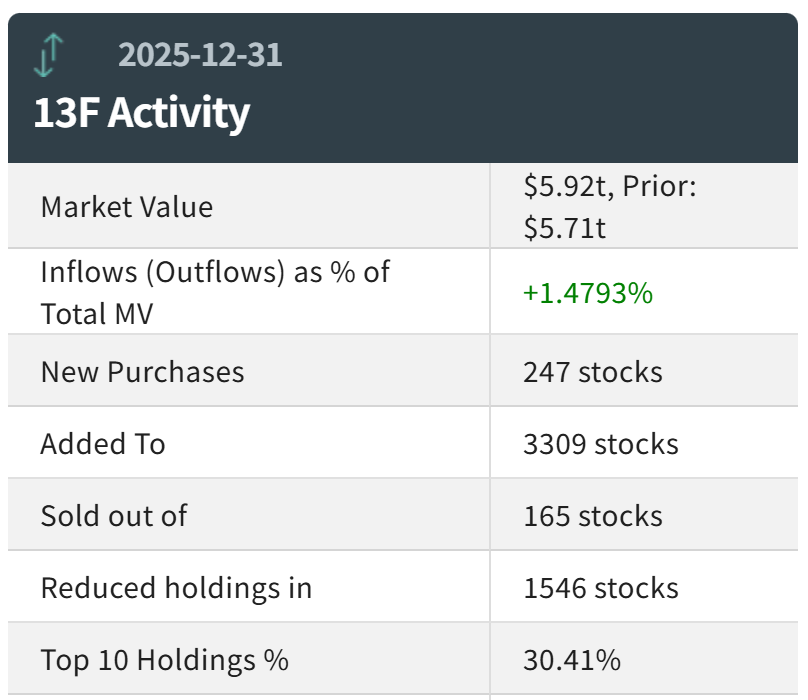
Core Viewpoint - BlackRock, a major asset management firm, reported a total market value of $5.92 trillion for its Q4 2025 holdings, reflecting a 3.67% increase from the previous quarter's $5.71 trillion [1][2]. Holdings Summary - The firm added 247 new stocks, increased holdings in 3,309 stocks, reduced holdings in 1,546 stocks, and completely sold out of 165 stocks during the quarter [1][2]. - The top ten holdings accounted for 30.41% of the total market value [2]. Top Holdings - Nvidia (NVDA.US) is the largest holding with approximately 1.94 billion shares valued at about $362.52 billion, representing 6.13% of the portfolio, with a 0.75% increase in shares held [3][4]. - Apple (AAPL.US) follows as the second-largest holding with around 1.16 billion shares valued at approximately $313.91 billion, making up 5.31% of the portfolio, with a 0.73% increase in shares held [3][4]. - Microsoft (MSFT.US) ranks third with about 601.90 million shares valued at approximately $291.09 billion, accounting for 4.92% of the portfolio, with a 1.70% increase in shares held [3][4]. - Amazon (AMZN.US) is fourth with approximately 734.38 million shares valued at about $169.51 billion, representing 2.87% of the portfolio, with a 1.67% increase in shares held [3][4]. - Alphabet Class A (GOOGL.US) is fifth with around 441.99 million shares valued at approximately $138.34 billion, making up 2.34% of the portfolio, with a 3.16% decrease in shares held [3][4]. Investment Strategy - BlackRock demonstrated a keen interest in emerging opportunities by establishing positions in Solstice Advanced Materials (SOLS.US) valued at approximately $838 million and Qnity Electronics (Q.US) valued at around $1.3 billion [4][5]. - The investment actions indicate a consolidation in existing tech sectors while exploring diversification into more cyclical industries such as industrials and materials [5].






HBM 4,竞争激烈
半导体芯闻· 2026-02-13 09:35
Core Viewpoint - The competition among the three major global memory semiconductor companies for HBM4 (the sixth generation high bandwidth memory) is intensifying, with Samsung Electronics leading the way in production ahead of SK Hynix and Micron, highlighting its advantages in R&D speed and performance [1][2]. Group 1: HBM4 Production and Market Dynamics - Samsung Electronics announced the mass production of HBM4 on the 12th, ahead of its competitors, emphasizing its commitment to exceeding JEDEC standards from the beginning of HBM4's development [2]. - The HBM4 memory will be installed in NVIDIA's upcoming "Rubin" AI accelerator, featuring 2048 I/O ports, which is double the number of the previous generation [2]. - SK Hynix and Micron are also set to begin mass production of HBM4 this month, with SK Hynix claiming to be the only company capable of simultaneously supplying both HBM3E and HBM4 [3][4]. - The term "mass production" used by these companies refers to "risk production," where chips are produced before receiving formal purchase orders, which may lead to market confusion [4][5]. Group 2: Supply Chain and Performance Concerns - The supply chain dynamics for HBM4 are expected to be significantly influenced by NVIDIA's supply strategy, which balances performance and supply stability [6]. - Samsung's HBM4 achieves a stable operating speed of 11.7 Gbps, setting a new industry standard, which is approximately 46% faster than the previous 8 Gbps standard [6]. - Despite Samsung's advancements, the company currently has a yield rate of about 60% for its 1c DRAM, which may decline further during post-processing [6][7]. - SK Hynix has secured the largest HBM4 allocation in negotiations with NVIDIA, but initial reliability assessments indicate challenges in meeting the 11 Gbps performance target [7]. Group 3: Future Expectations and Strategic Adjustments - Industry insiders suggest that NVIDIA may relax its performance requirements for HBM4 to ensure stable supply, given the current memory shortage [7]. - The ongoing investments in new and upgraded production facilities for 1c DRAM will take time to translate into actual capacity, impacting the overall supply chain [7].

公司问答丨日联科技:全球前20大半导体制造商中有近一半都是SSTI的客户 其中包括三星、美光等企业
Ge Long Hui A P P· 2026-02-13 07:01
Group 1 - The core viewpoint of the article highlights that SSTI, a subsidiary of Rilun Technology, has established business relationships with major semiconductor manufacturers, including Samsung, SK Hynix, and Micron [1] Group 2 - SSTI serves nearly half of the top 20 semiconductor manufacturers globally as clients, indicating a strong market presence and demand for its products [1]

集邦咨询:预计HBM4验证将于第二季度完成 三大原厂供应英伟达(NVDA.US)格局有望成形
智通财经网· 2026-02-13 06:04
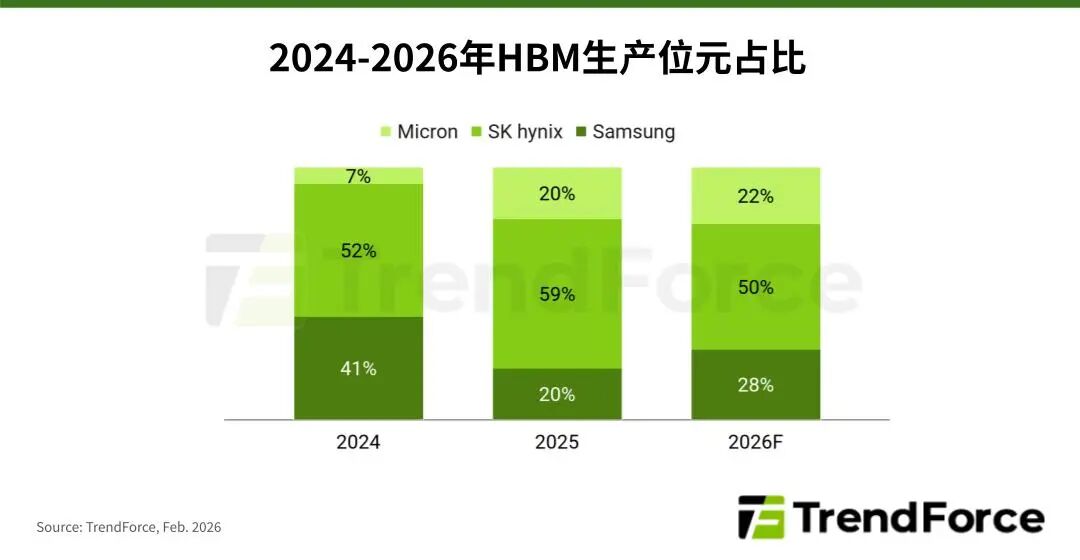
Group 1 - The core viewpoint of the articles highlights the growing demand for HBM4 driven by the expansion of AI infrastructure and GPU requirements, with NVIDIA's Rubin platform expected to significantly influence this demand [1][2] - TrendForce anticipates that the validation process for HBM4 by the three major memory manufacturers will be completed by the second quarter of 2026, with Samsung expected to lead the way due to its product stability [1][2] - The demand for high-performance storage devices is increasing, particularly among North American cloud service providers (CSPs) who are investing heavily in AI server construction starting from the end of 2025 [1] Group 2 - The overall shortage in memory capacity is intensifying, leading to significant price increases for Conventional DRAM products since the fourth quarter of 2025, which affects the profitability of HBM [2] - NVIDIA's reliance on specific suppliers for the Rubin platform may pose challenges in meeting demand, prompting manufacturers to adjust the supply distribution of HBM and Conventional DRAM to balance overall output and customer needs [2] - Samsung is progressing the fastest in the validation of HBM4, with expectations to begin quarterly mass production after completion in the second quarter, while SK hynix and Micron are also advancing but at different paces [5]
研报 | 预计HBM4验证将于2026年第二季度完成,三大原厂供应英伟达的格局有望成形
TrendForce集邦· 2026-02-13 04:07
Core Insights - The article discusses the growing demand for HBM4 (High Bandwidth Memory) driven by the expansion of AI infrastructure, particularly highlighting NVIDIA's upcoming Rubin platform which is expected to boost HBM4 demand [2][3] - Major memory manufacturers, including Samsung, SK Hynix, and Micron, are nearing the completion of HBM4 validation processes, with Samsung anticipated to lead in production [2][6] - The article emphasizes the need for a diversified supply chain for HBM4 to meet NVIDIA's demand, as relying on a single supplier may not suffice [3][6] Group 1: HBM4 Demand and Market Dynamics - The demand for high-performance storage devices is increasing, particularly among North American cloud service providers (CSPs) aiming to capture the AI Agent market [2] - The overall shortage in memory supply has led to significant price increases in conventional DRAM products since Q4 2025, prompting manufacturers to adjust their supply allocations [3] - NVIDIA maintains an optimistic outlook on the Rubin platform's prospects, which is expected to contribute positively to HBM4 demand growth [2][3] Group 2: Supplier Validation and Production Readiness - Samsung is progressing the fastest in the validation process and is expected to begin quarterly production after completion in Q2 2026 [6] - SK Hynix is also advancing and is likely to leverage its existing collaboration with NVIDIA to maintain a competitive edge in supply allocation [6] - Micron's validation is slower but is also expected to complete in Q2 2026, contributing to the overall supply ecosystem for HBM4 [6]
异动盘点0213 | 再鼎医药再涨7%,中国高精密盈警后跌超18%;存储概念股盘前普涨,知乎跌1.42%
贝塔投资智库· 2026-02-13 04:00
Group 1: Oil and Gas Sector - Oil stocks experienced a decline, with Sinopec (00386) down 3.89%, PetroChina (00857) down 3.17%, and CNOOC (00883) down 2.79%. This follows a drop in WTI crude oil futures by 2.77% to $62.84 per barrel and Brent crude by 2.71% to $67.52 per barrel [1] Group 2: Renewable Energy Sector - Solar stocks fell collectively, with Xinyi Solar (00968) down 3.62% and New Special Energy (01799) down 3.61%. The rise in silver prices has increased silver paste costs, impacting the battery and component sectors [1] Group 3: Precious Metals Sector - Lao Poo Gold (06181) saw a nearly 5% drop. Bank of America Securities reported that the company is expected to benefit from rising gold prices, with a projected revenue increase of 165% year-on-year for the second half of last year [1] Group 4: Pharmaceuticals - Zai Lab (09688) rose by 7% after its injection drug ZL-1310 was proposed for breakthrough therapy designation for extensive-stage small cell lung cancer (ES-SCLC), showing promising early clinical data [2] Group 5: Precision Manufacturing - China High Precision (00591) fell over 18% after issuing a profit warning, expecting a profit of approximately RMB 2.5 million to RMB 4.5 million for the six months ending December 31, 2025, due to project delays in the oil and petrochemical sectors [2] Group 6: Non-Ferrous Metals - Non-ferrous stocks faced significant declines, with China Nonferrous Mining (01258) down 5.08% and Zijin Mining (02899) down 5.29%. This is attributed to a "de-risking" sentiment in global financial markets, leading to a sell-off in precious metals [3] Group 7: Biotechnology - Xiansheng Pharmaceutical (02096) increased over 4.4% after announcing a licensing agreement with AbbVie for the investigational drug SIM0500, which includes upfront payments and potential milestone payments totaling up to $1.055 billion [3] Group 8: Gaming Sector - Gaming stocks declined, with Melco International Development (00200) down 6.21%. Wynn Macau reported a 7% year-on-year drop in EBITDA for Q4 2025, which was below market expectations [4] Group 9: Oilfield Services - Anton Oilfield Services (03337) rose over 9% after announcing a profit forecast of approximately RMB 360 million to RMB 380 million for 2025, representing a significant year-on-year increase of 48.4% to 56.6% [4] Group 10: U.S. Market Movements - Arko Petroleum (APC.US) opened with a 2.5% decline after its market debut. The company delivered 1.5 billion gallons of fuel in the nine months ending September 30, 2025 [5] - Albemarle (ALB.US) fell 9.41% despite a 16% year-on-year increase in Q4 sales to $1.4 billion, reporting a net loss of $414 million [5] - Boeing (BA.US) rose 1.31% as it plans to increase the monthly production of its 737 series aircraft to 63 units in the coming years [5] Group 11: Technology Sector - Cisco (CSCO.US) dropped 12.32% as it projected a decline in adjusted gross margin for Q3, indicating a worsening trend compared to previous quarters [7] - Storage stocks saw gains, with SanDisk (SNDK.US) up 5.16% and Western Digital (WDC.US) up 3.78% [7]


金价银价深夜跳水,白银猛跌超10%
Sou Hu Cai Jing· 2026-02-13 02:22
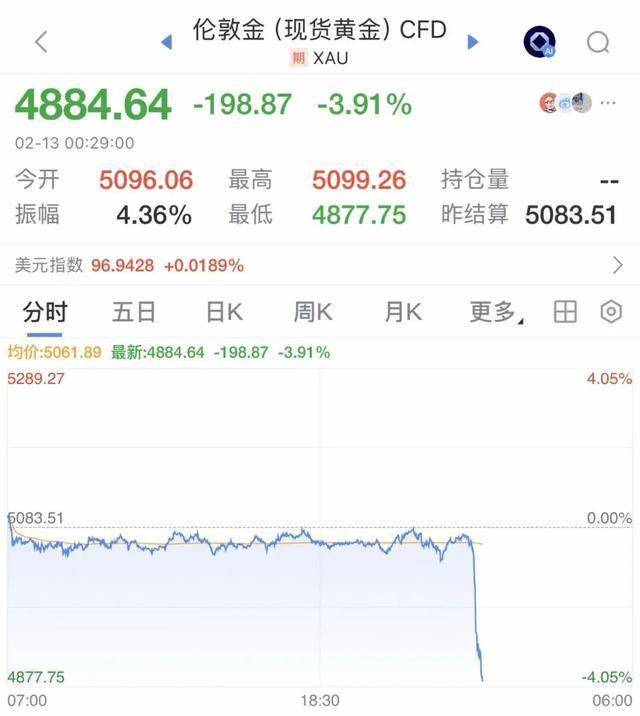
Group 1 - Gold prices experienced a sudden drop, with spot gold falling over 3% and nearly $200 during the day [1] - Silver prices also declined significantly, dropping over 8% [1] Group 2 - U.S. stock indices collectively fell, with the Nasdaq down over 1.5%, the Dow Jones down nearly 1%, and the S&P 500 down 1% [3] - Major tech stocks saw declines, with Apple dropping over 3% and losing more than $120 billion in market value (approximately 82 billion RMB) [5] - Other tech companies such as Microsoft, Amazon, Tesla, Meta, and Nvidia also experienced declines [5] Group 3 - Chinese concept stocks fell sharply, with the Nasdaq Golden Dragon China Index dropping nearly 3% [6]



AI angst in US stocks sends global money chasing Asia’s winners
The Economic Times· 2026-02-13 02:20
Core Insights - The shift in global funds' preference is moving from AI pioneers with high spending to hardware producers with strong pricing power, particularly in Asia [1][13] - Asian chipmakers are benefiting from surging memory chip prices, with companies like Samsung Electronics and TSMC playing crucial roles in the AI infrastructure [5][13] Company Performance - Samsung Electronics experienced a significant increase in foreign demand, leading to a 6.4% rise in its shares, with continued gains the following day [5][13] - Kioxia Holdings Corp. saw its shares surge by 15% due to strong AI demand, which contributed to a better-than-expected results outlook [6][13] - TSMC is approaching a 45% weighting in Taiwan's benchmark Taiex index, highlighting its dominance in the market [9][13] Market Trends - The MSCI Asia Pacific Index has risen over 12% in 2026, contrasting with declines in US benchmarks like the S&P 500 and Nasdaq 100 [12][13] - The correlation between Asian and US equities has decreased to 0.43, indicating a divergence in market performance [10][13] - The Topix insurance sub-index has increased by 6.2% since February 3, while the real estate counterpart has surged by 15% [9][13] Investment Focus - Investment strategies are increasingly targeting AI enablers such as chip manufacturers, with TSMC being a favored position among investors [12][13] - The resilience of Asian stocks is attributed to their roles in the AI ecosystem, cheaper valuations, and stronger earnings growth compared to US counterparts [12][13]


SEMICON-KOREA现场直击-存储超级周期的投资机会和三星-海力士走访
2026-02-13 02:17
Summary of Key Points from the Conference Call Industry Overview - The consumer electronics market is expected to shrink, with mobile phone and PC shipments projected to decline by 6.7% and 10% respectively. However, the semiconductor market is forecasted to grow robustly, potentially reaching $1 trillion by 2026, with storage growth nearing 40% and logic chip growth exceeding 30% [2][3][21]. Core Insights and Arguments - The storage supercycle significantly enhances corporate profits, with DRAM prices expected to rise by 105% to 110% quarter-over-quarter in Q1, far exceeding the previous quarter's increase [2][5]. - The supply side of DRAM is projected to grow by approximately 20% this year, primarily driven by technological upgrades due to cleanroom space limitations. Major new capacity releases are not expected until 2027, indicating a continued supply-demand imbalance unless consumer electronics demand drops significantly [2][6][7]. - South Korea's semiconductor industry benefits from a national system and sustained investment, with Samsung expected to regain its lead in HBM4 technology through vertical integration and favorable diplomatic policies [2][8]. Pricing and Market Dynamics - The pricing model in the memory market is heavily influenced by the channel market, with significant price increases expected in Q1, ensuring strong performance for related companies even if shipment volumes remain unchanged [2][9]. - The semiconductor industry's valuation is currently low, but there is potential for expansion during upward cycles. For instance, the P/E ratios for Hynix, Samsung, and Micron are significantly lower than those of semiconductor equipment companies, suggesting that increased investor confidence could drive valuations higher [4][15]. Competitive Landscape - Samsung and Hynix have a competitive edge in HBM4 technology, utilizing logic-based die processes, while Micron continues to use traditional memory-based die, placing it at a disadvantage [4][11]. - Samsung's storage business is characterized by strong cyclicality, with potential operating profit margins exceeding 40% during peak periods. Current projections indicate a positive trend for Q1 profits compared to Q4 of the previous year [12]. Future Outlook - The global smartphone market's supply-demand balance hinges on a significant drop in terminal demand. A hypothetical 20% decrease in global smartphone sales could lead to substantial declines for other brands, particularly Chinese manufacturers [10]. - The development of advanced packaging technologies, such as CPO (Co-Packaged Optics), is gaining traction, with companies like Samsung and ASE emphasizing the integration of front-end design to enhance performance and efficiency [19][20]. Conclusion - The semiconductor industry, particularly in the storage segment, is poised for significant growth despite challenges in the consumer electronics market. The interplay of supply constraints, technological advancements, and competitive dynamics will shape the industry's trajectory in the coming years [2][3][21].
半导体早参 | 深圳:以AI芯片为突破口做强半导体产业;中芯国际表示存储器、BCD供不应求,都在涨价
Mei Ri Jing Ji Xin Wen· 2026-02-13 01:59
Industry Overview - The Shenzhen Municipal Bureau of Industry and Information Technology has issued the "Artificial Intelligence + Advanced Manufacturing Action Plan (2026-2027)", aiming to promote the application of AI technology in key areas of the semiconductor industry, enhancing efficiency in chip design and software coding [1] - The plan focuses on developing high-performance, energy-efficient SoC chips for various AI terminal demands, including AI smartphones and intelligent robots, and supports the domestic replacement of automotive-grade AI chips for the new energy vehicle market [1] Company Updates - SMIC announced that its memory and BCD products are in high demand, leading to price increases [2] - Hua Hong Semiconductor reported a record high sales revenue of $659.9 million in Q4, a year-on-year increase of 22.4% and a quarter-on-quarter increase of 3.9%. The gross margin was 13.0%, up 1.6 percentage points year-on-year but down 0.5 percentage points quarter-on-quarter. The company expects Q1 2026 sales revenue to be between $650 million and $660 million, with a gross margin of 13% to 15% [2] - Aerospace Zhizhuang stated that it has provided chips for the GW-A2 constellation but is unclear about the specific launch mission's usage. The company cannot estimate the impact of the launch on its Q1 2026 operations [2] - Debon Securities noted that the semiconductor upstream sector showed overall growth in 2025, with semiconductor equipment performing better than materials and components, and packaging and testing outperforming wafer foundry [2] Related ETFs - The Sci-Tech Semiconductor ETF (588170) tracks the Shanghai Stock Exchange Sci-Tech Board Semiconductor Materials and Equipment Index, focusing on semiconductor equipment (60%) and materials (25%) [3] - The Semiconductor Equipment ETF (Hua Xia, 562590) also emphasizes semiconductor equipment (63%) and materials (24%), benefiting from the demand surge driven by the AI revolution and advancements in lithography technology [3]


