
Micron Technology(MU)

Search documents
Long Call Butterfly Trade Ideas for February 11th
Yahoo Finance· 2026-02-11 12:00
Core Insights - The article discusses the long call butterfly strategy, which is used by traders who believe a stock will not experience significant price movement between the initiation of the trade and its expiration [1][5]. Long Call Butterfly Strategy - A long call butterfly is constructed by buying an in-the-money call, selling two at-the-money calls, and buying an out-of-the-money call, resulting in a net debit that represents the maximum possible loss [1]. - The maximum profit is calculated as the difference between the short and long calls minus the premium paid for the spread [2]. Trade Examples - **Tesla (TSLA)**: - Trade involves buying a $350 strike call, selling two $425 strike calls, and buying one $500 strike call. - Cost: $5,400 (maximum loss), Maximum gain: $2,100, Lower breakeven: $404, Upper breakeven: $446, Risk/Reward Ratio: 2.57 to 1, Profit Probability: 55.6% [3][4]. - **AMD**: - Trade involves buying a $165 strike call, selling two $212.50 strike calls, and buying one $260 strike call. - Cost: $3,390 (maximum loss), Maximum gain: $1,360, Lower breakeven: $198.90, Upper breakeven: $226.10, Risk/Reward Ratio: 2.49 to 1, Profit Probability: 53.7% [7][8]. - **Nvidia (NVDA)**: - Further examples of long call butterfly trades on Nvidia are mentioned, indicating similar strategies and risk profiles [9]. Market Sentiment - The Barchart Technical Opinion rating for Tesla is an 8% Buy with a weak short-term outlook on maintaining the current direction [6]. - The Barchart Technical Opinion rating for AMD is a 40% Buy with a weak short-term outlook on maintaining the current direction [8].





AI Boom Gathers Momentum As Adoption Rates Outshine Wall Street Expectations - Amazon.com (NASDAQ:AMZN), Alphabet (NASDAQ:GOOGL)
Benzinga· 2026-02-11 10:49
Core Insights - The artificial intelligence sector is experiencing significant growth, with tech leaders expected to increase their spending on AI infrastructure to $400 billion in 2026, alleviating concerns about an AI bubble for the time being [1][2] Group 1: Industry Growth and Performance - Major companies like Nvidia, Micron, and Taiwan Semiconductor have consistently exceeded Wall Street earnings estimates, indicating robust growth in the AI sector [1][5][6] - AI adoption is widespread, with approximately 78% of businesses globally utilizing AI for at least one function, and 71% expected to use generative AI by late 2024 [3] - The United States leads in AI adoption with 29,618 firms, followed by India with 8,178 businesses [3] Group 2: Market Dynamics - The Dow Jones Industrial Average has surpassed the 50,000-point mark, driven by increased AI adoption in traditional sectors, as investors shift focus from software to AI-related stocks [2] - Despite a strong performance in 2023 and 2024, AI stocks showed more subdued growth in 2025, raising questions about Wall Street's ability to accurately gauge the AI boom [4][10] Group 3: Company Developments - Meta has announced a $6 billion partnership with Corning to supply fiber optic cables for new data centers, with expectations of a "major AI acceleration" in 2026 [7] - Companies like Walmart are expanding AI applications, such as AI-powered drone delivery, to enhance operational efficiency [8] Group 4: Future Outlook - Analysts predict that the AI boom will continue to gain momentum in 2026, with ongoing transformations in traditional sectors leading to improved efficiency and profitability [11]



涨!涨!涨!半导体行业掀涨价风暴
Xin Lang Cai Jing· 2026-02-11 10:16
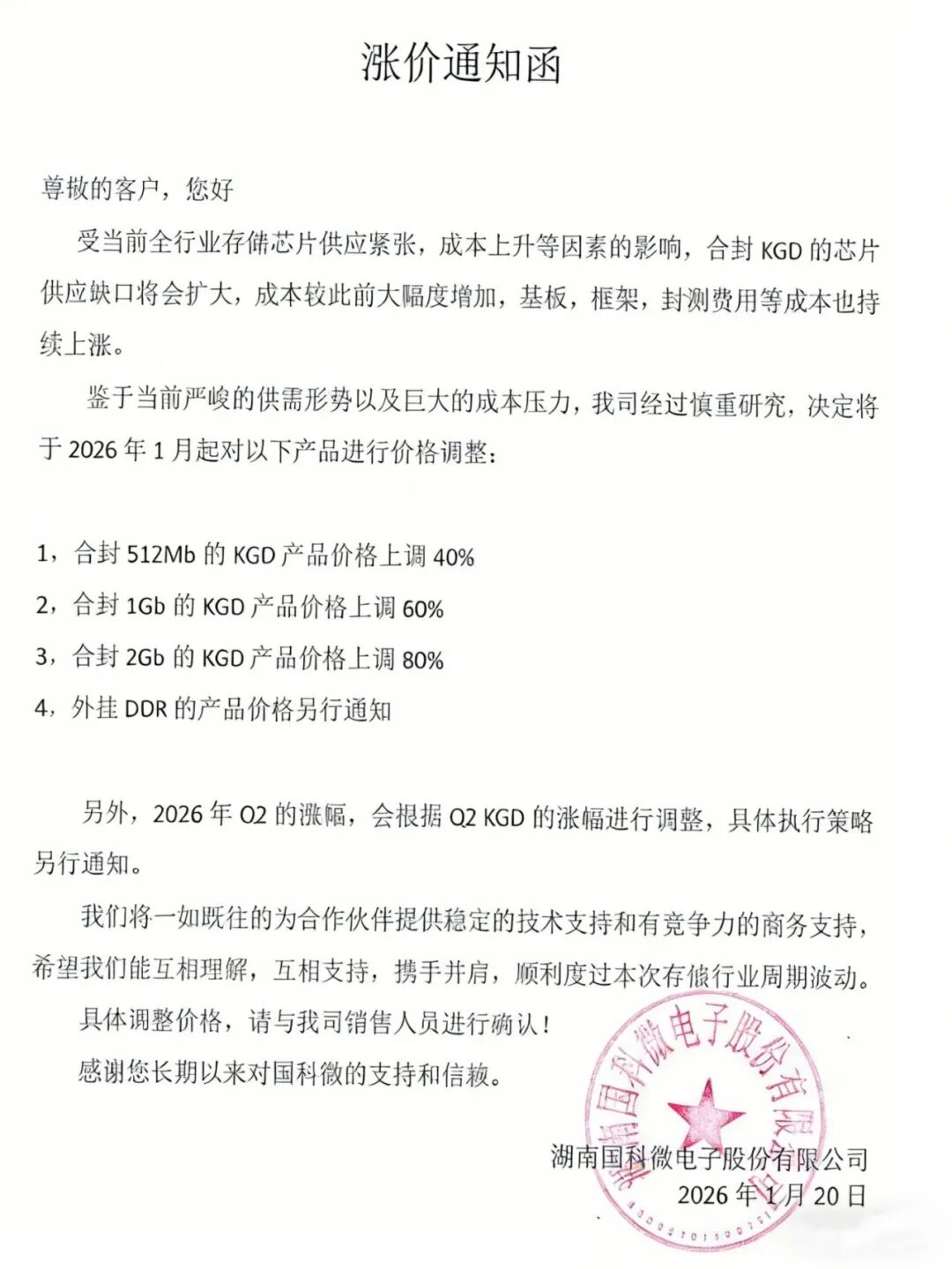
Core Viewpoint - The global semiconductor industry is experiencing a new wave of price increases across the entire supply chain, driven by surging AI demand and rising raw material costs [1][3][61]. Group 1: Price Increases in Domestic Semiconductor Companies - Over 20 semiconductor companies have officially announced price increases [2][62]. - Domestic chip manufacturers are significantly raising prices, with increases as high as 80% for certain products [4][63]. - Guokewai announced price hikes for its KGD storage products, with increases of 40% to 80% [6][66]. - Zhongwei Semiconductor is raising prices for MCU and NOR Flash products by 15% to 50% due to supply chain pressures [9][73]. - Biyiwei has also announced price increases across its entire product line, citing rising raw material costs [17][76]. Group 2: Price Increases in International Semiconductor Companies - International semiconductor giants are also raising prices, with ADI increasing prices by 15% to 30% starting February 1, 2026 [21][81]. - Infineon plans to raise prices for power switches and IC products due to increased demand from AI data centers [24][83]. - Texas Instruments is expected to raise prices by over 30% across nearly all categories due to rising costs [21][81]. Group 3: Price Increases in Wafer Foundry and Packaging - Wafer foundries are increasing prices, with TSMC raising advanced process prices by 3% to 10% [25][85]. - Packaging and testing services are seeing price increases of up to 30%, driven by high demand and capacity constraints [27][86]. Group 4: Impact of Raw Material Costs - The prices of precious metals like gold, silver, and copper are rising, significantly impacting chip manufacturing costs [57][116]. - The increase in raw material costs is leading to a ripple effect across the semiconductor supply chain, prompting many companies to raise their product prices [57][116]. Group 5: Effects on End Markets - The price increases in storage chips are affecting end markets, with PC manufacturers like Dell and Lenovo planning price hikes of 10% to 30% [59][118]. - In the smartphone sector, rising storage costs are pressuring new product pricing, particularly for low-end models [59][118]. - The automotive electronics sector is also feeling the impact, with companies like Xiaomi and NIO reporting cost pressures due to rising semiconductor prices [59][119].



Better AI Stock to Buy on the Dip: Micron or Microsoft?
The Motley Fool· 2026-02-11 09:44
Core Viewpoint - Both Micron Technology and Microsoft are positioned for potential rebounds despite recent declines in their stock prices, with Micron benefiting from strong demand for high-bandwidth memory and Microsoft facing challenges but maintaining a strong overall business outlook [1][2]. Micron Technology - Micron is experiencing a significant demand for high-bandwidth memory (HBM), with its entire 2026 HBM supply already sold out, indicating robust market conditions [5]. - The total addressable market for HBM is projected to grow at a compound annual growth rate of approximately 40%, expanding from $35 billion in 2025 to $100 billion by 2028 [5]. - Micron's shares are currently trading at a low valuation of 12 times forward earnings, which may present an opportunity for substantial growth if the company achieves strong revenue and earnings growth in the upcoming quarters [8]. - The demand for DRAM and NAND memory is also strong, leading Micron to negotiate multi-year supply agreements, which is a shift from past practices [7]. Microsoft - Microsoft is currently valued at a historically low earnings multiple, despite being a leader in the cloud sector [9]. - The company has faced challenges, including lower-than-expected revenue growth in its Azure cloud unit and increased capital expenditures, which have raised concerns among analysts [10]. - Competition is intensifying, particularly with the adoption of Microsoft 365 Copilot not meeting expectations and rival AI models gaining traction [11]. - Despite these challenges, Microsoft's business remains strong across various sectors, with CEO Satya Nadella highlighting the significant growth potential in AI diffusion and the total addressable market [13]. - Over the long term, Microsoft is expected to be a more significant winner, as historical trends show that buying Microsoft shares during significant declines has been rewarding for long-term investors [15].


2025,存储厂商们都赚了多少钱?
芯世相· 2026-02-11 06:19
Core Viewpoint - The storage chip market is expected to be the main focus throughout 2025, with ongoing reports of shortages and price increases continuing into 2026, indicating a sustained upward trend in the industry [3]. Group 1: Wafer Manufacturing - TSMC reported that its customers are not affected by storage price increases, achieving a record revenue of NT$3.8 trillion in 2025, a 31.6% year-on-year increase, with a gross margin of 59.9% [9][10]. - SMIC achieved an unaudited revenue of $9.327 billion in 2025, a 16.2% increase year-on-year, with a net profit of $685 million, up 39.1% [12]. - Huahong Semiconductor reported a revenue of $635 million in Q3 2025, a 20.7% year-on-year increase, with a gross margin of 13.5% [13]. Group 2: Storage Manufacturers - Samsung Electronics achieved a record revenue of 333.6059 trillion KRW (approximately $233.8 billion) in 2025, a 10.9% increase year-on-year, with a net profit growth of 31.2% [18]. - SK Hynix reported a record revenue of 97.15 trillion KRW (approximately $681.6 billion) in 2025, a 47% increase year-on-year, with a net profit of 42.95 trillion KRW [20]. - Micron's revenue surged from $25.11 billion to $37.38 billion in the 2025 fiscal year, with a 56.6% year-on-year increase in Q1 2026 [22]. Group 3: Storage Modules - Jiangbolong expects a revenue of 22.5 billion to 23 billion CNY in 2025, a 29%-32% increase, with a net profit growth of 150.66% to 210.82% [38]. - Bawei Storage anticipates a revenue of 10 billion to 12 billion CNY, with a net profit increase of 427.19% to 520.22% [39]. - Demingli expects a revenue of 10.3 billion to 11.3 billion CNY, with a net profit growth of 85.42% to 128.21% [40]. Group 4: Chip Distributors - Wanye achieved a revenue of approximately NT$1.18 trillion in 2025, a 22.8% year-on-year increase, marking a record high [49]. - Dalian Dadi reported a revenue of NT$999.12 billion in 2025, a 13.4% increase, driven by AI and high-performance computing demand [51]. - Airo's annual sales reached $30.853 billion in 2025, a 10% increase year-on-year [53].




How High Can Micron Go In the Memory Supercycle? Here's What History Says
The Motley Fool· 2026-02-11 03:30
Core Viewpoint - Micron Technology has significantly benefited from the AI boom, with its stock price increasing over 300% due to a generational shortage of memory chips driven by high demand for high-bandwidth memory (HBM) chips used in AI applications [1][2]. Financial Performance - Analysts project that Micron's revenue will double to $75.4 billion for fiscal 2026, with adjusted earnings per share expected to quadruple to $33.38, resulting in a forward P/E ratio of 12 [2]. - Micron is estimated to achieve a net income of approximately $35 billion for the current fiscal year, with profits expected to continue rising at least through 2027 [8]. Market Dynamics - The memory subsector is experiencing a supercycle, which has also positively impacted other memory companies like SK Hynix, Samsung, and Sandisk [4]. - Memory chips are subject to boom-and-bust cycles, with prices fluctuating based on demand and inventory levels, leading to intense capital costs in the semiconductor industry [5]. Historical Context - Micron has experienced multiple cycles over the past decade, with net losses reaching nearly $8 billion during the post-pandemic downturn [6]. - Historical memory cycles for Micron have been relatively short, with trough-to-peak or peak-to-trough periods lasting just a couple of years [9]. Stock Performance - Historically, Micron's stock has gained about 600% from trough to peak during its cycles over the last 20 years [13]. - The most recent cycle shows a significant gain of 840% so far, exceeding typical trough-to-peak gains [14]. Unique Current Conditions - The current memory boom is characterized by unprecedented capital expenditures from major tech companies, with over $600 billion planned for AI infrastructure, indicating sustained demand for memory [15]. - The ongoing shortage of memory chips is expected to impact the smartphone industry significantly, with new capacity taking time to come online [16]. Future Outlook - While the memory cycle will eventually peak, it may take years, and Micron is positioned as a strong investment opportunity in the AI boom, with potential for the stock to double before reaching its peak [17].
未知机构:美光科技MU下跌3因韩联社Yonhap报道称三星计划最早于本-20260211
未知机构· 2026-02-11 02:20
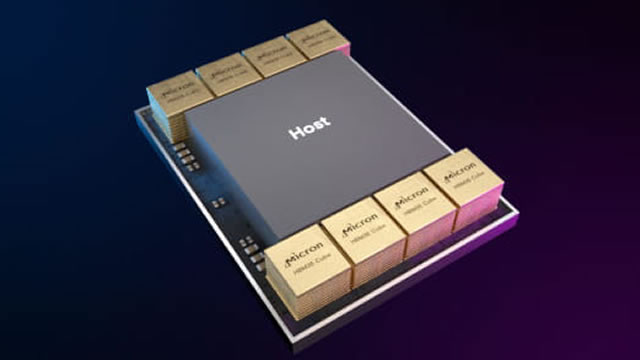
美光科技(MU)下跌 3%,因韩联社(Yonhap)报道称,三星计划最早于本月重启 HBM4(高带宽内存 4)的 大规模生产,以供应给英伟达(NVDA)的 Vera Rubin芯片。 我们早在去年 9 月就建议选择三星而非美光,因当时担忧美光在 HBM 领域的进展缓慢,而这些担忧如今似乎已在 一定程度上反映到市场中。 不过,自去年秋季以来,美光股价已累计上涨 200% 以上,而三星仅上涨 100% 美光科技(MU)下跌 3%,因韩联社(Yonhap)报道称,三星计划最早于本月重启 HBM4(高带宽内存 4)的 大规模生产,以供应给英伟达(NVDA)的 Vera Rubin芯片。 我们早在去年 9 月就建议选择三星而非美光,因当时担忧美光在 HBM 领域的进展缓慢,而这些担忧如今似乎已在 一定程度上反映到市场中。 今日与投资者交流后发现,多数人观点与我们一致,当前主要讨论焦点包括:亚马逊云服务(AWS)增速能有多 快、运营利润还有多少上调空间,以及资本支出周期将持续多久。 Spotify(SPOT)下跌 2%:上周末,TMTB 聊天群中就多空双方对该股的争论展开了热烈讨论,具体观点如 下: AnonCap(Ta ...

DRAM危机,短期无解
半导体行业观察· 2026-02-11 01:27
公众号记得加星标⭐️,第一时间看推送不会错过。 如果感觉如今科技领域的一切都与人工智能息息相关,那是因为事实的确如此。而计算机内存市场更 是如此。用于为人工智能数据中心中的GPU和其他加速器供电的DRAM内存需求巨大,利润丰厚,以 至于挤占了其他用途的内存供应,导致价格飙升。据Counterpoint Research的数据显示,本季度 DRAM价格已上涨80%至90%。 最大的人工智能硬件公司表示,他们已经确保了芯片供应到 2028 年,但这让其他所有人——个人电 脑制造商、消费电子产品制造商以及其他所有需要临时存储十亿比特数据的设备制造商——都不得不 争先恐后地应对供应短缺和价格上涨的问题。 电子行业是如何陷入如今这般困境的?更重要的是,它又该如何摆脱困境?IEEE Spectrum采访了经 济学家和存储器专家,请他们对此进行解释。他们认为,如今的局面是 DRAM 行业历史上长期存在 的繁荣与衰退周期,以及规模空前的 AI 硬件基础设施建设相互碰撞的结果。而且,除非 AI 领域出 现重大崩盘,否则新增产能和新技术需要数年时间才能使供应与需求相匹配。即便如此,价格也可能 依然居高不下。 要了解事情的来龙去脉 ...
道指“一枝独秀”再创新高 比特币回落至7万美元下方 西部数据(WDC.US)跌超8%
Zhi Tong Cai Jing· 2026-02-10 22:31
Market Overview - The Dow Jones reached an intraday record high of 50,512.79 points, closing up 52.27 points or 0.10% at 50,188.14 points, while the Nasdaq fell 136.20 points or 0.59% to 23,102.47 points, and the S&P 500 dropped 23.01 points or 0.33% to 6,941.81 points [1] - The latest retail sales report indicated that consumer spending in December remained flat, below economists' expectations of a 0.4% monthly increase, following a 0.6% increase in November [5] Cryptocurrency - Bitcoin fell below $70,000, down over 2% to $68,698, while Ethereum dropped 4.5% to $2,010 [3] Commodities - Gold prices decreased by 0.74% to $5,022.97, with a significant correction following a previous surge, while silver was priced at $80.818 per ounce [3] - WTI crude oil prices fell by 0.6% to $63.96 per barrel, and Brent crude oil dropped by 0.4% to $68.80 per barrel [4] Economic Indicators - The U.S. retail sales unexpectedly stagnated in December, indicating cautious consumer spending as the holiday season concluded, with 8 out of 13 retail categories showing declines [5] - The U.S. loan default rate surged to 4.8%, the highest level since 2017, driven by increased defaults among low-income and young borrowers [6] Federal Reserve Insights - Federal Reserve officials expressed cautious optimism regarding current interest rates, with no immediate need for rate adjustments, while acknowledging persistent inflation concerns [7][8] Corporate News - Boeing plans to increase the monthly production of its 737 aircraft to 63 units, which is crucial for improving its financial situation [11] - Stellantis is seeking to exit its joint battery venture with Samsung in the U.S., amid a strategic shift to conserve cash and reduce electric vehicle-related losses [12] - Morgan Stanley maintained a neutral rating on Tesla with a target price of $415 [13]



2 Millionaire-Maker AI Stocks to Buy in February
Yahoo Finance· 2026-02-10 22:05
Analysts at Goldman Sachs expect big tech giants to spend over half a trillion dollars on AI-related capital expenditure in 2026. And much of that money is going to data center hardware like AI accelerator chips, high-bandwidth memory devices, and various types of networking equipment. The eye-popping level of hardware spending contrasts with low profits and often huge losses on the consumer-facing software side of the industry. This dynamic means investors can maximize returns by betting on pick-and-shove ...
