新特

Search documents
利空也砸不下大A
虎嗅APP· 2026-01-15 00:29
Core Viewpoint - The A-share market is experiencing extreme enthusiasm, prompting regulatory measures to cool down the market, indicating a shift towards a "slow bull" market rather than a "crazy bull" market, emphasizing the need for investors to focus on fundamentals rather than emotions [5][6]. Market Sentiment and Regulatory Response - On January 14, the exchange announced an increase in the minimum margin ratio for financing from 80% to 100%, leading to an immediate market downturn [5]. - The regulatory stance is clear: the market can rise, but it should not be driven solely by emotions, and investors must return to fundamentals [6]. Investment Opportunities and Risks - The focus should be on identifying key sectors that are likely to perform well while avoiding those that may pose risks [7][8]. - The analysis will cover 13 high-interest sectors to provide insights on potential investment opportunities [9]. AI Computing Power - The rise of AI infrastructure is supported by increased investments from cloud vendors, with companies like "易中天" (New Yizhong, Zhongji Xuchuang, Tianfu Communication) showing significant stock price increases [11]. - However, the current high valuations may be unsustainable, and without new positive developments, there is a risk of a bubble burst in this sector [11]. Space Computing Industry - The space computing industry is expected to emerge as a significant market, with technologies deploying data centers in space to address ground-based limitations [13][15]. - China's advancements in space computing are supported by government initiatives, with plans for a comprehensive deployment strategy by 2025 [17][18]. Humanoid Robots - The humanoid robot sector is anticipated to see differentiation by 2026, with industrial applications being the primary focus, while household robots remain underdeveloped [20][22]. - Companies like 优必选 (UBTECH) are ramping up production, with expectations of significant output increases in the coming years [22][23]. Semiconductor Equipment - Domestic wafer fabs are planning expansions to meet AI chip demand and enhance production capacity, which will benefit semiconductor equipment suppliers [25][26]. Controlled Nuclear Fusion - The commercialization of controlled nuclear fusion is accelerating, with multiple technological pathways being explored [28][30]. - China is making significant strides in fusion energy, with projects like EAST and BEST expected to lead to practical applications by 2027 [32][33]. Commercial Aerospace - The commercial aerospace sector is experiencing a surge, driven by fears of missing out on investment opportunities, although there are concerns about the sustainability of this growth [41][42]. - China's satellite deployment is rapidly increasing, positioning the country as a major player in the global space race [44]. Photovoltaics - The photovoltaic sector is expected to reach a turning point in 2026, driven by supply-side adjustments and improved fundamentals [47][51]. - The cancellation of export tax rebates is likely to increase costs for exporters, benefiting larger firms with economies of scale [51][52]. Consumer Sector - The consumer sector is seen as a safe haven during market volatility, with specific focus areas including media, service consumption, and premium goods like liquor [66][70]. - The overall consumer demand is expected to recover gradually, but structural changes may lead to a lack of strong support for broad-based growth [67]. Banking Sector - The banking sector has shown resilience despite fundamental pressures, with attractive dividend yields drawing in long-term investors [72][73]. - However, the sector is unlikely to lead the market due to its lower growth potential compared to technology and growth stocks [74]. Insurance Sector - The insurance sector has outperformed banks, benefiting from stock market recovery and expected growth in both asset and liability sides [76]. - The aging population is likely to increase the importance of insurance companies in key areas like healthcare and retirement [76]. Brokerage Firms - Brokerage firms have seen strong earnings growth but face challenges in maintaining investor interest due to perceived volatility and lack of long-term growth [77].


多项产品出口退税政策调整,不改中国产业竞争优势
Orient Securities· 2026-01-11 15:38
Investment Rating - The industry investment rating is maintained as "Positive" [5] Core Viewpoints - The adjustment of export tax rebate policies does not alter the competitive advantage of China's chemical industry. The cancellation of export tax rebates for various chemical products is expected to increase export costs, reflecting China's energy and waste treatment capabilities. Despite theoretical concerns about competitiveness, high energy-consuming products like PVC lack global expansion capacity, and the price increase due to VAT will not significantly change competitive dynamics [2][7] - Market rumors do not change the profit recovery opportunities in the industry. Reports of regulatory discussions regarding monopolistic risks have led to stock price corrections for leading chemical companies. However, the industry is still in a self-rescue phase, with production cuts not aimed at achieving monopolistic profits but rather at facilitating recovery from previous losses [2][7] Investment Recommendations and Targets - Recommended leading companies in the refining industry include Sinopec (600028, Buy), Rongsheng Petrochemical (002493, Buy), and Hengli Petrochemical (600346, Buy). The report also highlights recovery opportunities in various chemical sub-industries, such as MDI leader Wanhua Chemical (600309, Buy) and PVC-related companies like Zhongtai Chemical (002092, Not Rated), Xinjiang Tianye (600075, Not Rated), Chlor-alkali Chemical (600618, Not Rated), and Tianyuan Co., Ltd. (002386, Not Rated). In the phosphoric chemical sector, companies like Chuanheng Co., Ltd. (002895, Not Rated) and Yuntianhua (600096, Not Rated) are noted for their growth potential driven by rapid energy storage growth. In the oxalic acid sector, attention is drawn to Hualu Hengsheng (600426, Buy), Huayi Group (600623, Buy), and Wankai New Materials (301216, Buy) [3]



【财闻联播】万科宣布:郁亮退休,辞去全部职务!摩尔线程,最新发布
券商中国· 2026-01-08 12:47
Macro Dynamics - The Chinese Foreign Ministry warns that Japan's growing nuclear ambitions pose a serious threat to global peace and stability, urging Japan to clarify its stance on nuclear weapons and adhere to international treaties [2] Company Dynamics - Vanke A announces the resignation of its executive vice president, Yu Liang, due to retirement age, effective January 8, 2026 [10] - Moore Threads releases version 1.1 of its open-source distributed training simulation tool, SimuMax, enhancing its capabilities for large model training [11] - Hao Wei Group sets the final price for its H-share issuance at HKD 104.80 per share, expected to be listed on January 12, 2026 [13][14] - Wens Foodstuff Group forecasts a significant decline in net profit for 2025, estimating a drop of 40.73% to 46.12% year-on-year due to falling pig prices despite stable production management [15] - Jinli Permanent Magnet anticipates a substantial increase in net profit for 2025, projecting a growth of 127% to 161% year-on-year, driven by its applications in various industries including new energy vehicles and robotics [16] Market Data - The Shanghai Composite Index fell by 0.07%, while the Shenzhen Component and ChiNext Index dropped by 0.51% and 0.82% respectively, with significant activity in the commercial aerospace sector [7] - As of January 7, the financing balance on the Shanghai Stock Exchange reached CNY 12,982.15 billion, an increase of CNY 123.16 billion from the previous trading day [8] - The Hang Seng Index declined by 1.17%, with technology stocks underperforming, while the semiconductor sector saw gains [9] Regulatory Updates - The Ministry of Commerce emphasizes that companies engaging in foreign investments and technology exports must comply with Chinese laws and regulations, particularly in the context of Meta's acquisition of Manus [3] - The State Administration for Market Regulation addresses potential monopoly risks in the polysilicon market, leading to a significant drop in polysilicon futures prices [12] Urban Development - Guangzhou issues a plan to accelerate the development of advanced manufacturing, aiming to double industrial added value by 2035 and focusing on strategic industry clusters [4]




光伏反内卷引领创新治理,新格局重塑产业逻辑
2025-12-22 01:45
Summary of Key Points from Conference Call Records Industry Overview - The conference call discusses the photovoltaic (PV) industry, highlighting the establishment of a multi-crystalline silicon storage platform by major companies to stabilize prices through coordinated production control. This initiative has already led to an increase in futures prices, with spot prices maintaining above 50,000 yuan, although transaction volumes remain limited. The platform is expected to enhance market confidence and drive price recovery across the industry [1][2][3]. Core Insights and Arguments - **Market Dynamics**: The overseas market is experiencing strong demand for photovoltaic products due to electricity shortages, with expectations for good demand in 2026. Conversely, the domestic market may see a decline in installed capacity next year, potentially setting the stage for a recovery [1][3]. - **Supply-Side Reforms**: The establishment of the multi-crystalline silicon storage platform, involving major players like Tongwei, Xiexin, and others, aims to achieve price stabilization and reasonable profitability across the supply chain. This contrasts with past supply-side reforms in industries like steel and cement [2]. - **Investment Opportunities**: The call emphasizes the importance of monitoring the photovoltaic sector and its supply-side reforms, which are expected to lead to a recovery in profitability [1][3]. Data Center Developments - The data center sector is focusing on the implementation of an 800-volt architecture to meet the power supply needs of AIGC (Artificial Intelligence Generated Content). This architecture enhances power density and reduces copper usage. Key components to watch include solid-state transformers, solid-state circuit breakers, and high-power PSUs [4]. Humanoid Robotics Progress - Recent developments in humanoid robotics include the launch of an application store by Yuzhu Technology, which allows users to share motion models, laying a foundation for ecosystem development. Additionally, Huawei has entered a procurement agreement with NewTaiKe, committing to purchase at least 1,000 units over the next three years, marking significant progress in the application of humanoid robots [5]. Solid-State Battery Advancements - The solid-state battery sector is gaining traction, with SAIC's new MG4 model featuring solid-state batteries completing its first batch of deliveries. QS, a key player in solid-state lithium metal technology, has signed a joint development agreement with the world's top ten automotive manufacturers, indicating steady progress in the solid-state battery supply chain [6]. Wind Power and Grid Construction Updates - In the wind power sector, downstream prices are recovering, and significant progress has been made in deep-sea projects, such as the successful grid connection of the 800 MW project in Jiangsu, which can supply electricity to 1.4 million households. The construction of ultra-high voltage (UHV) lines is also advancing, with new projects being approved and operational, indicating a steady progression in UHV construction and enhancing competitiveness in the wind power sector [7].
多晶硅期货破6万!多头诛杀空头,光伏高管每人赚了几千万!这是一个怎样的资本局?
Ge Long Hui· 2025-12-04 20:47
Core Insights - The price of polysilicon has surpassed 62,000 yuan per ton, reaching a historical high on December 3, 2023, with a significant drop in trading volume, indicating a potential market imbalance [1][2] - The disparity between futures and spot prices has raised concerns, with the futures price being approximately 14.9% higher than the average spot price, suggesting a structural issue in the market [3][4] - The current situation is attributed to a narrow design of deliverable products, concentrated warehouse receipts, and a significant imbalance between positions and deliverable resources, leading to extreme price movements [5][6][7] Market Dynamics - The trading volume for the PS2512 contract on December 3 was only 114 tons, a stark contrast to the 115,200 tons traded on July 31, indicating a drastic reduction in market activity [1] - The price increase of polysilicon futures has resulted in a price return of 87.7% since June 25, with margin trading yielding returns as high as 877% for informed traders [2] - The market has seen a significant concentration of deliverable resources, with only a few companies controlling the majority of the registered brands, raising concerns about market manipulation [9][10] Delivery and Warehouse Issues - The design of the delivery mechanism is overly restrictive, with only a limited number of brands eligible for delivery, which has led to a scarcity of deliverable products [11][12] - The actual volume of standard deliverable products is estimated to be only about 20% of total production, creating a mismatch between market supply and futures contracts [11][12] - Strict time constraints on warehouse receipts, including a 90-day production period and a 6-month validity, exacerbate the delivery challenges, especially during peak trading months [14] Speculative Behavior and Market Manipulation - The market has been influenced by speculative behavior, with some traders profiting significantly from the volatility, while others have faced substantial losses due to a lack of understanding of the delivery rules [17][18] - Reports of coordinated trading activities among industry insiders suggest potential manipulation, with some individuals reportedly making millions from trading polysilicon futures [18][19] - The prevalence of misleading information and rumors in the market has contributed to price volatility, with regulatory scrutiny needed to address these issues [20][21][22] Regulatory Considerations - The current market dynamics highlight the need for regulatory adjustments, including potential modifications to the delivery and warehouse receipt systems to prevent extreme price fluctuations [29][30] - There is a call for thorough investigations into the dissemination of misleading information that has coincided with significant market movements, to restore confidence in the trading environment [31] - The overall goal is to ensure that the polysilicon futures market serves its intended purpose as a risk management tool for the solar industry, rather than becoming a platform for speculative excess [28][30]
TrendForce集邦咨询:供需失衡持续演变 光伏产业链各环节均面临挑战
智通财经网· 2025-11-13 07:16
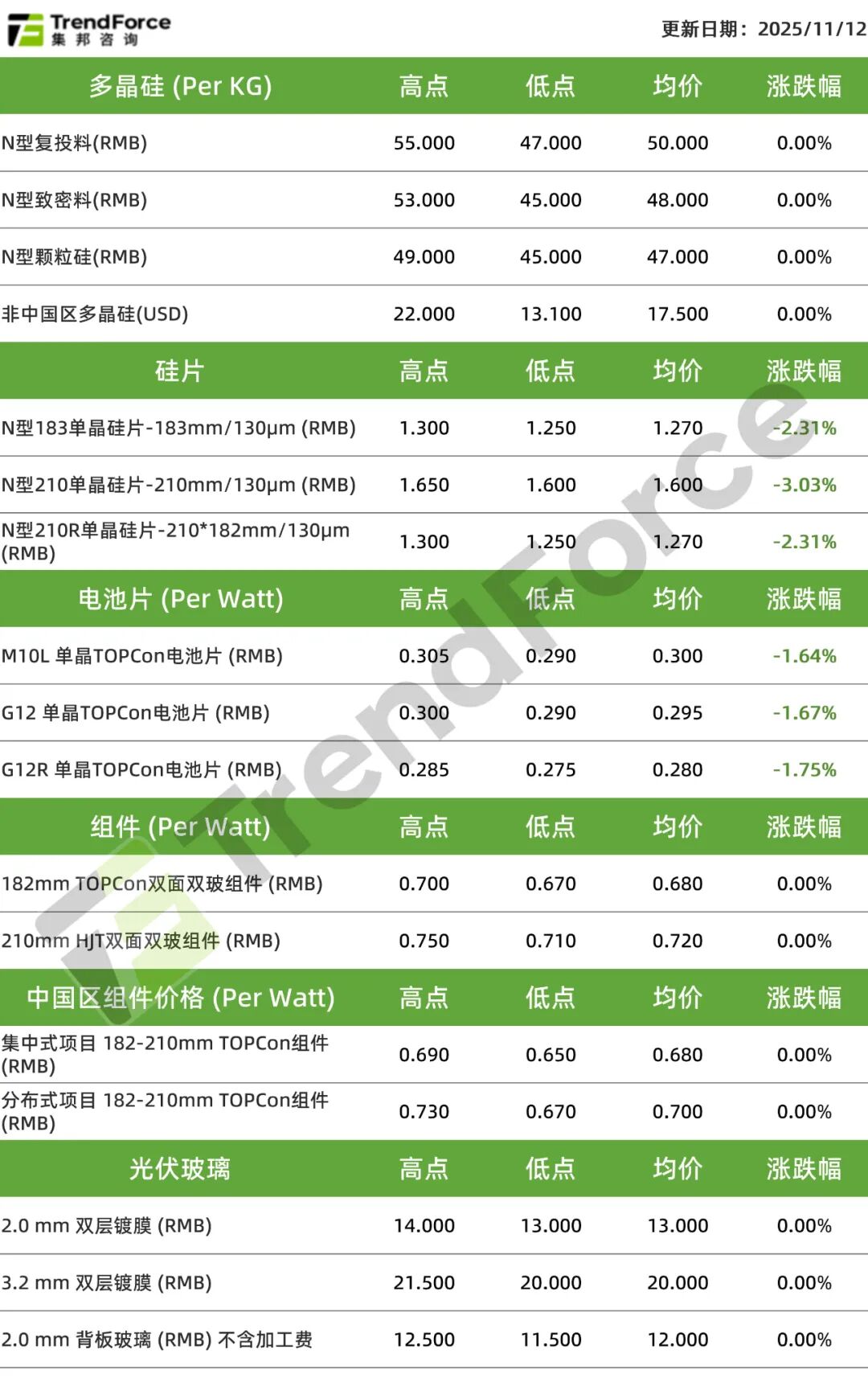
Group 1: Silicon Material - Current silicon material inventory has reached approximately 430,000 tons and is still in a continuous accumulation phase [2][3] - The actual transaction price of silicon material has shown signs of decline due to oversupply and inventory accumulation, but is expected to stabilize in the short term due to anticipated policy support [5] Group 2: Silicon Wafer - Current silicon wafer inventory remains high at over 23 GW, with some manufacturers beginning to reduce production, yet overall shipment pressure persists [6][7] - The market is characterized by a surplus, with supply still exceeding demand, leading to ongoing tension in the supply-demand relationship [8] - Silicon wafer prices are under significant downward pressure, with prices for 183N and 210RN approaching 1.25 RMB per piece, and 210N dropping to around 1.6 RMB per piece [9] Group 3: Battery Cells - Current inventory in the battery segment has accumulated to over 7 days, indicating a significant increase in inventory and sluggish turnover [10] - The supply side of the battery segment is expected to adjust due to high inventory and shrinking demand, with a substantial reduction in production anticipated [11] - Battery prices are under pressure, with mainstream prices for 183N at 0.3 RMB/W, 210RN at 0.28 RMB/W, and 210N at 0.29 RMB/W, with some traders resorting to low-price dumping [13] Group 4: Photovoltaic Modules - The module market is facing challenges from both domestic and international demand shrinkage, with significant weakening in end-user demand [14] - There is a divergence in supply, with major domestic manufacturers maintaining stable production while smaller producers are reportedly halting operations [14] - The overall price pressure on modules is increasing due to declining costs of upstream materials and shrinking end-user demand [15]
光伏周价格 | 供需失衡持续演变,光伏产业链各环节均面临挑战
TrendForce集邦· 2025-11-13 05:48
Core Viewpoint - The article discusses the current state of the photovoltaic industry, highlighting the weak demand and high inventory levels across various segments, including polysilicon, wafers, cells, and modules, leading to price pressures and a potential shift to a "weak stability" phase for polysilicon prices [4][6][8][12]. Polysilicon - Current polysilicon inventory has reached approximately 430,000 tons and continues to accumulate [4]. - The overall output in the industry has decreased, with an expected production of about 125,000 tons in November, a reduction of 11,000 tons month-on-month [5]. - Despite an increase in the number of orders, the actual demand for polysilicon is shrinking due to planned production cuts by downstream wafer manufacturers [6]. - The actual transaction prices for polysilicon have shown signs of decline, but a significant drop is not expected in the short term due to policy support [7]. Wafers - The current wafer inventory remains high at over 23 GW, with some manufacturers beginning to reduce production due to high inventory pressure [8]. - The market continues to exhibit an oversupply situation, with supply still exceeding demand despite some production cuts from smaller manufacturers [9]. - The actual demand remains weak, making it difficult to digest existing inventory and current production levels [10]. - Wafer prices are under significant downward pressure, with prices for 183N and 210RN wafers nearing 1.25 RMB and 1.6 RMB respectively [11]. Cells - The inventory in the cell segment has accumulated to over 7 days, indicating a significant increase in stock and slow turnover [12]. - The supply side is expected to adjust due to high inventory and shrinking demand, with a substantial reduction in production anticipated [13]. - The pressure from downstream module orders has increased, leading to a lack of confidence in the market [13]. - Current cell prices are under pressure, with mainstream prices for 183N at 0.3 RMB/W and 210RN at 0.28 RMB/W, with some traders resorting to low-price dumping [15]. Modules - The module market is facing challenges from both domestic and international demand shrinkage, exacerbated by the seasonal transition to winter [16]. - There is a divergence in supply, with major manufacturers maintaining stable production while smaller producers are reportedly halting operations [16]. - The strong desire among module manufacturers to increase year-end sales has led to price reductions, with conventional module prices dropping to around 0.65 RMB/W [16]. - The decline in costs for upstream materials like cells and glass, combined with weak terminal demand, is putting additional downward pressure on module prices [16].
光伏周价格 | 硅料价格弱势维稳,硅片、电池承压下行
TrendForce集邦· 2025-11-06 06:36
Core Viewpoint - The photovoltaic industry is currently facing a dual weakness in supply and demand, leading to downward pressure on prices across various segments of the supply chain [20]. Group 1: Polysilicon - Current industry inventory remains above 420,000 tons, primarily due to increased polysilicon output in October and cautious purchasing by downstream manufacturers [4]. - Supply is inconsistent, with some manufacturers ramping up production while others, like Tongwei, are reducing operating rates due to maintenance and demand issues, leading to an expected decrease in November output to approximately 127,000 tons [5]. - The market is experiencing a "dual weakness" scenario, with both supply and demand declining, putting continued pressure on polysilicon prices [6]. - Despite high inventory levels, there is some support for prices due to anticipated supply reductions and expectations of a "stockpiling" policy [7]. Group 2: Wafer - Current wafer inventory has risen to over 21 GW, with low purchasing willingness from downstream markets due to a bearish outlook on future prices [8]. - Demand remains weak, leading to a consensus among manufacturers to reduce production in response to price declines and high inventory levels [9]. - Overall transaction prices for wafers are continuing to decline, with significant price drops observed in second and third-tier companies, while leading firms still show some price support [10]. Group 3: Cell - Current inventory levels for cells are maintained at around 5-7 days, but there is structural differentiation, with pressure concentrated on the 210 RN size [11]. - Demand is structurally weak, particularly for the 210 RN size, with a notable increase in inventory for the 183 N size due to reduced demand from India [12]. - Overall price risks for cells are significant, with prices for the 183 N size approaching 0.3 RMB/W, and the 210 RN size stabilizing around 0.28-0.285 RMB/W [13]. Group 4: Modules - As winter approaches, outdoor projects are winding down, leading to reduced orders for module manufacturers and a decline in both domestic and overseas demand [14]. - The market is primarily supported by domestic centralized projects, but demand for 210 size modules is expected to drop sharply next month, putting pressure on prices [14]. - Overall, the module market is facing significant downward pressure due to weak terminal demand and insufficient order reserves [14].
TrendForce集邦咨询:硅料价格弱势维稳 硅片、电池承压下行
Zhi Tong Cai Jing· 2025-11-06 05:51
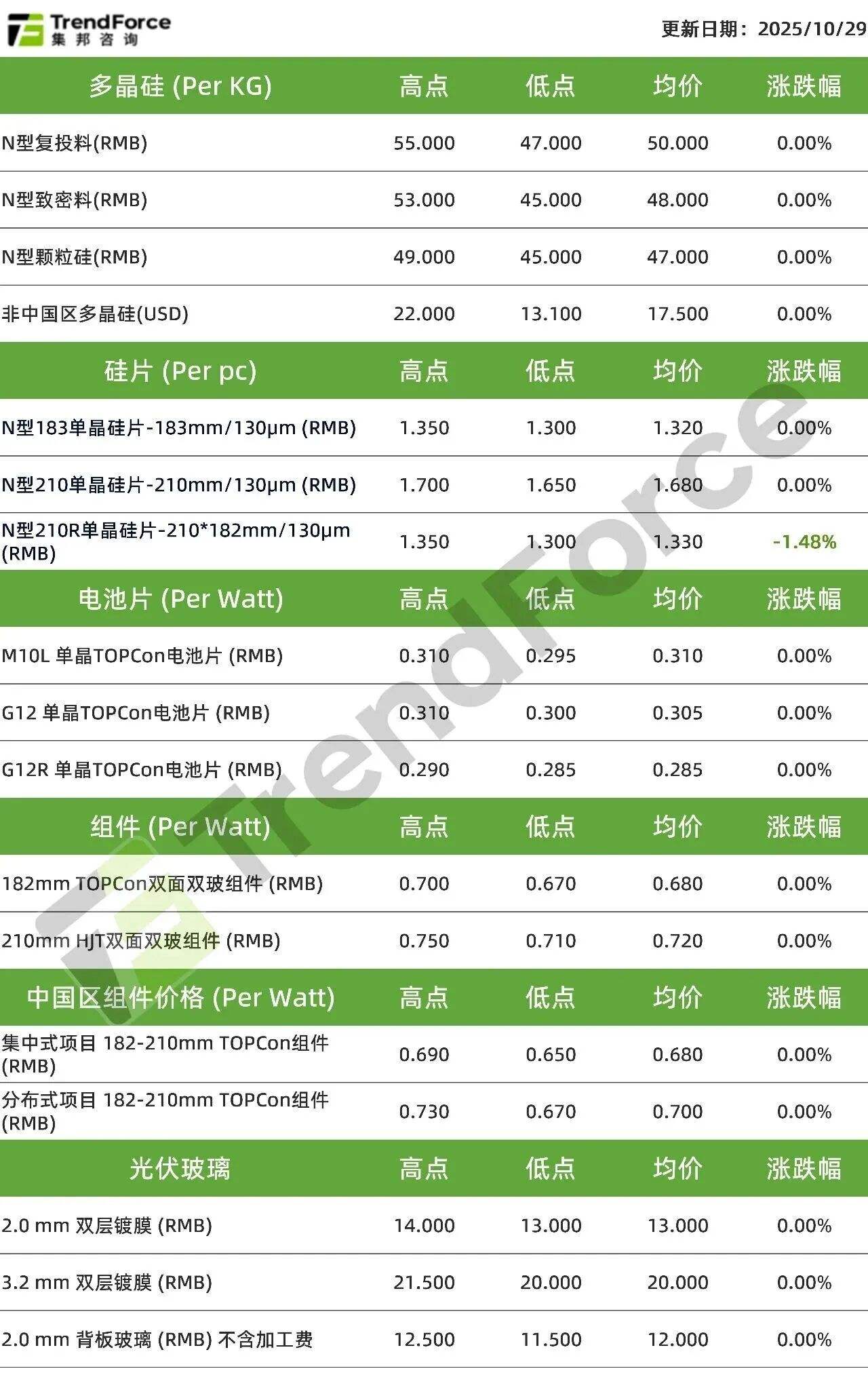
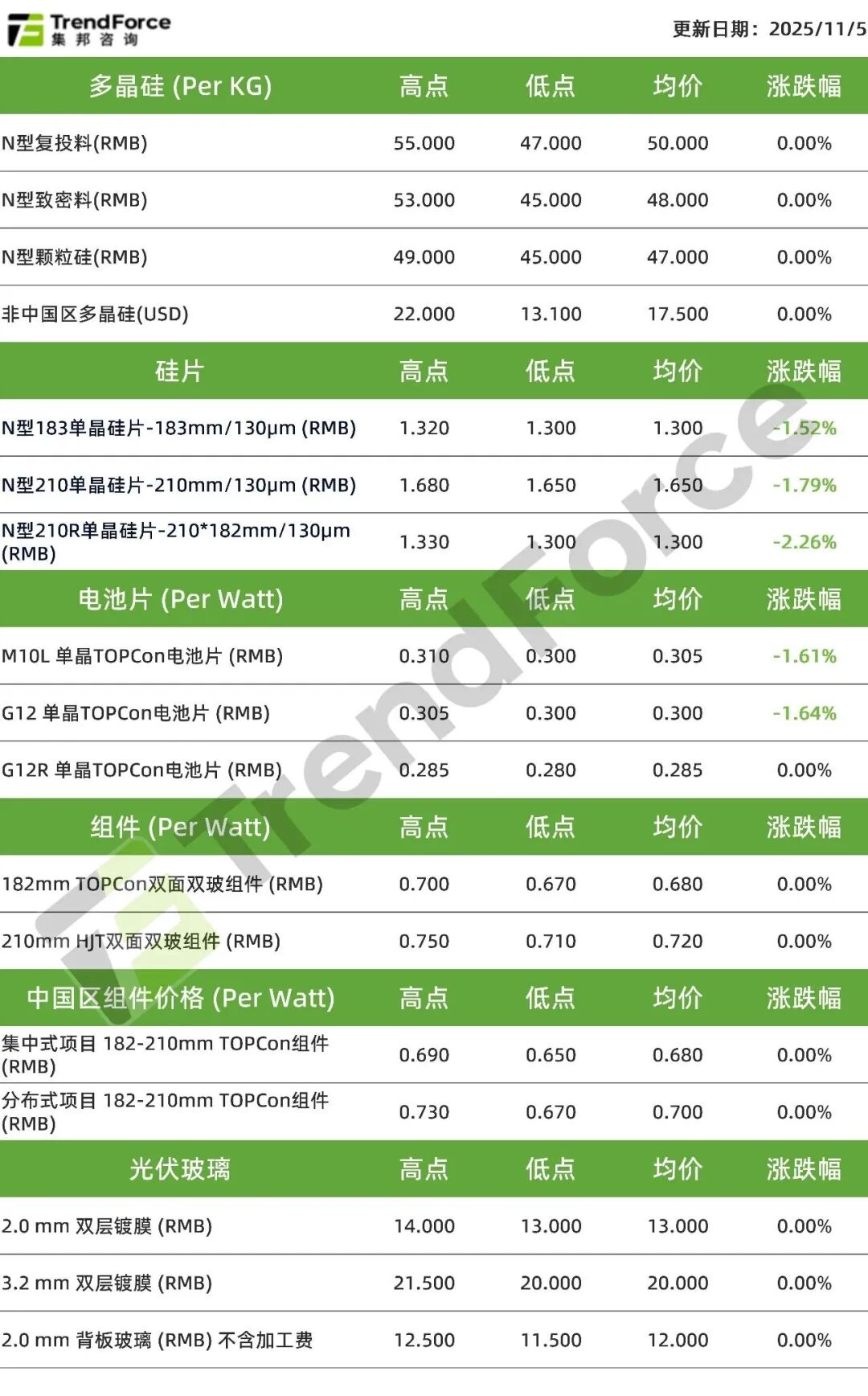
Core Viewpoint - The silicon material prices are under pressure due to high inventory levels, but supply contraction in November and expectations for a "stockpiling" policy may provide some price support, leading to a forecast of weak stability in prices [1][2]. Group 1: Polysilicon - Current industry inventory remains above 420,000 tons, primarily due to increased polysilicon output in October and cautious procurement by downstream manufacturers [2]. - The overall polysilicon production is expected to decrease by approximately 0.8 thousand tons to around 12.7 thousand tons in November due to mixed operational adjustments among manufacturers [2]. - The market is facing a "double weakness" in supply and demand, with downstream production also showing a downward trend [2]. Group 2: Silicon Wafers - Silicon wafer inventory has risen to over 21 GW, with low procurement willingness from downstream markets due to bearish price expectations [3]. - Some silicon wafer manufacturers have begun to reduce production in response to high inventory levels and declining prices, with an increasing consensus on "production cuts to support prices" [3]. - The overall transaction prices for silicon wafers continue to decline, with significant price drops observed in second and third-tier companies [3]. Group 3: Battery Cells - Current battery inventory levels are maintained at around 5-7 days, but structural differentiation persists, particularly with rising inventory pressures on the 210RN size [4]. - Demand is structurally weak, with declining interest in 210RN and 183N sizes, influenced by reduced procurement from downstream component manufacturers [4]. - The overall battery prices face significant downward risks, with prices for 183N gradually approaching 0.3 RMB/W and 210RN stabilizing at low levels [4]. Group 4: Photovoltaic Modules - As winter approaches, outdoor projects are winding down, leading to reduced orders for module manufacturers and a decline in both domestic and overseas demand [5]. - The market is primarily supported by domestic centralized projects, but demand for 210 version modules is expected to drop sharply next month [5]. - Conventional module prices remain around 0.65 RMB/W, with overall demand weakening and insufficient order reserves for manufacturers [5]. Group 5: Price Data - Polysilicon prices remain stable with no significant changes reported [6][7]. - Silicon wafer prices for N-type 183mm and 210mm sizes have seen slight declines of 1.52% and 1.79%, respectively [6][7]. - Battery cell prices are also under pressure, with M10L and G12 sizes showing declines of 1.61% and 1.64% [6][7].

集邦咨询:多晶硅市场供需双弱 价格走势聚焦政策落地
智通财经网· 2025-10-30 06:08
智通财经APP获悉,TrendForce集邦咨询发文称,11月多晶硅市场将面临供给减少及终端需求下降的"供需双弱"局面。在高库存压力下,尽管反内卷政策可 能助力硅料价格弱势维稳,但多晶硅大厂挺价意愿已现轻微松动。从供需面看,多晶硅涨价动力不足,需密切关注收储政策是否带来价格提振。 当前行业整体库存依旧保持在42万吨以上,且硅料厂库存后续有继续抬升趋势,主要系下游拉晶端自身库存依旧高企且观望情绪浓厚,仅按需采购。 当前行业开工增减不一,主要有红狮海东单线实现满产;通威包头分线检修,通威云南保山逐步降低开工率、乐山基地准备开始降开工率;协鑫乐山基地开 工率小幅下降、新特准东产能继续爬坡、南玻青海少量产出、晶诺稳定运行、东方希望宁夏新项目维持个别反应器试生产、戈恩斯继续检修,青海丽豪产能 爬坡。 硅片 现阶段硅片库存仍高于20GW,市场弥漫跌价预期,电池厂提货速度放缓,专业化硅片厂继续累库。从尺寸结构上来看,210RN库存压力持续,183N和210N 供需保持相对平衡。 光伏组件 随着寒冬淡季趋势逐渐显现,国内外装机需求后续均呈现下降趋势。 短期内,需求仍主要靠国内集中式项目支撑,其中210版型需求旺盛,需求有望延 ...