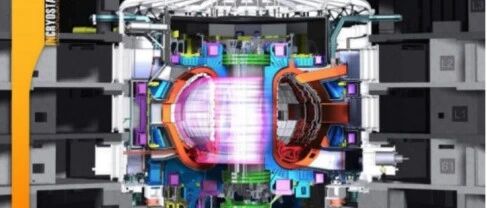
CFS

Search documents
奥特曼的核聚变与马斯克的太空算力,谁在贩卖泡沫
Xi Niu Cai Jing· 2026-02-11 07:46
来源:未尽研究 算力变得饥渴,追求终极的能源。今年,高风险偏好的投资者,将第一次有机会在公开市场交易两种极 端叙事:太空数据中心与商业核聚变。一边是试图逃离地球的轨道算力,一边是试图在地面复刻"人造 太阳"。 马斯克抛出了100GW级轨道数据中心的愿景,将SpaceX与xAI合并,估值1.25万亿美元,计划今年上 市;市场猜测特斯拉未来也可能换股整合。光伏、储能、芯片、大模型与火箭,构成垂直闭环。 戏剧性在于,马斯克长期斥为"愚蠢至极"的核聚变,如今成为另一股资本洪流。特朗普旗下TMTG与谷 歌支持的TAE签署最终合并协议,总值超过60亿美元;General Fusion也已定档年中完成SPAC交割。它 们都预定了纳斯达克的入场券。 在马斯克看来,2到3年内,生成AI算力的最低成本方式将出现在太空;而OpenAI创始人奥特曼投资的 商业聚变初创企业Helion,将向微软交付电力定在2028年。于是,AI领域的一大悬念诞生了,谁能兑现 承诺,谁在贩卖泡沫? 在科学层面,可控核聚变"并不存在根本性的未知问题"。今年年初,星环聚能完成10亿元A轮融资时, 公司创始人陈锐如此表述。但他执意要给行业降温。核聚变这场"终 ...
马斯克放弃核聚变
投资界· 2026-01-30 08:09
Core Viewpoint - A capital and technological competition surrounding nuclear fusion is redefining human imagination about the energy revolution, with significant investments flowing into nuclear fusion startups globally, particularly in the U.S. and China [3][4]. Group 1: Investment Trends - Nuclear fusion concept stocks are gaining traction worldwide, with venture capital continuously pouring into fusion startups in the U.S. and related stocks in China showing strong performance [3][4]. - High-profile investors, including tech billionaires and even former President Trump, are betting on various nuclear fusion technologies, indicating a collective pursuit of creating an "artificial sun" [4][5]. Group 2: Energy Demand and Supply Challenges - The U.S. is facing an electricity shortage, exacerbated by the rising demand from AI, data centers, and other tech sectors, marking a significant shift in energy consumption patterns [6][8]. - AI data centers currently account for approximately 3% of the total electricity consumption in the U.S., with projections suggesting this could rise to nearly 8% by 2030 [8][9]. Group 3: Nuclear Fusion's Advantages - Nuclear fusion is being revisited due to its potential as a clean, efficient, and sustainable energy source, with advantages such as high energy density and low greenhouse gas emissions [10][12]. - Unlike fossil fuels, nuclear fusion's primary fuel source is seawater, reducing geopolitical risks associated with energy supply [10]. Group 4: Technological Pathways in Nuclear Fusion - Various technological pathways for nuclear fusion are being explored, including pulse magnetic confinement, hydrogen-boron fusion, and tokamak systems, each with distinct engineering philosophies and timelines [13][14][15]. - Silicon Valley's investment strategy involves diversifying across multiple fusion technologies to hedge against risks associated with high uncertainty in the field [13][21]. Group 5: Elon Musk's Space Solar Initiative - Elon Musk has publicly criticized terrestrial nuclear fusion, advocating instead for space-based solar power, which he believes can harness solar energy more effectively [17][18]. - Musk's plan includes deploying solar AI satellites to maximize solar energy capture in space, potentially meeting the entire U.S. electricity demand with a relatively small area of solar panels [19][20]. Group 6: Strategic Implications of Investment - Silicon Valley's investment in nuclear fusion reflects a long-term strategic bet on future energy capabilities, with the understanding that technological advancements in fusion could yield benefits across various high-tech industries [21][22]. - The pursuit of nuclear fusion is seen not merely as an energy venture but as a critical component in determining future technological and competitive advantages in the global landscape [23].


机械设备行业事件点评报告:五年规划首提“能源强国”,核聚变招标大潮揭榜,多项目启动在即
Founder Securities· 2025-12-14 07:07
Investment Rating - The industry investment rating is "Recommended" [2] Core Insights - The "14th Five-Year Plan" has introduced the goal of becoming an "Energy Power," marking a significant shift in China's energy strategy, emphasizing the need for technological self-reliance and competitiveness in the energy sector [5][6] - The nuclear fusion industry is entering a phase of accelerated project launches, with significant bidding activity observed, indicating a robust market potential estimated to reach trillions during the "14th Five-Year Plan" period [6][7] - Key companies in the nuclear fusion sector, such as 合锻智能, 王子新材, and 永鼎股份, are highlighted as important players to watch due to their involvement in upcoming projects and expected growth in 2026 [7][8] Summary by Sections Industry Overview - The total number of listed companies in the machinery equipment industry is 632, with a total share capital of 4,356.64 million shares and sales revenue of 28,958.20 billion yuan [2] - The total profit for the industry stands at 2,150.95 billion yuan, with an average price-to-earnings (PE) ratio of 106.85 and an average stock price of 27.60 yuan [2] Market Performance - The machinery equipment sector has shown varying performance against the CSI 300 index, with a notable increase of 34% over the observed period [3] Future Projections - The nuclear fusion sector is expected to see a significant increase in bidding amounts in 2026, with ongoing projects like the 合肥 BEST project and the 江西 mixed pile project anticipated to drive growth [6][7] - The report emphasizes the importance of focusing on companies with a history of supplying fusion devices, such as 旭光电子 and 四创电子, as they are likely to benefit from the industry's expansion [8]
“人造太阳”热潮助推 全球高温超导龙头上海超导闯关科创板
2 1 Shi Ji Jing Ji Bao Dao· 2025-11-17 13:29
Core Viewpoint - The article highlights the rapid advancement of controllable nuclear fusion technology, particularly focusing on the key material, high-temperature superconducting tape, which is attracting significant capital interest. Shanghai Superconductor Technology Co., Ltd. is positioned as a leader in this field, with its IPO on the Sci-Tech Innovation Board aiming to raise 1.2 billion yuan for production and headquarters projects [1][2]. Company Overview - Shanghai Superconductor, established in 2011, is one of only two companies globally capable of producing over 1,000 kilometers of second-generation high-temperature superconducting tape annually, the other being a Japanese firm, FFJ [1][14]. - The company holds a dominant position in the domestic market with a market share exceeding 80% [2][14]. Product and Technology - High-temperature superconducting materials exhibit zero electrical resistance and complete magnetic resistance at extremely low temperatures, making them crucial for applications in energy transmission, medical imaging, and quantum computing [4]. - The second-generation high-temperature superconducting tape, produced by Shanghai Superconductor, is characterized by superior mechanical strength, lower raw material costs, and high current-carrying capacity, gradually replacing the first generation in emerging applications like controllable nuclear fusion [4][5]. Market Dynamics - The global commercialization of nuclear fusion has seen significant investment, with cumulative financing in the field reaching approximately $9.766 billion, an increase of $2.643 billion from the previous year [12]. - The demand for high-temperature superconducting tape is expected to grow rapidly, with the market size in the controllable nuclear fusion sector projected to increase from approximately 722 million yuan in 2025 to about 2.144 billion yuan by 2027 [12]. Financial Performance - Shanghai Superconductor's revenue has shown significant growth from 36 million yuan in 2022 to an estimated 240 million yuan in 2024, with a net profit of 72.01 million yuan expected in 2024 [15]. - The company experiences seasonal revenue fluctuations, with a substantial portion of its income concentrated in the fourth quarter due to the budget management practices of its major clients, which include large state-owned enterprises and research institutions [16]. Client Base - The client base of Shanghai Superconductor is highly concentrated, with the top five clients accounting for 75% to 85% of total revenue during the reporting period [16]. - A significant portion of revenue in the first half of 2025 is expected to come from the Chinese Academy of Sciences, which has been a stable partner since 2015 [16].
中金 | 核聚变之光02:能源革命的下个纪元
中金点睛· 2025-11-07 00:07
Core Viewpoint - The article emphasizes that nuclear fusion is entering a critical phase of "engineering verification" and "demonstration reactor introduction," suggesting a focus on the key window for industrialization configuration [1]. Group 1: Global Nuclear Fusion Landscape - Nuclear fusion is recognized for its environmental friendliness, abundant resources, high energy density, and self-limiting reaction mechanisms, making it a key focus in future energy strategies globally [3][4]. - Major economies, including China, the US, Japan, and the UK, are accelerating the development of nuclear fusion through legislative support and funding, establishing a comprehensive support system from top-level design to industrial practice [3][9]. - By mid-2025, the cumulative financing for the global commercial nuclear fusion industry is expected to reach $9.766 billion, marking the highest annual increase in three years [3][12]. Group 2: Technological Advancements and Cost Structure - The core value of nuclear fusion devices, such as the ITER project, is concentrated in four major systems: magnets, blanket, vacuum chamber, and divertor, with the highest cost shares being 28%, 17%, 14%, and 8% respectively [3][39]. - The transition to high-temperature superconductors is crucial for enhancing fusion power density and reducing the overall size of fusion reactors, significantly impacting the commercialization process [19][22]. - The cost of nuclear fusion plants is a decisive factor for their penetration in future power systems, with potential construction costs ranging from $11,300/kW to $2,800/kW influencing their market share [22]. Group 3: International Collaboration and Domestic Development - The ITER project represents a significant international collaboration, with China contributing to key components and systems, highlighting the global effort in nuclear fusion research [25][29]. - The US National Ignition Facility (NIF) serves as a representative platform for inertial confinement fusion research, showcasing advancements in energy release and control [27][31]. - China's nuclear fusion technology roadmap aims to establish a fusion engineering test reactor by 2025 and a commercial demonstration plant by 2050, indicating a structured approach to domestic development [37][41].

院士领衔,获联想等机构投资,「安东聚变」完成近亿元首轮融资 | 36氪首发
3 6 Ke· 2025-10-22 03:35
Core Insights - Antong Fusion has completed nearly 100 million yuan in its first round of financing, with investments from Lenovo Star, Qif Capital, Pangu Chuangfu, Daoyi Capital, and Tsinghua Alumni Fund, aimed at talent development, fusion driver system R&D, and testing platform construction [1] - Antong Fusion, established in November 2022, is the first commercial team in China focused on Z-pinch fusion technology, aiming to accelerate the development of controllable nuclear fusion technology and support future commercial power generation [1][3] - The company is led by Chief Scientist Peng Xianjue, a member of the Chinese Academy of Engineering, who has proposed the "Z-pinch fusion fission hybrid reactor" energy technology [1][4] Industry Overview - Controlled nuclear fusion is seen as a key solution for future energy needs, with significant investments and support from governments and tech giants globally [2][3] - In China, 2023 has been marked as the year of commercialization for controllable nuclear fusion, with 19 public investment events and over 10 billion yuan in total financing [3] - The maturity of controllable nuclear fusion technology is estimated to take 10-15 years, with challenges in achieving energy gain and control [4] Z-Pinch Technology - The Z-pinch method involves using a metal sleeve to load plasma with axial current, creating a magnetic field that compresses the plasma, leading to fusion reactions [5][6] - This method is considered more straightforward and cost-effective compared to other fusion techniques, with the potential for high energy conversion efficiency [5][6] Commercialization Strategy - Antong Fusion aims to leverage China's industrial capabilities in energy storage, electricity, and manufacturing to accelerate the commercialization of controllable nuclear fusion [6] - The company plans to develop a series of equipment, including the "Kuiniu" discharge unit and "Leizhenzi" integrated discharge module, with the goal of achieving mass production capabilities by 2030 [8][9] Talent Development - Antong Fusion has established a collaborative research team comprising experienced scientists from top universities and research institutions, ensuring a robust talent pipeline for its long-term goals [9] - The team includes senior scientists like Peng Xianjue, mid-level experts like Yang Qingwei, and younger scientists led by CEO Liu Cheng, focusing on both technological breakthroughs and commercialization efforts [9]

Hassabis官宣用AI点燃「人造太阳」,无限能源时代加速到来
3 6 Ke· 2025-10-17 12:59
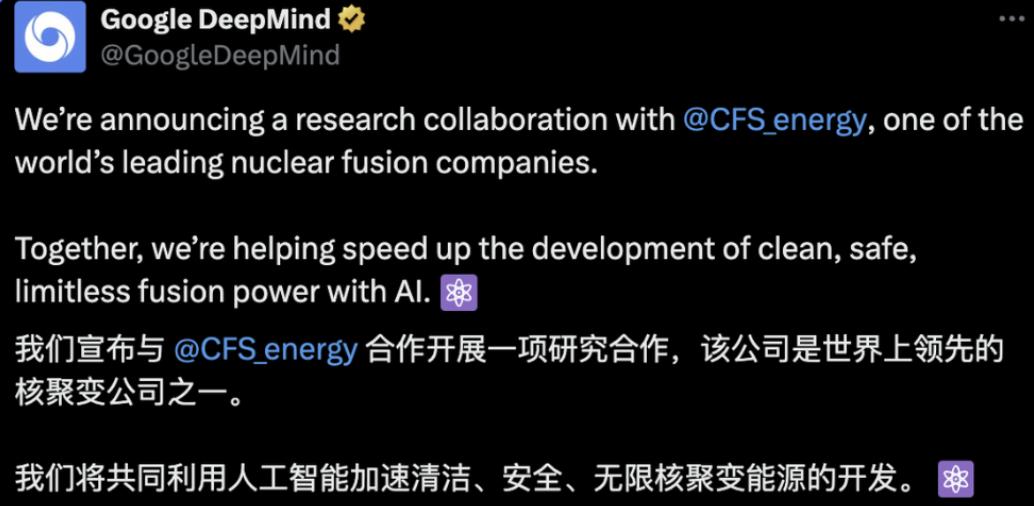
Core Insights - Google DeepMind has announced a collaboration with CFS to leverage AI in accelerating the development of the SPARC fusion device, marking a significant step in the nuclear fusion research phase and aiming for a sustainable energy future [1][2][5]. Group 1: Collaboration Details - The partnership aims to combine Google DeepMind's AI capabilities with CFS's advanced hardware to enhance nuclear fusion research [3][5]. - CFS is developing the SPARC device, which is designed to achieve net energy output from fusion, a milestone in the quest for viable fusion energy [5][12]. - The collaboration is built on previous successful AI applications in plasma control, demonstrating the potential of AI in optimizing fusion processes [6][12]. Group 2: Technology and Methodology - TORAX, a plasma simulator developed by Google DeepMind, will assist CFS in running millions of virtual experiments to optimize the SPARC device's operations [6][7]. - The use of reinforcement learning will help identify the most efficient paths for maximizing fusion energy output while maintaining safety [8][10]. - The integration of AI with traditional methods aims to streamline the search for optimal operational parameters, enhancing the efficiency of the research process [10][12]. Group 3: Future Implications - The collaboration signifies a transformative shift in research paradigms, where AI's computational power meets fusion science, potentially redefining the pace of innovation [12]. - Google has also invested in CFS to support breakthroughs in scientific research and the commercialization of fusion energy technology [12].

万亿赛道“奇点”已至!核聚变板块涨停潮起,第二轮行情正启?
Ge Long Hui A P P· 2025-10-09 06:16
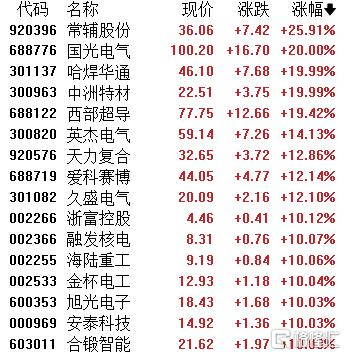
Core Viewpoint - The A-share controllable nuclear fusion sector experienced a surge in stock prices, driven by significant advancements in China's controllable nuclear fusion technology [1][3]. Group 1: Market Performance - Multiple stocks in the controllable nuclear fusion sector reached their daily limit up, including Guoguang Electric, Haheng Huaton, and Zhongzhou Special Materials, with increases of 20% and above [1][2]. - The overall market sentiment is positive, with several companies showing gains exceeding 10% [1][2]. Group 2: Technological Advancements - The recent surge is attributed to a key breakthrough in the construction of the compact fusion energy experimental device (BEST) in Hefei, Anhui, with the successful installation of the core component, the Dewar base [3]. - The completion of the Dewar base marks the beginning of the main assembly work for the BEST device, which is expected to be fully assembled by 2027 [3]. - BEST aims to demonstrate fusion energy generation for the first time globally, with the goal of lighting the first lamp by 2030 [3]. Group 3: Global Developments - The global nuclear fusion sector is witnessing rapid advancements, including a $1 billion power purchase agreement between CFS and Eni Group for a fusion power plant in Virginia, expected to be operational in the early 2030s [4][5]. - The international community is accelerating efforts towards the commercialization of fusion energy, with various countries investing significantly in fusion projects [5][6]. Group 4: Market Outlook - The global nuclear fusion market is projected to reach $496.55 billion by 2030, with a compound annual growth rate of 7.4% from 2024 to 2030 [7]. - Recent policy support in China, including the approval of the Atomic Energy Law, encourages research and development in controlled thermonuclear fusion, providing a favorable environment for industry growth [7][8]. - Analysts suggest that the second wave of market activity in the fusion sector is likely to commence, driven by intensified project financing and bidding processes [6][8].




中国聚变公司首次亮相,新建装置剑指高温超导磁体
Xuan Gu Bao· 2025-09-24 23:20
Group 1 - China Fusion Energy Company, with a registered capital of 15 billion yuan, made its debut at the 25th China International Industry Fair, showcasing its technology and business layout [1] - The company aims for commercial fusion energy by 2050, following the typical nuclear energy development path of experimental, demonstration, and commercial reactors, with R&D activities in Shanghai and Chengdu [1] - A new fusion experimental device named "China Circulation No. 4 (HL-4)" will be established in Shanghai to validate high-temperature superconducting magnets developed there [1] Group 2 - Open Source Securities is optimistic about the nuclear fusion sector's upward trend, highlighting the importance of core components such as magnets, main engines, and power supplies, as well as the potential for direct current transmission equipment companies to secure orders [2] - Listed companies like Lianchuang Optoelectronics and Antai Technology are actively involved in the fusion energy field, with Lianchuang's subsidiary engaged in the "Spark No. 1" project, accumulating orders worth approximately 5 billion yuan [3] - Antai Technology has successfully applied its tungsten composite components in the international thermonuclear fusion experimental reactor ITER project [3]
【转|太平洋新能源-可控核聚变深度】可控核聚变展望:进入关键导入期
远峰电子· 2025-09-21 11:47
Core Viewpoint - Controlled nuclear fusion is set to initiate a new energy revolution, offering abundant energy, zero emissions, and high safety, making it a strategic choice for achieving carbon neutrality goals [2][20]. Summary by Sections 1.1 Fusion Basic Principles - Fusion reactions involve light atomic nuclei like deuterium and tritium combining under extreme temperatures (over 100 million °C) to form heavier nuclei, releasing significant energy [3]. 1.2 Main Research Methods for Fusion - Global fusion research primarily focuses on two main technical paths: magnetic confinement fusion and inertial confinement fusion [6]. 1.3 Magnetic Confinement Fusion Devices: Tokamak - Tokamak devices utilize a combination of toroidal and poloidal magnetic fields to confine high-temperature plasma, achieving fusion conditions. They represent 90% of global fusion research [10]. 1.4 Magnetic Confinement Fusion Devices: Stellarator - Stellarators use a three-dimensional helical magnetic field to confine plasma without relying on plasma current, allowing for longer continuous operation [13]. 1.5 Inertial Confinement Fusion: Z-Pinch - Inertial confinement fusion compresses fuel pellets using high-power drivers (lasers, ion beams) in a very short time, achieving high density [15]. 1.6 Investment Trends in Controlled Nuclear Fusion - Investment in fusion research is accelerating globally, with significant funding from private enterprises and government projects, particularly in the U.S. and Europe [18][20]. 1.7 Key Companies in the Fusion Industry - Key players include: - Upstream: Jingda Co., Yongding Co., Western Superconducting, Antai Technology, etc. - Midstream: Aikesaibo, Lianchuang Optoelectronics, Shanghai Electric, etc. - Downstream: China National Nuclear Corporation [2]. 1.8 Domestic Major Fusion Projects Financing - Major projects include the China Fusion Engineering Test Reactor (CFETR) with over 20 billion yuan investment planned for the next five years [23]. 1.9 Domestic and International Major Fusion Projects Timeline - The average time from Q-value verification to facility completion is around 10-15 years globally, while China aims to shorten this to 3-5 years [24]. 1.10 Cost-Benefit Ratio of Major Fusion Projects - The investment recovery period for demonstration reactors is about 15 years, with an internal rate of return (IRR) of 8-12% [25]. 2.1 Core Equipment Cost Breakdown - The cost distribution for ITER includes superconducting magnet systems (28%), vacuum chambers (25%), heating and power systems (18%), and construction (14%) [27]. 2.2 Industry Chain Distribution and Key Enterprises Overview - The upstream includes superconducting materials and radiation-resistant materials, while the midstream focuses on magnet systems and cooling systems [28]. 2.3 Key Technology and Material Progress - Companies like Western Superconducting and Lianchuang Optoelectronics are making significant advancements in superconducting materials and systems for fusion applications [29]. 2.4 Lianchuang Optoelectronics: Leading in Optoelectronics and High-End Equipment - Lianchuang Optoelectronics is involved in the "Xinghuo No.1" project, providing superconducting magnet systems for fusion applications [33]. 2.5 Yongding Co.: Leader in Optical Communication and Superconducting Materials - Yongding Co. focuses on high-temperature superconducting tape production for fusion devices, significantly enhancing performance and reducing costs [36]. 2.6 Jingda Co.: Leader in Special Electromagnetic Wire - Jingda Co. is involved in the development of high-temperature superconducting materials for fusion applications [39]. 2.7 Antai Technology: Leader in Advanced Metal Materials - Antai Technology specializes in manufacturing key components for fusion devices, particularly tungsten-based components [43]. 2.8 Guoguang Electric: Core Enterprise in Vacuum and Microwave Applications - Guoguang Electric is a key player in providing vacuum and microwave application products for fusion technology [45].