Danaos Corp

Search documents
中方反制生效已满一周,关键在于这拳打开了
Guan Cha Zhe Wang· 2025-10-22 09:37
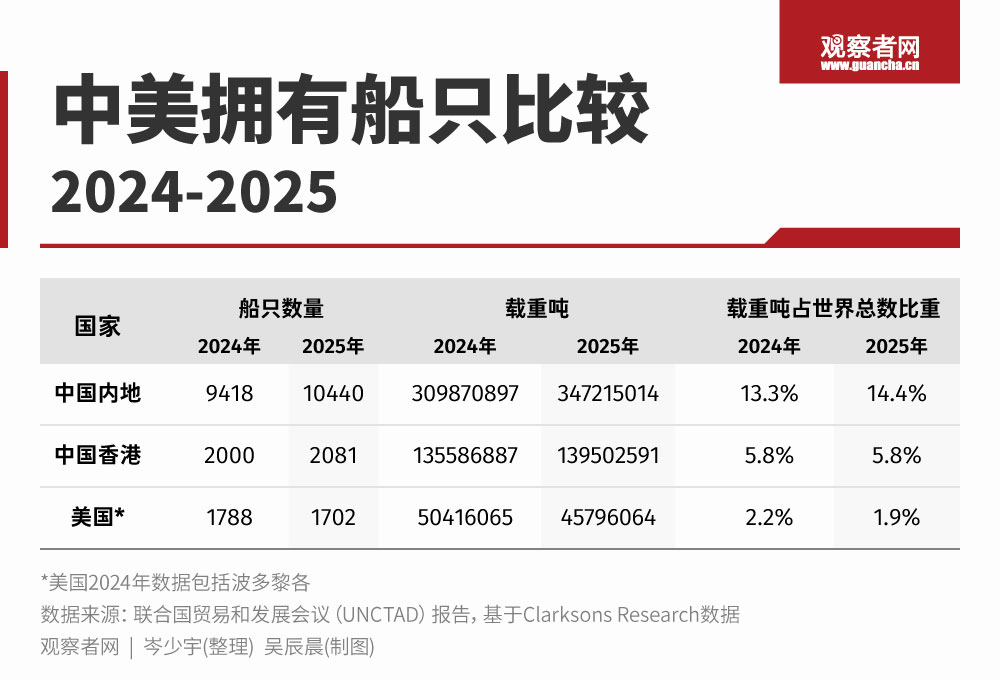
Core Points - The article discusses China's response to the U.S. imposition of special port fees on Chinese vessels, which is seen as a countermeasure to U.S. actions against China's maritime and logistics industries [1][2][34] - The implementation of the special port fee by China is viewed as a strategic move to maintain parity in the ongoing trade tensions between the two countries [2][34] Group 1: Impact on Shipping Industry - The U.S. will impose port service fees on Chinese-owned or operated vessels starting October 14, 2025, affecting a significant number of ships [1][3] - As of January 1, 2025, China is projected to have 10,440 vessels, an increase from 9,418 in 2024, while the U.S. will see a decrease from 1,788 to 1,702 vessels [4][6] - China's share of the global deadweight tonnage is expected to rise from 13.3% in 2024 to 14.4% in 2025, indicating a strengthening position in the global shipping market [6][8] Group 2: Financial Comparisons - The total value of Chinese vessels is projected to reach $255.236 billion in 2025, a 25.11% increase from 2024, while the U.S. total will be $116.447 billion, reflecting a 16.61% growth [13][17] - The value of bulk carriers in China is expected to be $68.454 billion in 2025, compared to $4.054 billion for the U.S., highlighting a significant disparity [17] - The value of container ships in China is projected to be $63.533 billion, while the U.S. will have $4.938 billion, further emphasizing China's dominance in this sector [17] Group 3: Regulatory Responses - The article notes that many U.S. companies have their own fleets, with significant numbers reported by major agricultural firms like Cargill and Bunge [19][22] - The complexity of ownership structures complicates the assessment of which vessels will be affected by the new fees, as many U.S. companies have foreign ownership or operations [25][29] - The article highlights that the U.S. has provided exemptions for certain vessels, which may influence the operational decisions of shipping companies [38] Group 4: Strategic Implications - China's countermeasures are seen as a way to disrupt U.S. efforts to weaken its shipping and shipbuilding industries, forcing global shipping companies to reconsider their strategies [34][39] - The article suggests that the ongoing situation may lead to a reevaluation of the relationships between shipping companies and their operational strategies in light of the geopolitical landscape [39]

Why J Mintzmyer Is Short Walmart And Long 3 Shipping Stocks
Seeking Alpha· 2025-05-13 11:00
Core Insights - The shipping sector has experienced significant volatility due to geopolitical tensions, tariff policies, and supply chain disruptions, making it a dynamic area for investment opportunities [4][6][9]. Shipping Sector Overview - The shipping industry has shifted from a stable, cyclical commodity market to one characterized by ongoing disruptions, including the COVID-19 pandemic, the Suez Canal crisis, and the Russia-Ukraine conflict [6][10]. - Recent U.S. tariff policies have created unexpected volatility, impacting shipping dynamics globally, particularly with China [8][9]. Earnings Calls and Market Indicators - Earnings calls from retail-focused companies like Walmart, Home Depot, and Costco are crucial for understanding consumer behavior and the impact of tariffs on the shipping sector [12][15]. - The first quarter of 2025 showed strong consumer spending, but many CEOs are downgrading future guidance, indicating potential challenges ahead [17][18]. Supply Chain Disruptions - Current import data indicates that many container ships are operating at only 60% capacity, suggesting supply chain issues that could affect inventory replenishment [27]. - The trucking sector is also facing challenges, with declining demand and rates, potentially leading to bankruptcies among truck drivers [29][30]. Container Shipping Industry - The container shipping industry is currently facing severe challenges, particularly for liner companies like Maersk and CMA CGM, due to high tariffs and reduced trade volumes [44][50]. - Despite the overall negative outlook for container shipping, companies with long-term leasing structures, such as Danaos Corp, may still present investment opportunities [49]. Tanker Industry Outlook - The tanker market is viewed positively, with strong demand driven by ongoing geopolitical tensions and sanctions against Russia, leading to increased tanker rates [51][64]. - Companies like International Seaways and Tsakos Energy Navigation are highlighted as strong investment candidates within the tanker sector [66][122]. Walmart Short Position - A short position is being taken against Walmart due to its high valuation relative to earnings, with concerns that tariffs will negatively impact profit margins despite potential increases in store traffic [76][82]. - The upcoming guidance update from Walmart is anticipated to be a critical moment for assessing the company's future performance amid tariff challenges [94].