
Frontier Group Holdings

Search documents
Spirit and Frontier Airlines eye merger, Bloomberg News reports
Reuters· 2025-12-16 22:26
Core Viewpoint - Bankrupt Spirit Aviation Holdings is in discussions to merge with Frontier Group Holdings, indicating potential consolidation in the aviation industry [1] Company Summary - Spirit Aviation Holdings is currently bankrupt and seeking a merger, which highlights the challenges faced by companies in the aviation sector [1] - Frontier Group Holdings is being considered as a potential partner for the merger, suggesting strategic moves within the industry to enhance competitiveness [1]



Frontier Airlines replaces CEO Biffle with carrier's president
CNBC· 2025-12-15 21:42
Group 1 - Frontier Group Holdings has replaced its CEO, Barry Biffle, with the airline's president, James Dempsey, who is now the interim CEO effective immediately [1] - Bill Franke, the Board Chair, praised Dempsey's contributions over the past 10 years and expressed confidence in his ability to lead the airline into the future [2] - There has been no immediate comment from Biffle or Frontier regarding the leadership change [2]

Frontier (ULCC) - 2025 Q2 - Earnings Call Transcript
2025-08-05 16:00
Financial Data and Key Metrics Changes - Total revenue for Q2 2025 was $929 million, down 5% year-over-year with a 2% lower capacity compared to the prior year quarter [6][14] - RASM was $0.0901, while stage length adjusted RASM was $0.0874, slightly higher than the same period last year [6][14] - Adjusted non-fuel operating expenses were $774 million, or $0.75 per available seat mile, reflecting a significant increase due to reduced aircraft utilization and lower sale leaseback gains [13][14] - The company reported a pretax loss and net loss of $70 million, resulting in a net loss per share of $0.31 [14] Business Line Data and Key Metrics Changes - The company launched 35 new routes in Q2, including services to Seattle and Puerto Plata, aiming to penetrate large markets with limited ULCC service [7][8] - Co-brand loyalty revenue per passenger increased over 40% year-over-year, driven by greater card acquisition and spending [10] - The company expects mid to high single-digit RASM growth in Q3, supported by improving industry capacity and loyalty initiatives [5][8] Market Data and Key Metrics Changes - The company noted a greater reduction in competitive capacity in frontier markets compared to the industry average, which is expected to support RASM growth [5][22] - Immature market concentration is expected to trend toward low teens over the next six months, significantly lower than the prior year [9] Company Strategy and Development Direction - The company is focused on enhancing its loyalty initiatives and premium product offerings to support profitability in 2026 [5][10] - The strategy includes modernizing digital tools, distribution, and onboard experience, with a focus on premiumization [11][12] - The management believes that the domestic airline industry is currently oversupplied, and expects continued capacity reductions, which will benefit the company as a low-cost provider [57][96] Management's Comments on Operating Environment and Future Outlook - Management expressed cautious optimism regarding future sales trends, noting significant improvements in bookings and yields since mid-July [20][46] - The company is planning for a similar utilization level unless demand changes, with a focus on maintaining flexibility in capacity adjustments [38][90] - Management acknowledged the challenges faced in the first half of the year but highlighted a positive trajectory moving forward, particularly in September [76][78] Other Important Information - The company ended the quarter with $766 million in total liquidity, including $561 million in unrestricted cash [14] - The company has committed financing expected to boost liquidity by over $200 million by year-end [14] Q&A Session Summary Question: What does the path back to positive margins look like? - Management discussed the importance of sales trends and competitive capacity reductions, indicating a positive trajectory for RASM and profitability [18][22] Question: Do you have an early view on your capacity plans for 2026? - Management stated that capacity plans for 2026 have not been finalized and will depend on industry trends [28][29] Question: What does the capacity evolution look like with flat capacity in Q4? - Management indicated that reduced utilization on certain days is driving flat capacity, with expectations for slight positive or negative changes in the coming months [32][33] Question: Are you seeing an acceleration in yield improvement? - Management confirmed that yield improvements are driving double-digit revenue growth, with significant increases in load factors [42][43] Question: Why is the guidance range unusually wide? - Management explained that while trends are positive, recent volatility in consumer sentiment necessitated a cautious approach to guidance [50][53] Question: Is the domestic capacity losing money specific to Frontier? - Management indicated that the entire domestic market is currently unprofitable, with expectations for capacity reductions benefiting low-cost carriers like Frontier [56][57] Question: What are the strategic actions to drive outcomes? - Management highlighted the potential for consolidation in the industry and the importance of right-sizing capacity to align with demand [99][100]
Sun Country Airlines (SNCY) 2025 Conference Transcript
2025-05-13 19:55
Summary of Sun Country Airlines (SNCY) Conference Call Company Overview - **Company**: Sun Country Airlines (SNCY) - **Industry**: Airlines - **Date of Conference**: May 13, 2025 Key Points and Arguments Business Model and Strategy - Sun Country operates not only as a passenger airline but also has a significant charter and cargo business, which is a key differentiator for the company [3][5] - The company is temporarily reducing its scheduled service to accommodate rapid growth in its cargo business, which is expected to double by the end of the year [5][6] - In April, Sun Country cut 5% of its Available Seat Miles (ASMs) but saw a 3% to 4% uplift in unit revenues, with a projected 3% unit revenue improvement year-on-year for Q2 [6][9] Market Demand and Capacity - The demand environment is showing signs of recovery, with strong bookings in April and May, although June and July remain uncertain [8][9] - The company is experiencing a pullback in capacity from competitors, particularly in its core market of Minneapolis, which is expected to benefit Sun Country [9][10] - The summer market has become a viable part of the network, focusing on big city connectivity to the Twin Cities, with a significant increase in fares due to high demand [12][13] Customer Demographics - The core customer base is primarily middle-income individuals, with a median household income slightly above $74,000 in Minnesota [15] - Sun Country aims to provide value and convenience, with a product designed to be superior to ultra-low-cost carriers (ULCCs) [16][18] Competitive Landscape - Sun Country competes with major airlines like Delta, which sets high expectations for operational performance and product quality [20] - The company has a unique approach to scheduling, focusing on maximizing aircraft utilization based on real-time demand rather than traditional methods [71][72] Growth Opportunities - Sun Country is positioned to grow at a rate of 5% higher than GDP annually, with a focus on expanding its cargo and charter operations [44][46] - The company is exploring opportunities in counter-seasonal markets to Minneapolis, particularly during the winter months [83] Cargo and Charter Business - Cargo revenue per block hour increased by 20%, driven by a contractual agreement with Amazon that ensures stable revenue [48][53] - Approximately half of the charter business is under long-term contracts, providing a reliable revenue stream [61][62] Industry Outlook - The airline industry is expected to undergo consolidation, which could benefit Sun Country by rationalizing capacity [75][76] - The company is prepared to take advantage of opportunities arising from the challenges faced by low-cost carriers [78] Future Considerations - Sun Country is focused on maintaining a strong balance sheet and leveraging its cargo operations for future growth [80] - The company recognizes the importance of rationalizing the low-cost space to enhance profitability [82] Additional Important Insights - The company has a unique scheduling strategy that allows it to optimize aircraft usage based on demand fluctuations, which is different from traditional airline scheduling practices [71][72] - Sun Country's operational model allows it to remain profitable even during downturns, as evidenced by its positive EBITDAR during the COVID-19 pandemic [55][56]

中美双边关税大幅降低 哪些美股将显著受益?
智通财经网· 2025-05-12 13:27
Core Points - The recent high-level economic talks between China and the U.S. in Geneva resulted in significant agreements, including a reduction of bilateral tariffs, with the U.S. canceling 91% of additional tariffs and China reciprocating with a similar reduction [1] - The easing of trade tensions is expected to boost cross-border trade, lower input costs, and alleviate supply chain pressures in key industries, leading to positive market reactions, particularly in shipping, semiconductors, and logistics [1] Shipping and Logistics - Stocks such as ZIM, Matson, FedEx, UPS, and Uber saw significant pre-market gains, benefiting from increased trade volumes and improved cross-border transportation efficiency due to reduced tariffs [3] Semiconductors - Companies like Nvidia, AMD, Marvell Technology, TSMC, ASML, and Intel experienced notable pre-market stock increases, as tariff reductions are expected to ease supply chain disruptions and lower manufacturing costs for chipmakers [4] Retailers - Major retailers including Walmart, Amazon, Costco, and Target reported pre-market stock gains, as lower import costs could enhance profit margins and pricing power for those reliant on Chinese goods [5] Automotive and Parts - Automotive stocks such as Tesla, Ford, General Motors, and Aptiv saw pre-market increases, benefiting from reduced costs of metals and electronic components, which could enhance profitability for major manufacturers [6] Industrial Equipment - Companies like Caterpillar and Deere & Company experienced stock gains, as tariff reductions on machinery parts may improve profit margins and production capacity for firms reliant on imported components [7] Consumer Electronics - Apple and Dell saw pre-market stock increases, as supply chain cost savings are expected to enhance profitability, particularly for companies with supply chains centered in China [8] Airlines - Airline stocks including United Airlines, American Airlines, Delta Airlines, and JetBlue experienced pre-market gains, as reduced tariffs could lower operational costs and potentially increase air freight demand due to strengthened global trade [9] Chinese Tech Giants Listed in the U.S. - Stocks of Alibaba, JD.com, and Baidu saw pre-market increases, as tariff reductions are likely to alleviate supply chain pressures and improve market access conditions for these companies [10]



JetBlue Airways Stock: Bull vs. Bear
The Motley Fool· 2025-05-11 09:38
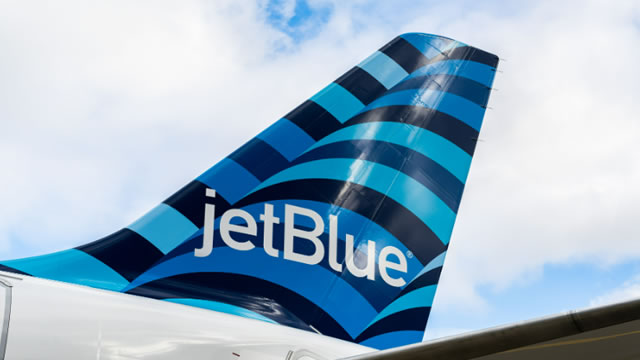
Core Viewpoint - JetBlue Airways is facing significant challenges, with its stock down nearly 80% from 2021 highs, amid growing investor concerns about the economy and regulatory hurdles impacting its growth plans [1][2]. Group 1: Financial Position - JetBlue's total assets were reported at $17.1 billion, with net tangible assets of approximately $2.05 billion after accounting for liabilities [6]. - The company's market capitalization is currently $1.58 billion, indicating it trades at a significant discount to its net tangible assets [6]. - JetBlue's debt is nearly five times the value of its equity, the highest ratio in the industry, which raises concerns about its financial stability [12]. Group 2: Growth Challenges - JetBlue's planned $3.8 billion acquisition of Spirit Aviation Holdings was blocked by regulators, and a partnership with American Airlines was also rejected due to antitrust issues [2][8]. - The airline lacks the route network to compete effectively with larger carriers that control nearly 80% of the domestic market, while also facing high operational costs compared to low-cost competitors [10][11]. - Management is attempting to reduce costs, but the absence of a clear growth strategy, especially after the Spirit deal fell through, complicates its path forward [11][12]. Group 3: Potential Opportunities - There is speculation about a potential partnership with United Airlines, which could help JetBlue improve operations and possibly lead to a merger in the future [8][9]. - JetBlue's assets, including a fleet of 254 Airbus planes, may become more attractive given the current challenges faced by Airbus and Boeing in ramping up deliveries [7]. - The company's loyalty programs and co-branded credit cards could be valuable to a potential acquirer, enhancing its attractiveness in the M&A landscape [7].
Frontier (ULCC) - 2025 Q1 - Earnings Call Transcript
2025-05-01 21:32
Financial Data and Key Metrics Changes - Total operating revenue for Q1 2025 was $912 million, a 5% increase compared to the prior year quarter, driven by a 5% higher capacity [9][17] - RASM was approximately $0.0917, roughly in line with the prior year quarter, while total revenue per passenger decreased by 6% to $116 [9][17] - The first quarter pretax loss was $40 million, yielding a 4.4% loss margin, with a net loss of $43 million or $0.19 per share [19][20] Business Line Data and Key Metrics Changes - The company significantly reduced capacity through its mid-November selling schedule, expecting capacity to be down low single digits in Q2 and a similar reduction in the second half of the year [7][20] - Adjusted non-fuel operating expenses were $720 million, an 8% increase compared to the previous quarter, mainly due to lower average daily aircraft utilization and increased station costs [18] Market Data and Key Metrics Changes - The company experienced a disruption in travel demand in March due to macroeconomic uncertainty, which led to aggressive pricing and promotions across the industry [5][9] - Current booking trends suggest that demand for May and early summer travel has stabilized, supported by recent revenue and network enhancements [5][20] Company Strategy and Development Direction - The company is focused on capacity management and cost control while providing customers with competitive value in air travel [5][6] - The introduction of the "New Frontier" strategy aims to enhance customer engagement and loyalty, with improvements in product offerings and loyalty programs [13][16] Management's Comments on Operating Environment and Future Outlook - Management acknowledged that the travel demand shock primarily affected domestic leisure travel, but recent booking trends indicate stabilization [5][31] - The company is targeting profitability in the second half of the year, supported by capacity reductions and revenue initiatives [20][36] Other Important Information - The company expects capacity reductions to result in over $300 million in combined cost reductions and capital spending deferrals for the remainder of the year [20] - The company took delivery of four A321neo aircraft and two spare aircraft engines during the quarter, raising the total fleet to 163 [18] Q&A Session Summary Question: Average fare decline and impact of premium products - Management noted that premium products are performing well, but the average fare decline was primarily due to concentrated capacity in March and lower load factors [24][26] Question: Capacity adjustments and focus on core markets - Management confirmed that capacity adjustments would lead to a focus on core profitable markets, with a reduction in developmental markets [28][30] Question: Factors driving profitability in the second half - Management indicated that profitability would be driven by cost reductions, capacity adjustments, and improved demand environment [35][36] Question: Competitive landscape and market dynamics - Management observed that both low-cost and high-cost carriers had flooded certain markets, but this has moderated recently [81] Question: Growth in loyalty program and customer engagement - Management reported a 30% year-over-year increase in spend rates within the loyalty program, indicating strong customer engagement [78] Question: Fleet delivery updates - Management confirmed a shift in aircraft deliveries, with one less aircraft expected for the full year due to scheduling changes [115]
Frontier (ULCC) - 2025 Q1 - Earnings Call Transcript
2025-05-01 21:32
Financial Data and Key Metrics Changes - Total operating revenue for the first quarter increased by 5% year-over-year to $912 million, driven by a 5% increase in capacity [9][18] - RASM was approximately $0.09, remaining in line with the prior year quarter, while total revenue per passenger decreased by 6% to $116 [9][18] - The first quarter pretax loss was $40 million, resulting in a 4.4% loss margin, with a net loss of $43 million or $0.19 per share [20][21] Business Line Data and Key Metrics Changes - The company significantly reduced capacity through its mid-November selling schedule, expecting capacity to be down low single digits in the second quarter and a similar reduction in the second half of the year [7][21] - The economy bundle introduced last year has enhanced product offerings, providing customers with a direct comparison to other airlines' economy fares [11][12] Market Data and Key Metrics Changes - The domestic leisure concentration of the business experienced an outsized impact due to macroeconomic uncertainty, leading to aggressive pricing and promotions across the industry [5][9] - Current booking trends suggest that demand for May and early summer travel has stabilized, supported by recent revenue and network enhancements [5][21] Company Strategy and Development Direction - The company is focused on capacity management and cost control while providing customers with the best overall value in air travel [6][8] - The introduction of the new frontier and enhanced product offerings aims to elevate loyalty and customer engagement, ensuring competitiveness in the market [13][17] Management's Comments on Operating Environment and Future Outlook - Management acknowledged that the results for the quarter were lower than expectations due to a disruption in travel demand in March, but they are optimistic about stabilizing demand moving forward [5][21] - The company is targeting profitability in the second half of the year based on a stabilized demand outlook and self-help measures in moderating industry capacity [8][24] Other Important Information - The company expects capacity reductions to support over $300 million in combined cost reductions and capital spending deferrals over the balance of the year [21] - The company took delivery of four A321neo aircraft and two spare aircraft engines during the quarter, raising the total fleet to 163 [20] Q&A Session Summary Question: Average fare decline and impact of premium products - Management noted that premium products are performing well, but the average fare decline was primarily due to concentrated capacity in March and lower load factors [26][28] Question: Capacity adjustments and focus on core markets - Management confirmed that they are focusing on core profitable markets and adjusting capacity to align with demand [30][32] Question: Factors driving return to profitability - Management indicated that several factors, including reduced capacity and stabilizing demand, will contribute to a return to profitability in the second half of the year [38][39] Question: Competitive landscape and market dynamics - Management acknowledged that both low-cost and high-cost carriers have flooded certain markets, but they are seeing moderation in capacity and improvement in demand [84][86] Question: Loyalty program performance - Management reported a 30% year-over-year increase in spend related to the loyalty program, indicating strong engagement and growth [81] Question: Fleet delivery updates - Management confirmed a shift in aircraft deliveries, with one less aircraft expected for the full year, but no significant issues with engine availability [115][117]
Here's Why Frontier Group (ULCC) is Poised for a Turnaround After Losing -31.11% in 4 Weeks
ZACKS· 2025-03-24 14:35
Group 1 - Frontier Group Holdings (ULCC) has experienced significant selling pressure, resulting in a stock price decline of 31.1% over the past four weeks, but it is now considered to be in oversold territory with potential for better earnings than previously predicted by analysts [1] - The Relative Strength Index (RSI) is a key technical indicator used to identify oversold stocks, with a reading below 30 typically indicating oversold conditions [2] - The RSI reading for ULCC is currently at 23.73, suggesting that the heavy selling may be exhausting itself and a price reversal could occur soon [5] Group 2 - Analysts have raised earnings estimates for ULCC by 0.4% over the last 30 days, indicating a positive trend that often leads to price appreciation [6] - ULCC holds a Zacks Rank 1 (Strong Buy), placing it in the top 5% of over 4,000 ranked stocks based on earnings estimate revisions and EPS surprises, further supporting the potential for a turnaround [7]
