META

Search documents
Companies cutting jobs as investments shift toward AI
Reuters· 2026-02-25 16:38
Core Insights - The rapid adoption of artificial intelligence (AI) is leading to significant job losses in various industries, with Goldman Sachs estimating that AI was responsible for 5,000 to 10,000 monthly net job losses in the most affected U.S. sectors last year [1] - AI accounted for 7% of total planned layoffs in January, indicating a growing trend of companies restructuring their workforce in response to automation [1] Company Layoffs Linked to AI - AGORA plans to lay off up to 166 employees, or 6.56% of its workforce, to improve its digital business [2] - ALLIANZ intends to cut up to 1,800 jobs in its travel insurance division due to AI replacing manual processes [3] - AMAZON confirmed 16,000 corporate job cuts as part of an AI and efficiency-driven overhaul [3] - AUTODESK will reduce about 1,000 jobs, approximately 7% of its global workforce, to focus on cloud and AI initiatives [4] - BRITISH AMERICAN TOBACCO announced an AI-driven productivity program that will lead to unspecified job cuts [4] - DOW plans to cut about 4,500 jobs, which is 13% of its total workforce, by streamlining processes through automation and AI [5] - HP INC expects to cut 4,000 to 6,000 jobs globally by fiscal 2028 as it adopts AI [5] - MERCADOLIBRE laid off 119 employees as part of its AI expansion [6] - META is cutting over 1,000 jobs at its Reality Labs unit and around 600 positions in its Superintelligence Labs to pivot towards AI devices [6] - NIKE is laying off 775 employees to enhance profits and increase automation [7] - PINTEREST plans to cut up to 15% of its workforce to focus on AI roles and strategy [7] - SEB announced a restructuring plan that may impact up to 2,100 jobs worldwide by 2027 due to AI [8] - TELSTRA plans to cut 650 jobs in an AI-driven restructure [9] - WISETECH will reduce about 2,000 jobs, nearly one-third of its global workforce, as it integrates AI into its operations [9]


港股开盘:恒指跌0.62%,恒生科指跌1.02%,科网股多数走低,哔哩哔哩跌逾2%
Jin Rong Jie· 2026-02-24 02:17
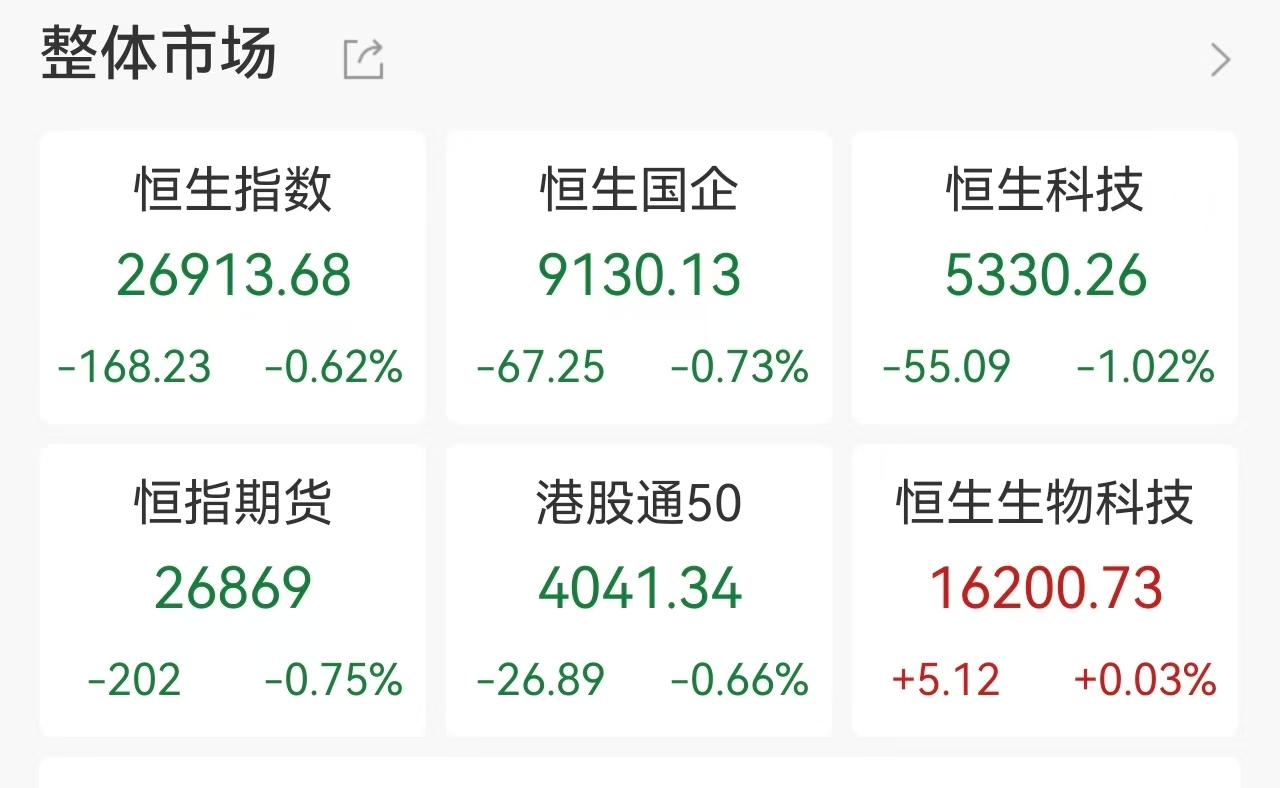
港股恒生指数开盘跌0.62%,报26913.68点,恒生科技指数跌1.02%,报5330.26点,国企指数跌0.73%,报9130.13点,红筹指数跌0.57%,报4441.24点。 5、工信部等三部门印发《酿酒产业提质升级指导意见(2026—2030年)》。其中提出,到2028年,培育3个以上千亿级传统优势酒产区,10个以上百亿级特 色酿酒产业园区;培育5个以上年营业收入超100亿元的茶产业集群。 6、国投白银LOF出台补偿方案,对估值调整影响金额(由-17%调至-31.5%的部分)为1000元以下的自然人投资者,按实际影响金额全额确定和解金额(该 部分投资者占当日赎回投资者的比例超9成);对估值调整影响金额(由-17%调至-31.5%的部分)超过1000元(含)的自然人投资者,在1000元基础上加上 超1000元部分乘以一定比例确定总和解金额。 | 恒生指数 | 恒生国企 | 恒生科 | | --- | --- | --- | | 26913.68 | 9130.13 | 5330.2 | | -168.23 -0.62% -67.25 -0.73% -55.09 - | | | | 恒指期货 | 港股通 ...

万亿外资巨头,调仓!
Zhong Guo Ji Jin Bao· 2026-02-20 13:21
Core Insights - BlackRock has increased its holdings in major tech stocks such as Nvidia, Apple, and Microsoft, reflecting a strategic shift in its investment portfolio [1][2]. Group 1: Portfolio Overview - BlackRock's total portfolio value reached $5.92 trillion, marking a quarter-over-quarter increase of 3.67% [1]. - The firm added 247 new stocks and sold off 165 stocks during the fourth quarter [1]. - The top ten holdings account for 30.41% of the total portfolio value [1]. Group 2: Major Stock Increases - Nvidia saw a 0.75% increase in shares, totaling approximately 1.943 billion shares, with a market value of about $362.52 billion, representing 6.13% of the portfolio [2]. - Apple’s shares increased by 0.73%, holding around 1.155 billion shares, valued at approximately $313.91 billion, making up 5.31% of the portfolio [2]. - Microsoft’s holdings rose by 1.70%, with about 602 million shares valued at approximately $291.09 billion, accounting for 4.92% of the portfolio [2]. - Amazon's shares increased by 1.67%, totaling around 734 million shares, valued at approximately $169.51 billion, representing 2.87% of the portfolio [2]. Group 3: New Investments in Materials and Chemicals - BlackRock has made new investments in the materials and chemicals sectors, including Solstice Advanced Materials with a holding value of approximately $838 million and Qnity Electronics valued at around $1.3 billion [4]. - The firm has shown a differentiated approach in the electric vehicle sector, significantly increasing its stake in NIO and Xpeng while slightly reducing its position in Li Auto [4][6]. Group 4: Electric Vehicle Holdings - BlackRock increased its holdings in NIO by 337,590 shares to 5.5827 million shares, a 153% increase, with a total market value growth of 69.3% to approximately $28.47 million [4]. - The firm raised its stake in Xpeng by 77,980 shares to 2.8721 million shares, a 37% increase, with a market value of approximately $5.82 million [5]. - Conversely, BlackRock reduced its holdings in Li Auto by 61,400 shares to 826,200 shares, a 7% decrease, with a market value of approximately $1.40 million [6].
大举加仓这些股,桥水最新持仓曝光,达利欧发声
Zhong Guo Ji Jin Bao· 2026-02-14 12:45
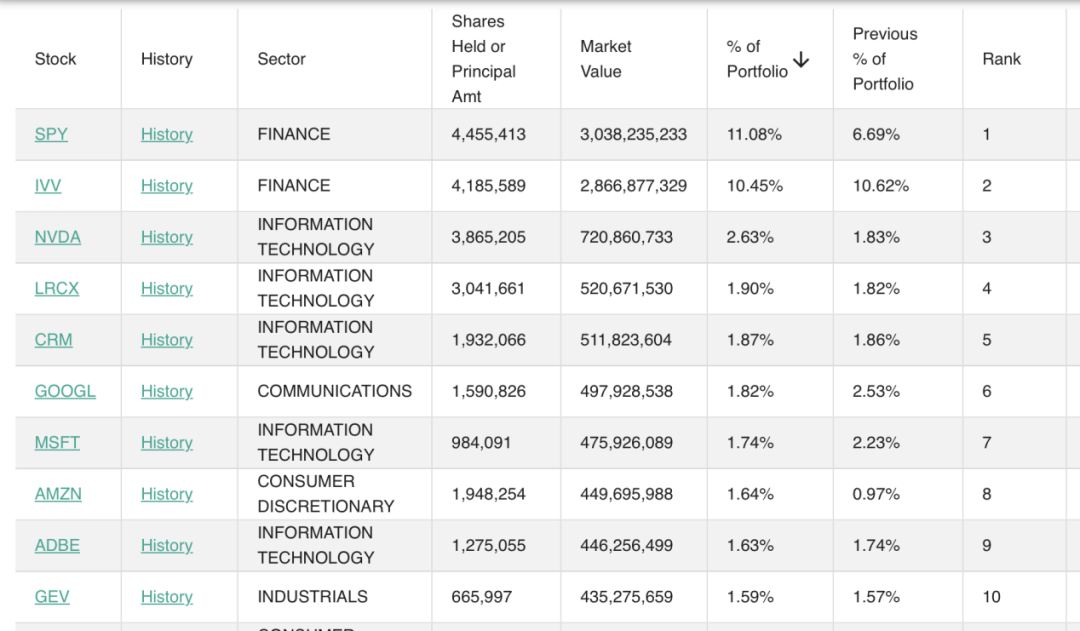
Group 1 - Bridgewater's latest 13F report reveals a total market value of $27.4 billion in Q4 2025, up from $25.5 billion in Q3 2025 [3] - The top ten holdings account for 36.35% of the total portfolio, with significant positions in SPDR S&P 500 ETF (SPY), iShares S&P 500 ETF (IVV), Nvidia, Amazon, and Newmont [3][4] - The five largest increases in holdings include SPY, Micron Technology, Oracle, Nvidia, and Newmont Corporation [4][5] Group 2 - Bridgewater increased its Nvidia shares from 2.51 million in Q3 to 3.87 million in Q4, a 54% increase, and also raised its Amazon holdings to 1.95 million shares [5] - The report indicates a reduction in holdings for companies like Uber, Fiserv, Google, META, and Microsoft [5] Group 3 - Ray Dalio emphasizes that the main sources of returns in 2025 stem from changes in currency value and the underperformance of U.S. stocks compared to non-U.S. stocks and gold [8] - The dollar depreciated against several currencies, with a notable 39% decline against gold, which emerged as the best-performing asset [8] - The report highlights a significant capital reallocation from the U.S. to international markets, a trend expected to continue [8]




麦格米特(002851):看好AI电源业务逐步兑现业绩增量
HTSC· 2026-02-14 05:32
Investment Rating - The report maintains a "Buy" rating for the company [7] Core Views - The company is expected to benefit from the growing demand for AI power supply products, leveraging its product, technology, and channel advantages to secure orders and enhance performance [1][2] - The recent completion of a private placement, raising 2.63 billion RMB, is anticipated to support the company's long-term development and competitiveness in the AI power supply market [2] - Despite a significant decline in net profit for 2025, the company is projected to recover starting in 2026, driven by scale effects and the delivery of AI power supply orders [2] Company Overview - The company is deeply embedded in the power supply iteration cycle of NVIDIA, continuously matching the power supply product development needs for new generation chips like GB300 and Rubin [4] - The company has established a strong customer base and is enhancing its competitive edge through technological advancements and partnerships across the entire supply chain [4] Industry Insights - The demand for AI power supplies is expected to accelerate in the first half of 2026, driven by the ongoing iteration of AI chips and the increasing power requirements for new products [3] - The global market for AI server power supplies compatible with NVIDIA GPUs is projected to reach 47.4 to 63.5 billion RMB in 2026, reflecting a year-on-year growth of approximately 87% [15][16] Financial Forecasts and Valuation - The company's net profit for 2025 is revised down to 141 million RMB, while projections for 2026 and 2027 are increased to 1.1 billion RMB and 1.84 billion RMB, respectively, indicating a compound annual growth rate (CAGR) of 61.65% from 2025 to 2027 [5][19] - The target price for the company is raised to 151.38 RMB, based on an 80x price-to-earnings (PE) ratio for 2026, reflecting the company's competitive advantages in the AI power supply sector [5][21]

外资巨头,减持美股科技股
Shang Hai Zheng Quan Bao· 2026-02-12 22:56
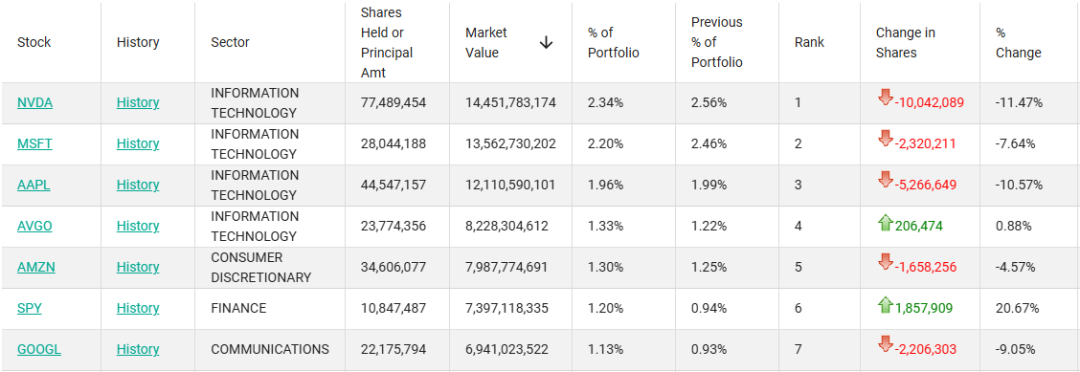
Core Viewpoint - UBS and Goldman Sachs have significantly reduced their holdings in major US tech stocks like Nvidia and Microsoft in Q4 2025, raising market concerns about the tech sector's future performance [1][3]. Group 1: Holdings Reduction - UBS reduced its holdings in Nvidia by 10,042,089 shares, a decrease of 11.47%, and also cut its positions in Microsoft by 2,320,211 shares (7.64%), Apple by 5,266,649 shares (10.57%), Amazon by 1,658,256 shares (4.57%), and Google by 2,206,303 shares (9.05%) [3][4]. - Goldman Sachs also reported reductions, cutting 319,700 shares of Microsoft (5.86%), 247,000 shares of Tesla (8.27%), 343,300 shares of Broadcom (9.33%), and 241,400 shares of META (13.51%) [5]. Group 2: Capital Expenditure Plans - Major tech companies, excluding Nvidia, have announced plans to significantly increase capital expenditures, with Meta projecting up to $135 billion for 2026 (an increase of 87%), Google planning $185 billion, and Amazon announcing a $200 billion capital expenditure plan for 2026 [7]. - Following these announcements, stock prices for Amazon, Google, META, and Microsoft have seen declines of 14.72%, 8%, 6.67%, and 6%, respectively, since February [7]. Group 3: Market Sentiment and AI Investment - There is growing skepticism in the market regarding the return on investment (ROI) from the substantial capital expenditures in AI, which had previously been tolerated by investors [6][8]. - Despite short-term concerns about ROI, some analysts believe that the current investments represent a strategic positioning for future productivity, affirming the long-term trend of AI development [8][9]. Group 4: AI Development Trends - The AI sector is transitioning from a phase of technological exploration to one of large-scale application and infrastructure development, with a focus on increasing computational power and practical AI applications [9]. - The demand for computational resources in the tech industry continues to exceed market expectations, indicating a rapid expansion phase for AI infrastructure [9][10].


云服务商AI资本支出超预期,台积电营收增长提速
BOCOM International· 2026-02-12 12:44
Investment Rating - The industry is rated as "Leading" indicating expected performance above the benchmark index over the next 12 months [3]. Core Insights - Recent performance shows that US and Hong Kong tech stocks underperformed the market, while A-share tech stocks outperformed. The MSCI Information Technology Index slightly declined by 0.2%, lagging behind the MSCI Global Index which rose by 1.8% [3]. - AI capital expenditures from cloud service providers are expected to grow significantly, with a forecasted increase of 65% year-on-year to reach $619.4 billion in 2026, surpassing previous expectations of 33% growth [3][39]. - TSMC reported a 37% year-on-year revenue growth in January 2026, indicating a strong demand for AI infrastructure and a robust capital expenditure guidance of $52-56 billion for 2026 [3][25]. - The semiconductor manufacturing equipment imports in December 2025 decreased by 3% year-on-year, but the decline is narrowing, suggesting a stable demand for domestic semiconductor equipment [3][34]. Summary by Sections Market Performance - In the period from January 10 to February 9, 2026, the software sector saw a significant decline of 15.8%, while hardware and semiconductor stocks performed better [3]. - The A-share Wind Information Technology Index increased by 0.6%, contrasting with the 0.8% decline in the CSI 300 Index [3]. Semiconductor Market - The average spot price for DDR5 (16Gb) has slightly decreased to $33.61, while the contract price for DDR4 (8Gb) rose to $13.00 in January 2026 [3]. - NAND prices have stabilized after a significant increase over the previous months, with the average price for 1Tb QLC remaining flat in February 2026 [3][31]. Investment Recommendations - The report suggests investors focus on AI infrastructure and domestic substitution opportunities, while also being cautious of high valuations that may increase market volatility [3]. - Recommended stocks include Nvidia (NVDA US), Broadcom (AVGO US), and TSMC (TSM US), all rated as "Buy" with reasonable valuations [3][40].

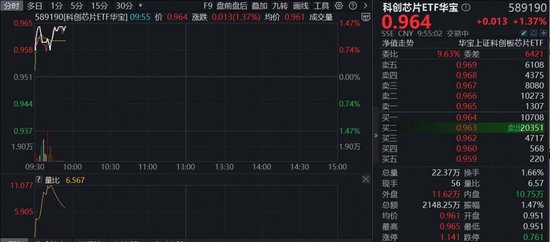
业绩预期炸裂,晶晨股份领涨16%!“全芯”科创芯片ETF(589190)涨逾1%,机构:AI是核心驱动力
Xin Lang Cai Jing· 2026-02-12 02:09
Group 1: Market Performance - On February 12, chip stocks strengthened, with Jingchen Co. leading a 16% increase, followed by Yuanjie Technology, Shengke Communication-U, and Shijia Photonics rising over 5% [1][7] - The "Chip" ETF Huabao (589190) opened high and rose by 1.37% during the session [1][7] Group 2: Company Performance - Jingchen Co. announced a revenue forecast of 6.77 billion for 2025, representing a year-on-year growth of 14.6%, and a net profit of 870 million, up 6% year-on-year [2][10] - The company expects a revenue growth of 10%-20% in Q1 2026 and 25%-45% for the entire year, driven by strong partnerships with major internet companies like Google, Amazon, and META [2][10] Group 3: Industry Insights - The semiconductor industry is currently in an upward cycle, with AI as the core driver; North America's four major cloud providers are expected to increase capital expenditures by 67% year-on-year in Q4 2025 [3][10] - Global semiconductor sales increased by 37.1% year-on-year in January 2026, marking 26 consecutive months of positive growth, with DRAM and NAND Flash spot prices rising approximately 39% and 35% respectively [3][10] Group 4: ETF Performance - The Huabao Chip ETF has an annualized return of 17.93% since its inception, outperforming similar indices [12][13] - The index has shown a maximum drawdown that is smaller compared to other semiconductor indices, indicating a better risk-reward ratio [12][13]

道指新高!“中国金龙” 四连涨
Zhong Guo Zheng Quan Bao· 2026-02-10 23:19
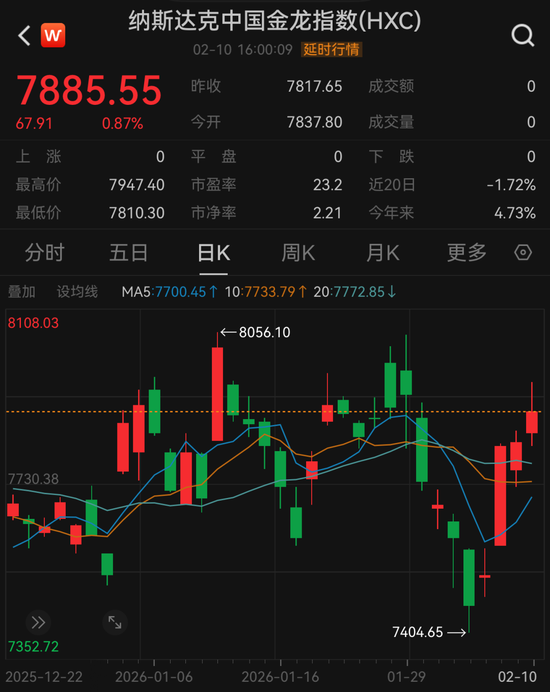
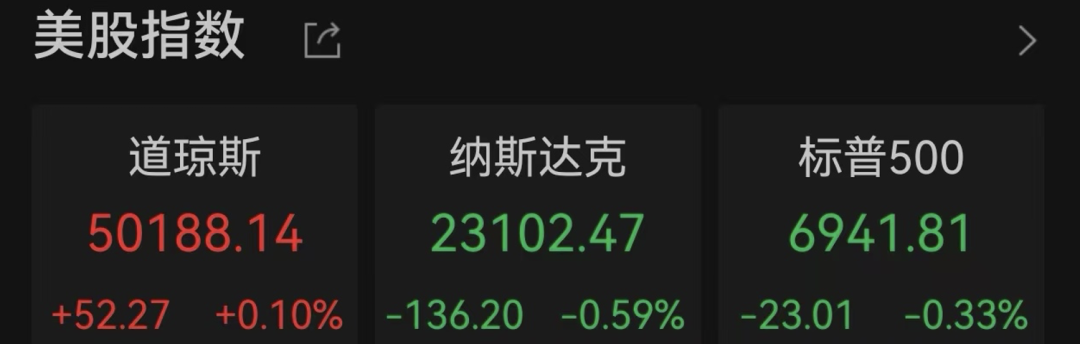
Market Performance - The Dow Jones Industrial Average reached a new all-time high, peaking at 50,512.79 points during the day, closing with a slight gain of 0.1% [2] - The Nasdaq and S&P 500 indices turned negative, with declines of 0.59% and 0.33% respectively [2] - Large-cap tech stocks showed mixed results, with Tesla rising nearly 2%, while major players like Microsoft, Apple, Nvidia, Amazon, and Meta experienced declines [4][5] Chinese Stocks - The Nasdaq Golden Dragon China Index saw a continuous rise for four trading days, increasing by nearly 1% [5] - Notable Chinese stocks such as Shengda Technology and Dingdong Maicai surged over 7%, while Hesai Technology and Zai Ding Pharmaceutical rose over 6% [5][6] Precious Metals - International gold prices fluctuated around $5,000 per ounce, while silver prices hovered near $80 per ounce [8] - As of February 11, gold futures and spot prices fell by 0.6% and 0.71%, respectively, while silver futures and spot prices dropped over 2% and 3% [8] - Analysts suggest that while gold remains at high levels, silver still has relative upside potential, although caution is advised due to high volatility [10] Oil Market - International oil prices experienced slight declines, with NYMEX crude futures and ICE Brent futures reported at $64.19 per barrel and $69.01 per barrel, respectively [8]
道指新高!“中国金龙”,四连涨
Xin Lang Cai Jing· 2026-02-10 23:13
Market Performance - The Dow Jones Industrial Average reached a new all-time high, peaking at 50,512.79 points, closing up by 0.1% [3][16] - The Nasdaq and S&P 500 indices turned negative, with declines of 0.59% and 0.33% respectively [3][16] - Large-cap tech stocks showed mixed results, with Tesla rising nearly 2%, while Microsoft, Apple, Nvidia, Amazon, and Meta all declined [6][17] Chinese Stocks - The Nasdaq Golden Dragon China Index saw a continuous rise for four trading days, increasing by nearly 1% [2][19] - Notable gains were observed in companies such as Shengda Technology and Dingdong Maicai, both rising over 7% [19] Commodity Prices - International gold prices fluctuated around $5,000 per ounce, while silver prices hovered near $80 per ounce [4][20] - As of February 11, gold futures and spot prices fell by 0.6% and 0.71% respectively, while silver futures dropped over 2% [20][21] Oil Market - International oil prices experienced slight declines, with NYMEX crude oil futures at $64.19 per barrel and ICE Brent crude at $69.01 per barrel [20][21] - The oil market is transitioning from event-driven pricing to fundamental trading, with a higher likelihood of a trend towards oversupply pressure [22]