
OneStream

Search documents
美国银行家称:软件股暴跌正扰乱部分并购与IPO交易
Xin Lang Cai Jing· 2026-02-11 11:46
Core Viewpoint - The significant sell-off in software stocks is causing a slowdown in M&A and IPO activities, with market volatility making valuations unreliable and potential buyers becoming more cautious [1][2][10]. Group 1: Market Conditions - Software stocks have experienced a substantial decline, with the S&P 500 Software and Services Index recording its worst three-month performance since May 2002 [1][2]. - Despite some recovery, the software sector is down approximately 25% from its historical peak on October 28, 2025, while the S&P 500 index has increased by 1% during the same period [1][2]. Group 2: Reasons for Slowdown - The sharp drop in software stocks has led to rapid fluctuations in valuation benchmarks, making it difficult for both buyers and sellers to agree on prices [2][10]. - Buyers are concerned about overpaying for assets that may depreciate further, while sellers are reluctant to sell at low prices [2][10]. Group 3: Impact on Transactions - The volatility has resulted in a challenging negotiation environment, with many transactions likely to be canceled or repriced in the coming weeks [11][12]. - Financial technology company Brex was valued at over $12 billion during a funding round in October but was acquired for approximately $5.15 billion, highlighting the impact of valuation reassessment [2][11]. Group 4: Broader Market Effects - The downturn in software stocks has extended to Europe, with companies like RELX and Wolters Kluwer seeing stock price declines of around 20% [12]. - The IPO market is particularly affected, with companies like Liftoff Mobile postponing their listing plans due to the current market environment [12]. Group 5: Emotional vs. Fundamental Drivers - Market volatility is perceived to be driven more by emotional responses and uncertainty rather than fundamental performance [13][14]. - Some industry leaders suggest that AI will empower rather than replace software, indicating a potential for recovery [13][14]. Group 6: Investor Sentiment - Certain investors are beginning to see buying opportunities, with private equity firms expressing interest in acquiring software companies [15][16]. - The message from these investors is clear: they are looking for the best acquisition targets in the current market [16].
Analysis-Software selloff is disrupting some M&A and IPO deals, US bankers say
Yahoo Finance· 2026-02-11 11:03
Core Insights - A significant selloff in software stocks is hindering deal-making and IPOs in the sector, as volatility leads to unreliable valuations and cautious buyers [1][2] - The S&P 500 software and services index has experienced its worst three-month performance since May 2002, with software stocks down approximately 25% from their peak on October 28, while the S&P 500 index itself is up 1% [1][2] - The decline in software share prices has made it difficult for buyers and sellers to agree on valuations, with sellers reluctant to transact at low levels and buyers fearing overpayment for assets that may further decline in value [2][3] Market Dynamics - Anxiety surrounding artificial intelligence's impact on software business models is contributing to market volatility, with investors trading based on fear rather than a detailed analysis of company fundamentals [4] - The repricing of software companies is evident in recent deals, such as Brex, which was valued at over $12 billion during a funding round but sold for approximately $5.15 billion [5] - OneStream went public at a valuation near $6 billion but was taken private for about $6.4 billion, indicating limited gains for investors [6] Deal-Making Challenges - The volatility in the market complicates price negotiations, making it more challenging for dealmakers to reach agreements [7]
KKR(KKR) - 2025 Q4 - Earnings Call Transcript
2026-02-05 15:02
Financial Data and Key Metrics Changes - The company reported fee-related earnings per share of $1.08, total operating earnings per share of $1.42, and adjusted net income per share of $1.12, with the adjusted net income excluding carried interest repayment obligation being $1.30 for Q4 [4] - Management fees for the quarter were $1.1 billion, up 24% year-over-year, driven by fundraising initiatives and deployment across the firm [4] - Total transaction and monitoring fees were $269 million in the quarter, while fee-related earnings were $972 million, reflecting a 15% year-over-year increase [5] Business Line Data and Key Metrics Changes - The Insurance segment reported operating earnings of $268 million in Q4, with potential earnings being approximately $320 million if investment marks were included [6][7] - Strategic Holdings operating earnings were $44 million in Q4, more than doubling compared to 2024 [8] - Realized performance income within the asset management segment was $528 million, with total monetization activity exceeding $550 million [9] Market Data and Key Metrics Changes - The company raised $28 billion of new capital in Q4, bringing the full-year total to $129 billion, marking the highest fundraising year in its history [11] - The North America Private Equity Fund has over $19 billion of committed capital, while the Global Infrastructure Fund is nearing $16 billion in commitments [12][13] - The K-Series suite of products raised $4.5 billion in Q4 and over $16 billion for the full year, nearly doubling the amount raised in 2024 [15] Company Strategy and Development Direction - The company aims to leverage its three growth engines: asset management, Insurance, and Strategic Holdings, to position itself well for long-term growth [18] - The acquisition of Arctos, valued at $1.4 billion, is expected to enhance the company's position in the sports investment sector and create a new investing vertical called KKR Solutions [24][27] - The company is focused on building a $100 billion AUM solutions franchise through strategic acquisitions and partnerships [32] Management's Comments on Operating Environment and Future Outlook - Management expressed confidence in exceeding fundraising and fee-related earnings targets for 2026, with a focus on maintaining a strong pipeline of monetization opportunities [29] - The company is well-positioned with $118 billion of dry powder, allowing it to capitalize on investment opportunities despite market volatility [21][46] - Management noted that the current economic environment presents both challenges and opportunities, emphasizing the importance of disciplined portfolio construction [33][36] Other Important Information - The company plans to increase its annual dividend from $0.74 to $0.78 per share, marking the seventh consecutive year of dividend increases since its C-Corp conversion [16] - Total embedded gains reached a record $19 billion, up 19% year-over-year, indicating strong performance across asset classes [10] Q&A Session Summary Question: How has the company reunderwritten its private portfolios in light of tariffs and AI? - Management indicated that they have minimal exposure to tariffs and have been proactive in addressing AI-related risks through careful portfolio construction and asset sales [41][44] Question: Is the strong 2025 result a level to build off of, given the linear deployment model? - Management confirmed that they expect to deploy more this year, citing broad-based deployment across strategies and geographies [51][58] Question: What are the expectations for management fee growth in 2026? - Management expressed confidence in exceeding the $450 million FRE target for 2026, supported by record capital raising and strong momentum in management fees [61][65] Question: What is the potential for realized investment income moving forward? - Management anticipates an increase in realized investment income, although it may decrease relative to recurring earnings as capital is reinvested for growth [69] Question: What are the recent trends at Global Atlantic? - Management expects to maintain a quarterly target of $250 million for Global Atlantic, with potential for growth in accrued income over the next few years [72][76]

KKR(KKR) - 2025 Q4 - Earnings Call Transcript
2026-02-05 15:02
Financial Data and Key Metrics Changes - The company reported fee-related earnings per share of $1.08, total operating earnings per share of $1.42, and adjusted net income per share of $1.12, with the adjusted net income excluding carried interest repayment obligation being $1.30 for Q4 [4] - Management fees for the quarter were $1.1 billion, up 24% year-over-year, driven by fundraising initiatives and deployment across the firm [4] - Total transaction and monitoring fees were $269 million in the quarter, while capital markets fees reached $225 million [5] - Fee-related earnings were $972 million, reflecting a 15% year-over-year increase, with an ROI margin of 68% for the quarter [5] Business Line Data and Key Metrics Changes - Insurance segment operating earnings in Q4 were $268 million, with potential earnings being approximately $320 million if marks on investments were included [6][7] - Strategic Holdings operating earnings were $44 million in Q4, more than doubling compared to 2024 [8] - Realized performance income within the asset management segment was $528 million, excluding carried interest repayment obligation [9] Market Data and Key Metrics Changes - The company raised $28 billion of new capital in Q4, bringing the full-year total to $129 billion, the highest in its history [11] - The North America Private Equity Fund has over $19 billion of committed capital, while the Global Infrastructure Fund is nearing $16 billion in commitments [12][13] - The K Series suite of products raised $4.5 billion in Q4 and over $16 billion for the full year, nearly double the amount raised in 2024 [15] Company Strategy and Development Direction - The company aims to leverage its three growth engines: asset management, insurance, and strategic holdings, to position itself well for the long term [18] - The acquisition of Arctos, valued at $1.4 billion, is expected to enhance the company's position in sports investments and GP solutions, with a goal of building a $100 billion AUM solutions franchise [24][27] - The company is focused on maintaining a collaborative culture to maximize business impact and attract top talent [18] Management's Comments on Operating Environment and Future Outlook - Management expressed confidence in exceeding fundraising and fee-related earnings targets for 2026, with a focus on long-term performance rather than short-term market conditions [29] - The company is well-positioned with $118 billion of dry powder for future investments, indicating a strong pipeline of opportunities despite market volatility [21][46] - Management noted that the current economic environment presents opportunities for strong returns, emphasizing the importance of disciplined portfolio construction [33][46] Other Important Information - The company plans to increase its annual dividend from $0.74 to $0.78 per share, marking the seventh consecutive year of dividend increases since its C-Corp conversion [16] - Total embedded gains reached a record $19 billion, up 19% year-over-year, indicating strong performance across asset classes [10] Q&A Session Summary Question: How has the company reunderwritten its private portfolios in light of tariffs and AI? - Management indicated that they have minimal exposure to tariffs and have been proactive in addressing AI-related risks, focusing on portfolio construction and linear pacing to mitigate potential disruptions [41][42][44] Question: Is the strong 2025 result a level to build off of, given the linear deployment model? - Management confirmed that 2025 was a record deployment year and expects to deploy more in the coming year, highlighting broad-based activity across strategies and geographies [51][58] Question: What are the expectations for management fee growth in 2026? - Management expressed confidence in exceeding the $450 million FRE target for 2026, citing strong capital raising momentum and operational efficiency [61][65] Question: What is the potential for realized investment income moving forward? - Management anticipates an increase in realized investment income over the next few years, although it will be relatively decreasing compared to recurring earnings as capital is reinvested for growth [69] Question: What are the recent trends at Global Atlantic? - Management expects to maintain a quarterly target of $250 million for Global Atlantic, with potential for growth in accrued income over the next few years [72][75]
KKR(KKR) - 2025 Q4 - Earnings Call Transcript
2026-02-05 15:00
Financial Data and Key Metrics Changes - The company reported fee-related earnings per share of $1.08, total operating earnings per share of $1.42, and adjusted net income per share of $1.12, with adjusted net income per share excluding carried interest repayment obligation being $1.30 for Q4 [3] - Management fees for the quarter were $1.1 billion, up 24% year-over-year, driven by fundraising initiatives and deployment across the firm [3] - Total transaction and monitoring fees were $269 million in the quarter, while fee-related earnings were $972 million, reflecting a 15% year-over-year increase [4] Business Line Data and Key Metrics Changes - Insurance segment operating earnings in Q4 were $268 million, with total insurance economics for 2025 reaching $1.9 billion, up 15% for the year [4][6] - Strategic Holdings operating earnings were $44 million in Q4, more than doubling compared to 2024 [6] - Realized performance income within the asset management segment was $528 million, with total monetization activity exceeding $550 million [7] Market Data and Key Metrics Changes - The company raised $28 billion of new capital in Q4, bringing the full-year capital raise to $129 billion, the highest in its history [9] - The North America Private Equity Fund now has over $19 billion of committed capital, while the Global Infrastructure Fund has nearly $16 billion of commitments [10][11] - The K Series suite of products raised $4.5 billion in Q4 and over $16 billion in full year 2025, nearly double the amount raised in 2024 [12] Company Strategy and Development Direction - The company is focused on three growth engines: asset management, insurance, and strategic holdings, positioning itself well for long-term growth [15] - The acquisition of Arctos, valued at $1.4 billion, aims to create a new investing vertical called KKR Solutions, expected to reach $100+ billion of AUM [20][24] - The company emphasizes a collaborative culture to maximize business impact and attract top talent [15] Management's Comments on Operating Environment and Future Outlook - Management expressed confidence in exceeding fundraising and fee-related earnings targets for 2026, with a focus on maintaining a strong monetization pipeline [26] - The company noted that despite market volatility, it remains well-positioned due to its disciplined portfolio construction and deployment strategy [30] - Management highlighted the importance of long-term performance over chasing favorable conditions, indicating a strong outlook for the next several years [33] Other Important Information - The company plans to increase its annual dividend from $0.74 to $0.78 per share, marking the seventh consecutive year of dividend increases since its C-Corp conversion [13] - The company has $118 billion of dry powder available for future investments, indicating strong capital availability [18] Q&A Session Questions and Answers Question: How has the company reunderwritten its private portfolios for tariffs and AI? - Management indicated that they have minimal exposure to tariffs and have been proactive in addressing AI-related risks through careful portfolio construction and selling assets that posed threats [34][36][38] Question: Is the strong 2025 result a level to build off of, given the linear deployment model? - Management confirmed that 2025 was a record deployment year and expects to deploy more in the current year, highlighting broad-based deployment across strategies and geographies [42][48] Question: What are the expectations for management fee growth in 2026? - Management expressed confidence in exceeding the $450 million FRE target for 2026, supported by record capital raising and a strong trajectory for management fees [49][51]
Will private equity’s pivot to continuation vehicles continue in 2026?
Yahoo Finance· 2026-01-22 10:41
Core Insights - The total dollar value of continuation funds is projected to reach $100 billion by the end of 2025, a significant increase from $35 billion in 2019, indicating a growing trend in private equity practices [1][2] - Continuation funds allow private equity firms to sell portfolio companies from one fund to another managed by the same firm, often at the end of the original fund's lifecycle, providing limited partners (LPs) the option to reinvest or cash out [2][6] - The median holding period for portfolio companies has extended to almost six years in 2025, the longest in 25 years, reflecting a slowdown in selling activity despite ongoing acquisitions [3] Continuation Funds Dynamics - Continuation funds have gained popularity as private equity firms seek to return promised returns to LPs, with many LPs opting to cash out rather than reinvest [2][6] - The motivations for establishing continuation funds have evolved, with firms now using them for well-performing assets rather than just hard-to-divest ones, aiming for better selling prices [7][8] - Critics highlight governance concerns, as continuation funds can create conflicts of interest between exiting and incoming investors, particularly when a significant majority of existing investors prefer cashing out [10][11] Legal and Regulatory Context - A legal case in the Delaware Court of Chancery involving a private equity firm and a foreign investor may impact the future of continuation funds, with potential outcomes that could either encourage or hinder their use [6][12] - The lack of stringent regulation around continuation funds raises concerns, although recent SEC rules aimed at addressing conflicts of interest have been stalled due to political changes [14][15] Implications for Portfolio Companies - Being included in a continuation fund may signal ongoing investment interest from private equity sponsors, potentially leading to additional capital infusion and increased scrutiny of portfolio companies [16][17] - Management teams may view this as a positive sign, indicating confidence in the business's prospects, but it may also result in heightened involvement from private equity owners [17]
Finance tech firm Datarails raises $70M, rolls out new AI agents
Yahoo Finance· 2026-01-21 15:19
Group 1: Market Overview - The "office of the CFO software market" is projected to grow from $71 billion in 2023 to $131 billion in 2028, indicating significant expansion opportunities [3]. - OneStream, a major player in this market, has agreed to be acquired by Hg for $6.4 billion, highlighting ongoing consolidation trends within the industry [3]. Group 2: Company Developments - Datarails raised $70 million in Series C funding, bringing its total funding to $175 million, aimed at geographic expansion and product portfolio enhancement [5][9]. - The company reported a 70% year-over-year revenue growth last year, with its workforce nearly doubling to over 400 employees [5]. Group 3: Product Innovations - Datarails is evolving its software tools from a focus on financial planning and analysis to a comprehensive finance platform, with over 50% of its growth in 2025 attributed to products launched in the past year [6]. - New products being introduced include AI finance agents for strategy, planning, and reporting, which assist finance professionals in generating board-ready materials [7]. - Upcoming releases include "AI in Excel" and "Spend Control," aimed at enhancing financial management capabilities [8].
OneStream Goes Private, Navan at 4x ARR: Are The IPO Markets Really That Open?
SaaStr· 2026-01-08 15:10
Core Insights - OneStream is going private just 17 months after its IPO, highlighting challenges in the public market despite initial success [1][2] - The IPO market is open but companies face significant valuation reductions, with examples like Navan and JAMF illustrating the harsh realities of current market conditions [6][12][21] Company Performance - OneStream had a valuation of $6 billion at its IPO, but is being acquired for $6.4 billion, reflecting a 31% premium despite a 35% drop from its IPO highs [2][3] - Navan, with a current trading price of $17, is 32% below its IPO price of $25, trading at 4x ARR, indicating a tough market for non-AI B2B software [6][21] - JAMF, despite tripling its ARR from $225 million to $710 million, was acquired for $2.2 billion, which is less than half its initial IPO valuation, due to a significant slowdown in growth [9][20] Market Dynamics - The median public SaaS multiples have reset to 6-7x ARR, reflecting a return to 2016-2017 levels, with a widening gap between top and bottom performers [13][14] - Private equity investment in enterprise software has increased by 28% year-to-date in 2025, as PE firms can operate profitably at lower multiples [14][21] Investment Considerations - Companies need to achieve 25-40% growth to command premium multiples; those growing below 20% are likely to receive valuations of 3-7x ARR [15][23] - GAAP profitability is becoming increasingly important, with investors now seeking both growth and profitability, contrasting with previous years where growth alone sufficed [16][21] - The timeline to IPO is longer than anticipated, as seen with Navan's delayed public offering and OneStream's brief public tenure [17][21] Future Outlook - The IPO window is not closed but is characterized by a more realistic assessment of company valuations, particularly for those not in the AI sector [19][22] - Companies achieving 30%+ growth with GAAP profitability may still find favorable IPO conditions, while others may face acquisition at lower multiples by private equity [23]


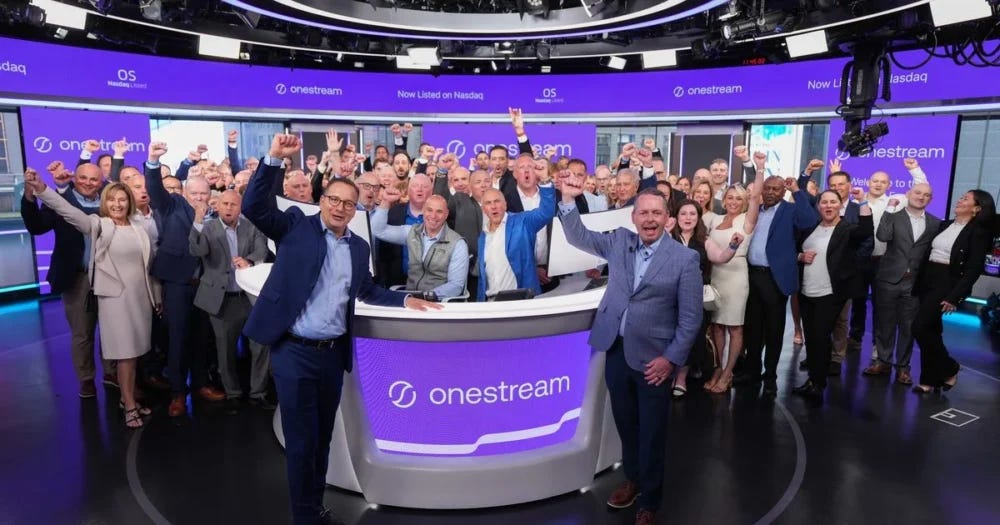
London based Private Equity Firm Hg to Acquire OneStream
Crowdfund Insider· 2026-01-08 04:28
Core Insights - Hg has acquired OneStream for an equity value of approximately $6.4 billion, marking a return to private ownership just 17 months after its IPO, reflecting changing dynamics in the tech sector amid economic uncertainties [1][3] - OneStream provides an AI-enabled platform for enterprise finance management, serving major clients like Toyota and UPS, and competes with industry leaders such as Oracle and SAP [2][9] Company Overview - OneStream, founded in 2010, has evolved from Oracle's Hyperion technology into a unified system for streamlining financial processes for large organizations [3] - The company went public in July 2024 with an initial valuation near $6 billion but saw its market cap decline to about $4.48 billion by early January 2026 due to softer macroeconomic conditions [3] Acquisition Details - Hg will become the majority voting shareholder, with minority stakes held by General Atlantic and Tidemark, while KKR exits its position entirely [5] - The acquisition offers OneStream shareholders $24 per share, representing a 31% premium over the January 5, 2026 closing price and a 27% uplift from the 30-day volume-weighted average [5] Strategic Implications - Leadership continuity is assured with CEO Tom Shea remaining in charge, allowing OneStream to focus on AI-driven innovations without public market pressures [6] - Hg's involvement is expected to enhance OneStream's growth trajectory and AI capabilities, aligning with broader trends in fintech where AI integration is driving consolidation [6][8] Market Response - Following the announcement, OneStream shares surged over 28%, indicating a positive market reaction [7] - Analysts view the acquisition as a vote of confidence in OneStream's platform, suggesting it could reshape the competitive landscape and enable the company to capture more market share [9]


Crystal Ball: Where venture capital and private equity are headed in 2026
Fortune· 2026-01-07 12:38
Core Insights - The private markets are experiencing a shift towards larger firms, with a focus on differentiation and scale for survival [2] - Private equity is expected to see a 20% increase in transaction volume in 2026 compared to 2025, driven by favorable market conditions [3] - Venture capital is consolidating around mega-funds and niche specialists, leaving generalist firms at risk [4] Private Equity - In 2026, private equity firms will prioritize capital return over capital growth, leading to increased M&A and IPO activity [3] - The decline in interest rates is expected to enhance liquidity and market activity, with a more stable environment for long-term value creation [3] - Sectors with defensive demand and operational upside will attract more capital, with returns driven by execution rather than multiple expansion [3] Venture Capital - Major venture firms are expected to launch mutual funds to gather more assets, capitalizing on regulatory changes [4] - The "generalist middle" is collapsing, with capital consolidating around larger funds and niche specialists [4] - LPs will have increased negotiating power due to a smaller number of active allocators, impacting fundraising for emerging managers [5] Startups - Many AI startups are facing challenges due to market saturation and price wars, with few expected to succeed [6] - Founders are advised to focus on operational discipline and fundamentals as the market resets [6] - A significant increase in startup formation and product releases is anticipated, driven by easier access to technology [6] Recent Deals - xAI raised $20 billion in Series E funding, indicating strong investor interest in AI [8] - Hg is acquiring OneStream for approximately $6.4 billion, highlighting ongoing consolidation in the private equity space [10] - PicPay filed for an IPO on Nasdaq, reporting $1.7 billion in revenue for the year ending September 30 [16] Funds - BV Investment Partners raised $2.5 billion for its seventh fund, focusing on business services and IT sectors [17]

