
Yum China

Search documents
Value's Full Plate: Food Stocks Worth Watching & YUM Options Trade
Youtube· 2026-02-13 19:00
Core Insights - The restaurant sector is experiencing mixed performance, with some stocks showing resilience while others struggle [2][3][12] Restaurant Performance - McDonald's reported strong earnings, particularly in comparable sales, contributing to its stable performance [2][15] - Chipotle is trading higher, reflecting positive market sentiment [2] - Brinker, known for its Chili's brand, is highlighted as a best-in-class performer, benefiting from attractive promotions that draw customers [5][6] Investment Preferences - Individual stock selection is crucial, with a focus on outperformers rather than traditional giants like McDonald's [4][12] - Darden, which includes brands like Olive Garden and Capitol Grill, is favored for its diverse dining options [7] - Non-traditional restaurant stocks such as Casey's and Dutch Bros are also considered strong investments, with Casey's being recognized for its pizza offerings [8][9] Consumer Trends - Value is a significant factor driving consumer choices, with casual dining establishments like Chili's and Olive Garden being well-positioned in the current market [9][12] - Fast food chains are facing challenges due to inflation and pricing pressures, impacting their margins [10][13] Market Strategies - Yum Brands, which includes Taco Bell and KFC, is noted for its unique offerings, although it is not among the top five holdings [13][15] - A covered call strategy is suggested for Yum Brands, allowing investors to benefit from dividend yields while managing risk [16][18]


Xi's Diplomatic Blitz: Back-to-Back Calls With Putin, Trump | The China Show 2/5/2026
Bloomberg Television· 2026-02-05 04:38
9 a. m. in Shanghai, Shenzhen, and here in Hong Kong, you're watching the China show.I'm Yvonne Man with Annabel Jewelers. We're counting down to the opening of markets in Greater China and our top stories this morning. Asian stocks sliding as a rotation out of tech shares continues to gather pace on Wall Street.Fears of disruption for many still rippling through markets. We speak exclusively this hour with Taiwan silicon motion about their latest results and outlook when it comes to the memory chip busines ...

YUM CHINA(9987.HK):KEY TAKEAWAYS FROM YUMC 2025 INVESTOR DAY
Ge Long Hui· 2025-11-24 21:41
Core Viewpoint - Yum China has effectively navigated macroeconomic challenges, achieving a significant recovery in same-store sales (SSS) for KFC and Pizza Hut, with KFC and Pizza Hut's SSS recovery at 88% compared to 2019, outperforming the industry average of 70% [1] Group 1: Company Performance - The company anticipates a mid- to high-single-digit compound annual growth rate (CAGR) for system sales during FY26E-28E, with KFC targeting mid- to high-single-digit and Pizza Hut aiming for high single-digit growth [3] - Yum China expects restaurant operating margins to improve from 15.7% in FY24 to 16.2%-16.3% in FY25E, and to 16.7% or above in FY28E, with KFC's margin remaining stable at around 17.3% [3][7] - The company plans to maintain a capital expenditure of approximately US$ 600 million to 700 million annually during FY26E-28E, despite accelerating store expansion [3] Group 2: Shareholder Returns - Yum China is committed to returning at least US$ 1.5 billion in cash to shareholders in FY26E, with expectations of increasing dividends and distributing 100% of free cash flow from FY27E onwards [4] - The effective cash return for FY27E-28E is projected to be between US$ 1.65 billion and 1.89 billion, exceeding the guaranteed US$ 1.5 billion in FY26E [4] Group 3: Strategic Initiatives - The company will focus on enhancing value-for-money offerings and core products while executing the RGM 3.0 strategy to improve efficiency across various operational aspects [2] - KFC's growth strategy includes product innovation, enhancing value-for-money, and expanding store formats, targeting a store count of 20,000 by FY26E and 30,000 by FY30E [6][8] - Pizza Hut aims for a high-single-digit system sales CAGR and plans to increase its store count to approximately 6,000 by FY28E, with a focus on production innovation and improving value-for-money [7][8]
中国消费行业 _ 2025 年上半年、2025 年第二季度业绩回顾及下半年展望 _ 企业间每股收益修正分歧扩大-China Consumer Sector_ H125_Q225 results review and H2 outlook_ EPS revision divergence among companies widened
2025-09-11 12:11
Summary of Key Points from the Conference Call Industry Overview - **Industry**: Greater China Consumer Sector - **Period Covered**: H125/Q225 results and H2 outlook - **Key Findings**: - Weighted average revenue and net profit grew by 11% and 12% YoY in H125, respectively, compared to 7% and 16% YoY in Q125, indicating a deceleration in net profit over Q2 [2][3] - 37 companies had positive EPS revisions while 36 had negative revisions, with the percentage of companies with positive revisions declining from 60% in Q125 to 51% in H125, although this still marks a YoY improvement from 41% in H124 [2][3] Earnings Performance - **New Consumer Names**: Companies like Younghui Superstores, Laopu, Pop Mart, Guming, and Arashi Vision are leading positive EPS revisions, with Yonghui Superstores showing the largest EPS revision for the next 12 months due to a potential turnaround in 2026 [2][3] - **Consumer Staples and Home Appliances**: Most companies in these sectors underperformed due to slowing demand recovery, intensifying competition, and phasing-out subsidies. However, established leaders like Nongfu, CR Beer, and Weilong showed positive EPS revisions [2][3] Market Performance - **MSCI China**: Delivered a 30% return YTD, with the Consumer Discretionary sector posting a 22% return, supported by resilient demand among new consumer names. The Consumer Staples sector lagged with a 19% return due to soft overall demand [2][3] Economic Indicators - **Retail Sales Growth**: China's retail sales grew by 4.0% YoY in July 2025, up from 2.7% YoY in July 2024. Restaurant sales rose by 1.1% YoY, down from 3.0% YoY a year ago, reflecting the impact of delivery subsidies [3][4] - **Government Policies**: Supportive policies introduced by the Chinese government, including childcare subsidies and interest subsidies on personal consumption loans, are expected to boost consumption in H2 [3][4] Stock Recommendations - **Preferred Stocks**: - Stocks benefiting from domestic consumption policies (e.g., Yum China, DPC Dash) - Value plays with decent shareholder returns (e.g., WH Group) - Structural growth opportunities (e.g., Pop Mart, China Pet Food) - Home appliance makers with overseas earnings potential (e.g., Roborock, Midea) [4][5] Sector-Specific Insights - **Agriculture**: Hog prices stable YoY in H125, with Muyuan increasing its dividend payout ratio to 47.5% [7] - **Baijiu Sector**: Notable revenue and NP declines in Q225, with Kweichow Moutai showing resilience [8] - **Beer Sector**: Yanjing Brewery and CR Beer reported revenue/NP growth, attributed to premium product growth [9] - **Beverages**: Freshly-made beverage chains reported strong revenue growth, driven by store expansion [10] - **Condiments and Frozen Food**: Sluggish sales in Q225, with Yihai expected to accelerate growth in H225 [11] - **Dairy**: Liquid milk sales under pressure, while infant milk formula showed recovery signs [12] - **Pet Food**: Strong domestic growth, with both China Pet Foods and Gambol reporting 40% YoY growth [14] - **Next-Generation Tobacco**: RLX and Smoore saw strong revenue growth, with RLX benefiting from regulatory tailwinds [15] Conclusion - The Greater China consumer sector is experiencing a mixed performance with notable divergences among companies. While some new consumer names are thriving, traditional sectors like consumer staples and home appliances are facing challenges. Government policies aimed at boosting consumption may provide a tailwind for the sector in the second half of the year.
亚洲领袖大会首日要点,全球策略、大宗商品观点、亚洲策略盈利修正_ Asia Leaders Conference Day 1 Takeaways, Global Strategy, Commodity Views, Asia Strategy Earnings Revisions
2025-09-04 01:53
Summary of Key Points from the Asia Leaders Conference Day 1 Industry and Companies Involved - **Consumer Sector**: Anta, Laopu Gold, Yum China, Guming, Miniso, CR Beer, Xtep, Galaxy Entertainment, Melco, Hindustan Unilever - **Technology Sector**: Baidu, Didi, Tencent Music, Trip.com - **Financial Sector**: AIA, HKEx - **Healthcare Sector**: CSPC Pharma - **Materials Sector**: Elite Material, Nidec Core Insights and Arguments Anta - Anta is expected to achieve long-term sustainable growth through solid multi-brand operations, with a target price of HK$121. The company is confident in reaching operating profit margin (OPM) targets across brands, showcasing strong cost control capabilities. Management is exploring new M&A opportunities globally in various sports verticals [1][1][1]. Laopu Gold - The company has seen robust demand following a 12.5% price hike, with gross profit margin (GPM) reaching approximately 40%. Repeat purchases have increased from 30% to 40% of sales in 1H25, with average spending rising to RMB100k. Laopu Gold plans for 2-3 price hikes annually, maintaining a normalized GPM of around 40% [1][1][1]. Yum China - Management reiterated guidance for a mid-single-digit percentage system sales growth in 2H25, with stable margins for KFC and slight improvements for PH restaurants. The company is focused on cost savings and operating leverage to support OPM expansion [1][1][1]. Guming - Guming is focusing on sustainable growth through rapid store expansion, aiming for around 13,000 stores by year-end. The company is not altering its store opening plans despite food delivery subsidies impacting dine-in trends [1][1][1]. Miniso - Miniso and Guming are experiencing structural growth opportunities driven by increased consumer demand and expansion into new markets, despite overall fluid demand in China [1][1][1]. China Resources Beer - The company is seeing steady volume trends and is focused on improving operational efficiency. There is potential for growth in the Heineken brand, particularly in Eastern China and Sichuan [1][1][1]. Xtep International - Xtep is on track with its full-year plan, showing resilience amid competitive pressures. The company is optimistic about future growth, particularly for its Saucony brand, with a target price of HK$7.10 [1][1][1]. Galaxy Entertainment - The company reported a GGR market share increase to approximately 21% in August, supported by the ramp-up of the Capella hotel and a busy event schedule. Galaxy is considering further capital returns after increasing its dividend payout to 58% [1][1][1]. Melco Resorts & Entertainment - Melco's GGR share improved in August, with a focus on achieving a Top-3 market position. The company is prioritizing debt reduction due to its leveraged balance sheet [1][1][1]. Hindustan Unilever - HUL is investing in future categories and channels, expecting FMCG growth revival in India, particularly with GST rate cuts. The company plans to shift its beauty segment towards premium products [1][1][1]. Baidu - Baidu's outlook for its Robotaxi and AI Cloud business is promising, with management focusing on unlocking asset value and shareholder returns [1][1][1]. Didi - Didi is experiencing healthy growth in mobility and profitability, with a focus on international food delivery investments [1][1][1]. Trip.com - Trip.com reported resilient domestic travel demand, gaining market share amid industry supply growth [1][1][1]. CSPC Pharma - CSPC is progressing smoothly in business development negotiations, with plans for clinical trials and a commitment to maintaining dividend payouts [1][1][1]. Elite Material - The company is expected to hold a significant share of the AI GPU CCL market, with estimates of around 40-45% by 2026E [1][1][1]. Nidec - Nidec announced the establishment of a third-party committee to investigate suspected accounting issues, which may negatively impact investor sentiment [1][1][1]. Other Important Insights - The overall sentiment at the conference was optimistic, with many companies focusing on growth strategies and operational efficiencies. The discussions highlighted the importance of adapting to market dynamics and consumer behavior changes, particularly in the context of e-commerce and premium product offerings [1][1][1].
中国市场 - 即便过去一年已涨 42%,仍有三大理由保持看涨-JPM _ CHINA - 3x reasons to stay bullish, even post +42% past 1y..
2025-08-26 13:23
Summary of Key Points from the Conference Call Industry Overview - The focus is on the **Chinese equity market**, which has seen a significant increase of **+42% over the past year** and **+26% year-to-date in USD** [1] Core Arguments 1. **Equity vs Rate Correlation** - There is a **bullish disconnect** between equities and rates in China, typically positively correlated through the cycle. However, at policy tipping points, equities can rally while rates remain low due to adequate policy easing. This signals the beginning of a cyclical inflection, similar to the US scenario from **2010-2012** [1] 2. **Liquidity Uplift** - China's **money supply** is rising, with **M1 growth** increasing from **0% earlier this year to over 5%** and **M2 growth** from **7% to nearly 9%**. This increase in liquidity is expected to lead to higher asset prices. Additionally, excess liquidity in China has risen from **9.1% of GDP in 3Q24 to 12.6% in 2Q25** [7] 3. **October Plenary** - The upcoming **October Plenary** will be crucial for understanding China's economic direction, particularly regarding the **15th Five-Year Plan**. Key areas of focus may include supporting consumption and improving supply/demand balance. The shift from a supply-side focus to a more balanced approach is anticipated to take years, not months [12] Additional Insights - A focus on **consumer sectors** is recommended, as companies like **Anta (9.5x EV/EBITDA)**, **Yum China (9.4x)**, **Galaxy Entertainment (8.5x)**, and **CR Beer (7.5x)** are trading at attractive multiples. This suggests potential for significant upward movement if consumption is prioritized in policy discussions [13] - The **anti-involution policy** is seen as a long-term strategy, indicating a shift in focus from supply-side growth to a more sustainable economic model [12] Conclusion - The overall sentiment remains **bullish** on the Chinese equity market, driven by favorable liquidity conditions, potential policy shifts towards consumption, and historical parallels with previous market cycles in the US. Investors are encouraged to monitor developments closely, particularly the outcomes of the October Plenary [1][7][12][13]
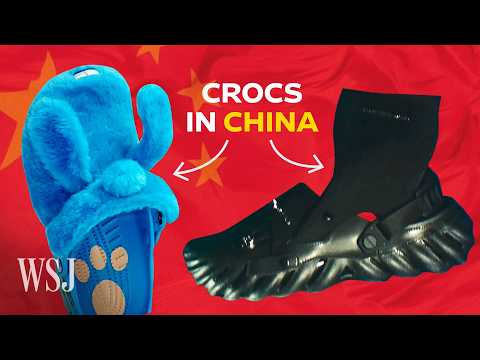
Crocs Is Crushing It in China. Here’s Why | WSJ
The Wall Street Journal· 2025-08-18 15:36
Market Trends & Competition - Nike's quarterly sales in China decreased by 17% year-over-year, indicating challenges for some American brands [1] - Anti-American sentiment and tough local competition are impacting American brands in China [1] Company Performance (Crocs) - Crocs' revenue in China increased by over 30% in the most recent quarter, contrasting with a 6.5% decline in North America revenue [1] - Crocs is successfully targeting China's Gen Z consumer segment [2] Marketing & Localization Strategies - Crocs adapted its global slogan "Come As You Are" to "Just match my vibes" and "born to be free" to resonate with young Chinese consumers [2][3] - Crocs utilizes Jibbitz to enable young consumers to personalize their shoes and express their identity [4][5] - Crocs avoids overt American symbols in its stores and uses local celebrity endorsers like Bai Lu [6] - Crocs collaborates with Chinese designers like Feng Chen Wang and streetwear brands like Melting Sadness to cater to local tastes [8] - Crocs is following the example of brands like McDonald's and KFC by embracing local tastes and understanding Chinese consumer preferences [9] Expansion & Future Outlook - Yum China, which owns KFC, plans to operate 20,000 food and beverage outlets by the end of next year, highlighting the growth potential in the Chinese market [10] - Brands need to understand and adapt to the fast-paced Chinese market to succeed [11]
摩根士丹利:中国消费者
摩根· 2025-07-28 01:42
Investment Rating - The report indicates a slight improvement in China's retail sales, with an expected growth rate of 4%-5% for 2025, establishing a new normal driven by government subsidies for durable goods [1][4]. Core Insights - Essential goods are expected to see relatively higher growth, while discretionary spending is significantly impacted [1][4]. - The consumer price index (CPI) shows a positive correlation with consumer stock valuations, with overall consumer stock P/E ratios currently low due to deflationary pressures [1][6]. - Emerging consumer companies have achieved remarkable growth, with some stocks rising over 150%, while the worst-performing stocks have seen declines of 9%-30% [1][8]. - The liquor market faces challenges in 2025, with weak enterprise demand and government controls affecting wholesale prices [1][10]. Summary by Sections Retail Sales Trends - Retail sales in China are projected to improve slightly in 2025, with growth between 4% and 5%, supported by government subsidies for durable goods [1][4]. Impact of Raw Material Prices - Rising prices of raw materials like gold and palm oil may pressure margins for noodle and food companies, while many essential goods companies could benefit from lower raw material costs [1][5]. Consumer Stock Valuation and Growth Outlook - The CPI is closely linked to consumer stock valuations, with current P/E ratios being low. Earnings growth for 2025 and 2026 is expected to be in the low single digits to 10% range [1][6]. Market Dynamics and Investment Flow - There has been a significant increase in southbound capital inflow into the Greater China consumer sector, which has positively impacted market indices [1][7]. Performance of New vs. Traditional Consumption - There is a stark performance disparity between new and traditional consumption sectors, with emerging companies showing exceptional growth while traditional sectors lag [1][8]. Liquor Market Challenges - The liquor market is expected to remain challenging in 2025, with weak demand and government regulations impacting wholesale prices [1][10]. Beer and Spirits Industry Challenges - The beer and spirits industries face multiple challenges, including fluctuating sales and pressure from restaurant demand [1][11]. Dairy Market Conditions - The raw milk market is currently in a surplus cycle, expected to end by the end of 2025, potentially leading to a slight price recovery in early 2026 [2][12]. Food and Beverage Sector Performance - The food and beverage sector shows varied performance, with noodle businesses under pressure from palm oil prices and a shift towards healthier beverage options [2][14]. Consumer Preferences - Consumers prioritize product quality and cost-effectiveness when choosing brands, indicating a shift in purchasing behavior [2][15]. Restaurant Sector Developments - The restaurant sector, represented by companies like Yum China, is navigating challenges but is focusing on service quality and efficient supply chains to improve profitability [2][16]. Large Appliances Market - The large appliances sector benefits from government subsidies and export opportunities, but faces uncertainty as subsidy effects diminish [2][17]. Jewelry Market Trends - The jewelry market is evolving, with emerging brands focusing on high-end fixed-price gold products gaining popularity [2][21]. Duty-Free Sales Performance - Duty-free sales in Hainan are stable, but meaningful growth will depend on macroeconomic improvements and competitive dynamics [2][24]. Cosmetics Industry Dynamics - The cosmetics industry is experiencing pressure from consumers seeking value, but growth is expected to stabilize as pricing pressures ease [2][25].
Starbucks reportedly received bids on its China business, valuing the company around $10B. 💰☕️
Yahoo Finance· 2025-07-10 15:30
Potential Acquisition & Valuation - Starbucks China business is valued at approximately $10 billion [1] - Starbucks intends to retain a majority stake, around 30% [1][2] - Potential buyers would hold less than 30% stake [2] Competitive Landscape - Centurium Capital, a potential contender, is a majority shareholder of Luckin Coffee, Starbucks' top rival in China [1][2] - Starbucks China has approximately 8,000 stores [4] - Luckin Coffee has more than 20,000 stores in China [4] Strategic Considerations - Starbucks is seeking a strategic partner with aligned values and remains committed to China [3] - Starbucks has struggled to compete with Luckin Coffee and Yum China's low-price model and rapid innovation [3]
GREEN TEA GROUP(6831.HK):A CASUAL CHINESE CUISINE LEADER OF GREAT VALUE
Ge Long Hui· 2025-06-25 01:51
Core Insights - Green Tea Group is a leading casual Chinese cuisine restaurant group in China, ranking as the 4th largest brand in the industry with a 0.7% market share in 2023, generating RMB 3.6 billion in sales from 360 stores in FY23, and achieving a 20% sales CAGR during FY19-23 despite the pandemic [1][3] Group 1: Sales Performance - Green Tea's sales per store recovery rate is at 94% in FY23 compared to FY19, outperforming competitors like Haidilao and KFC, both at 87%, and JMJ at 77% [1] - The company has a strong sales performance driven by its outstanding price to product quality and a distinctive store environment, making it popular for group dining [1] Group 2: Delivery Business Potential - The delivery business has significant growth potential, with delivery sales accounting for only 14% of total sales in FY23, compared to an industry average of 32% [2] - Green Tea is implementing a strategic shift to enhance its delivery offerings, including competitively priced delivery menus that are about 5% cheaper than dine-in options [2] Group 3: Future Growth Projections - Forecasts indicate an 18% sales CAGR from FY23-26E, driven by a 32% store CAGR and adjustments in sales per store [3] - The adjusted net profit is expected to grow by 25% CAGR during the same period, supported by menu adjustments, supply chain improvements, and economies of scale [3] Group 4: Valuation and Investment Outlook - The company is projected to achieve over 20% sales growth and over 30% net profit growth in 1H25E [4] - Initiating coverage with a BUY rating and a target price of HK$ 9.73, based on a 12x FY25E adjusted P/E, which reflects a 30% discount to the median of China peers [4]