Health care

Search documents
This Expert Says Small Caps Will Outperform This Year—and Two More 'Surprises' to Watch
Investopedia· 2026-02-12 21:40
Group 1 - The outlook for small-cap stocks is expected to improve this year, with predictions of a "positive surprise" according to State Street's Michael Arone [1] - Small-cap stocks, defined as those with market capitalizations below $2 billion, have underperformed large-cap stocks for the past nine years, but this trend may change in 2026 [1] - Investors have withdrawn approximately $12 billion from small-cap ETFs over the past year, indicating a potential shift in sentiment as the Russell 2000 index has risen 8% year-to-date [1] Group 2 - Healthcare stocks are predicted to outperform the broader market, with the sector experiencing net inflows of only $537 million in the past year, compared to $10.6 billion in the industrials sector [1] - The Health Care Select Sector SPDR ETF has produced the second-lowest returns among sector funds over the past five years, suggesting a compelling investment opportunity due to depressed valuations [1] - Historical trends indicate that healthcare stocks tend to perform well in mid-term election years, which may bode well for the sector in 2026 [1] Group 3 - Expectations of lower interest rates are favorable for small-cap companies, as declining interest expenses are anticipated to boost profitability [1] - The Federal Reserve is not expected to lower rates until June, when a new chair may take over, impacting market dynamics [1] - Inflation is expected to undershoot expectations, with predictions of tariff-related price increases diminishing by mid-year [1]


Payrolls rose 22,000 in August, less than expected in further sign of hiring slowdown
CNBC· 2025-09-05 12:34
Labor Market Overview - Nonfarm payrolls increased by only 22,000 in August, significantly below the expected rise of 75,000, indicating a slowdown in job creation [2][3] - The unemployment rate rose to 4.3%, reflecting a broader trend of labor market weakening [2][3] Revisions and Historical Context - The July payroll increase was revised up to 79,000, while June saw a net loss of 13,000 after a downward revision of 27,000 [3][4] - The recent changes in payroll figures come after the dismissal of former BLS Commissioner Erika McEntarfer, which has raised concerns about the integrity of the data [4][12] Sector Performance - The federal government reported a payroll reduction of 15,000, while the health care sector added 31,000 jobs and social assistance contributed 16,000 [6] - Manufacturing and wholesale trade both experienced declines of 12,000 jobs, highlighting weaknesses in these sectors [6][9] Economic Indicators and Federal Reserve Expectations - Markets are anticipating a 25-basis-point interest rate cut by the Federal Reserve, with a 12% probability of a half-point cut being priced in [3][7] - Despite weak job creation, average hourly earnings increased by 0.3% for the month, with an annual gain of 3.7%, slightly below the forecast [5] Broader Labor Market Trends - The household survey indicated an increase of 288,000 employed individuals, but the number of unemployed also rose by 148,000, leading to a higher unemployment rate [10] - The labor force participation rate edged up to 62.3%, with a total labor force increase of 436,000 [10] Controversies and Future Outlook - The upcoming release of annual benchmark revisions has been a source of controversy, particularly regarding the accuracy of post-Covid employment data [11] - National Economic Council director Kevin Hassett expressed expectations for the August payroll count to be revised higher, noting historical trends of initial counts being revised lower [13]

Real ROI is being driven by AI investments, says FirstMark's Heitzmann
CNBC Television· 2025-07-08 20:07
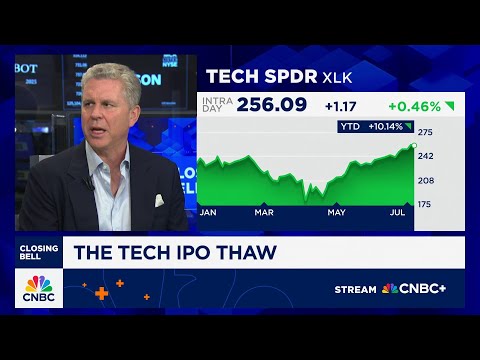
IPO Market & M&A - The IPO market is experiencing a general thaw with increased activity across industries [1][2] - M&A activity is providing tension in the markets, with a pause in early Q2 due to tariffs, but is now becoming functional again [3] - Several companies are preparing to go public, including StubHub and SeatGeek on the consumer side, and more crypto names [4] Healthcare Sector - Healthcare is a super hot space, especially related to AI, with potential for numerous AI-related healthcare companies to go public [6][7] - Direct-to-consumer healthcare is growing as consumers take more control of their health and seek better value [7] - Companies like Ro Health are hitting metrics and partnering with Eli Lilly and Novo Nordisk, potentially getting closer to going public [6] - AI and digital solutions are providing a better consumer experience at a cheaper price in healthcare [8] AI & Technology - AI is beginning to see a real ROI, with companies and consumers paying real money for it [10] - The fundamental demand for SaaS, AI, and consumer companies is pretty good, despite tariff crosswinds [9] - 2025 is seen as a critical year to determine if investments in AI will pay off [11] - AI is providing a huge amount of leverage in coding and automation [12] - There is no slowdown in demand for AI, driven by orders from sovereigns and hyperscalers [14] Crypto - Circle's IPO could lead other crypto firms to go public [15] - Stablecoins are emerging as a good use case for crypto, offering a better, cheaper, and faster way to transfer money [15]