
AGRICULTURAL BANK OF CHINA(01288)

Search documents
银行存贷差走阔意味着什么?
GF SECURITIES· 2026-02-26 15:12
Investment Rating - The report provides a "Buy" rating for the banking sector, indicating an expectation that stock prices will outperform the market by more than 10% over the next 12 months [54]. Core Insights - Recent high growth in bank deposits has led to market interpretations of banks being "asset deficient." However, this interpretation is challenged by the contractual nature of banking operations, where deposits and loans are derived simultaneously [4][12]. - The widening of the loan-to-deposit spread (LDR) is influenced by six key factors: cash withdrawal demand, reserve requirements, interbank lending, bond investment scale, bond issuance, and bank capital [4][14]. - The increase in net bond financing is a significant factor contributing to the widening of the loan-to-deposit spread. Two scenarios are identified: when bond financing costs are lower than loan rates, and when non-bank entities reduce their borrowing, leading to a return of funds to banks [4][35]. - From January 2025 to January 2026, the loan-to-deposit spread widened by 11.4 trillion CNY, with new bond investments contributing 16.6 trillion CNY and market bond net financing at 20.6 trillion CNY [4][45]. - In January 2026, net bond investment increased by 1.9 trillion CNY, while total market bond net financing was only 1.4 trillion CNY, indicating a negative contribution of -9.68% from bond financing to the loan-to-deposit spread [4][45]. Summary by Sections Section 1: Implications of Widening Loan-to-Deposit Spread - The loan-to-deposit spread for large banks increased from 15.8 trillion CNY in January 2025 to 21.8 trillion CNY in January 2026, while for medium-sized banks, it rose from 16.5 trillion CNY to 23.5 trillion CNY [12]. - The decline in loan-to-deposit ratios for large banks from 89.1% to 86.5% and for medium-sized banks from 88.3% to 84.7% reflects a shift in asset allocation demands [12]. Section 2: Factors Influencing Loan-to-Deposit Spread - The six factors affecting the loan-to-deposit spread include: 1. Cash withdrawal demand 2. Reserve situation 3. Interbank lending to non-banking entities 4. Scale of bond investments 5. Bond issuance 6. Bank capital [4][14]. - The report emphasizes that the relationship between bond financing and loans must differentiate between government and non-government bonds, as the issuance of government bonds does not affect the loan-to-deposit spread [4][35]. Section 3: Analysis of Recent Changes in Bank Assets and Liabilities - The report details the contributions of various factors to the loan-to-deposit spread, including a -47% contribution from bank funds exiting the balance sheet and a 173% contribution from the substitution effect of bonds for loans [4][45]. - The analysis of January 2026 data shows that non-bank funds returning to banks contributed 25.9% to the loan-to-deposit spread, while interbank net assets contributed 43.3% [4][45].



银行业2025年四季度监管数据总结:利润增速回正,息差连续两季度企稳
GF SECURITIES· 2026-02-26 14:05
Investment Rating - The industry investment rating is "Buy" [2] Core Viewpoints - The banking industry has shown a recovery in profit growth, with net profit for commercial banks increasing by 2.33% year-on-year in 2025, reflecting a quarter-on-quarter improvement of 2.35 percentage points [13][14] - The overall asset growth of commercial banks continued, with total assets increasing by 9.01% year-on-year as of Q4 2025, while loan growth slightly decreased to 7.26% year-on-year [29][30] - Net interest margin stabilized for two consecutive quarters at 1.42%, with expectations for a gradual recovery in 2026 [54] Summary by Sections Performance - The net profit of commercial banks increased by 2.33% year-on-year in 2025, with state-owned banks, joint-stock banks, city commercial banks, and rural commercial banks showing growth rates of 2.25%, -2.84%, 12.87%, and 4.57% respectively [13][14] - The return on equity (ROE) and return on assets (ROA) for commercial banks were 7.78% and 0.60%, reflecting a year-on-year decline of 0.33 percentage points and 0.03 percentage points respectively [13] Scale - Total assets of commercial banks grew by 9.01% year-on-year as of Q4 2025, with state-owned banks showing a growth rate of 10.78% [29][30] - Loan growth for commercial banks was 7.26% year-on-year, with city commercial banks experiencing a counter-cyclical increase in loan growth [29][30] Interest Margin - The net interest margin for commercial banks was stable at 1.42%, with a year-on-year decline of 10.50 basis points [54] - Expectations for 2026 indicate potential downward pressure on net interest margins in Q1, but a gradual recovery is anticipated thereafter [54] Asset Quality - The non-performing loan ratio for commercial banks was 1.50%, showing a quarter-on-quarter decrease of 2.00 basis points, while the provision coverage ratio was 205.21% [54] Capital - The core Tier 1 capital adequacy ratio for commercial banks was 10.92%, reflecting a quarter-on-quarter increase of 0.05 percentage points [54]


保证金比例上调至100%!金价迅猛上涨,工行、农行紧急出手
2 1 Shi Ji Jing Ji Bao Dao· 2026-02-26 13:56
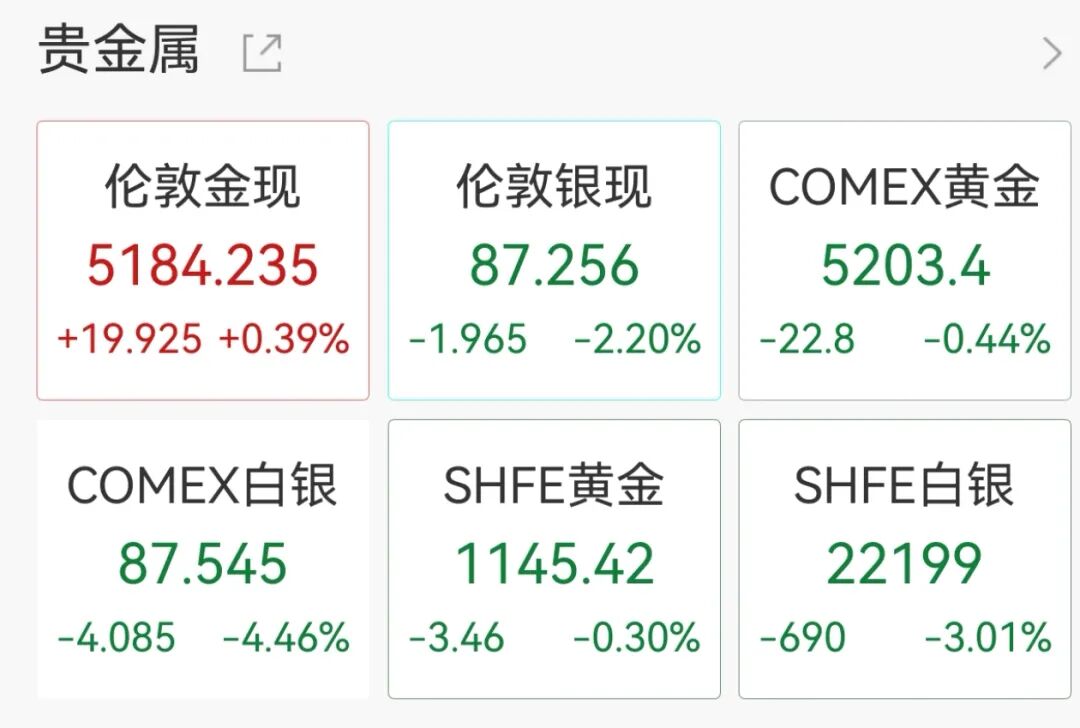
(文章来源:21世纪经济报道) 在国际贵金属价格持续高位震荡、个人投资热度攀升的背景下,工商银行、农业银行近期相继宣布,将 代理个人贵金属延期业务的保证金比例由80%统一上调至100%。 值得注意的是,此次上调保证金比例直接降低了交易的杠杆水平,有助于平抑过度投机,引导客户理性 投资。例如,原先交易价值100万元的合约,仅需80万元保证金(杠杆约1.25倍);比例调至100%后, 则需要足额100万元保证金(杠杆为1倍)。同时,这也是金融机构在贵金属市场处于历史高位、波动加 剧时期,为防范潜在风险、落实投资者适当性管理而采取的主动行为。 春节后,国际贵金属市场延续强劲走势。伦敦现货黄金在连续反弹后,于2月26日重新站上5200美元/盎 司,最高触及5205.472美元/盎司。 ...
上调至100%!金价迅猛上涨,工行、农行紧急出手
2 1 Shi Ji Jing Ji Bao Dao· 2026-02-26 13:55
Core Viewpoint - Major banks in China, including Industrial and Agricultural Banks, have raised the margin requirement for personal precious metals deferred business from 80% to 100% to mitigate risks associated with increased market volatility in precious metals [1][3][5]. Group 1: Market Conditions - The international precious metals market has shown strong performance, with spot gold prices rebounding to over $5,200 per ounce as of February 26, 2026, indicating a continued upward trend [1]. - The price of gold has surged nearly 65% throughout 2025, with prices exceeding $5,500 per ounce in 2026, attracting a significant number of individual investors and amplifying market risks [8]. Group 2: Bank Actions - Agricultural Bank announced on February 25, 2026, that it would increase the margin requirement for various precious metals contracts to 100% starting from the market close on February 26, 2026, citing heightened market risks [3]. - Industrial Bank followed suit, adjusting the margin for personal clients' contracts to 100% effective February 27, 2026, as a proactive measure to protect investors [5]. Group 3: Contract Types - The contracts affected by the margin increase include Au (T+D), mAu (T+D), and Ag (T+D), which represent different types of gold and silver deferred contracts, allowing investors to choose between immediate or deferred delivery [7][8]. - The adjustment in margin requirements effectively reduces the leverage for trading, moving from a leverage of approximately 1.25 times to 1 time, thereby encouraging more rational investment behavior among clients [8]. Group 4: Industry Trends - Prior to the margin increase, several banks had begun to tighten their personal precious metals trading operations, with some banks announcing the closure of related business functionalities for clients without positions or debts [9]. - The tightening of margin requirements and the closure of certain trading functionalities reflect a broader trend among financial institutions to manage risks in a volatile market environment [9].

农业银行代理上海黄金交易所个人贵金属交易业务调整延期合约保证金比例
Xin Hua Cai Jing· 2026-02-26 01:01
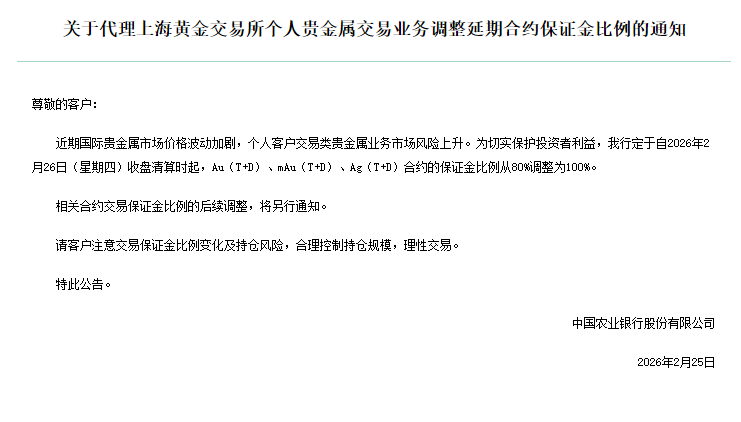
Group 1 - The core viewpoint of the article is that Agricultural Bank of China is adjusting the margin ratio for precious metal trading contracts due to increased market risks [1] - Starting from February 26, 2026, the margin ratio for Au (T+D), mAu (T+D), and Ag (T+D) contracts will be raised from 80% to 100% [1] - This decision is aimed at protecting the interests of individual investors amid heightened volatility in the international precious metals market [1]
申万菱信基金管理有限公司关于旗下部分基金调整长期停牌股票估值方法的公告
Xin Lang Cai Jing· 2026-02-25 17:54
根据《中国证监会关于证券投资基金估值业务的指导意见》(证监会公告[2017]13号)等有关规定,经 与相关基金托管人协商一致,申万菱信基金管理有限公司决定自2026年2月25日起采用"指数收益法"对 旗下基金(ETF基金除外)持有的"东阳光"(股票代码:600673)进行估值,敬请投资者予以关注。 待上述股票复牌且其交易体现了活跃市场交易特征后,将恢复为采用当日收盘价格进行估值,届时不再 另行公告。 风险提示:本公司承诺以诚实信用、勤勉尽责的原则管理和运用基金资产,但不保证基金一定盈利,也 不保证最低收益。敬请投资人注意投资风险。 特此公告。 申万菱信基金管理有限公司 2026年2月26日 申万菱信基金管理有限公司 关于以通讯方式召开申万菱信量化对冲策略灵活配置混合型发起式证券投资基金基金份额持有人大会的 第二次提示性公告 申万菱信基金管理有限公司(以下简称"基金管理人")已于2026年2月25日在《上海证券报》、基金管 理人网站(www.swsmu.com)及中国证监会基金电子披露网站(http://eid.csrc.gov.cn/fund)发布了《关 于以通讯方式召开申万菱信量化对冲策略灵活配置混合型发起 ...

农业银行:Au(T+D)等合约保证金比例将从80%调整为100%
Bei Jing Shang Bao· 2026-02-25 11:57
北京商报讯(记者 孟凡霞 周义力)2月25日,农业银行发布公告称,近期国际贵金属市场价格波动加 剧,个人客户交易类贵金属业务市场风险上升。为切实保护投资者利益,该行定于自2026年2月26日 (星期四)收盘清算时起,Au(T+D)、mAu(T+D)、Ag(T+D)合约的保证金比例从80%调整为 100%。相关合约交易保证金比例的后续调整,将另行通知。农业银行提醒,请客户注意交易保证金比 例变化及持仓风险,合理控制持仓规模,理性交易。 ...
农业银行:注意金市通业务合约涨跌幅度限制变化及持仓风险
Xin Lang Cai Jing· 2026-02-25 03:17
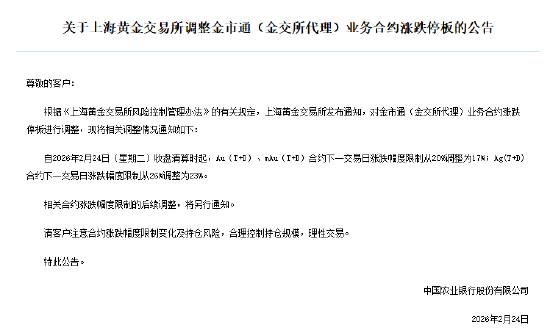
2月25日金融一线消息,农业银行昨日发布公告称,根据《上海黄金交易所风险控制管理办法》的有关 规定,上海黄金交易所发布通知,对金市通(金交所代理)业务合约涨跌停板进行调整,现将相关调整 情况通知如下: 自2026年2月24日(星期二)收盘清算时起,Au(T+D)、mAu(T+D)合约下一交易日涨跌幅度限制 从20%调整为17%;Ag(T+D)合约下一交易日涨跌幅度限制从26%调整为23%。 相关合约涨跌幅度限 制的后续调整,将另行通知。 农业银行提示,请客户注意合约涨跌幅度限制变化及持仓风险,合理控制持仓规模,理性交易。 责任编辑:秦艺 2月25日金融一线消息,农业银行昨日发布公告称,根据《上海黄金交易所风险控制管理办法》的有关 规定,上海黄金交易所发布通知,对金市通(金交所代理)业务合约涨跌停板进行调整,现将相关调整 情况通知如下: 自2026年2月24日(星期二)收盘清算时起,Au(T+D)、mAu(T+D)合约下一交易日涨跌幅度限制 从20%调整为17%;Ag(T+D)合约下一交易日涨跌幅度限制从26%调整为23%。 相关合约涨跌幅度限 制的后续调整,将另行通知。 农业银行提示,请客户注意合约涨跌幅度限 ...
金融服务守护春节烟火气
Jing Ji Ri Bao· 2026-02-24 22:07
让老百姓"好吃、好住、好行、好游、好购、好玩"需要哪些支持措施?加大金融支持是关键环节。《方案》 鼓励金融机构与重点商户合作,策划春节专属活动,推出消费红包、消费立减等优惠,扩大活动覆盖面。例 如,中国建设银行以"福享舌尖、福暖新家、福行天下、福购到家、福乐生活"为主题,策划开展了15项惠民 活动,并集中推出微信立减金、消费券、数字人民币智能合约红包、支付满减、利率优惠等多重权益,助力 实现马年消费"开门红"。 随着"春节档"电影市场热度持续升温,消费者观影热情也持续高涨。记者从中信银行获悉,中信银行信用卡 中心响应市场需求,全新升级"9元享看",活动期间,持卡12个月以上的中信银行信用卡主卡持卡人消费达标 后,即可在动卡空间抢兑"19元双人电影票"权益。与此同时,全国各地"以旧换新"补贴政策陆续落地,春节 作为传统消费旺季,消费者对家具家电、电子设备等大件购置需求旺盛。对此,中信银行信用卡推出"以旧换 新,优惠加码"专项优惠活动,用户在领取最高1500元政府补贴之外,还可额外叠加享受中信银行银联信用卡 加码活动优惠。 图为中国农业银行浙江温州分行营业部员工为客户讲解消费贷款财政贴息政策。(资料图片) 每逢新 ...

银行经营周期如何定价各类资产?
GF SECURITIES· 2026-02-24 12:04
Investment Rating - The report assigns a "Buy" rating for the banking sector, indicating an expectation of stock performance exceeding the market by more than 10% over the next 12 months [58]. Core Insights - In 2025, the banking sector's asset growth is projected to be 8.01%, an increase from 6.52% in 2024, driven by factors such as fiscal stimulus, cross-border capital inflows, and the activation of maturing deposits [5][13]. - The report identifies two key cycles affecting asset pricing in banking: the bank expansion cycle and the interest margin cycle, suggesting a comprehensive analysis of these cycles [5][13]. - The debt cycle is characterized as a fundamental aspect of the bank expansion cycle, with a model proposed by Dalio outlining seven stages of a typical debt cycle, which can be influenced by external debt reliance [16][19]. - The report anticipates limited upward space for the debt cycle in 2026, with government leverage expected to increase by 5.89%, lower than the 7.6% projected for 2025 [35][36]. - The banking interest margin cycle is expected to stabilize in 2025, following two complete cycles since 2010, with a correlation observed between bank interest margins and the 30Y-10Y government bond spread [41][45]. Summary by Sections Bank Expansion Cycle - The asset growth rates for different types of banks in 2025 are projected as follows: state-owned banks at 11%, joint-stock banks at 4.74%, city commercial banks at 9.68%, and rural commercial banks at 5.17%, all exceeding the average growth rate [5][13]. - The report emphasizes the importance of understanding the relationship between bank assets and liabilities, highlighting that credit and debt expansion are cyclical and self-reinforcing [15][16]. Debt Cycle Analysis - The report outlines that the current debt cycle, which began in 2022, has lasted 16 quarters, surpassing previous cycles, and indicates a shift in leverage dynamics among enterprises, government, and households [35][36]. - The analysis includes a comparison of deflationary and inflationary debt cycles, noting that the U.S. faces greater inflationary pressures due to higher external debt reliance compared to China [21][19]. Interest Margin Cycle - The report notes that the banking interest margin has experienced significant fluctuations since 2010, with a stabilization phase expected to begin in 2025 [41][45]. - It highlights the impact of loan repricing cycles on interest margins, with a notable decline in loan rates observed in recent years [49][50].

