
BANK OF GUIZHOU(06199)

Search documents
贵州银行股权变动与业务进展:国资增持、村镇银行收购及财务表现
Jing Ji Guan Cha Wang· 2026-02-13 03:18
财务状况 财务数据显示,2025年前三季度营业收入为87.46亿元,净利润31.05亿元;上半年营收61.02亿元,净利 润21.29亿元,同比增速分别为2.26%和0.31%,增长略显乏力。股东结构中,贵州省财政厅与贵州茅台 (600519)为前两大股东,地方国资近期增持可能意在稳定股权结构。 以上内容基于公开资料整理,不构成投资建议。 经济观察网 近期,贵州银行在股权结构、公司治理及业务拓展方面出现多项动态。股权方面,贵州水 投资本管理有限责任公司通过司法拍卖以9200万元竞得1亿股,这是其本月第二次增持。同时,贵州宏 财投资集团持有的部分股权仍处于变卖阶段,市场反应谨慎。公司治理层面,2025年新领导班子组建完 成,包括行长吴帆及多位副行长任职资格获批,治理架构趋于稳定。 业务进展情况 业务拓展上,贵州银行股东大会已审议通过收购三家村镇银行的议案,计划以吸收合并方式推进,后续 需监管批准。资产质量方面,2025年上半年不良贷款率为1.69%,较年初微降,但房地产贷款与个人贷 款的不良率仍较高,显示零售转型与风险管控面临挑战。法律事件上,原董事长因违法发放贷款被判 刑,该行正通过数字化风控等措施强化内控。 ...
贵州企业凭“数”获利
Xin Lang Cai Jing· 2026-02-08 22:43
转自:贵州日报 贵州数据宝帮助国塑管业获得数据知识产权登记证书,成功打造实体工业领域数据资产入表标杆案例。 (受 访单位供图) 贵州东亿电气科技有限公司。(受访单位供图) 贵州日报天眼新闻记者 鲍贝贝 ● 2025年贵州实现数据知识产权质押贷款4.07亿元,交易许可3064万元,带动数据资产入表4707.88万元。 ● 截至目前,全省已登记数据知识产权1813件,覆盖17个行业大类、12省264家主体。 2025年贵州省数据知识产权在增信融资、作价入股、资产证券化、市场交易等渠道上取得新成绩。全省多举 措激活数据要素资产属性,推动企业数据资产实现从"数据资源"到"数据信用"的价值跃升,拓宽融资新渠 道,实现价值倍增。 双证登记 激活数据要素资产属性 在数字化浪潮下,数据已经成为企业最重要的资产之一。然而,数据资产不在于有,而在于用,即数据资产 要可确权、可计量、可交易。 有了数据知识产权,该如何将其转化为实实在在的经济效益和竞争优势?贵州省知识产权局联合贵阳大数据 交易所上线"数据要素—数据知识产权"双登记专栏,推出双证登记,助力企业激活数据要素资产属性。 "创新主体登记数据要素后,符合条件的可申请数据知识产 ...



贵州银行(06199) - 截至二零二六年一月三十一日止股份发行人的证券变动月报表
2026-02-03 08:32
FF301 致:香港交易及結算所有限公司 公司名稱: 貴州銀行股份有限公司(「本行」) 呈交日期: 2026年2月3日 I. 法定/註冊股本變動 | 1. 股份分類 | 普通股 | 股份類別 | H | | 於香港聯交所上市 (註1) | | 是 | | | --- | --- | --- | --- | --- | --- | --- | --- | --- | | 證券代號 (如上市) | 06199 | 說明 | | | | | | | | | | 法定/註冊股份數目 | | | 面值 | | 法定/註冊股本 | | | 上月底結存 | | | 2,200,000,000 | RMB | | 1 RMB | | 2,200,000,000 | | 增加 / 減少 (-) | | | | | | RMB | | | | 本月底結存 | | | 2,200,000,000 | RMB | | 1 RMB | | 2,200,000,000 | | 2. 股份分類 | 普通股 | 股份類別 | 其他類別 (請註明) | | 於香港聯交所上市 (註1) | | 否 | | | --- | --- | --- | ...
贵州银行1亿股拍卖成交 竞得方为公司股东
Xi Niu Cai Jing· 2026-02-02 06:48
值得注意的是,上述股票的持有人钟山开投与竞得方贵州水投均为国资背景企业。贵州水投也是贵州银行的股东之一。据贵州银行定期报告,截至2025年6 月末,该公司持有贵州银行逾1.91亿股,占该行总股本的1.31%,为第九大内资股股东。 1月15日,贵州水投还以约1842.51万元的价格,在法拍市场拿下贵州宏财投资集团有限责任公司所持有的贵州银行2000万股内资股。 1月26日至27日,贵阳市中级人民法院通过淘宝司法拍卖网络平台,对贵州钟山开发投资(集团)有限责任公司(以下简称"钟山开投")持有的贵州银行1亿 股股票进行了首次公开拍卖。拍卖竞价结果显示,贵州水投资本管理有限责任公司(以下简称"贵州水投")以最高应价胜出,拍卖成交价为9200万元。 日前,贵州银行1亿股股票在阿里拍卖平台上拍卖成交。 ...

贵州银行1亿股股票法拍落定 国资股东接连出手,另有逾6000万股打折变卖中
Mei Ri Jing Ji Xin Wen· 2026-01-28 13:20
一笔由国资持有的贵州银行(HK06199,股价0.980港元,市值142.96亿港元)1亿股股票,首拍即告落 槌成交。 目前,贵州宏财投资集团名下仍有约6025万股贵州银行内资股在同一平台变卖,变卖价约为6131万元, 在评估价基础上打了逾6折。虽然该笔股权60天的变卖期已过大半,但截至发稿时仍无人报名。 法拍市场股东连续"扫货" 2026年1月26日至27日,贵阳市中级人民法院通过淘宝司法拍卖网络平台,对贵州钟山开投公司持有的 贵州银行1亿股股票进行了首次公开拍卖。 公开信息显示,贵州钟山开投公司是一家综合性国有企业,由贵州省六盘水市钟山区国有资产和金融服 务中心控股,实际控制人为六盘水市钟山区人民政府。公司主要承接六盘水市钟山区内社会重大项目的 经营建设和房地产开发销售运营业务,已发展成为当地城投背景房地产开发公司的龙头企业。 近年来,贵州钟山开投公司因对外担保借款合同纠纷等多次涉诉,并被列为被执行人。根据竞买公告, 本次拍卖源于"(2025)黔01执恢340号"执行案件,拍卖标的为1亿股贵州银行股票,不包括股息、红利 等,议价9200万元,并以相同的价格起拍。拍卖期间,仅一名竞拍者报名参与。 1月26日 ...
中小银行整合提速,小股东为何频繁投出反对票?三大问题值得关注
Xin Lang Cai Jing· 2026-01-28 00:33
智通财经记者 | 安震 此前,苏州农商银行(苏农商行,603323.SH)吸收合并张家港渝农商村镇银行议案获通过,但反对票 达13.08%。 相比之下,银行日常经营中股东对议案表决赞成比例通常在99%以上,而吸收合并中小地方银行为何频 繁遭到部分股东反对? 中小股东"发声"投下反对票 从上市银行公告的一些案例中可以看出,部分股东对于银行吸收合并议案存在不同意见。 比如,1月15日,苏农商行召开2026年第一次临时股东会,审议通过了关于吸收合并江苏张家港渝农商 村镇银行并设立分支机构的议案。该议案获得85.97%的同意票,反对票占比13.08%,弃权票占比 0.95%。其中,持股5%以下的股东同意比例为80.25%,反对和弃权比例分别为18.42%和1.34%。 这样的情况并非孤例。贵州银行(06199.HK)在第三次临时股东大会上审议通过收购盘州万和村镇银 行、凯里东南村镇银行和白云德信村镇银行并设立支行的三项议案。每项议案反对票均超过1.5%,弃 权票均超过3.7%。 此外,去年11月,贵阳银行(601997.SH)拟收购息烽发展村镇银行并设立分支机构的议案获得80.83% 的赞成票,反对票达19.07%, ...


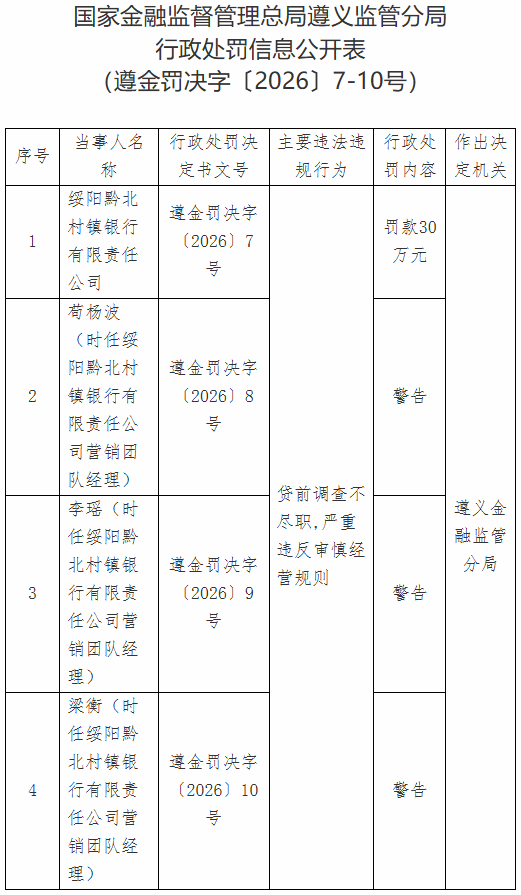
绥阳黔北村镇银行违规被罚 第一大股东为贵州银行
Zhong Guo Jing Ji Wang· 2026-01-27 07:08
以下为原文: 国家金融监督管理总局遵义监管分局 行政处罚信息公开表 (遵金罚决字〔2026〕 7-10号) | 序号 | 当事人名 | 行政处罚决 | 主要违法违 | 行政处 | 作出决 | | --- | --- | --- | --- | --- | --- | | | 称 | 定书文号 | 规行为 | 罚内容 | 定机关 | | 1 | 绥阳黔北 村镇银行 | 遵金罚决字 (2026) 7 | | 罚款30 | | | | 有限责任 | | | 万元 | | | | 公司 荷物波 | 를 | | | | | | (时任绥 阳黔北村 | 遵金罚决字 | | | | | 2 | 镇银行有 | (2026) 8 | | 警告 | | | | 限责任公 | 를 | | | | | | 司营销团 | | | | | | | 队经理) | | 贷前调查不 | | | | | 李瑶(时 | | 尽职,严重 | | 遵义金 | | | 任绥阳黔 | | 违反审慎经 | | 融监管 | | | 北村镇银 | 遵金罚决字 | 营规则 | | 分局 | | 3 | 行有限责 | (2026) 9 | | 警告 | | | | ...
个人贷款不良率骤增 银行超低折竞抛
经济观察报· 2026-01-25 04:58
Core Viewpoint - The article discusses the increasing trend of personal non-performing loan (NPL) transfers in the banking sector, driven by regulatory changes and the rising pressure of bad debts on financial institutions [1][5]. Group 1: Market Dynamics - The personal NPL transfer market is experiencing a surge, with transaction volumes rising from 186.48 billion in 2021 to 965.30 billion in 2023, and projected to reach 1583.50 billion in 2024 [3][4]. - As of January 22, 2026, there were 20 new announcements for personal NPL transfers within the month, indicating heightened activity in the market [2][8]. - The average discount rate for personal NPL packages has significantly decreased, with rates dropping from 8%-10% before 2023 to around 5% in 2026 [10][11]. Group 2: Regulatory Impact - A regulatory notification extended the trial period for bulk transfers of personal NPLs until December 31, 2026, allowing a wider range of financial institutions to participate in the transfer process [2][4]. - The expansion of trial institutions to include city commercial banks and rural commercial banks has led to a notable increase in the volume of NPL transfers [5][17]. Group 3: Borrower Profile and Economic Context - The borrower demographic for personal NPLs includes failed entrepreneurs, unemployed individuals relying on credit cards for living expenses, and consumers with excessive debt [4][20]. - The economic backdrop, characterized by macroeconomic fluctuations and income instability, has exacerbated the bad debt situation, compelling banks to offload risk assets [5][20]. Group 4: Challenges in Asset Recovery - The recovery rates for NPLs have declined, with some packages facing average recovery rates below 6%, marking the lowest in five years [12][13]. - Financial institutions are facing challenges in asset valuation and recovery due to incomplete documentation and inefficient legal processes [26][28]. Group 5: Strategic Adjustments - Banks are adapting their strategies by improving the quality of NPL packages, such as reducing overdue times and increasing the concentration of borrowers in economically developed areas [24][25]. - There is a push for enhanced transparency and standardization in the NPL transfer process to improve market confidence and asset pricing [28].


一场“不付现金”的承接: 信托受益权置换丰富中小银行改革工具箱
Zhong Guo Zheng Quan Bao - Zhong Zheng Wang· 2026-01-22 23:45
Core Viewpoint - A recent transaction involving 1.913 billion yuan in deposits has attracted market attention due to its "non-cash" payment arrangement, where Guizhou Bank acquires the deposits of Longli Guofeng Village Bank through a trust plan without immediate cash payment [1][2]. Group 1: Transaction Details - Guizhou Bank signed a deposit transfer agreement with Longli Guofeng Village Bank, effective from January 12, 2026, with a total deposit principal and interest amounting to 1.913 billion yuan, leading to a final transfer price of 1.849 billion yuan after deducting related rights [2][3]. - The payment arrangement is unique as Guizhou Bank does not pay cash directly but instead receives a beneficial interest in a trust plan, allowing for a quick transfer of deposit liabilities without complex negotiations [2][5]. Group 2: Regulatory and Operational Context - The Guizhou Financial Regulatory Bureau approved the dissolution of Longli Guofeng Village Bank on January 8, 2026, with Guizhou Bank taking over all deposits and managing existing loans [3]. - Guizhou Bank only assumes deposit liabilities and does not take on loan assets, ensuring that customer obligations remain unchanged and repayments continue as per original agreements [3]. Group 3: Reform and Innovation - The transaction is viewed as an innovative attempt to navigate the ongoing reforms in village banks, which have included various restructuring methods since 2026, such as mergers and acquisitions [4][8]. - The use of trust tools in this context is relatively rare, and it serves to align with policy advancements and regional risk management efforts [4][6]. Group 4: Risk Management and Future Considerations - While the model aims to isolate risks, experts caution that risks have merely transformed rather than disappeared, with underlying credit risks still present [6][7]. - The uncertainty surrounding the recovery of underlying assets, primarily loans from the village bank, poses potential challenges for the trust's beneficial interests and the bank's liquidity [7][8].
一场“不付现金”的承接:信托受益权置换丰富中小银行改革工具箱
Zhong Guo Zheng Quan Bao· 2026-01-22 20:56
Core Viewpoint - A recent transaction involving 1.913 billion yuan in deposits has attracted market attention due to its "non-cash" payment arrangement, where Guizhou Bank acquires the deposits of Longli Guofeng Village Bank through a trust plan without immediate cash payment [1][2] Group 1: Transaction Details - Guizhou Bank signed a deposit transfer agreement with Longli Guofeng Village Bank, effective from January 12, 2026, where Guizhou Bank will assume the liabilities and rights related to the deposits totaling 1.913 billion yuan, with a final transfer price of 1.849 billion yuan after deducting related rights [1][2] - The payment is structured through a trust plan, allowing Guizhou Bank to receive trust benefits instead of direct cash payment, facilitating a quicker transfer of deposit liabilities without complex negotiations [2] Group 2: Regulatory and Structural Context - The transaction is part of ongoing reforms in village banks, with Guizhou Bank being the main initiator of Longli Guofeng Village Bank, which was established in December 2008 [2] - Regulatory approval was granted for the dissolution of Longli Guofeng Village Bank, with all deposits to be managed by Guizhou Bank from January 9, 2026, while new loans will not be issued [2] Group 3: Risk Management and Implications - Guizhou Bank is only assuming deposit liabilities and not the loan assets, maintaining the existing debtor-creditor relationship between customers and the village bank [3] - The use of trust tools in this transaction is seen as a novel approach to manage potential asset risks while alleviating immediate capital and liquidity pressures on the main initiator [3][4] - The model aims to isolate risks but does not eliminate them, as the underlying credit risks of the assets remain, necessitating careful management of uncertainties related to asset recovery and liquidity [5][6]