
CRM(688396)

Search documents
放宽H200对华出口限制,算力产业链多环节利好!科创50ETF(588000)成交额14.26亿元,持仓股华润微逆势涨超13%
Mei Ri Jing Ji Xin Wen· 2025-12-10 03:07
Group 1 - The core viewpoint of the news is that the approval of NVIDIA's H200 AI chip sales to China is expected to benefit the domestic AI industry chain and computing power in China [1][2] - The recent performance of the ChiNext 50 ETF (588000) shows a significant inflow of funds, with a net inflow of 1.722 billion in the last three days and 1.847 billion in the last five days, indicating strong investor interest [1] - The ChiNext 50 ETF tracks the ChiNext 50 Index, which has a high concentration in the electronics sector (69.39%) and computer industry (4.88%), aligning well with the development of cutting-edge industries like AI and robotics [2] Group 2 - If the H200 chip is approved, it is expected to restart demand for NVIDIA's series of computing servers, which will positively impact AI servers, supernode servers, and server power supply sectors [2] - The approval may also enhance demand for supporting infrastructure such as data centers, power supply, and cooling equipment, which are essential for AI server adaptation [2] - The recovery of supply for chips like the H200 could drive the upgrade of domestic large models and accelerate the development of the domestic AI ecosystem, benefiting the domestic chip sector in the long term [2]


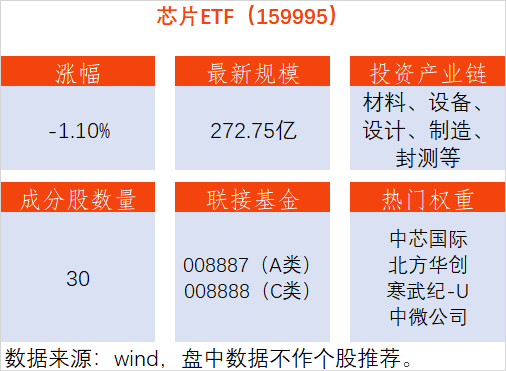
H200芯片或放开,芯片ETF(159995.SZ)下跌1.10%,华润微上涨10.06%
Mei Ri Jing Ji Xin Wen· 2025-12-10 02:55
Group 1 - A-shares experienced a collective decline on December 10, with the Shanghai Composite Index dropping by 0.60% during the session, while sectors such as forestry, retail, and engineering machinery showed positive performance [1] - The chip sector remained sluggish, with the chip ETF (159995) down by 1.10% as of 10:31 AM, and key component stocks like Lanke Technology, Haiguang Information, and Zhongwei Company falling by 3.27%, 2.69%, and 2.23% respectively [1] - Some individual stocks were active, with Huazhong Microelectronics rising by 10.61% and Haowei Group increasing by 2.97% [1] Group 2 - On December 9, U.S. President Trump announced that NVIDIA would be allowed to deliver its H200 chip products to qualified customers in China and other countries, under the condition of ensuring U.S. national security [3] - The sales revenue from these chip products will see 25% allocated to the U.S. government, and it was noted that China has been informed and responded positively [3] - Open Source Securities indicated that the restoration of supply for chips like the H200 could promote the comprehensive upgrade of domestic AI models, accelerating the development of the domestic AI ecosystem and potentially expanding demand for domestic computing power chips, which would be a long-term benefit for the domestic chip sector [3]





纳斯达克中国金龙指数收跌1.37%,热门中概股多数下跌
Mei Ri Jing Ji Xin Wen· 2025-12-09 21:17
Core Viewpoint - The Nasdaq China Golden Dragon Index experienced a decline of 1.37%, with most popular Chinese concept stocks also falling [1] Group 1: Stock Performance - Baidu saw a drop of 4.7% [1] - Other companies such as Beike, Xpeng, WeRide, and Li Auto all fell by over 3% [1] - Century Internet increased by 2% [1] - JinkoSolar rose by 2.5% [1] - Daqo New Energy experienced a rise of 3% [1]


PCB、存储、被动元件...这些芯片大厂都在涨价!
芯世相· 2025-12-08 06:30
Core Viewpoint - The article discusses the ongoing price increases across the semiconductor supply chain, driven by rising raw material costs and surging demand from AI applications, leading to a widespread tightening of supply and price hikes across various components [3][4][6]. Group 1: Price Increases in PCB and Wafer Manufacturing - The price increase trend has spread to the PCB industry, with major players like 建滔 and 南亚 raising prices by 5% to 10% and 8% respectively due to rising raw material costs [8][9]. - TSMC has announced price hikes for advanced process nodes, with increases expected to be in the range of 8% to 10% starting in 2026, and potentially up to 50% for 2nm wafers [12][11]. Group 2: Storage Market Dynamics - The storage market is experiencing significant price increases, with DRAM and NAND prices rising by 20% to 30% due to AI demand and supply constraints [15][19]. - Major manufacturers like 三星 and SK海力士 have suspended pricing for certain products, indicating a tightening supply situation [17][18]. - Flash memory prices have surged, with companies like 闪迪 announcing a 50% increase in NAND flash contract prices [21]. Group 3: Passive Components Price Adjustments - Passive component manufacturers are also raising prices, with increases driven by raw material costs and heightened demand from AI applications [32][33]. - Companies like 国巨 and 风华高科 have issued price hikes for various components, with increases ranging from 5% to 30% [35][36]. Group 4: Power Devices and Other Components - The power semiconductor market is seeing price increases, particularly following the 安世事件, which has led to a surge in demand for alternative products [42][44]. - 华润微 has confirmed price increases for certain IGBT products, citing rising raw material costs and strong order performance as key factors [45]. Group 5: Market Sentiment and Future Outlook - The overall sentiment in the semiconductor market remains optimistic, with expectations of continued price increases and strong demand driven by AI and other emerging technologies [26][27][28]. - The storage market is anticipated to maintain a tight supply situation, with companies like 兆易创新 predicting further price increases in the coming quarters [23].




研判2025!中国高纯铟行业政策、产业链上下游、市场规模及发展趋势分析:短期承压后回暖,高纯铟行业迎稳健增长新阶段[图]
Chan Ye Xin Xi Wang· 2025-12-08 01:04
Core Insights - The high-purity indium industry in China has experienced rapid growth, becoming a crucial support for semiconductor materials, photovoltaic industries, and electronic device manufacturing. However, in 2023, the market faced a significant downturn due to a deep destocking cycle in the semiconductor market and a persistent slump in the consumer electronics market, leading to a 25% year-on-year decline in market size. A recovery is expected in 2024, with the market size projected to reach 2 billion yuan, a 6% increase year-on-year. The industry is anticipated to continue growing, driven by high-end manufacturing and the expansion of the new energy sector, particularly in semiconductor materials as reliance on high-purity indium increases with advancements in 5G communication, artificial intelligence, and data center construction [1][6]. Industry Overview - High-purity indium is a silver-white metal material purified through processes such as electrolysis, chemical cleaning, and vacuum distillation, achieving purity levels from 5N (99.999%) to 7N8 (99.999998%). It is primarily used in the preparation of III-V semiconductor compounds like indium phosphide (InP) and indium antimonide (InSb), as well as in ITO targets and high-purity alloys. The main production methods include electrolysis, vacuum distillation, zone melting, metal-organic compound methods, and low-halogen compound methods [2][3]. Industry Chain - The upstream raw materials for the high-purity indium industry include primary indium and recycled indium. Primary indium is mostly a byproduct of zinc mining, with China being rich in zinc reserves, particularly in Yunnan, Guangxi, and Hunan. Recycled indium is becoming increasingly important due to stricter environmental policies and tight primary indium supply, with secondary resources like waste ITO targets and liquid crystal panel dismantling waste becoming key supplements. The midstream refers to the high-purity indium industry, while the downstream includes applications in semiconductors, electronics, and new energy sectors [4][5]. Market Size and Trends - China is the largest producer of primary indium, holding 72% of the global reserves. In 2024, the production of primary indium in China is expected to reach 688 tons, a 6.5% year-on-year increase. This growth in primary indium production will ensure a stable supply of raw materials for high-purity indium production. The semiconductor industry, which has strict purity requirements, is projected to grow significantly, with the Chinese semiconductor market expected to reach $630.5 billion in 2024, a 43% increase from $440.4 billion in 2020 [5][6]. Competitive Landscape - The competitive landscape shows that overseas markets for high-purity indium and its oxides have advanced technology and established companies like Dowa and Rasa. In contrast, China's high-purity indium industry has been developing rapidly in recent years, with companies like Zhuzhou Keno New Materials Co., Ltd., Yunnan Tin Company Limited, and Henan Yuguang Gold and Lead Co., Ltd. making significant strides [6][7]. Development Trends 1. Recycled indium is becoming a critical support for supply, with the domestic recycled indium production accounting for about 30% of the total. The market share of recycled indium is expected to continue increasing, with companies focusing on improving recovery technologies for waste materials [10]. 2. The industry concentration is expected to rise, with smaller companies facing challenges due to outdated technology and increasing environmental costs. Leading companies are expanding capacity and securing stable raw material supplies through investments in overseas mines and long-term supply agreements [11][12]. 3. Domestic companies are advancing in high-purity indium production, particularly in the 7N grade, which has historically been dominated by Japanese and Korean firms. With government support and increased R&D investment, companies are expected to overcome key technological barriers and promote green processes to enhance purity stability while reducing energy consumption and emissions [13].





趋势研判!2025年中国开关电源行业发展历程、产业链、市场规模、竞争格局及前景展望:5G基建加速与新能源发展,拉动开关电源市场规模提升[图]
Chan Ye Xin Xi Wang· 2025-12-08 01:04
Core Insights - The switch power supply is a crucial component in power supply systems, widely used in various electronic devices, converting power voltage into stable voltage required by devices, with advantages such as miniaturization, lightweight, and high conversion efficiency [1][12] - The market for switch power supplies in China is projected to grow from 114.98 billion yuan in 2015 to 253.2 billion yuan by 2025, with a compound annual growth rate (CAGR) of 8.55% [1][14] - The demand for high-performance power supplies is driven by the construction of 5G networks, the proliferation of the Internet of Things (IoT), and the expansion of data centers, particularly in servers, edge devices, and smart terminals [1][13] Industry Overview - Switch power supplies, also known as switched-mode power supplies (SMPS), are high-frequency power conversion devices that convert voltage from AC or DC sources to the required DC voltage for devices [4][9] - The industry has a well-established supply chain, with upstream suppliers controlling the manufacturing technology of power supply IC chips, midstream manufacturers providing various power products, and downstream applications spanning multiple sectors including industrial automation, medical devices, and consumer electronics [11][12] Market Dynamics - The application of switch power supplies is concentrated in the industrial sector (53.94%) and consumer electronics (33.05%), indicating a high industry concentration [15] - The rapid development of new energy industries such as photovoltaics and wind power has significantly increased the demand for related power supply equipment [1][13] Competitive Landscape - The switch power supply industry in China features both international and domestic players, with global leaders like TDK-Lambda and Mean Well dominating the high-end market, while domestic companies like Oulutong and Maoshuo Power are rapidly emerging through technological innovation and cost advantages [16][17] Development Trends - The industry is expected to see advancements in high frequency, modularization, low noise, and enhanced stability, driven by new semiconductor materials and innovative circuit designs [18][19][20][21]




中国功率半导体,逆袭
3 6 Ke· 2025-12-08 00:07
Core Viewpoint - The collaboration between global semiconductor giants and Chinese technology leaders signifies a profound industrial transformation, with Chinese companies rapidly advancing in the power semiconductor sector, moving from the periphery to the center of the global stage [1][2][3] Group 1: Collaborations and Partnerships - Onsemi and Innoscience have formed a deep collaboration to develop next-generation efficient power devices based on Innoscience's 8-inch silicon-based GaN technology, targeting markets such as industrial, automotive, telecommunications, consumer electronics, and AI data centers [1][3] - STMicroelectronics and Sanan Optoelectronics are jointly building a silicon carbide (SiC) manufacturing plant in Chongqing, with an expected annual capacity of hundreds of thousands of wafers, marking a significant investment of approximately 230 billion RMB [4][5] - Infineon has established long-term supply agreements with domestic companies for high-quality SiC substrates, ensuring a stable supply of materials for SiC semiconductor production [6][7] Group 2: Market Dynamics and Growth - The global power semiconductor market is projected to see GaN technology capture approximately $2.9 billion (11%) by 2030, with a compound annual growth rate of 42% from 2024 to 2030 [3] - China's power semiconductor industry is expected to reach a market size of 105.775 billion RMB in 2024, maintaining its position as the largest consumer market globally, with a domestic production rate exceeding 80% for low-end power devices [10][11] - Innoscience has achieved a global market share of over 42.4% in 2024, with cumulative shipments exceeding 2 billion chips, highlighting its significant position in the global semiconductor landscape [11] Group 3: Industry Trends and Future Outlook - The shift from passive following to active selection by international giants indicates a recognition of China's capabilities in core technology breakthroughs and market potential [8][9] - The rise of domestic companies in the power semiconductor sector is characterized by a combination of integrated device manufacturing (IDM) and specialized divisions, enhancing self-sufficiency and competitiveness [9][10] - The future landscape will require Chinese companies to focus on technological innovation, global expansion, and collaborative industry chain development to maintain their competitive edge [14][15]


海外机构最新关注这些股 多股全年业绩有望高增
Zheng Quan Shi Bao Wang· 2025-12-05 00:11
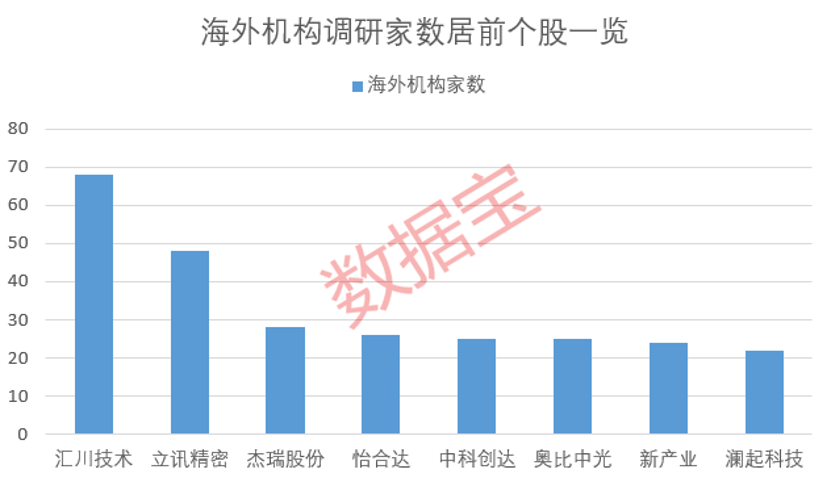
Group 1 - A total of 433 companies were investigated by institutions in the past 10 days, with 381 being securities firms and 302 being fund companies [1] - 88 listed companies were researched by overseas institutions, with 8 companies receiving attention from more than 20 overseas institutions, including Huichuan Technology, which was investigated by 68 overseas institutions [1] - Lixun Precision was the second most researched company, with 48 overseas institutions participating in the investigation, indicating significant growth potential in the non-overseas consumer electronics market over the next decade [1] Group 2 - Stocks that were investigated by overseas institutions saw an average increase of 0.36% in the past 10 days, with Shenghui Integration experiencing the highest increase of 32.47% [3] - 13 stocks received ratings from at least 15 institutions, with a consensus forecast of over 20% profit growth in 2025, including Kaiying Network, Lixun Precision, and Huichuan Technology [3] - Jinli Permanent Magnet is predicted to have the highest profit growth, with 18 institutions forecasting a net profit increase of 152.52% in 2025 [3][4]




科创价值ETF华夏(589550)开盘跌0.85%,重仓股寒武纪涨0.55%,中芯国际跌0.26%
Xin Lang Cai Jing· 2025-12-02 05:39
Core Viewpoint - The article discusses the performance of the Huaxia Science and Technology Value ETF (589550) on December 2, highlighting its opening decline and the performance of its major holdings [1] Group 1: ETF Performance - The Huaxia Science and Technology Value ETF (589550) opened down by 0.85%, priced at 1.165 yuan [1] - Since its establishment on July 16, 2025, the fund has achieved a return of 17.67%, while its return over the past month has been -5.45% [1] Group 2: Major Holdings Performance - Major holdings include: - Cambrian: opened up by 0.55% - SMIC: down by 0.26% - Haiguang Information: down by 0.48% - Lanke Technology: down by 0.32% - Jinghe Integration: down by 0.88% - Zhongwei Company: down by 0.01% - Transsion Holdings: up by 2.69% - Times Electric: down by 0.27% - China Resources Microelectronics: down by 1.83% - Canadian Solar: unchanged [1]


华润微跌2.00%,成交额3.86亿元,主力资金净流出7407.01万元
Xin Lang Zheng Quan· 2025-12-02 02:51
Core Viewpoint - China Resources Microelectronics (华润微) has experienced fluctuations in stock performance, with a recent decline of 2.00% in midday trading, reflecting a total market capitalization of 66.257 billion yuan [1][2]. Company Overview - China Resources Microelectronics, established on January 28, 2003, and listed on February 27, 2020, is located in Wuxi, Jiangsu Province, and Shanghai. The company specializes in the design, production, and sales of power semiconductors, smart sensors, and smart control products, as well as providing open wafer manufacturing and packaging testing services [2]. - The revenue composition of the company includes 54.34% from products and solutions, 42.92% from manufacturing and services, and 2.74% from other sources [2]. Stock Performance - Year-to-date, the stock price of China Resources Microelectronics has increased by 5.95%, with a 7.98% rise over the last five trading days. However, it has seen a decline of 4.58% over the past 60 days [2]. Financial Performance - For the period from January to September 2025, the company reported a revenue of 8.069 billion yuan, representing a year-on-year growth of 7.99%. The net profit attributable to shareholders was 526 million yuan, reflecting a growth of 5.25% [2]. Dividend Distribution - Since its A-share listing, China Resources Microelectronics has distributed a total of 886 million yuan in dividends, with 521 million yuan distributed over the past three years [3]. Shareholder Information - As of September 30, 2025, the number of shareholders increased by 19.22% to 52,500, while the average circulating shares per person decreased by 16.12% to 25,309 shares [2]. - The top ten circulating shareholders include various ETFs, with notable reductions in holdings for several funds, indicating a shift in institutional investment [3].