
ADP(ADP)

Search documents
3 HCM Stocks to Consider After January's Strong U.S. Jobs Report
ZACKS· 2026-02-11 22:05
Core Viewpoint - The article suggests that several human capital management (HCM) technology stocks are currently in oversold territory and may present buying opportunities following a strong U.S. jobs report in January, where 130,000 jobs were added, exceeding expectations of 68,000-75,000, and the unemployment rate decreased to 4.3% from an expected 4.4% [1]. Group 1: Workday (WDAY) - Workday is identified as the largest global HCM applications vendor, with its stock down nearly 50% from its 52-week high of $281 per share [4][5]. - Despite slower annual revenue growth, a 12% increase is projected for FY26 and FY27, with revenue approaching $10 billion [5]. - Annual earnings are expected to rise by 24% this year and another 16% in FY27 to $10.57 per share, with the stock trading at its lowest forward earnings multiple of 14X since becoming profitable [6]. Group 2: Paylocity (PCTY) - Paylocity, which provides cloud-based payroll and HCM software solutions, has seen its stock price cut in half from a one-year high of $218 per share [9]. - The stock is considered affordable, with single-digit growth appealing at a 15X forward earnings multiple, and it recently reported Q2 EPS of $1.85, exceeding expectations of $1.57 and up 21% from $1.52 a year ago [10]. Group 3: Automatic Data Processing (ADP) - ADP is recognized as a diverse provider of HCM technology solutions, with its stock down more than 30% from its 52-week high of $329 per share [12]. - The stock is trading at a reasonable 20X forward earnings multiple, with projected EPS growth of over 9% for FY26 and FY27 [13]. - ADP is forecasted to have 5% annual revenue growth, with strong financial figures, cash flow, and recurring revenue, and is noted as a Dividend King with a current annual yield of 3.02% [14][15].



Comparative Study: Automatic Data Processing And Industry Competitors In Professional Services Industry - Automatic Data Processing (NASDAQ:ADP)
Benzinga· 2026-02-11 15:01
Core Insights - Automatic Data Processing is considered undervalued compared to its peers in the Professional Services industry based on PE, PB, and PS ratios, indicating potential investment opportunities [2] - The company demonstrates strong performance in ROE, EBITDA, and gross profit, reflecting efficient operations and profitability [2] - A low revenue growth rate is identified as a potential concern for the company's future prospects within the industry [2] Financial Position - Automatic Data Processing has a lower debt-to-equity ratio of 0.68 compared to its top 4 peers, indicating a stronger financial position and less reliance on debt financing [4] - The favorable balance between debt and equity is viewed positively by investors, suggesting a lower financial risk profile [4]

Automatic Data Processing Inc (NASDAQ:ADP) Showcases Strong Financial Performance and Positive Employment Trends
Financial Modeling Prep· 2026-02-11 00:00
Core Insights - ADP is a leading provider in the HR and payroll solutions sector, serving over 1.1 million clients globally and focusing on data-driven workplace solutions [1] - The latest ADP National Employment Report shows a positive trend in U.S. private employment, with an average of 6,500 jobs added weekly for the four weeks ending January 24, 2026 [2] - ADP's recent earnings report revealed earnings per share of $2.62 and revenue of approximately $5.36 billion, both exceeding market expectations [3] - Despite positive employment trends and strong financial results, ADP's stock price has seen fluctuations, currently priced at $223.92, down approximately 1.19% [4] - Analyst David Grossman from Stifel Nicolaus has set a price target of $270 for ADP, indicating a potential upside of about 16.7% from the current price [5] Financial Performance - ADP reported earnings per share of $2.62, surpassing the estimated $2.57, and achieved revenue of approximately $5.36 billion, exceeding the estimated $5.34 billion [3][6] - The stock has fluctuated, with a current price of $223.92, reflecting a decrease of about 1.19% [4][6] Employment Trends - The ADP National Employment Report indicates a positive trend in U.S. private employment, with an average of 6,500 jobs added per week [2][6]

ADP National Employment Report Preliminary Estimate for January 24, 2026
Prnewswire· 2026-02-10 13:15
Group 1 - The ADP National Employment Report indicates that U.S. private employers added an average of 6,500 jobs per week for the four weeks ending January 24, 2026, reflecting a slight increase from the previous week [1] - The job gains have shown a week-over-week increase, with the previous week's average at 5,000 jobs and the week before that at 3,750 jobs [1] - The NER Pulse is based on a four-week moving average and is seasonally adjusted, providing a more accurate estimate of real-time employment trends [1] Group 2 - The next NER Pulse report is scheduled for release on February 17, 2026, and will continue to provide insights into employment trends [1] - ADP Research collaborates with the Stanford Digital Economy Lab to produce the ADP National Employment Report and the NER Pulse, emphasizing the importance of data-driven discovery in understanding the future of work [1] - ADP has been a leader in HR and payroll solutions for over 75 years, serving more than 1.1 million clients across 140+ countries [1]

美推迟发布就业报告,市场重新依赖私营部门数据
Guo Ji Jin Rong Bao· 2026-02-05 11:17
Core Viewpoint - The recent "technical shutdown" of the U.S. government has delayed the release of key economic data, leading market participants to rely on alternative data from private institutions to assess the current economic situation [1] Group 1: Impact of Private Sector Data - The ADP monthly employment report indicated that only 22,000 jobs were added in the private sector last month, reflecting a significant weakness [2] - Analysts are closely monitoring various private data sources, including Revelio Labs' employment indicators, Indeed's job vacancy data, and Paychex's small business employment index, as these are seen as leading signals for official data [2] - The importance of alternative data has been increasing, especially during periods when government data is unavailable, as seen during the recent government shutdown [2] Group 2: Historical Context and Technological Advancements - Historically, private sector data has played a crucial role in U.S. economic analysis, predating the establishment of the modern official statistical system in the 1930s [3] - The acceleration of digitalization has allowed companies to collect and process data on a much larger scale, enhancing the value of private data in macroeconomic research [3] - During economic shocks, the timeliness of private data becomes particularly advantageous, as demonstrated during the COVID-19 pandemic when economists utilized high-frequency indicators to track economic activity [3] Group 3: Limitations of Private Sector Data - Despite the advantages, private sector data cannot fully replace government data due to its unmatched coverage, transparency, and continuity [4] - Private data often suffers from sample bias, as noted by ADP's data scientist, indicating that the data may not accurately represent the overall employment situation [4] - Different types of data serve distinct purposes, limiting the macroeconomic applicability of private data for short-term predictions [5] Group 4: Sustainability Concerns - Private sector data faces uncertainties regarding sustainability, as data providers may cease to publish indicators or adjust statistical methodologies for commercial reasons [5] - The discontinuation of certain data streams, such as those from ADP to the Federal Reserve, raises concerns about the stability of private data sources [5]
美国“小非农”仅增2.2万不及预期,劳动力市场降温明显
Feng Huang Wang· 2026-02-04 23:32
Core Viewpoint - The latest ADP report indicates a slowdown in the U.S. labor market at the beginning of 2026, with private sector job growth significantly below expectations [1][4]. Employment Data Summary - In January, the private sector added only 22,000 jobs, falling short of the anticipated 48,000 and down from 37,000 in December [1][4]. - The goods-producing sector saw a net increase of only 1,000 jobs, with construction adding 9,000 jobs, while manufacturing lost 8,000 jobs [3]. - The service sector experienced mixed results, with trade/transport/utilities adding 4,000 jobs, financial services increasing by 14,000, education and health services up by 74,000, and leisure and hospitality adding 4,000 jobs [3]. - Conversely, the information sector lost 5,000 jobs, professional/business services decreased by 57,000, and other services fell by 13,000 [3]. - Employment changes by company size showed small businesses (1-49 employees) remained stable, medium-sized businesses (50-499 employees) added 41,000 jobs, while large businesses (500+ employees) lost 18,000 jobs [3]. Economic Insights - ADP's Chief Economist Nela Richardson expressed concern over the low growth in hiring, particularly in manufacturing and professional/business services, which have been experiencing job losses since March 2024 [3]. - Despite some signs of stabilization in recent months, the weaker-than-expected job growth in January suggests continued cooling in the labor market [4]. - Wells Fargo's Senior Economist Sarah House noted that the data reflects a stagnant labor market, with no significant improvement or deterioration in hiring trends [4].
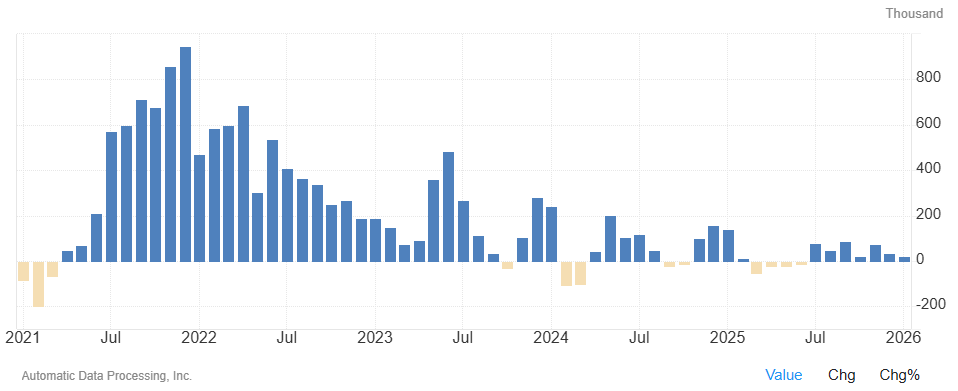
ADP Payrolls Come in Way Below Expectations
ZACKS· 2026-02-04 16:50
Market Overview - Pre-market futures have shown a recovery from early lows, influenced by Q4 earnings reports and private-sector job numbers, with the Dow up by 142 points and the S&P 500 up by 10 points, while the Nasdaq is down by 66 points [1] Employment Data - Private-sector payrolls for January reported by ADP came in at +22K, significantly below expectations, and down from a revised +37K the previous month, marking the first back-to-back monthly job gains since April and May of the previous year [2] - Services employment accounted for most of the private-sector hires, with +21K in services compared to only +1K in goods-producing sectors; Healthcare Services led with +74K hires, followed by Financial Services with +14K and Construction with +9K, while Professional & Business Services lost -57K jobs [3] - ADP Chief Economist noted that hiring trends are following consumer demand rather than technology advancements, indicating a disconnect between stock market performance and private-sector job growth [4] Sector Insights - The job gains in the Construction sector may hint at increased labor demand due to data-center buildouts, although it is considered premature to draw definitive conclusions [5] - A new ADP methodology revealed a downward adjustment of -212K fewer hires for the private sector in 2025, reducing total expected hires from +771K in 2024 to +398K in 2025, which may provide a clearer picture of the labor market [6] Earnings Reports - Eli Lilly & Co. reported a +7.9% earnings surprise with earnings of $7.54 per share and revenues of $19.29 billion, driven by strong performance in diabetes and weight loss drugs [8] - AbbVie reported earnings of $2.71 per share, exceeding estimates of $2.66, while Novartis reported $2.03 per share, beating consensus by 4 cents; however, AbbVie shares fell by -3% despite the positive earnings [9] - Phillips 66 reported earnings of $2.47 per share, surpassing expectations of $2.11 and significantly improving from a loss of -$0.15 per share in the same quarter last year, with shares up by +1.3% in pre-market trading [10]



ADP Jobs Lower, Q4 Earnings Reports Up
ZACKS· 2026-02-04 16:22
Market Overview - Pre-market futures have improved from early lows, influenced by Q4 earnings reports and private-sector job numbers, with the Dow up 142 points and the S&P 500 up 10 points, while the Nasdaq is down 66 points and the Russell 2000 is up 12 points [1] Private Sector Employment - Private-sector payrolls for January reported by ADP show an increase of only 22K, significantly below expectations, and down from a revised 37K the previous month, marking the first back-to-back monthly job gains since April and May of the previous year [2] - The services sector accounted for most of the job gains, adding 21K jobs, while goods-producing sectors only added 1K jobs. Healthcare Services led with 74K hires, followed by Financial Services with 14K and Construction with 9K. Professional & Business Services lost 57K jobs, and Manufacturing has not seen positive job growth since early 2024 [2][3] - A new ADP methodology indicates a downward revision of 212K fewer hires for the entire year of 2025, reducing total private-sector hires from 771K in 2024 to 398K in 2025 [4] Earnings Reports - Eli Lilly & Co. reported a 7.9% earnings surprise with earnings of $7.54 per share and revenues of $19.29 billion, also exceeding estimates by 7.9%, driven by strong performance in diabetes and weight loss drugs [6][7] - AbbVie reported earnings of $2.71 per share, beating estimates of $2.66, while Novartis reported $2.03 per share, surpassing consensus by 4 cents. Novartis shares rose 1.6%, while AbbVie shares fell 3% [7] - Phillips 66 reported earnings of $2.47 per share, exceeding expectations of $2.11 and significantly improving from a loss of $0.15 per share in the same quarter last year, with shares up 1.3% in pre-market trading [8]

ADP首席经济学家Nela Richardson:2025年美国新增就业岗位数量有所减少
Xin Hua Cai Jing· 2026-02-04 13:56
Core Insights - The chief economist of ADP, Nela Richardson, indicated that the number of new jobs added in the U.S. is expected to decrease in 2025 [1] Group 1 - The forecast for new job creation in the U.S. for 2025 shows a decline compared to previous years [1]
ADP jobs report shows sluggish payrolls growth to start 2026
Yahoo Finance· 2026-02-04 13:41
Core Insights - Private sector hiring has stagnated, with only 22,000 jobs added in January 2026, indicating a continuation of sluggish job growth from the end of 2025 [1][2] - The overall job growth would have been negative without the addition of 74,000 jobs in the education and health services sector, highlighting a significant reliance on these sectors for job creation [2] - Manufacturing has experienced job losses for nearly two years, contributing to the overall slowdown in job growth alongside declines in professional and business services [2][3] Employment Trends - Job creation in 2025 was significantly lower, with private employers adding 398,000 jobs compared to 771,000 in 2024, reflecting a dramatic slowdown over the past three years [3] - Wage growth has remained stable despite the slowdown in job creation, suggesting that while hiring has decreased, compensation levels have not followed suit [3] - The federal government's December jobs report indicated modest growth but raised concerns about the economy's stability, with signs of a prolonged "no-hire, no-fire" situation [4] Sector-Specific Developments - A notable decline of 25,000 jobs in retail employment was reported, indicating a deeper pullback in hiring, potentially due to companies cutting costs regardless of consumer spending [5] - Job losses in business services and IT sectors are particularly concerning as they are closely tied to corporate investment and white-collar employment [3][4]