AMD(AMD)

Search documents
老黄苏妈投了同一家世界模型公司
3 6 Ke· 2026-02-12 09:52
Core Insights - Runway, an AI video company, has shifted its focus to world models and has secured significant investment from Nvidia and AMD, indicating strong industry confidence in its new direction [1][2][12]. Company Overview - Runway was founded in 2018 by three art students and has undergone two major transformations, leading to a current valuation of $5.3 billion with only 140 employees [1][4]. - The company initially focused on video editing tools, gaining traction with its "green screen" feature, which led to early funding rounds totaling $200 million [6][8]. Recent Developments - Runway completed its Series E funding round, raising $315 million (approximately 2.17 billion RMB) to develop the next generation of world models [2][4]. - The latest funding round was led by General Atlantic, with participation from Nvidia and AMD, reflecting a strong belief in Runway's potential [2][12]. Valuation Growth - Following the recent funding, Runway's post-money valuation nearly doubled to $5.3 billion (approximately 36.58 billion RMB) [4][12]. - The company has seen a steady increase in valuation through its strategic pivots, particularly its entry into generative AI following the launch of ChatGPT [6][8]. Product Evolution - Runway's product evolution includes the introduction of the Gen-1 and Gen-2 models, with Gen-2 being the first commercially viable text-to-video model [8][10]. - The company has recently launched the GWM-1 (General World Models-1), which allows for interactive control and real-time image generation, marking a significant advancement in its technology [10][12]. Industry Context - The world model technology is gaining traction across various sectors, including autonomous driving, with companies like Tesla and Waymo developing their own models [13][17][22]. - Nvidia's investments in Runway and other companies utilizing world models highlight the growing importance of this technology in the AI landscape [12][22].



AI算力竞速(下):生态之战与国产GPU的未来价值重估
3 6 Ke· 2026-02-12 03:30
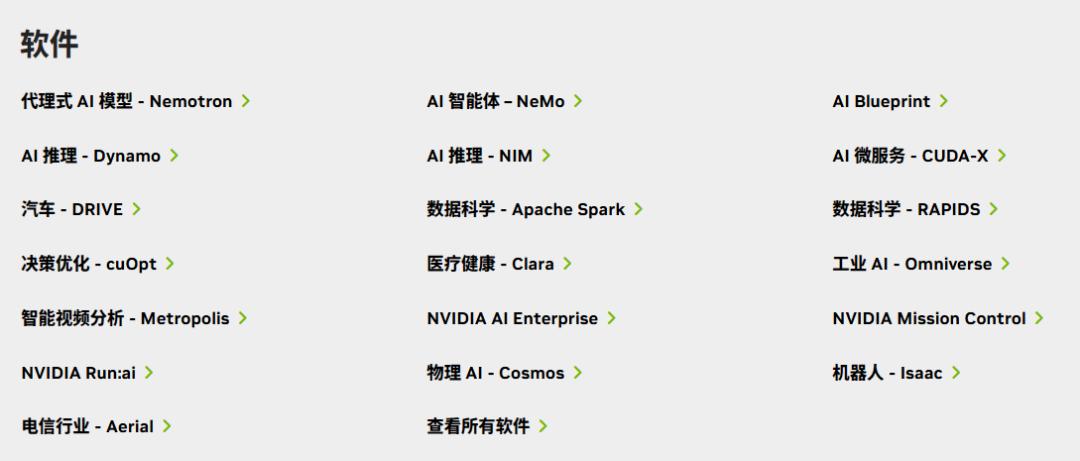
Core Insights - The article emphasizes the significant challenge of ecological barriers faced by domestic GPU companies in China, which goes beyond hardware performance and capital market achievements [1] - The current global GPU market is dominated by Nvidia and AMD, whose competitive advantage has shifted from hardware specifications to software and ecosystem development [1] - The article highlights the importance of building a robust ecosystem that requires deep understanding of developer needs, continuous improvement of the toolchain experience, and long-term community cultivation [2] Group 1: Ecological Barriers - Domestic GPU manufacturers are adopting a "compatible ecosystem" strategy to quickly enter the market, but this may lead to a long-term dependency on existing ecosystems, hindering the development of unique competitive advantages [2] - The construction of an ecosystem is a slow process that tests patience, capital, and foresight, requiring solid technical foundations and ongoing support from investors [2] Group 2: Industry Constraints and Capital Challenges - Domestic GPU companies face multiple constraints from the industry foundation, including limitations in advanced manufacturing processes, core IP self-sufficiency, and challenges in advanced packaging technologies [3] - The high investment nature of the GPU industry makes it a "capital endurance battle," with companies like Wallen Technology investing 85% of their IPO proceeds into R&D [3] - The financial performance of domestic GPU companies often shows strong revenue growth but delayed profitability, reflecting the industry's inherent characteristics [3] Group 3: Market Survival and Competition - The current growth of domestic GPUs is largely driven by policy support and specific replacement demands, but true commercial success requires navigating a fully market-driven and competitive landscape [4] - The ultimate test for domestic GPUs lies in their ability to support large-scale AI models, run top-tier games, and provide reliable services in high-precision industrial simulations and life sciences [4] Group 4: Investment Value Reevaluation - Investors are advised to maintain a rational perspective on the GPU sector, focusing on actual penetration rates, order visibility, and the quality of revenue growth [7] - Key mid-term indicators include breakthroughs in core architecture, the robustness of the software ecosystem, and clarity in profitability pathways [7] - Long-term success will depend on the ability to create a globally influential development platform and transition from a technology follower to a rule-maker [7] Group 5: Strategic Importance of GPU Development - The evolution of GPUs represents a strategic contest for control over foundational infrastructure and standards in the intelligent era, with significant implications for China's technological competitiveness [9] - The collective efforts of domestic GPU companies are seen as a crucial expedition that aligns with national expectations and industrial missions [9] - The journey towards establishing a self-sufficient GPU industry is expected to be challenging yet rewarding, with the potential to reshape the global computing landscape [10]
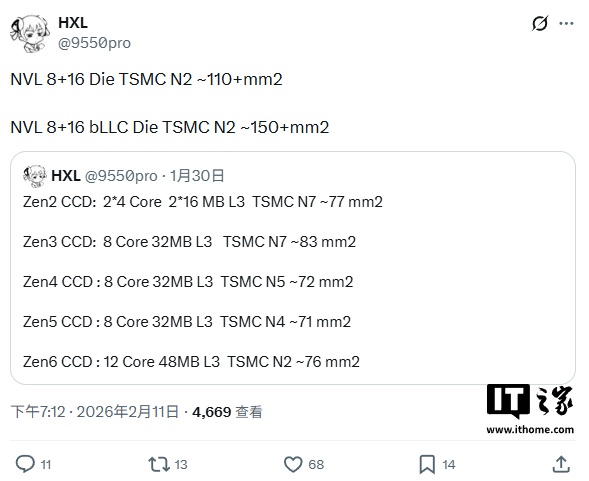
英特尔 Nova Lake 处理器尺寸曝光:单芯片面积远超 AMD,采用台积电代工
Xin Lang Cai Jing· 2026-02-12 01:24
Core Insights - Intel's next-generation Nova Lake processors are set to utilize TSMC's N2 process technology, featuring a base configuration of 8 P-cores and 16 E-cores, with a die size significantly larger than AMD's competitors [1][6] - The standard Nova Lake chip's die size is approximately 55% larger than AMD's Zen 5 CCD and about 44% larger than Zen 6 CCD [1][6] Processor Configuration - Both desktop and mobile versions of Nova Lake will adopt the 8P+16E base configuration, with options for entry-level and mainstream markets featuring 4P+8E configurations by disabling some cores [2][7] - Nova Lake will incorporate P-cores based on the Coyote Cove architecture and E-cores based on the Arctic Wolf architecture, with each cluster of P-cores containing 4MB of L2 cache [2][8] Dual Chip Design - Intel plans to introduce a flagship model with dual compute chips totaling 52 cores, with a standard dual-chip version's die size around 220mm² and a bLLC large cache version nearing 300mm², offering up to 288MB of L3 cache and a total cache size of 320MB [3][8] - The thermal design power (TDP) for these models will increase to 175W [3][8] Packaging and Compatibility - Despite the increased die size, all SKUs will utilize the same packaging and LGA1954 socket [3][9] - The bLLC technology differs from AMD's X3D stacking technology, and while Intel has similar additional cache technologies, they are not applied in Nova Lake [5][9]


拉夫罗夫突然发出警告,美国前所未有的举动,不只是冲着中国来的
Sou Hu Cai Jing· 2026-02-11 23:49
Group 1: Semiconductor Tariffs - The U.S. has initiated a "tariff war" in the semiconductor sector, which is not solely aimed at China but reflects broader ambitions [3][10] - Starting from August 2025, the U.S. plans to impose nearly 100% tariffs on all imported semiconductors, with exemptions for companies that build factories in the U.S. [3][5] - By January 2026, tariffs of 25% will be applied to advanced computing chips from companies like NVIDIA and AMD, with a 100% tariff threat on storage chips unless produced domestically [5][10] Group 2: Impact on Allies and Global Market - Major South Korean companies, Samsung and SK Hynix, controlling nearly 70% of the DRAM market, face existential threats from U.S. tariffs [5][12] - Taiwan's semiconductor firms are pressured to invest at least $250 billion in the U.S. to secure trade benefits, totaling $500 billion in commitments [7][8] - The U.S. semiconductor tariff strategy is causing significant financial strain on European and Asian semiconductor companies, with losses linked to the loss of the Chinese market [12][22] Group 3: Energy Control and Geopolitical Maneuvering - The U.S. aims to control global energy transport routes, with recent actions including claims over the Panama Canal and aggressive moves in the Caribbean [14][16] - The U.S. has been seizing Venezuelan oil tankers, disregarding national sovereignty, and is focused on controlling critical energy pipelines in Europe [16][18] - The U.S. is leveraging energy supply chains to force countries like India and European nations to purchase American liquefied natural gas at higher prices [20][22] Group 4: Humanitarian Aid and Global Order - The U.S. has dismantled key humanitarian aid institutions, leading to a significant loss of support for millions globally, particularly in impoverished regions [24][26] - The closure of the U.S. Agency for International Development has resulted in a predicted additional 9.4 million deaths by 2030 due to reduced aid [26][28] - The U.S. is criticized for undermining global humanitarian efforts while simultaneously promoting a "rules-based international order" that serves its interests [30][32] Group 5: Long-term Consequences - The U.S. strategy of imposing tariffs and controlling energy routes is seen as a short-term gain that could lead to long-term global instability [35][37] - The actions taken by the U.S. are not only affecting China but also harming its allies and many other countries, leading to a potential backlash against American policies [35][37]

AI PCs Built for Real Users: What Enterprises and End Users Actually Need
AMD· 2026-02-11 20:30
AI-enabled PCs should start with real customer needs. Gaston Sandoval shares how AMD goes deeper on end-user workflows to deliver AI experiences that matter in the enterprise. Discover more: https://www.amd.com/en/products/processors/business-systems.html Follow us on AMD Enterprise LinkedIn: https://www.linkedin.com/showcase/amd-enterprise/ Follow us on AMD Channel Partner LinkedIn: https://www.linkedin.com/showcase/amd-channel-partners/ *** Subscribe: https://bit.ly/Subscribe_to_AMD Join the AMD Gaming Di ...

AMD's Inflection Is Here
Seeking Alpha· 2026-02-11 17:55
Core Insights - The article emphasizes the importance of identifying high-potential investment opportunities before they experience significant growth, focusing on asymmetric opportunities with a potential upside of 3-5 times the downside risk [1] Investment Strategy - The investment approach prioritizes leveraging market inefficiencies and contrarian insights to maximize long-term compounding while safeguarding against capital impairment [1] - A strong margin of safety is sought to protect against capital impairment, ensuring that risk management is a key component of the investment strategy [1] - The investment horizon is set at 2-3 years, allowing the company to endure market volatility and emphasizing the importance of patience, discipline, and intelligent capital allocation for achieving substantial returns over time [1]
全球半导体及半导体资本设备:2025 年 12 月 WSTS 追踪-销售额环比 + 4.8%,高于典型值(2.2%);同比 + 41.3%;2025 财年增长 26% 至 7920 亿美元
2026-02-11 15:40
Summary of Semiconductor Industry Conference Call Industry Overview - The conference call focused on the global semiconductor industry, specifically discussing the WSTS report for December 2025, which tracks sales, units, and average selling prices (ASPs) across the semiconductor sector [2][27]. Key Financial Metrics - **2025 Semiconductor Sales**: Grew by 26% year-over-year, reaching approximately $792 billion, following a 20% increase in 2024 [3][28]. - **December 2025 Sales Growth**: Total semiconductor sales increased by 41.3% year-over-year, with memory sales growing by 67.6% year-over-year [3][29]. - **Monthly Sales Performance**: December sales rose by 4.8% month-over-month, significantly above the historical average of 2.2% [4][38]. Product Category Performance - **Logic Sales**: Increased by 40% year-over-year, leading the growth among product categories [28][32]. - **Memory Sales**: Grew by 35% year-over-year, with a notable 67.6% increase in December alone [3][29]. - **Analog Standard Linear**: Sales rose by 17%, while Discretes and Microcontroller Units (MCUs) saw declines of 1% each [28][32]. - **Monthly Performance by Product Group**: - Discretes: 18.3% growth vs. typical 14.5% - Optoelectronics: 14.2% vs. typical -0.1% - Logic: 3.7% vs. typical -1.1% - MCU: 13.8% vs. typical 11.6% [5][40]. Geographic Sales Insights - **Year-over-Year Sales Growth by Region**: - Americas: Up 32.5% - Europe: Up 23.3% - China: Up 40.3% - Asia Pacific/All Other: Up 77.6% - Japan: Down 11.3% [45]. - **Month-over-Month Sales Growth**: - Americas: Up 10.5% - China: Up 5.8% - Europe: Up 4.7% - Japan: Flattish at -0.7% - Asia Pacific/All Other: Down 1.2% [46]. Unit Shipments and ASPs - **Total Unit Shipments**: Increased by 9.6% month-over-month, with ASPs down by 4.4% [52]. - **Year-over-Year Shipment Growth**: Increased by 4.1%, with notable increases in Discretes, Optoelectronics, and Logic [53]. - **ASP Changes**: - ASPs increased for Discretes (6.3%), Optoelectronics (7.3%), and NAND (11.5%). - ASPs decreased for Sensors & Actuators (-4.6%) and Logic (-3.6%) [55][56]. Investment Implications - **ADI (Analog Devices)**: Rated Market-Perform with a target price of $270.00, executing well but shares considered expensive [11]. - **AMD (Advanced Micro Devices)**: Rated Market-Perform with a target price of $235.00, driven by high AI expectations and a new deal with OpenAI [11]. - **AVGO (Broadcom)**: Rated Outperform with a target price of $475.00, benefiting from a strong AI trajectory [11]. - **NVDA (NVIDIA)**: Rated Outperform with a target price of $275.00, with significant opportunities in the datacenter market [13]. - **QCOM (Qualcomm)**: Rated Outperform with a target price of $175.00, despite memory headwinds, shares are considered cheap [14]. Additional Insights - The semiconductor industry is experiencing robust growth driven by various product categories, particularly logic and memory, with significant regional disparities in performance. - The overall market sentiment remains positive, with several companies positioned for growth amid ongoing technological advancements and demand for semiconductors.


AMD发布2025年财报,下半年将量产AI新品并深化客户合作
Jing Ji Guan Cha Wang· 2026-02-11 14:25
Core Insights - AMD reported record revenue and profit figures for Q4 2025 and the full year, highlighting a strong financial performance [1] - Management emphasized a pivotal business outlook for 2026, with key developments expected in the second half, including the launch of new AI accelerator products and enhanced customer collaborations [1] Financial Performance - AMD plans to begin mass production of the Instinct MI450 series AI accelerators in the second half of 2026, which is expected to significantly boost revenue starting from Q3 [2] - The company is also set to introduce the Helios rack-level solution, further contributing to revenue growth [2] Strategic Collaborations - Collaborations with clients such as OpenAI are anticipated to enter an enhancement phase in the second half of 2026, indicating a strategic focus on partnerships [2] - The next-generation MI500 series chips are in the planning stages, with a target release set for 2027, which may strengthen AMD's competitive position in the data center and AI sectors [2]
Broadcom Vs. AMD: Which AI Chipmaker Is The Better Stock?
247Wallst· 2026-02-11 14:18
4,605,371-$35.7117.22%$171.68[S&P Global][SPGI]• Vol: 10,889,454-$43.119.71%$401.08[Raymond James Financial][RJF]• Vol: 4,178,329-$15.198.75%$158.48[Incyte][INCY]• Vol: 4,748,731-$8.988.24%$100.05[Western Digital][WDC]• Vol: 9,454,445-$23.438.19%$262.56 Broadcom Vs. AMD: Which AI Chipmaker Is The Better Stock? - 24/7 Wall St.[S&P 5006,986.60 +0.44%] [Dow Jones50,441.70 +0.35%][Nasdaq 10025,343.60 +0.62%][Russell 20002,706.22 +0.72%][FTSE 10010,463.00 +0.85%][Nikkei 22558,421.70 +0.69%][Investing]# Broadcom ...

AMD: Something Doesn't Add Up (NASDAQ:AMD)
Seeking Alpha· 2026-02-11 14:12
Core Viewpoint - Advanced Micro Devices, Inc. (AMD) reported its fourth-quarter and full-year 2025 financial results on February 3, 2026, which were highly anticipated by investors expecting strong performance [1] Financial Performance - The financial report included key metrics that investors were eager to analyze, reflecting AMD's performance in a competitive market [1] Market Expectations - Investors had high expectations for the report, indicating confidence in AMD's growth trajectory and market position [1]