Bank of America(BAC)

Search documents
美银调查:市场情绪仍然极度看多 第一季度资产价格上行难度较大
Xin Lang Cai Jing· 2026-02-17 09:45
Core Viewpoint - Investor sentiment remains "extremely bullish," but further price increases in assets during the first quarter will be more challenging as nearly everyone has already positioned for the rise [1] Group 1: Investor Positioning - The allocation to commodities has reached its highest level since May 2022, with a net allocation of 28% [1] - The allocation to equities has risen to its highest level since December 2024, with a net allocation of 48% [1] - The underweight position in bonds is at its highest since September 2022, with a net underweight of 40% [1] - Cash levels have slightly increased from a record low of 3.2% last month to 3.4% [1]
BofA:美元空仓降至 2012 年以来低点,比特币与美元现异常正相关
Xin Lang Cai Jing· 2026-02-17 09:07
Core Viewpoint - Investor bearish positions on the US dollar have dropped to the lowest level since 2012, indicating a historically low allocation to the dollar [1] Group 1: Dollar and Bitcoin Correlation - Traditionally, a weaker dollar benefits risk assets like Bitcoin; however, since early 2025, Bitcoin has shown an unusual positive correlation with the dollar index, with a 90-day correlation coefficient reaching 0.60 [1] - If this correlation persists, further declines in the dollar may not necessarily benefit Bitcoin and could instead exert pressure on it [1] - Conversely, if the dollar rebounds due to short covering, Bitcoin may rise alongside it, leading to increased market volatility [1]
Galapagos Receives Transparency Notification from Bank of America

Globenewswire· 2026-02-16 21:01
Core Viewpoint - Bank of America Corporation has crossed the 5% threshold of voting rights in Galapagos NV, indicating a significant increase in its stake in the company as of February 9, 2026 [1][6]. Summary by Relevant Sections Voting Rights - As of February 11, 2026, Bank of America Corporation, including its affiliates, holds 104,522 voting rights and 3,415,894 equivalent financial instruments, totaling 5.34% of Galapagos' 65,897,071 outstanding shares [2][6]. - The direct voting rights after the transaction are 0.16%, while the equivalent financial instruments account for 5.18%, leading to a total of 5.34% voting rights [3]. Transaction Details - The threshold was crossed on February 9, 2026, with the notification received on February 11, 2026 [6]. - The acquisition was due to the purchase of financial instruments treated as voting securities [6]. Breakdown of Voting Rights - The previous notification indicated no voting rights held by Bank of America Corporation, while after the transaction, the total voting rights held is 104,522, representing 0.16% [5]. - The breakdown of equivalent financial instruments includes various types such as rights to recall and swaps, with a total of 3,415,894 equivalent financial instruments representing 5.18% [7]. Total Voting Rights - The combined total of voting rights and equivalent financial instruments held by Bank of America Corporation is 3,520,416, which constitutes 5.34% of Galapagos' voting rights [7].


Brian Moynihan isn’t so worried about an AI jobs bloodbath, pointing to a 1960s theory that computers would end all management roles
Yahoo Finance· 2026-02-16 15:47
There’s a fair amount of hand-wringing over how much damage artificial intelligence will inflict on the jobs market: Fed chairman Jerome Powell is keeping a close eye on it, Anthropic’s CEO Dario Amodei reckons about 50% of entry-level white collar jobs will be eliminated, and the “Godfather of AI” Geoffrey Hinton predicts it will cause massive unemployment.It’s perhaps no surprise, then, that a study from Pew Research last year showed approximately half of workers (52%) are worried about the future impact ...

Is Stock Market Open Today? What's Open, What's Closed On Presidents Day 2026? - Bank of America (NYSE:BAC), Capital One Finl (NYSE:COF)
Benzinga· 2026-02-16 06:58
Financial Markets And Banking - The New York Stock Exchange (NYSE) and Nasdaq are closed for Presidents' Day, with trading set to resume on Tuesday, Feb. 17 [2] - U.S. bond markets are also fully closed for the holiday as per the Securities Industry and Financial Markets Association (SIFMA) [2] - Major commercial banks, including JPMorgan Chase & Co., Bank of America Corp., and Capital One Financial Corp., are closed, following the Federal Reserve holiday schedule, although online banking and ATM services remain functional [3] Mail And Shipping Services - The U.S. Postal Service (USPS) has suspended regular mail delivery and closed all retail post office locations for the holiday, while private carriers continue to operate [4] Government And Schools - All non-essential federal government offices, including the IRS and Social Security offices, are closed for Presidents' Day, along with most state and local government buildings [5] - Public school districts and many universities are also closed, although some may use the day as a "snow day" makeup [5] Retail And Grocery - Many department stores are taking advantage of the holiday to hold significant "Presidents Day Sales," particularly in the furniture and appliance categories [6]

华尔街重回“镀金时代”:六大行掌门人年薪均超4000万
Hua Er Jie Jian Wen· 2026-02-15 23:16
Core Viewpoint - The compensation for CEOs of major U.S. banks has returned to pre-financial crisis levels, with annual total pay exceeding $40 million, surpassing records set in 2006 and 2021 [1][2]. Group 1: CEO Compensation Trends - The annual total compensation for CEOs of the six largest U.S. banks has reached or exceeded $40 million, marking a significant increase compared to previous years [1][2]. - Bank of America CEO Brian Moynihan's compensation rose by 17% year-over-year to $41 million, while Citigroup CEO Jane Fraser's pay increased by 22% to $42 million [1][2]. - Goldman Sachs CEO David Solomon's 2025 compensation is set at $47 million, the highest among peers, reflecting a 21% increase [2]. Group 2: Profitability and Performance - The rise in CEO compensation is directly linked to improved industry profitability, with top U.S. financial institutions reporting their largest annual profits since 2021 [3]. - Increased activity in trading, lending, and mergers and acquisitions has contributed to enhanced performance and bonus pools [3]. Group 3: Governance and Retention Strategies - Some pay increases signal governance confidence, such as Citigroup's raise for Jane Fraser, viewed as a vote of trust from the board after years of underperformance [4]. - Goldman Sachs' compensation discussions focus on retention, with significant bonuses aimed at keeping key executives amid competition from private equity investors [4]. - Compensation structures often include stock-based payments, aligning executive interests with those of shareholders [4]. Group 4: Shareholder Sentiment and Cost Concerns - Despite some opposition, CEO compensation plans generally pass shareholder votes without major obstacles [5]. - There is growing scrutiny on costs and compensation, particularly with the rise of artificial intelligence, leading to increased questioning of how banks will manage expenses while pursuing revenue growth [5]. - Investors are likely to monitor both the return of high salaries and the emphasis on cost control in upcoming earnings seasons and compensation votes [5].


华尔街重回“镀金时代”:六大行掌门人年薪均超4000万,刷新08年危机后上限
Hua Er Jie Jian Wen· 2026-02-15 12:18
Core Viewpoint - The compensation for CEOs of major U.S. banks has returned to pre-financial crisis levels, with annual total pay exceeding $40 million, surpassing records set in 2006 and 2021 [1][2]. Group 1: CEO Compensation Trends - The annual total compensation for CEOs of the six largest U.S. banks has reached or exceeded $40 million, marking a significant increase compared to previous years [1][2]. - Bank of America CEO Brian Moynihan's compensation rose by 17% year-over-year to $41 million, while Citigroup CEO Jane Fraser's pay increased by 22% to $42 million [1][2]. - Goldman Sachs CEO David Solomon's 2025 compensation is set at $47 million, the highest among peers, reflecting a 21% increase [2]. Group 2: Industry Profitability and Performance - The rise in CEO compensation is directly linked to improved industry profitability, with top U.S. financial institutions reporting their largest annual profits since 2021 [3]. - Increased activity in trading, lending, and mergers and acquisitions has contributed to the enhanced performance and bonus pools for banks [3]. Group 3: Governance and Retention Strategies - Some compensation increases signal governance intentions, such as Citigroup's raise for Jane Fraser, viewed as a vote of confidence from the board after years of underperformance [4]. - Goldman Sachs' compensation discussions focus on retention, with significant bonuses aimed at keeping key executives amid competition from well-funded private equity investors [4]. Group 4: Shareholder Sentiment and Cost Concerns - Although there has been some opposition to executive compensation plans among shareholders, these plans typically pass without major obstacles during voting [5]. - There is a growing focus on costs and compensation within the industry, particularly as concerns rise over employee and technology investments driven by artificial intelligence [6]. - Investors are likely to monitor the dual aspects of "high salary returns" and "cost control" in upcoming earnings seasons and compensation votes [6].
特朗普拟缩减关税稳选情 1040亿外资流入发达市场 20.2万亿美股巨头承压
Jin Rong Jie· 2026-02-15 07:26
美国银行迈克尔·哈特奈特表示,美国贸易政策正在推动全球资产配置进入再平衡阶段,投资者正将美 元及美股资产转换为国际资产,美国例外主义正向全球再平衡转变。这一趋势将推动国际股市上行。同 时,新兴市场大宗商品生产商将从人工智能需求增长中获得收益。 市场有风险,投资需谨慎。本文为AI基于第三方数据生成,仅供参考,不构成个人投资建议。 本文源自:市场资讯 作者:观察君 特朗普政府正推进部分产品关税缩减计划,以缓解国内消费者生活成本过高的压力。《英国金融时报》 报道称,该计划的推出源于当前危机已削弱其11月中期选举支持率。 全球资金配置正发生显著转向。美国银行引用EPFR Global的报告称,今年以来欧洲、日本及其他国际 发达市场股票基金累计获得1040亿美元资金流入,远超流入美国基金的250亿美元。这一资金流向转变 使得总市值达20.2万亿美元的美股七大巨头集体承压。 知情人士透露,特朗普政府计划缩减的关税此前加剧了美国消费者的生活成本压力,同时令企业在成本 核算过程中遇到阻碍。美国贸易代表办公室正着手解决去年商务部仓促推进关税议程所引发的相关问 题。 ...
伯克希尔13F即将揭盅 巴菲特的最后一季会有哪些操作?
智通财经网· 2026-02-15 06:07
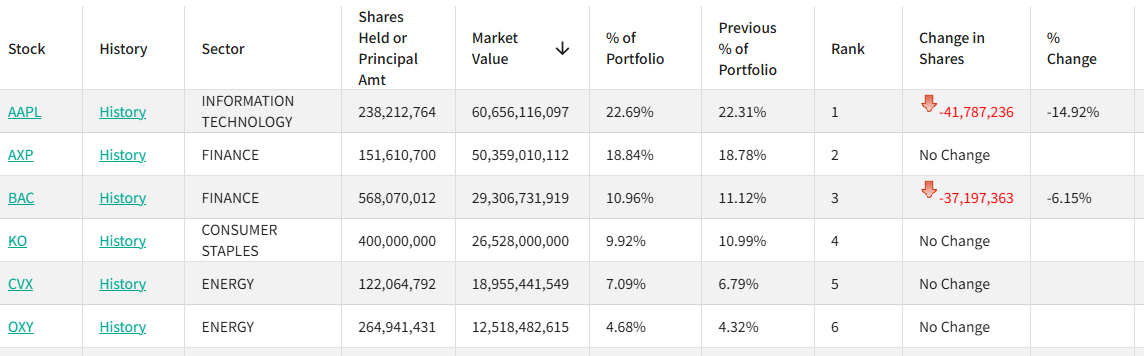
Core Viewpoint - The upcoming 13F quarterly filing deadline for Berkshire Hathaway is generating significant interest, particularly following Warren Buffett's resignation as CEO, with market participants eager to understand the investment decisions made during his final quarter in charge [1]. Group 1: Berkshire Hathaway's Holdings - Berkshire Hathaway's major holdings include Apple, American Express, Bank of America, Coca-Cola, Chevron, and Occidental Petroleum, which are believed to be primarily influenced by Buffett himself [2]. - As of the end of the third quarter, Berkshire's largest position is in Apple, valued at approximately $60.66 billion, representing 22.69% of the portfolio [2]. - The second-largest holding is American Express, valued at about $50.36 billion, making up 18.84% of the portfolio [2]. Group 2: Changes in Holdings - Significant reductions in holdings were observed for Apple and Bank of America, with Apple shares decreasing by nearly 42 million (approximately 15%) and Bank of America shares down by 37 million (over 6%) compared to the previous quarter [3]. - Apple's holdings have shrunk by about 75% from their peak, while Bank of America's holdings have nearly halved since the summer of 2024 [3]. - Berkshire's cash reserves have reached a new high, indicating a potential shift in investment strategy [3]. Group 3: Leadership Transition and Investment Strategy - Greg Abel has officially taken over as CEO of Berkshire Hathaway, following Buffett's departure, with Todd Combs previously seen as a strong candidate for the role [1]. - There is speculation regarding whether Berkshire will divest some positions established under Combs, particularly in companies like Amazon, Verizon, First Capital Credit, Visa, and Mastercard [3]. - Historical precedents suggest that when investment managers leave Berkshire, the company often sells off the majority of their managed holdings [3].


资金大撤离!美国关税,突生变数!140万亿资产承压,下一个风口在哪?
券商中国· 2026-02-15 05:56
Core Viewpoint - The narrative shift in the market is driven by Trump's "affordability" politics, which is reallocating funds from "Wall Street elites" to "ordinary people," leading to a rise in small-cap value stocks while tech giants face pressure [1][3]. Group 1: Economic Policies and Market Impact - Trump's administration plans to reduce certain tariffs, which have exacerbated the "affordability crisis" for American consumers and complicated cost calculations for businesses [2][3]. - The affordability crisis is causing a change in market narrative, with small-cap value stocks gaining traction and the narrative around artificial intelligence shifting from "awe" to "poverty," resulting in increased related debt [3]. Group 2: International Market Dynamics - According to a report by EPFR Global, international developed markets, including Europe and Japan, have attracted $104 billion this year, significantly surpassing the $25 billion inflow into U.S. funds, indicating a shift in investor focus [3]. - The U.S. trade policy is creating a "new world order," prompting investors to exchange U.S. assets for international ones, suggesting a transition from U.S. exceptionalism to global rebalancing [3]. Group 3: Stock Market Trends - Despite tax cuts, the S&P 500 index has lagged behind international peers, with the dollar index dropping over 10% since the end of 2024 [4]. - The current market environment is characterized by significant volatility due to the "AI disruption" affecting various sectors, including software services and logistics [4]. - The upcoming leaders in the market are expected to be emerging markets and small-cap stocks as U.S. exceptionalism gives way to global rebalancing [4]. Group 4: Investment Opportunities - After a period of intense selling, the valuation of internet companies is becoming increasingly attractive, suggesting potential investment opportunities as the market returns to a more rational pricing logic [5].