
Citi(C)

Search documents
Citi’s HR department ‘spearheaded’ a harassment campaign, former managing director alleges
Yahoo Finance· 2026-01-27 15:52
This story was originally published on HR Dive. To receive daily news and insights, subscribe to our free daily HR Dive newsletter. Dive Brief: Citigroup’s human resources department “spearheaded” a harassment campaign against a former managing director, involving a “deeply misogynistic” and one-sided set of investigations that ultimately resulted in her constructive discharge, the former employee alleged in a lawsuit filed Monday. After she allegedly endured “unrelenting and egregious sexual harassment ...

Over Half of US Banks Set To Offer Bitcoin, New Research Shows — Here’s Who’s Still Out
Yahoo Finance· 2026-01-27 12:12
Core Insights - Nearly 60% of the largest banks in the U.S. are either already offering Bitcoin-related services or expect to do so, indicating a significant trend towards Bitcoin adoption in the banking sector [1][5] Group 1: Current Offerings and Initiatives - Major U.S. banks such as JPMorgan Chase have launched Bitcoin trading services, while Citigroup, Wells Fargo, Goldman Sachs, and Morgan Stanley provide Bitcoin exposure primarily to high-net-worth clients [2] - U.S. Bank and BNY Mellon are among the first systemically important banks to offer custody services for Bitcoin [3] - PNC Group has launched both Bitcoin custody and trading services, while State Street and HSBC's U.S. operations have announced custody plans [5] Group 2: Exploratory Stages and Recommendations - Some banks, including Citigroup and Fifth Third, are still in the exploratory stages regarding custody and trading offerings [6] - Bank of America has recommended that clients allocate up to 4% of their portfolios to cryptocurrencies, reflecting a shift in stance even among banks without direct Bitcoin products [4][9] - Bank of America also plans to initiate coverage of four U.S.-listed spot Bitcoin exchange-traded funds (ETFs), which provide direct exposure to Bitcoin [10] Group 3: Banks Yet to Enter the Market - Despite the growing momentum, a significant minority of large U.S. banks have not yet announced Bitcoin-related products or plans, with nine banks remaining on the sidelines [7][8][11]


花旗最新商品展望:牛市情景下,金价6000美元、铜15000、铝剑指4000大关
Hua Er Jie Jian Wen· 2026-01-27 10:18
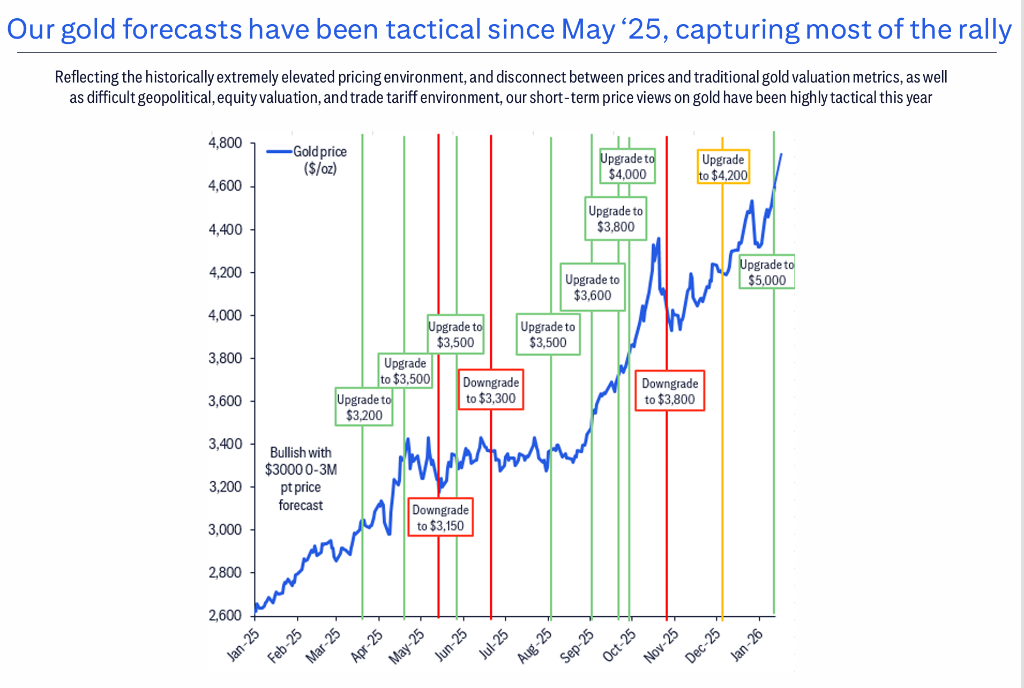
在最新发布的年度商品展望报告中,花旗大宗商品研究团队把焦点放在两个矛盾点上:一边是贵金属价格与矿山成本"脱钩"、利润率飙到几十年罕见; 另一边是基本金属短期顺风仍在,但真正能讲中期故事的,集中在铜、铝以及它们背后的电力与AI叙事。 据追风交易台消息,花旗分析师Max Layton等人对黄金的核心判断,是其定价锚正在发生结构性迁移:金价不再由边际开采成本主导,而是由全球对黄 金的名义支出规模,与高度刚性的供给能力共同决定。在矿产供给、回收与存量抛售弹性有限的前提下,价格本身成为唯一的清算机制。实物黄金市场 体量过小,使得哪怕极小比例的财富再配置,也只能通过价格大幅上行来完成平衡,黄金因此从"避险工具"转变为反映全球财富结构变化的宏观资产。 在花旗设定的"牛市情景"下,黄金、铜、铝的价格中枢将显著抬升:黄金可能上看6000美元/盎司,铜升至15000美元/吨,铝则逼近4000美元/吨。 黄金涨到"脱离成本",反而让对冲变成高风险动作 报告先抛出一个直观事实:金价已经在名义和实际口径都创了新高,并且与边际开采成本出现明显背离,远期价格也显著高于现货。结果是——高成本 金矿的利润率冲到"半个世纪最高",甚至比1980 ...

Morgan Stanley, BofA see more in best carry rally since 2009
The Economic Times· 2026-01-27 00:36
Core Insights - Emerging market currencies are performing well, particularly in Latin America, with the Brazilian real returning 4.5% in 2026 and the Mexican peso returning 4.3% [2][12] - Carry trades, which involve borrowing in lower-yielding currencies to invest in higher-yielding ones, are up 1.3% this year, building on last year's 18% rally [12] - High real interest rates in developing countries are supporting carry strategies, as many central banks maintain tight monetary policies despite slowing inflation [12] Latin American Currencies - The Brazilian real has seen a significant return of 4.5% in 2026, following a 23.5% return last year, with interest rates at 15% [2][12] - The Mexican peso's carry trade has also performed well, returning 4.3% this year, with Deutsche Bank maintaining a bullish outlook [2][12] - Citi strategists recommend buying the Brazilian real against the dollar and also favor the Turkish lira [3] Underperforming Currencies - The Indian rupee, which was the worst performer last year, is down about 2% in carry terms this year [4] - The Indonesian rupiah has also resulted in losses for investors [5] Market Conditions and Predictions - The record for carry strategies was in 2003 with a 25% return, but current conditions require the dollar to weaken further and emerging currency volatility to remain low [9][12] - BofA strategist Alex Cohen suggests that carry trades will continue to outperform if volatility remains suppressed, although geopolitical risks could pose challenges [10][11]


X @Bloomberg
Bloomberg· 2026-01-26 23:12
A former Citigroup wealth management executive sued the firm, alleging that she faced sexual harassment from one of the bank’s top leaders, Andy Sieg https://t.co/EnkUv97fWT ...
Contributor: The weird bipartisan alliance to cap credit card rates is onto something
Yahoo Finance· 2026-01-26 11:11
Core Insights - The credit card market in the U.S. is dominated by a few large financial institutions, leading to high costs for consumers and businesses [1][3] - There is a growing national discussion on potential government interventions to lower credit card costs, including proposals for a 10% cap on fees [2] - The credit card industry is characterized by an oligopoly of major banks and a duopoly of processing networks, resulting in limited competition [3] Industry Dynamics - Major banks like JPMorgan Chase, Bank of America, American Express, Citigroup, and Capital One account for approximately 70% of all credit card transactions [3] - Visa and Mastercard process over 80% of these transactions, reinforcing their dominant position in the market [3] - The markup on credit card borrowing compared to benchmarks like the prime rate has increased to 16.4%, indicating rising costs for consumers [4] Impact on Small Businesses - Credit cards serve as a significant source of credit for small businesses, but the associated costs are becoming increasingly burdensome [5] - Merchant fees charged by Visa and Mastercard have nearly doubled in five years, reaching $111 billion in 2024, which are often passed on to consumers [5] - These fees rank among the highest costs for merchants, following real estate and labor expenses [5] Comparative Analysis - The cost of credit card transactions in the U.S. is significantly higher than in other industrialized countries, where competition and regulation are more favorable [6][7] - Consumer credit is also less expensive in other regions due to these factors, highlighting inefficiencies in the U.S. market [6][7]


异动盘点0126 | 石油股继续走高,老铺黄金涨超7%;美股锂矿概念股多数上涨,英特尔大跌17.03%
贝塔投资智库· 2026-01-26 04:01
Group 1 - China Aluminum International (02068) saw a mid-day increase of over 2.4% after announcing a joint venture to undertake a new electrolytic aluminum project with an annual capacity of 394,000 tons, with the first phase set at 294,000 tons [1] - CGN Mining (01164) rose over 8.3% following the submission of a preliminary prospectus for a trust that plans to issue up to $2 billion in transferable, non-redeemable trust shares over 25 months, with annual uranium procurement not exceeding 9 million pounds [1] - China Shengmu Organic Milk (01432) increased nearly 6% after a joint announcement regarding a potential conditional cash offer to acquire all issued shares of the company [1] Group 2 - Yijun Group Holdings (02442) surged over 18%, with a cumulative increase of nearly 500% since its resumption of trading in December, following the sale of shares by its controlling shareholder [2] - China Rare Earth Holdings (03788) rose over 10%, reaching a historical high of 5.49 HKD, after announcing the termination of its gold spin-off plan to focus on gold business [2] - Laopuqin Gold (06181) increased over 7.3% as consumer demand is expected to rise during the upcoming Spring Festival, driven by higher gold prices and anticipated price increases [2] Group 3 - Oil stocks continued to rise, with CNOOC (02883) up 4.19%, Sinopec (00386) up 2.54%, and PetroChina (00857) up 3.68%, amid escalating geopolitical tensions in Iran and Cuba [3] - Changfei Optical Fiber (06869) saw a rise of over 15.4% due to significant price increases and supply tightness in the G.652.D optical fiber market, with major manufacturers unable to meet their own orders [3] Group 4 - Nanshan Aluminum International (02610) increased over 2.6% after announcing plans to start construction on a 250,000-ton electrolytic aluminum project in 2026, with an investment of $437 million [4] - Xindong Company (02400) saw a slight increase of 0.43% as its mobile game "Xindong Town" surpassed 10 million downloads, indicating strong user growth [4] Group 5 - EquipmentShare.com (EQPT.US) debuted on the US stock market with an IPO price of $24.5, closing up 32.9% on its first day [5] - The solar energy sector saw initial gains, with JinkoSolar (JKS.US) up 9.03% and Canadian Solar (CSIQ.US) up 4.57%, following discussions at the Davos Forum [5] - Silver-related stocks experienced gains, with First Majestic Silver (AG.US) rising 5.04% as spot silver prices surpassed $100 [5] Group 6 - Lithium mining stocks mostly rose, with Sigma Lithium (SGML.US) up 17.54% after announcing additional sales of high-purity lithium powder [6] - Bank stocks declined, with Goldman Sachs (GS.US) down 3.75% amid legal issues involving President Trump and JPMorgan [6] - Redwire (RDW.US) increased by 4.51% following comments from Elon Musk about SpaceX's plans for reusable rocket technology [6] Group 7 - Semiconductor stocks showed strength, with AMD (AMD.US) up 2.35% and Nvidia (NVDA.US) up 1.53%, as Nvidia's CEO visited China to discuss future plans [7] - Ericsson (ERIC.US) rose 8.87% after reporting strong fourth-quarter earnings, with adjusted EBITA reaching 12.7 billion SEK, a 24% increase year-over-year [8] - Intel (INTC.US) fell 17.03% due to disappointing performance outlooks and manufacturing issues [8]



全球宏观策略:格陵兰专题-宏观问答及影响分析-Global Macro Strategy_ Greenland_ Macro Q&A and implications
2026-01-26 02:50
Summary of Key Points from the Conference Call Industry and Company Involved - **Industry**: Global Macro Strategy focusing on geopolitical tensions and trade implications, particularly involving the US and Greenland - **Company**: Citigroup Global Markets Inc. (Citi Research) Core Insights and Arguments 1. **US-Greenland Relations**: The US has intensified its focus on Greenland, with President Trump announcing tariffs on goods from several European countries as part of efforts to pursue control over Greenland. A 10% tariff will be imposed starting February 1, 2026, increasing to 25% by June 1, 2026, unless a deal for the complete purchase of Greenland is reached [5][6][19] 2. **European Military Presence**: Several European nations, including France, Germany, and the UK, have deployed troops to Greenland to bolster NATO's presence against perceived threats from Russia and China in the Arctic [5][6] 3. **Strategic Importance of Greenland**: Greenland is viewed as a critical maritime hub due to its geographical position and potential resources, including an estimated 36 million tonnes of rare earth minerals, which are vital for technology and defense sectors [8][10] 4. **EU Retaliation Options**: The EU is preparing a tariff package worth EUR 93 billion in response to US tariffs, alongside potential use of the Anti-Coercion Instrument (ACI) to counter US economic pressure [14][15] 5. **Economic Implications**: The new tariffs are expected to have a marginally negative impact on European growth in the short term but could lead to increased inflation risks and a stronger case for enhanced European defense spending [6][19] 6. **Potential Scenarios**: Various scenarios for US actions regarding Greenland include: - **Negotiated Deal**: A potential agreement allowing the US to extract resources while increasing NATO's defense efforts [8] - **Forced Sale**: Economic coercion through tariffs to incentivize a sale of Greenland [11] - **Independence Push**: Supporting Greenland's independence to negotiate directly with its government [12] - **Military Intervention**: Considered highly unlikely due to severe geopolitical consequences [13] Other Important but Overlooked Content 1. **Tariff Mechanisms**: The report outlines various non-IEEPA avenues for tariffs, including Sections 232, 201, and 301, which could be utilized if the Supreme Court rules against IEEPA [19][22] 2. **Market Reactions**: The report suggests that geopolitical tensions may lead to increased defense spending in Europe, impacting various financial instruments, including Eurostoxx defense stocks and gold prices [23][24] 3. **Long-term Currency Implications**: The EURUSD exchange rate is expected to be influenced by the evolving geopolitical landscape, with potential for both bearish and bullish outcomes depending on European cohesion and defense spending [25] This summary encapsulates the critical insights and implications discussed in the conference call, highlighting the geopolitical dynamics surrounding Greenland and the potential economic ramifications for Europe and the US.
中国材料:2026 实地需求监测- 铝库存与消费情况-China Materials_ 2026 On-ground Demand Monitor Series #12 – Aluminum Inventory and Consumption
2026-01-26 02:49
Summary of Aluminum Inventory and Consumption in China (January 2026) Industry Overview - **Industry**: Aluminum - **Focus**: Tracking and analyzing high-frequency on-ground demand trends in China, particularly aluminum ingot and billet production, inventory, and consumption data for the week of January 15th to 21st, 2026 [1] Key Points Production Data - **Total Aluminum Production**: 858,000 tons (kt), unchanged week-over-week (WoW), +3% year-over-year (YoY), and +3% YoY on the lunar calendar [2] - **Aluminum Billet Production**: 330,000 kt, -4% WoW, +9% YoY, and -3% YoY on the lunar calendar [2] - **Year-to-Date (YTD) Production**: - Total aluminum production: 3.4 million tons (mnt), +2.8% YoY - Aluminum billet production: 1.4 mnt, +6.1% YoY [2] Inventory Levels - **Total Aluminum Inventory**: 1,201 kt as of January 22, 2026, +2% WoW, +29% YoY, and +56% YoY on the lunar calendar [3] - **Social Inventory**: 998 kt, +4% WoW, +48% YoY, and +64% YoY on the lunar calendar - **Producers' Inventory**: 203 kt, -3% WoW, -20% YoY, and +25% YoY on the lunar calendar - **Aluminum Ingot Inventory**: 848 kt, +1% WoW, +58% YoY, and +56% YoY on the lunar calendar [3] - **Aluminum Billet Inventory**: 353 kt, +5% WoW, -10% YoY, and +57% YoY on the lunar calendar [3] Apparent Consumption - **Overall Aluminum Apparent Consumption**: 841 kt, +6% WoW, +21% YoY, and +2% YoY on the lunar calendar [4] - **Aluminum Ingot Consumption**: 871 kt, +3% WoW, +4% YoY, and +2% YoY on the lunar calendar - **Aluminum Billet Consumption**: 300 kt, +2% WoW, +84% YoY, and -3% YoY on the lunar calendar - **YTD Apparent Consumption**: - Overall: 3.2 mnt, -1.1% YoY - Aluminum ingot: -3.6% YoY - Aluminum billet: +16.0% YoY [4] Takeaways - The increase in aluminum ingot and billet inventory is indicative of overall aluminum demand trends, suggesting a cautious market expectation for demand recovery [5] - The apparent consumption levels during the week were higher than the same period in 2024-25 on the lunar calendar, indicating a potential upward trend in demand [7] Additional Insights - The report emphasizes the importance of inventory data in assessing overall aluminum demand, as it reflects changes across various types of aluminum inventory [5] - The aluminum sector is currently ranked highest in the sector pecking order, followed by copper, battery materials, gold, coal, cement, and steel [1]
华尔街大行密集发债,美国公司债潮涌背后风险需警惕
Xin Lang Cai Jing· 2026-01-25 14:08
Group 1 - The core viewpoint of the articles highlights a significant surge in bond issuance by major Wall Street banks, driven by declining borrowing costs and increased demand for financing related to artificial intelligence (AI) investments, with projections indicating a total issuance of approximately $2.5 trillion in the U.S. corporate bond market by 2026 [1][4][5] - Major Wall Street banks, including JPMorgan Chase, Wells Fargo, Morgan Stanley, and Goldman Sachs, have recently launched substantial bond financing plans, with Goldman Sachs' issuance being the largest in history for investment-grade bonds at $16 billion [1][2][3] - The overall corporate bond issuance in the U.S. is expected to reach $2.46 trillion in 2026, an 11.8% increase from $2.2 trillion in 2025, with a net issuance of $945 billion anticipated for this year, reflecting a 30.2% growth from last year [4][5] Group 2 - The surge in capital returns by the six major Wall Street banks, exceeding $140 billion in 2025 through dividends and stock buybacks, is attributed to soaring bank profits and relaxed regulatory policies, which enhance corporate financing confidence [2][3] - The demand for high-quality dollar-denominated bonds is driving down corporate financing costs, with the current credit spread for U.S. investment-grade corporate bonds being the lowest since June 1998, at just 0.73 percentage points above U.S. Treasury yields [4][5] - Concerns are rising among investors regarding the substantial debt incurred by tech giants for AI infrastructure, as there is skepticism about the profitability of such large-scale capital expenditures [6]

