
DuPont(DD)

Search documents
“黄金薄膜”破局指南:中国聚酰亚胺(PI)产业的生死突围与投资机遇
材料汇· 2025-12-06 15:31
Core Insights - Polyimide (PI) is a high-performance polymer material known for its exceptional thermal stability, withstanding temperatures from -269℃ to over 500℃, making it crucial in aerospace, flexible displays, and advanced chips [2][5][19] - The PI industry faces significant challenges due to high-end product monopolization by foreign companies, leading to a "bottleneck" in domestic production capabilities [2][10][21] Group 1: Overview of Polyimide - Polyimide is a polymer characterized by the presence of imide rings, synthesized from diamines and dianhydrides [4] - It is recognized as one of the most promising engineering plastics of the 21st century, with applications across various high-tech industries [5][7] Group 2: Polyimide Industry Chain - The PI industry chain follows a "raw material supply - product manufacturing - application" model, with a notable integration of synthesis and product formation [10][26] - The upstream segment includes core monomers and auxiliary materials, with a reliance on imports for high-end monomers [14][15] - The midstream focuses on the manufacturing of various PI products, with significant technical barriers and a concentration of production among a few global leaders [17][18] - The downstream applications span electronics, aerospace, and military sectors, driven by the demand for high-performance materials [23][24] Group 3: Market Supply and Demand - Global PI production capacity increased from approximately 90,000 tons in 2020 to an estimated 110,000 tons by the end of 2023, with a compound annual growth rate (CAGR) of 6.9% [28][30] - The market for PI materials is projected to reach 104.4 billion yuan by 2030, with a CAGR of 6.98% from 2023 to 2030 [37] - In China, the PI production capacity is expected to grow significantly, with a focus on high-end applications, although the country still relies heavily on imports for advanced PI products [42][46] Group 4: Technological Aspects - The production of PI involves complex chemical reactions and requires a deep understanding of polymerization mechanisms and process control [55][57] - Various synthesis methods for PI resins include one-step, two-step, and three-step processes, each with distinct technical requirements [58]


Kevlar® EXO™ Expands Protection Capabilities with Launch of Hard Armor Applications
Prnewswire· 2025-12-05 14:02
Core Insights - Kevlar® EXO™ is being developed for hard armor applications, including helmets and ballistic plate inserts, enhancing performance through superior impact resistance and energy absorption [1][3] - The material serves as a reinforcement within composite structures in hard armor, improving structural integrity and energy dispersion [2] - The expansion into hard armor follows the success of Kevlar® EXO™ in soft armor applications, with a focus on lightweight strength and impact resistance across various industries [3][4] Company Overview - DuPont is a global innovation leader providing advanced solutions across key markets such as healthcare, water, construction, and transportation [5] - TYR Tactical® is a leading manufacturer of tactical gear and equipment for military and law enforcement, committed to high standards of product quality [6]

日本光刻胶真会全面断供?从产业格局与中日博弈看隐形限制的真相
材料汇· 2025-12-01 14:10
Core Viewpoint - The article discusses the potential supply disruption of core photoresists by Japanese companies like Canon and Nikon, analyzing the implications of such actions in the context of the semiconductor industry and the ongoing China-Japan semiconductor rivalry [3][21]. Group 1: Japan's Supply Power - Japan holds significant power in the semiconductor materials and equipment sector, particularly in photoresists, where it dominates 95% of the global market share through companies like JSR, Shin-Etsu Chemical, and Tokyo Ohka Kogyo [5][8]. - In the photoresist market, the domestic production rates for G-line and I-line photoresists exceed 60%, while KrF photoresists have a low domestic production rate of less than 5% [7]. - Japan's dominance extends to 14 out of 19 critical semiconductor materials, with major players like Shin-Etsu Chemical holding a 27% market share in silicon wafers [8]. Group 2: Economic Interdependence - China is Japan's largest customer in the semiconductor sector, with Japan's semiconductor equipment exports to China reaching $11.843 billion in 2021, accounting for 38.8% of Japan's total exports [10]. - The semiconductor trade between China and Japan exceeded $47 billion in 2021, with over 30,000 Japanese semiconductor-related companies operating in China, relying on the Chinese market for 20%-30% of their revenue [10][11]. - The potential for a complete supply disruption poses a significant risk to Japanese companies, as it could severely impact their production capacity and revenue [10][11]. Group 3: Emerging Supply Chain Challenges - While a complete supply disruption is unlikely, "de facto" supply restrictions are becoming more common, such as increased export controls and approval delays for semiconductor equipment [12][14]. - Approval rates for photoresist exports to China have dropped from 89% to 76%, with longer approval times indicating a tightening of supply [14]. - Japanese companies may prioritize supply to international clients over Chinese firms, leading to reduced quantities and increased prices for Chinese customers [15][16]. Group 4: China's Response and Opportunities - The pressure from Japan's supply restrictions is prompting Chinese wafer fabs to prioritize supply chain security, accelerating the validation and application of domestic photoresists [18][20]. - Chinese companies have made significant advancements in high-end photoresist production, with several firms achieving stable sales and customer validation for their products [18][20]. - The shift towards domestic alternatives is seen as a critical strategy for breaking Japan's monopoly in the semiconductor materials sector [18][20]. Conclusion - A complete supply disruption from Japan is deemed unlikely due to mutual economic interests, but the trend of indirect supply restrictions is expected to persist in the ongoing semiconductor rivalry [21][22]. - The focus for China should be on enhancing its capabilities across the semiconductor supply chain to mitigate reliance on Japanese imports [22].

DuPont Can Become a ‘Compounder.' Why the Stock Could Gain 20%.
Barrons· 2025-11-25 18:03
Core Viewpoint - Deutsche Bank analyst David Begleiter has maintained a Buy rating on the shares with a price target set at $46 [1] Summary by Category - **Analyst Rating** - David Begleiter from Deutsche Bank reiterated his Buy rating on the shares [1] - **Price Target** - The price target for the shares is set at $46 [1]

德银下调杜邦目标价至46美元
Ge Long Hui· 2025-11-25 13:52
Group 1 - Deutsche Bank has lowered DuPont's target price from $90 to $46 while maintaining a "Buy" rating [1]
杜邦在华建特种润滑剂生产基地
Zhong Guo Hua Gong Bao· 2025-11-24 03:24
杜邦MOLYKOTE与Vespel全球业务总经理涂凯诺表示:"今天的奠基仪式标志着我们开启了新的篇章, 致力于更好地服务中国客户,加快创新步伐,并成为各行业解决磨损与摩擦挑战的首选合作伙伴。这一 新设施将增强本地应用及新配方开发能力,赋能客户协作,实现实时响应。" 中化新网讯 11月18日,杜邦公司在江苏省张家港市举行MOLYKOTE特种润滑剂新生产基地的奠基仪 式,标志着MOLYKOTE业务在全球产能扩张、客户响应速度提升以及本地创新发展方面迈出了坚实步 伐。 据介绍,该生产基地落户于张家港保税区的长江国际化工工业园,预计于2027年初正式投产。通过这一 战略性投资,杜邦将满足中国市场交通运输、工业、能源以及电子等行业对特种润滑解决方案日益增长 的需求。新工厂将通过更短的交付周期、更高的灵活性以及与本地客户更紧密的协作,打造创新、合作 与发展的平台,高效、精准地提供下一代润滑解决方案。 ...
1300+新材料深度报告下载:含半导体材料/显示材料/新材料能源等
材料汇· 2025-11-23 15:46
Investment Insights - The article emphasizes the importance of understanding the investment landscape in new materials, particularly in sectors like semiconductors, renewable energy, and advanced manufacturing [9][11][16]. Semiconductor Sector - The semiconductor industry is highlighted as a critical area for investment, with a focus on various materials and technologies such as silicon wafers, photolithography, and advanced packaging [4][6]. - Key players in the semiconductor space include ASML, TSMC, and SMIC, which are pivotal for technological advancements and market growth [6]. Renewable Energy - The renewable energy sector, particularly lithium batteries and hydrogen energy, is identified as a significant investment opportunity, driven by the global push for sustainability [4][5]. - Innovations in battery technology, such as solid-state batteries and silicon-based anodes, are crucial for enhancing energy storage solutions [4]. New Materials - The article discusses the growing demand for new materials, including advanced composites and specialty chemicals, which are essential for various applications across industries [5][6]. - The focus on carbon neutrality and lightweight materials is driving innovation and investment in this sector [6]. Investment Strategies - Different stages of investment are outlined, from seed rounds with high risks to pre-IPO stages with lower risks and higher returns, emphasizing the need for thorough due diligence at each stage [8]. - The importance of assessing team capabilities, market potential, and financial health is stressed for making informed investment decisions [8].





1300+新材料深度报告下载:含半导体材料/显示材料/新材料能源等
材料汇· 2025-11-22 15:11
Group 1: Investment Opportunities - The article emphasizes the importance of understanding the investment landscape in new materials, particularly in sectors like semiconductors, renewable energy, and advanced manufacturing [4][6][9]. - It highlights various investment strategies based on the maturity stage of companies, from seed rounds to pre-IPO stages, indicating that risk and potential returns vary significantly across these stages [8]. Group 2: Industry Trends - The document outlines key trends in the semiconductor industry, including advancements in materials and technologies such as FinFET and GAA architectures, which are crucial for future developments [13]. - It discusses the growing significance of new energy materials, particularly in lithium batteries and solid-state technologies, as the demand for sustainable energy solutions increases [4][5]. Group 3: Company Profiles - The article lists notable companies in the new materials sector, including ASML, TSMC, and Tesla, which are recognized for their innovation and market leadership [6]. - It mentions the role of companies in driving technological advancements and their contributions to achieving carbon neutrality and lightweight solutions in various industries [6][9].

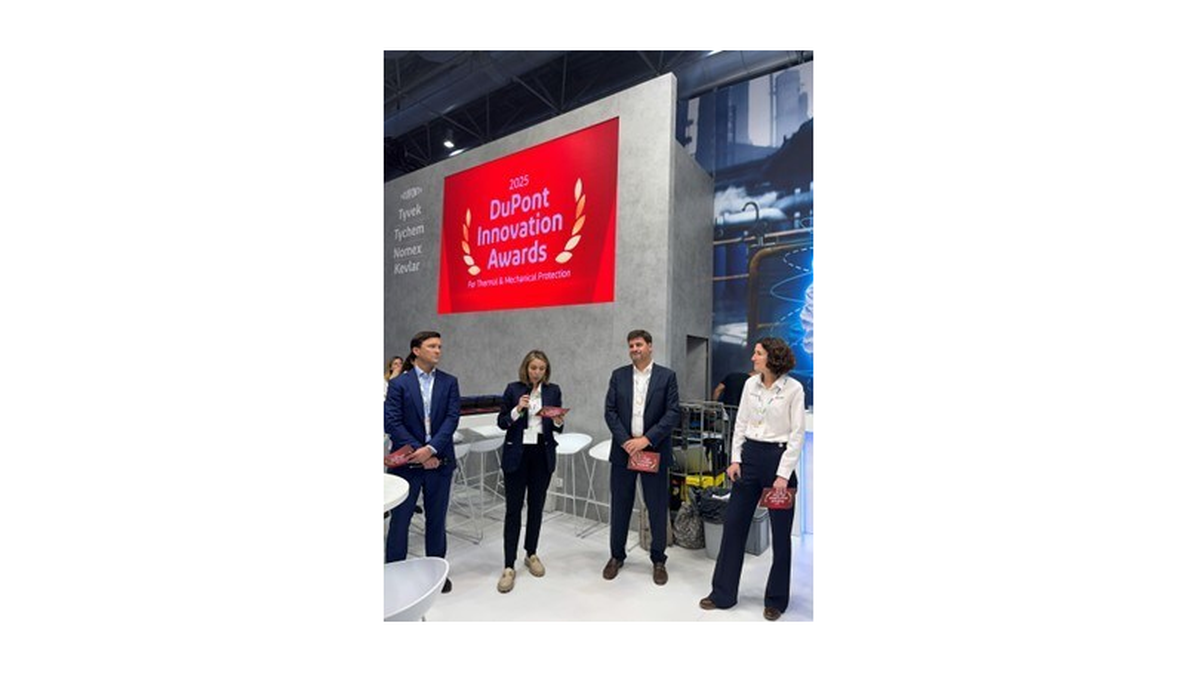
DuPont Innovation Awards Recognize the Best PPE and Fabrics Against Emerging Risks
BusinessLine· 2025-11-20 09:23
Core Insights - DuPont announced the winners of the 2025 DuPont Innovation Awards for Thermal and Mechanical Protection, recognizing advancements in personal protective equipment (PPE) and Emergency Response industries, marking the first global edition of the awards [1][3] Group 1: Award Overview - The awards were open to new products made using Nomex® or Kevlar® fabrics or fibers, reflecting the growing demand for multi-hazard protection due to evolving risks [1][2] - Judges evaluated entries based on product performance, innovative design, quality of manufacturing, and environmental responsibility [3] Group 2: Key Themes - Common themes among entries included reducing the environmental footprint of PPE, advancing recyclability, and addressing unprecedented electrical hazards [2] - Firefighter safety was a significant focus, with multiple entries targeting particulate hazards from electric vehicle fires [2] Group 3: Winners in Nomex® for Industrial PPE - Phenix protective clothing from Groupe Mulliez-Flory features Nomex® Comfort fabric with EcoForce™ finish, enhancing durability and sustainability for oil and gas, chemical, and electrical sectors [4] - Iturri SA developed post-consumer Nomex® Recycled garments with 30% recycled materials for the oil and gas industry [4] - The Weldforce Welding Suit from İşmont Tekstil combines flame and heat resistance with enhanced mobility [4] - SureWerx's 40 Cal LAN Series Arc Flash Suit is ultra-lightweight, providing optimal comfort while meeting high arc flash protection requirements [4] Group 4: Winners in Kevlar® for Industrial PPE - Ejendals' TEGERA® welding gloves offer heat and cut protection with optimal fit and comfort [5] - Escorts Advanced Textiles' Kevlar® SoftShield 379 Level A9 Liner provides the highest cut protection level (A9) with soft Kevlar®-based fabric [5] - PIP Global Safety's G-Tek® Paradox™ Cut Resistant Gloves deliver outstanding dexterity and heat resistance [5] - S.E.R.B. Regain Perform's Anti-laceration, Flame-Resistant, and Antistatic sleeve is versatile for law enforcement and glass industry workers [5] Group 5: Winners in Emergency Response - Ibena Shanghai's Rambo Outershell Fabric for firefighter suits features Nomex® spun yarn interwoven with Kevlar® filament, offering 30% higher tensile strength than conventional fabrics [6] - Kipas Mensucat Isletmeleri A.S. developed Nomex® Xtreme Max for high mechanical performance in firefighter suits [6] - PGI Safety Ltd's BarriAire Carbon Laminate Nano Flex Particulate Hood enhances performance for firefighters [6] - Alpex Protection Particulates' Nomex® Nano FlexLAM AIR hoods feature an innovative air cushion for increased breathability and thermal protection [6] Group 6: Additional Innovations - Sofileta's 7158 Navy protective fire-resistant knit fabric protects against electric arc hazards and chemical liquids [7] - Theodolf Fritsche GmbH's Elastic Premium fabric uses a unique elastic yarn that is more durable than Elasthan [7]

DuPont Advances MOLYKOTE Growth Strategy With China Expansion
ZACKS· 2025-11-19 13:31
Core Insights - DuPont de Nemours, Inc. has initiated the construction of a new MOLYKOTE specialty lubricants manufacturing facility in Zhangjiagang, Jiangsu Province, aimed at enhancing the company's global expansion and innovation strategy [2][3][4] Investment Highlights - The new facility is set to begin operations by early 2027 and is strategically located in the Yangtze River International Chemical Industrial Park within the Zhangjiagang Free Trade Zone [2][7] - This investment reflects DuPont's commitment to meeting the increasing demand for high-performance lubrication technologies in China and the Asia-Pacific region, particularly in sectors such as transportation, industrial equipment, energy, and electronics [3][4] Operational Strategy - By establishing production closer to key customers, DuPont aims to reduce lead times, improve responsiveness, and foster collaboration for real-time engagement in application development [3][7] - The facility will also function as an innovation center, enhancing DuPont's application engineering and formulation capabilities, allowing for quicker responses to customer needs and accelerating the development of next-generation MOLYKOTE solutions [4][5] Market Position - The MOLYKOTE business has a robust global presence, supported by R&D and manufacturing sites across North America, Europe, and the Asia-Pacific region, with the new China facility reinforcing DuPont's long-standing legacy in specialty lubricants [5][6] - MOLYKOTE technologies have been developed for over 75 years to address wear and friction challenges across various industries, including greases, oils, anti-friction coatings, dispersions, pastes, and compounds [5]
