
HPE(HPE)

Search documents
Hewlett Packard Enterprise (NYSE:HPE) Faces Challenges Amid Memory Price Surge
Financial Modeling Prep· 2025-11-24 20:00
Core Viewpoint - Hewlett Packard Enterprise (HPE) is experiencing mixed market sentiments with a recent upgrade from Citigroup but facing challenges due to rising memory prices impacting margins [1][2][3][6] Company Summary - Citigroup upgraded HPE's rating to "Positive" from "Buy," with the stock priced at $20.52 [1][6] - Morgan Stanley downgraded HPE from "overweight" to "equal weight," leading to a 7% drop in its stock price [2][3][6] - HPE's current stock price is $20.99, reflecting a 2.31% increase, with a market cap of approximately $27.69 billion [3][6] Industry Summary - Rising memory prices are creating a "pricing supercycle" for NAND and DRAM, which could negatively affect Original Equipment Manufacturers (OEMs) like HPE and Dell [2] - The memory price surge has particularly impacted Dell, resulting in a downgrade from "overweight" to "underweight" and a price target reduction from $144 to $110 [4] - Other companies like HP Inc and Lenovo also experienced share drops of up to 6% due to the memory price surge [4] - Morgan Stanley maintains a positive outlook on Pure Storage and Apple, indicating that not all companies are equally affected by the memory price surge [5]


US vendors Apple, Cisco, Broadcom, HPE jointly oppose Jio, Vodafone Idea on 6GHz band
ETTelecom.com· 2025-11-24 02:34
Core Viewpoint - US technology companies, including Amazon and Qualcomm, oppose the allocation of the upper 6GHz band for International Mobile Telecommunications (IMT) services, advocating instead for the entire 6GHz band to be designated for Wi-Fi services due to concerns over technical and commercial readiness [1][8][10] Group 1: Spectrum Allocation and Auction - The Indian government has stated that 400MHz of airwaves in the 6GHz band are available for auction, with an additional 300MHz expected by 2030, and 500MHz to be delicensed for low-power applications like Wi-Fi [2][10] - Reliance Jio is pushing for the entire 1200MHz spectrum in the 6GHz band to be included in the upcoming auction, despite the government's decision to delicence part of the band for low-power applications [2][10] - Airtel and Qualcomm have called for the deferment of the auction for the 6425-6725 MHz and 7025-7125 MHz bands, citing the need for ecosystem readiness and alignment with global standards [4][10] Group 2: Industry Associations' Stance - The Cellular Operators Association of India (COAI) opposes the delicensing of the 6GHz band, arguing that licensed IMT spectrum is essential for quality service and scalability for future applications like 6G [5][6][10] - COAI warns that delicensing any part of the 6GHz band could permanently limit India's digital capacity and affordable service provision [6][10] - The Manufacturers Association of Information Technology (MAIT) supports the idea of allowing unlicensed access in the lower 6GHz band and suggests extending this to parts of the upper 6GHz for future Wi-Fi generations [7][10]



HPC市场迎来十年最快增长
半导体行业观察· 2025-11-23 03:37
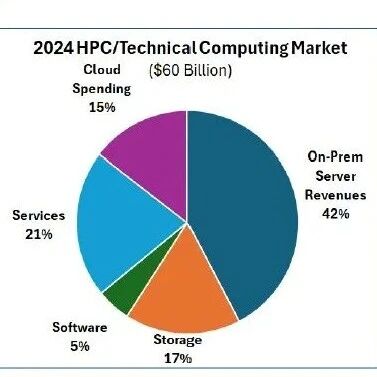
Core Insights - The article discusses the significant growth in data center infrastructure spending driven by AI training and inference cluster architectures, which also positively impacts the HPC (High-Performance Computing) architecture [1][2]. HPC-AI Market Overview - According to Hyperion Research, the global HPC spending over the past three years and future five-year forecasts indicate a robust market [2]. - The HPC-AI market is projected to generate $59.93 billion in total sales in 2024, reflecting a 23.5% growth compared to 2023, with on-premises HPC-AI systems contributing $50.39 billion (up 22.9%) and cloud HPC-AI systems contributing $9.54 billion (up 4.9%) [4][5]. Future Projections - For 2025, the overall HPC-AI market is expected to bring in $58.963 billion, a 17% increase from 2024, with cloud consumption at $12.38 billion and on-premises systems at $57.75 billion [5][6]. - The growth rate is anticipated to stabilize at around 7% to 8% annually by the end of the decade, which is still double the historical average [6]. Spending Breakdown - In 2024, cloud computing consumption will account for 15.9% of the HPC-AI product spending, with 30% of cloud spending allocated to storage, compared to 21.7% for on-premises HPC-AI centers [8]. - Services constitute a significant portion of the HPC-AI budget, primarily for system installation, maintenance, and technical support, while software accounts for only 5% of the total budget [8]. Revenue by Vendor - In 2024, the leading vendors in the HPC-AI market include HPE with $7.151 billion (28.2% market share), Dell Technologies with $3.916 billion (15.5%), and Lenovo with $1.450 billion (5.7%) [13][14]. - Non-traditional suppliers, referred to as Original Design Manufacturers (ODMs), have revenue nearly equal to HPE, indicating a competitive landscape [14]. Market Segmentation - The HPC-AI market is segmented into various price ranges, with the largest share (27.9%) coming from large HPC systems priced between $1 million and $10 million, while entry-level HPC systems (under $250,000) account for 24.3% [15]. Investment Trends - Investment in HPC-AI systems is accelerating, as evidenced by new supercomputers announced by the US Department of Energy, which are expected to stabilize revenue over time due to a shift towards cloud models [17].




慧与科技(HPE.US)收购瞻博网络或再受阻 美国多州获准介入
智通财经网· 2025-11-19 08:50
Core Points - A judge has allowed some states to intervene in Hewlett Packard Enterprise's (HPE) $14 billion acquisition of Juniper Networks, while the U.S. Department of Justice has proposed a settlement to allow the deal to proceed [1] - HPE's spokesperson expressed opposition to the ruling but believes an objective review will conclude that the settlement is appropriate [1] - The U.S. Department of Justice initially filed a lawsuit to block the deal, citing concerns over competition and market control [1] - Colorado and other states are requesting an investigation into the role of lobbying groups associated with the Trump administration in the agreement [1] - New terms from the U.S. Department of Justice require HPE to sell its instant connection wireless network business to a strong competitor and prohibit HPE from repurchasing that business for ten years [2] Summary by Sections Legal Proceedings - A judge has stated that some states can intervene in HPE's acquisition of Juniper Networks [1] - The U.S. Department of Justice has proposed a settlement to allow the transaction to continue [1] Company Response - HPE's spokesperson disagrees with the judge's ruling but is confident in the settlement's appropriateness [1] Regulatory Concerns - The U.S. Department of Justice filed a lawsuit to block the acquisition, claiming it would suppress competition [1] - Colorado and other states are seeking an investigation into lobbying influences related to the deal [1] New Conditions - The U.S. Department of Justice has introduced new terms requiring HPE to divest its wireless network business and prohibits repurchase for ten years [2]
US states can intervene in case over HPE's $14 billion Juniper acquisition, judge rules
Reuters· 2025-11-18 19:47
Core Viewpoint - A group of U.S. states is allowed to intervene in the case regarding Hewlett-Packard Enterprise's $14 billion acquisition of Juniper Networks, which the U.S. Department of Justice has proposed to settle [1] Group 1 - The acquisition deal is valued at $14 billion, indicating a significant investment by Hewlett-Packard Enterprise [1] - The U.S. Department of Justice has proposed a settlement regarding the acquisition, suggesting regulatory scrutiny and potential concerns about market competition [1] - The involvement of multiple U.S. states in the case highlights the importance of the acquisition and its potential impact on the industry [1]

人工智能云市场:解读算力背景-对话 Lambda 高管-The AI Cloud Market Making sense of the compute backdrop - aconversation with a Lambda executive
2025-11-18 09:41
Summary of Key Points from the Webinar on AI Cloud Market Industry Overview - The discussion centers around the AI cloud market, specifically focusing on Lambda, a cloud service provider that primarily rents NVIDIA GPUs and offers various software services [1][15]. Core Insights 1. **Neocloud Business Model**: Neoclouds provide speed and flexibility, allowing hyperscalers to offload Capex risk and fill capacity gaps quickly, which is crucial during periods of under-forecasting or bureaucratic delays [2][24]. 2. **Enterprise Adoption of AI**: While enterprise adoption of AI is slower, companies are developing generative AI solutions using hyperscaler infrastructure. Many enterprises are building their own AI capabilities but are still reliant on hyperscalers for capacity [3][23]. 3. **Supply Chain Constraints**: The industry faces significant bottlenecks, particularly in networking, data center space, and power availability. GPU lead times are manageable, but data center availability is low, leading to contracts being signed well into the future [4][30]. 4. **Power Bottlenecks**: Power availability is a critical constraint, with many data centers operating at less than 2% capacity. Companies are exploring off-grid solutions and natural gas generation to address these issues [32][36]. 5. **NVIDIA's Dominance**: NVIDIA remains the leading provider in the GPU market, with its products being preferred for their performance and total cost of ownership. Competitors like AMD are lagging due to inferior software support [6][40]. Competitive Landscape 1. **Lambda's Position**: Lambda competes with other neoclouds and hyperscalers, focusing on providing quick deployment and flexibility. Its primary competitors include Coreweave and Nebius [20][21]. 2. **OEM vs. ODM Suppliers**: Lambda primarily partners with OEMs for reliability and support, despite ODMs offering lower prices. The trade-off in pricing is often not worth it for standard architectures [7][33]. 3. **Market Leaders**: Dell and Super Micro lead the AI server market, with Dell benefiting from high-quality servers and financing options, while HPE is seen as lagging behind [8][12]. Financial Insights 1. **Investment Implications**: - NVIDIA (Outperform, $225): Significant upside potential in the datacenter market. - AVGO (Outperform, $400): Strong growth trajectory expected in AI. - DELL (Outperform, $180): Large upside opportunities in AI servers and storage [11][12]. 2. **Contract Durations**: Standard contracts for hyperscalers typically last 5 years, with the effective useful life of GPUs expected to extend to 7-8 years due to warranty provisions [42][43]. Additional Considerations 1. **Emerging Technologies**: TPUs are gaining traction in the market, but NVIDIA's GPUs remain superior for inference tasks. The software ecosystem is a significant factor in hardware competitiveness [37][39]. 2. **Future Power Solutions**: The industry is looking towards nuclear and off-grid solutions to meet future power demands, but these will take time to implement [35][36]. This summary encapsulates the key points discussed in the webinar, highlighting the dynamics of the AI cloud market, Lambda's positioning, and the broader industry challenges and opportunities.


谁将为“存储超级周期”买单?
财联社· 2025-11-18 02:35
Core Viewpoint - The semiconductor memory market is experiencing a "super cycle" with significant price increases, impacting the profitability of OEMs and ODMs, particularly in the hardware sector [3][6]. Group 1: Market Dynamics - Memory prices for NAND and DRAM have surged by 50% to 300% over the past six months, with expectations of continued quarterly increases in 2026 [3]. - The demand from hyperscale cloud service providers and a shift towards high-bandwidth memory are key drivers of this price surge [3]. Group 2: Company Ratings and Forecasts - Morgan Stanley downgraded Dell Technologies from "Overweight" to "Underweight," reducing its target price from $144 to $110, with Dell's stock falling over 7% [3][5]. - The forecast for Dell's gross margin for FY27 has been lowered to 18.2%, a decrease of 220 basis points from previous estimates [5]. - Hewlett Packard's rating was downgraded from "Hold" to "Underweight," with a target price cut from $26 to $24, while Hewlett Packard Enterprise was downgraded to "Hold" with a target price of $25 [5]. Group 3: Resilience Among Companies - Apple and Pure Storage are viewed as more resilient to memory price fluctuations due to their differentiated business models and higher software revenue proportions [6]. - Morgan Stanley maintains an "Overweight" rating for Apple, the only U.S. tech hardware company to receive this rating, and raised Pure Storage's target price from $72 to $90 [5][6].


S&P 500 Gains and Losses Today: Dell Stock Drops; Google Parent Alphabet Climbs on Bet by Buffett's Berkshire
Investopedia· 2025-11-17 21:35
Group 1: Market Performance - Major U.S. equities indexes declined at the start of the trading week, with the Nasdaq falling 0.8%, the S&P 500 sliding 0.9%, and the Dow dropping 1.2% [2] - Google parent Alphabet was the top performer in the S&P 500, with shares jumping 3% after Berkshire Hathaway disclosed a new stake in the company [6][8] Group 2: Company-Specific Developments - Dell Technologies shares dropped over 8% after Morgan Stanley downgraded the stock to "underweight" due to concerns about rising memory chip prices affecting gross margins [3][8] - Hewlett Packard Enterprise also faced a downgrade from Morgan Stanley, with shares sinking 7% [3] - Generac Holdings saw its shares decline around 7% following weaker-than-expected third-quarter results, attributed to a decline in power outages impacting residential generator sales [5] Group 3: Industry Trends - Rising prices for memory components are expected to pressure margins for several computer hardware manufacturers [3][8] - Google launched AI-enabled travel tools, which negatively impacted shares of competing online travel booking platforms, with Expedia Group losing nearly 8% [9]


Dell, HPE shares sink after Morgan Stanley downgrades — computer hardware stocks also hit
CNBC· 2025-11-17 21:11
Core Insights - Data center stocks experienced significant declines following Morgan Stanley's downgrade of seven hardware companies, including Dell and Hewlett Packard Enterprise (HPE) [1] - The downgrades reflect concerns over an unprecedented pricing "supercycle" affecting computer makers, driven by increased demand from hyperscalers [2] - Rising costs in DRAM and NAND memory are expected to pressure margins, with memory fulfillment rates potentially dropping to 40% in the next two quarters, posing risks to future earnings estimates [3] Group 1: Company Downgrades - Morgan Stanley downgraded Dell from overweight to underweight, resulting in an 8% drop in its stock price [1] - HPE was downgraded from overweight to equal weight, leading to a 7% decline in its stock price [1] - Other companies such as HP Inc, Asustek, and Pegatron were downgraded from equal weight to underweight, with share prices dipping up to 6% [2] Group 2: Market Dynamics - Analysts noted that the current environment is characterized by a pricing "supercycle" as hyperscalers drive demand for data center hardware, pushing valuations to all-time highs [2] - The impact of rising memory costs on margins is highlighted, with memory accounting for 10-70% of a product's bill of materials, indicating a significant risk to earnings estimates for the hardware sector [3]

HPE's Cloud Portfolio Gains Momentum: What's Driving the Growth?
ZACKS· 2025-11-17 16:36
Core Insights - Hewlett Packard Enterprise's (HPE) hybrid cloud segment experienced a year-over-year growth of 14.2% in Q3 of fiscal 2025, driven by its diverse solutions in storage, private cloud, infrastructure, and software-as-a-service [1][9] Hybrid Cloud Solutions - HPE provides capabilities for virtual machines and containers in its private cloud offerings, enabling customer self-management [2] - The company launched its Hybrid Cloud Ops Suite, integrating various tools to enhance customer experience [3] Performance Metrics - HPE shipped over 5,000 Alletra MP arrays in 2025, achieving triple-digit revenue growth, and added 2,000 new users to its GreenLake cloud, totaling 44,000 customers [4][9] - The number of private cloud AI customers doubled sequentially in Q3 of fiscal 2025, contributing to HPE's rapid top-line growth [5] Competitive Landscape - HPE competes with major players like Amazon and Microsoft, with Amazon leading in cloud services and Microsoft having a strong enterprise presence through Azure Stack [6][7] - HPE differentiates itself by integrating private cloud, AI factory, and networking solutions [7] Financial Performance and Valuation - HPE's shares have increased by 6.9% year-to-date, compared to the Zacks Computer - Integrated Systems industry's growth of 87.6% [8] - The Zacks Consensus Estimate for HPE's fiscal 2025 earnings is $1.90 per share, reflecting a 4.5% decrease year-over-year, while fiscal 2026 estimates indicate a 24% increase to $2.36 per share [10] - HPE trades at a forward price-to-sales ratio of 1.28, significantly below the industry's average of 7.87 [11]
