IBM(IBM)

Search documents
IBM to Support Missile Defense Agency SHIELD Contract
Prnewswire· 2026-02-05 14:00
Core Insights - IBM has been awarded a contract by the Missile Defense Agency for the SHIELD program, with a ceiling value of $151 billion, aimed at enhancing defense capabilities through innovative technology delivery [1][2]. Company Overview - IBM has a long-standing history of supporting the U.S. federal government, focusing on technology that improves mission outcomes while ensuring security [2]. - The company is leveraging its expertise in AI and advanced technology to enhance efficiency, productivity, and decision-making in defense operations [2][3]. - IBM's commitment to trust, transparency, and inclusivity underpins its service offerings, which include hybrid cloud solutions and AI innovations [3]. Contract Details - The SHIELD program contract is an indefinite-delivery/indefinite-quantity (IDIQ) agreement, allowing for rapid delivery of capabilities to the warfighter [1]. - The contract encompasses a wide range of work areas, emphasizing speed and agility in delivering innovative solutions [1]. Strategic Importance - IBM aims to equip the warfighter with advanced capabilities to respond effectively in complex threat environments, highlighting the importance of agility and confidence in defense operations [3]. - The partnership with the Missile Defense Agency is positioned as a critical step in accelerating the deployment of modern defense capabilities [3].



芯片太热,怎么办?
半导体行业观察· 2026-02-05 01:08
Core Viewpoint - The article discusses the challenges of heat dissipation in modern semiconductor technology, particularly as transistor sizes shrink and power density increases due to advancements in artificial intelligence. IBM's Thermonat project aims to address these challenges by modeling semiconductor thermal behavior at the atomic level, achieving unprecedented accuracy and speed in predictions [2][3][6]. Group 1: Heat Dissipation Challenges - The speed of new smartphone releases has slowed due to heat dissipation issues arising from increased processing power in confined spaces [2]. - The shrinking size of transistors has led to significant heat generation, complicating the design of cooling systems for new chips [3][6]. Group 2: IBM's Thermonat Project - IBM's Thermonat project focuses on overcoming heat dissipation challenges by accurately modeling thermal behavior in semiconductors, achieving prediction accuracy within 1 degree Celsius, which is 0.002% [6]. - The project utilizes machine learning to create simplified models that maintain accuracy while reducing data processing requirements, resulting in simulation speeds that are 50,000 times faster than existing methods [5][6]. Group 3: Multidisciplinary Approach - The success of the Thermonat project is attributed to the collaboration of multidisciplinary experts within IBM, including materials scientists and thermal system specialists, leveraging extensive internal semiconductor data [8]. - The project also benefits from partnerships with companies like Synopsys, utilizing advanced machine learning techniques to enhance model accuracy and speed [8]. Group 4: Implications for Chip Design - Improved thermal modeling tools will enable engineers to design chip layouts that consider heat dissipation, potentially enhancing chip performance and efficiency [3][9]. - The methodologies developed in the Thermonat project can be applied broadly across semiconductor applications where heat generation is a concern, indicating a versatile tool for future chip development [9].

2纳米被疯抢的原因
半导体行业观察· 2026-02-05 01:08
Core Insights - The introduction of 2nm and more advanced process nodes will require new power consumption and thermal management methods, while also providing greater design flexibility and more options for performance enhancement and cost optimization [2] - The semiconductor market is evolving, with a shift from traditional low-power chips for mobile devices and high-performance chips for servers to more specialized applications driven by artificial intelligence [2][3] - The transition to multi-die components allows for prioritization of different processors and functionalities, simplifying emergency plans during component shortages [2][3] Group 1: Design and Manufacturing Challenges - The complexity of integrating various components in chipsets is significant, as designing and manufacturing chipsets is easier than integrating them [4] - A hybrid design approach allows for the combination of different standard cells, enhancing flexibility and performance while managing power consumption [5] - The interconnect technology between chips has improved, allowing for the mixing of different process nodes, which helps mitigate cost and yield challenges [6] Group 2: Performance and Power Management - The performance and power advantages of new nodes are not absolute; the real value lies in how close the system can approach the physical limits of silicon [7] - The economic benefits of 2nm technology depend on intelligent management of the power band, as excessive power bands can lead to wasted investments [7] - The trend of increasing power density with each new node presents challenges in thermal management, necessitating advanced cooling solutions [11][12] Group 3: Market Dynamics and Future Directions - The reasons for upgrading to higher process nodes are no longer based on a single factor but vary by market segment and workload [15] - The integration of multiple nodes in a single design is becoming more common, with new PPA/C trade-offs to balance priorities in large systems [15] - The semiconductor industry is at a turning point, requiring continuous management of correctness rather than assuming everything is normal at acceptance [10]


Tech Sell-Off Weighs on Broader Market, Dow Defies Trend Amid Key Earnings and Economic Data
Stock Market News· 2026-02-04 17:07
Market Overview - The U.S. stock market is experiencing mixed trading patterns with a notable rotation out of technology giants and into broader market sectors [1] - The S&P 500 has slipped around 0.2% to 0.3%, marking a modest decline for the fourth time in the last five days [2] - The Nasdaq Composite has traded approximately 1% lower, with the Nasdaq 100 specifically seeing a 1.4% loss [2] - The Dow Jones Industrial Average has risen by as much as 389 points, or 0.8%, indicating a shift away from tech stocks towards firms expected to benefit from improving growth prospects [2] Economic Indicators - The yield on 10-year Treasuries has remained steady at 4.28% [3] - Upcoming economic data includes the ADP Employment Change and ISM Services PMI for January, which are crucial for assessing the labor market and services sector [5] - The week will culminate with the U.S. Employment Report on February 6th, which includes non-farm payrolls and average hourly earnings [6] Company-Specific Highlights - Advanced Micro Devices (AMD) shares dropped by as much as 15.7% despite stronger-than-expected profits, indicating high expectations for AI-related companies [9] - Uber Technologies (UBER) fell 3% to 5% after its quarterly results and profit forecast fell short of expectations [10] - Super Micro Computer (SMCI) rallied by 12% to 14% after delivering stronger-than-expected profits [10] - Eli Lilly (LLY) surged by 9.2% after exceeding profit expectations and providing strong guidance, driven by its obesity drugs [11] - Silicon Laboratories (SLAB) shares soared by 51% following the announcement of its acquisition by Texas Instruments for approximately $7.5 billion [13] - Nvidia (NVDA) shares declined 2.8% due to a broad tech sell-off and uncertainty surrounding its OpenAI investment [14]







Should IBM Stock Be Part of Your Portfolio Post Solid Q4 Earnings?
ZACKS· 2026-02-04 15:01
Core Insights - IBM reported strong fourth-quarter 2025 results, with adjusted earnings and revenues exceeding Zacks Consensus Estimates, driven by robust software growth from hybrid cloud and watsonx AI platform, continued momentum in Red Hat, healthy consulting demand, and improved cost efficiency [1][8] Financial Performance - IBM's earnings estimates for 2026 have increased by 1.3% to $12.35, while estimates for 2027 have risen by 1.4% to $13.29, indicating positive sentiment regarding the stock's growth potential [9] - The company has seen an 11.9% stock price increase over the past year, outperforming industry growth of 118.1% and competitors like Amazon and Microsoft [6] Business Strategy - IBM is focusing on hybrid cloud and AI as key growth drivers, with expectations of benefiting from analytics, cloud computing, and security in the long run [3] - The acquisition of HashiCorp has enhanced IBM's capabilities in managing complex cloud environments, complementing its Red Hat portfolio [4] Technology and Innovation - The watsonx platform is central to IBM's AI capabilities, offering foundational models to enhance enterprise productivity through its three products: watsonx.ai, watsonx.data, and watsonx.governance [5] Market Challenges - Despite strong performance in hybrid cloud and AI, IBM faces stiff competition from Amazon Web Services and Microsoft Azure, leading to pricing pressure and margin erosion [10] - The company is undergoing significant job cuts, particularly in India, to reduce operating costs and focus on high-margin AI and software sectors [11]

As IBM Stock Breaks Below Its 100-Day Moving Average, Should You Buy the Dip?
Yahoo Finance· 2026-02-04 14:59
International Business Machines (IBM) shares have lost more than 6% this week after Anthropic launched new plugins for Claude Cowork, signaling it’s now moving into the application layer. The downward pressure on IBM has pushed its price below a key support level — coinciding with its 100-day moving average (MA), signaling the bearish momentum could sustain in the near-term. More News from Barchart Despite the recent selloff, IBM stock remains up more than 25% versus its August low. www.barchart.com ...
What's Going On With IBM Stock Wednesday? - IBM (NYSE:IBM)
Benzinga· 2026-02-04 11:19
Core Insights - IBM's stock has seen a rise in premarket trading following the announcement of a global request for proposals (RFP) aimed at leveraging artificial intelligence for transformative education and workforce development [1][2] Group 1: AI Initiative and Education - The initiative is part of the IBM Impact Accelerator program, which aims to collaborate with nonprofits and government organizations to improve learning and career transition solutions [2] - IBM's announcement underscores the urgent need for educational institutions to adapt to rapidly changing job requirements due to AI advancements, with 67% of executives believing that job roles are becoming shorter-lived and many current employee skills expected to be obsolete by 2030 [3] Group 2: RFP Objectives - The RFP seeks to address the challenges in education by inviting organizations to create AI-enabled tools that enhance teaching, learning, and workforce preparation [4] Group 3: Earnings and Analyst Insights - Investors are anticipating the next earnings report scheduled for April 22 [5] - The stock currently holds a Buy Rating with an average price target of $282.21, with recent analyst actions indicating a competitive edge in the market [6] - Key financial estimates include an EPS of $1.80 (up from $1.60 YoY) and a revenue estimate of $15.60 billion (up from $14.54 billion YoY), indicating a premium valuation with a P/E of 26.4x [7]
IBM Opens Global RFP for AI-Driven Solutions Shaping the Future of Work and Education
Prnewswire· 2026-02-04 09:00
Core Insights - IBM has launched a global request for proposals (RFP) for the next cohort of the IBM Impact Accelerator, focusing on AI for transformative education and workforce development [1][4] - The widening gap between education and employer needs is highlighted, with 67% of executives noting that job roles are becoming shorter-lived, and by 2030, 57% expect most current employee skills to be obsolete [2][3] - The initiative aims to support organizations that leverage AI to enhance learning, upskilling, and job placement in response to rapid economic changes driven by AI [3][4] Group 1: Program Details - The IBM Impact Accelerator invites nonprofits and government organizations to collaborate on solutions that improve learning effectiveness and career transitions [1][3] - Selected organizations will receive a two-year, pro bono technology and implementation grant, including access to IBM's AI technologies and support from its ecosystem [5] - The RFP is open for submissions until March 25, 2026, with eligibility criteria available on the IBM Impact Accelerator webpage [6] Group 2: Economic Context - The U.S. economy incurs an estimated cost of $1.1 trillion annually due to slow transitions between education and work [2] - Many education and workforce institutions lack the necessary data infrastructure and tools to adapt to the fast-paced changes in the labor market [3] - The program aims to address these systemic challenges by supporting innovative projects that apply AI to education and workforce preparation [4][5] Group 3: IBM's Commitment - Launched in 2022, the IBM Impact Accelerator is part of a broader commitment to invest up to $45 million over five years to support communities facing environmental and economic challenges [7] - The program has already supported 25 organizations, benefiting approximately 2.5 million people across various sectors [7]

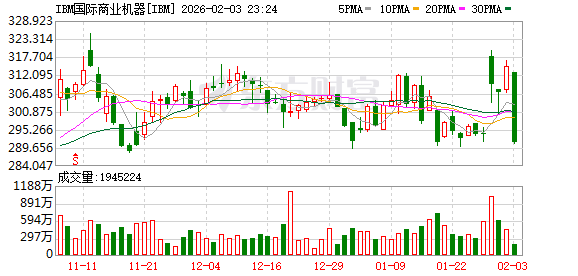
IBM股价下跌6.3%
Mei Ri Jing Ji Xin Wen· 2026-02-03 15:23
(文章来源:每日经济新闻) 每经AI快讯,2月3日,IBM股价下跌6.3%,有望创下六个月来的最大单日跌幅。 ...
ETFs to Watch as IBM Shares Jump Following Q4 Earnings Beat
ZACKS· 2026-02-03 15:21
Core Insights - IBM's shares increased by 5.1% following the release of its better-than-expected fourth-quarter 2025 results, surpassing analysts' estimates on both earnings and revenue [1][10] Financial Performance - IBM reported adjusted earnings per share (EPS) of $4.52, exceeding the Zacks Consensus Estimate by 4.4%, while revenues surpassed the consensus mark by 2.5% [5] - Year-over-year, both EPS and revenues grew by double digits, with a 9% revenue growth at constant currency marking the highest level in over three years [5] - The company ended 2025 with a strong liquidity position, holding cash of $14.5 billion, and reported free cash flow of $7.55 billion in the fourth quarter, up from $6.16 billion in the prior year [8] Segment Performance - All four segments of IBM registered positive year-over-year growth, with the Infrastructure unit showing the strongest increase of 21%, driven by the z17 platform [6] - IBM's cumulative GenAI book of business exceeded $12.5 billion, with the Software unit contributing over $2 billion and Consulting over $10.5 billion, both achieving their largest quarterly increases to date [6] Future Outlook - IBM expects annual revenue growth to exceed 5% by the end of 2026 on a constant-currency basis, driven by a strong portfolio mix and productivity-related yield [2] - The company projects free cash flow to increase by $1 billion [2] Analyst Reactions - Following the earnings release, Bank of America analyst reiterated a buy rating and raised the target price from $335 to $340, while Bernstein SocGen Group analyst raised the price target to $330 from $280, maintaining a "Market Perform" rating [11] ETFs to Consider - Several ETFs hold significant stakes in IBM, including: - **First Trust NASDAQ Technology Dividend Index Fund (TDIV)**: $3.81 billion in net assets, 7.81% weightage in IBM, surged 24.7% over the past year [13] - **FT Vest Technology Dividend Target Income ETF (TDVI)**: $281 million in net assets, 7.81% weightage in IBM, soared 14.9% over the past year [14] - **AXS Green Alpha ETF (NXTE)**: Actively managed portfolio with 6.04% weightage in IBM, rallied 28.3% over the past year [15] - **State Street SPDR Portfolio S&P Sector Neutral Dividend ETF (SPDG)**: $11.8 million in net assets, 5.71% weightage in IBM, gained 13% over the past year [16] - **Invesco Dow Jones Industrial Average Dividend ETF (DJD)**: $415.7 million in market value, 5.40% weightage in IBM, rallied 13.1% over the past year [17]