
KKR(KKR)

Search documents
KKR's Chris Sheldon on Credit Strategy, Spreads, M&A
Yahoo Finance· 2026-02-18 21:52
Core Insights - KKR's Co-Head of Credit & Markets, Christopher Sheldon, discusses the firm's 2026 credit strategy report, highlighting the current market conditions and investor challenges [1] - The report emphasizes the tight credit spreads in the market, which are occurring alongside an increase in M&A activity [1] Market Conditions - Investors are facing challenges due to tight credit spreads, which can limit the availability of capital for new investments [1] - The rising M&A activity indicates a competitive landscape, where companies are actively seeking growth opportunities through acquisitions [1]

Reddit, KKR, and 2 Biotech IPOs Seeing the Love From Insiders
247Wallst· 2026-02-16 13:40
Core Insights - Insider buying has been observed in four notable companies: KKR, Reddit, SpyGlass Pharma, and Veradermics, indicating management's confidence in their future prospects [1] Group 1: Insider Buying Activity - SpyGlass Pharma saw significant insider purchases, with RA Capital Management acquiring approximately 3.7 million shares and NEA adding 937,500 shares at the IPO price of $16.00 per share [1] - Veradermics had Suvretta Capital Management purchase 282,700 shares at a weighted average price of about $36.50, totaling $10.5 million, reflecting a nearly 20% increase in their stake over six months [1] - Reddit's director bought 50,500 shares between $139.11 and $150.00, totaling nearly $7.5 million, marking one of the first major purchases post-IPO lock-up [1] - KKR's director purchased 50,000 shares at prices ranging from $104.36 to $107.10, totaling over $5.2 million, amidst a 22.5% stock retreat in the past month [1] Group 2: Company Performance and Analyst Sentiment - SpyGlass Pharma's stock is trading near $28.20, above the IPO price, with analysts giving a Strong Buy consensus due to its potential in the $5 billion glaucoma market [1] - Veradermics received an Overweight rating from Wells Fargo following successful Phase 3 trial enrollment, with shares currently at $43.46, reflecting a 19% gain for insiders [1] - Reddit's stock is currently at $139.65, with analysts remaining bullish on its high-margin data licensing deals despite recent volatility [1] - KKR reported record assets under management exceeding $740 billion, with analysts optimistic about private equity firms benefiting from the IPO market reopening [1]


KKR & Co. Inc. (KKR) Builds Scale Across Markets and Sectors
Insider Monkey· 2026-02-15 09:09
Core Insights - Generative AI is viewed as a transformative technology by Amazon's CEO Andy Jassy, indicating its potential to significantly enhance customer experiences [1] - Elon Musk predicts that humanoid robots could create a market worth $250 trillion by 2040, representing a major shift in the global economy driven by AI innovation [2] - Major firms like PwC and McKinsey acknowledge the multi-trillion-dollar potential of AI, suggesting a broad consensus on its economic impact [3] Company and Industry Analysis - A breakthrough in AI technology is redefining work, learning, and creativity, leading to increased interest from hedge funds and top investors [4] - There is speculation about an under-owned company that may play a crucial role in the AI revolution, with its technology posing a threat to competitors [4] - Prominent figures in technology and investment, including Bill Gates and Warren Buffett, recognize AI as a significant advancement with the potential for substantial social benefits [8] Market Opportunities - The AI ecosystem is expected to reshape how businesses, governments, and consumers operate, indicating vast investment opportunities [2] - The narrative suggests that investors may soon regret not owning shares in a specific AI company that is positioned to capitalize on this technological wave [9] - The company in question is described as quietly enhancing critical technology that underpins the AI revolution, suggesting a strategic advantage [6]

索罗斯Q4调仓路线图:猛砍Snowflake,狂买微软、英伟达,新建仓黄金股
美股IPO· 2026-02-14 04:12
Core Viewpoint - Soros Fund Management made significant adjustments to its investment portfolio in the fourth quarter, focusing on increasing exposure to tech giants while engaging in "buy high, sell low" strategies for energy and cryptocurrency stocks [1]. Group 1: Technology Sector Investments - The fund substantially increased its holdings in core technology stocks, including adding 161,000 shares of Microsoft (MSFT.US), 118,000 shares of Nvidia (NVDA.US), and approximately 66,000 shares of Apple [3]. - In the software and mobility sectors, the fund also increased its positions by acquiring approximately 216,000 shares of Atlassian (TEAM.US), 55,000 shares of Salesforce (CRM.US), and 119,000 shares of Uber (UBER.US) [3]. Group 2: Defensive and Growth Investments - In the defensive sector and consumer space, the fund increased its holdings in utility company Exelon (EXC.US) by approximately 488,000 shares and in gaming giant Electronic Arts (EA.US) by about 318,000 shares [3]. Group 3: Reduction in High Volatility and Financial Stocks - The fund reduced its positions in high-volatility and financial stocks, significantly cutting approximately 168,000 shares of Snowflake (SNOW.US) [4]. - It also reduced its holdings in Circle Internet Group (CRCL.US) by about 151,000 shares and in Interactive Brokers (IBKR.US) by approximately 813,000 shares, indicating a cautious stance towards the financial brokerage sector [5][6]. Group 4: New Positions and Exits - The fund opened new positions by purchasing gold-related assets such as New Gold (NGD.US) and established positions in DigitalBridge (DBRG.US), Blue Owl Capital (OWL.US), Exact Sciences (EXAS.US), and Xcel Energy (XEL.US) [7]. - It completely exited positions in KeyCorp (KEY.US), CareTrust REIT (CTRE.US), Cipher Mining (CIFR.US), and KKR & Co. (KKR.US), indicating a shift away from traditional banking and certain cryptocurrency mining stocks towards more stable or defensive sectors [7]. Group 5: Overall Strategy - The overall strategy of Soros Fund Management in the fourth quarter reflects a clear approach: embracing AI and core tech assets like Microsoft and Nvidia while avoiding high-volatility cloud and data companies like Snowflake, and hedging against macroeconomic uncertainties by investing in gold stocks. This "pick and choose" adjustment strategy highlights the pursuit of certainty and safety margins amid global economic uncertainties [7].







遭软件抛售潮波及,美股私募巨头高管纷纷出面安抚投资者
Zhi Tong Cai Jing· 2026-02-13 13:25
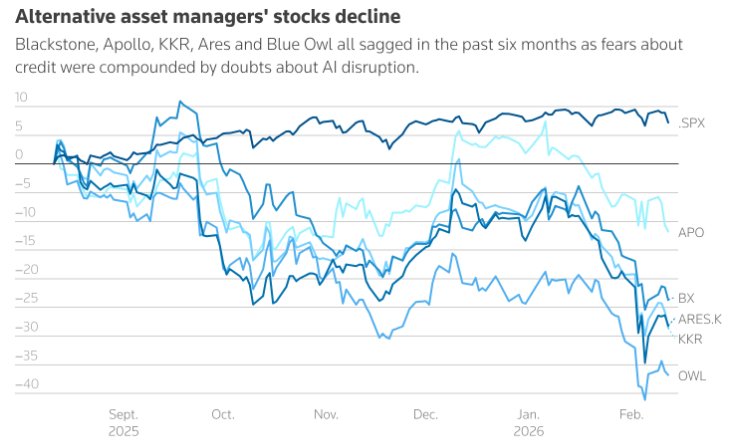
Core Viewpoint - Private equity firms are striving to convince investors that their portfolios are resilient against the recent sell-off in the software sector, driven by concerns over artificial intelligence undermining competitiveness in the industry [1] Group 1: Company Performance and Portfolio Exposure - Ares reported that approximately 6% of its overall assets are invested in software companies, with a diversified portfolio minimizing exposure to AI-related risks [2] - Apollo Global Management has less than 2% exposure to the software industry, with its private equity business having nearly zero exposure [2] - KKR has about 7% of its portfolio in the software sector, while Blue Owl has 8%, both experiencing significant stock price declines of 29% and over 36% respectively in the past six months [3][6] Group 2: Market Reactions and Investor Sentiment - Despite strong financial performance, private equity firms have seen stock sell-offs, with one firm experiencing a nearly 6% drop this week and an 11% decline over the past six months [3] - Concerns about excessive investments in AI by alternative asset management firms have led to fears of potential losses if AI fails [6][7] - Analysts suggest that the narrative around alternative asset management firms suffering losses due to AI's transformative impact may be flawed, indicating a potential misjudgment in market sentiment [7]


从高盛到黑石,华尔街巨头都来站台:软件不会垮
美股IPO· 2026-02-12 00:54
Core Viewpoint - Concerns about AI leading to the demise of the software industry are significantly exaggerated, according to executives from Goldman Sachs, Blackstone, Apollo, and KKR. They acknowledge that while AI will bring about a "dramatic technological cycle" and disruption, established software companies are likely to be protected and may even benefit from these changes [1][3][10]. Group 1: Market Reaction and Software Industry Outlook - The recent sell-off in the software sector was triggered by fears that AI could replace traditional software functions, leading to significant declines in stock prices for major companies like Salesforce and Adobe, resulting in the evaporation of hundreds of billions in market value [3][6][8]. - Executives from major financial institutions argue that the market's reaction is an "indiscriminate" sell-off, and the belief that all software companies will become obsolete is overly broad and unfounded [3][9][10]. - Apollo's John Zito stated that while the software industry will not disappear, its business logic will change, emphasizing that the usage of software is expected to increase significantly [4][5]. Group 2: Investment Risks and Diversification - KKR's CFO Robert Lewin indicated that approximately 15% of their private equity investments are exposed to software companies, which represents about 7% of their total assets, suggesting a manageable risk exposure [11]. - Goldman Sachs' CEO David Solomon downplayed the risk exposure in software investments, stating it is "insignificant" relative to the overall scale of their platform [13]. - The executives emphasized the importance of diversification in their investment portfolios to mitigate the impact of potential disruptions in the software sector [11][12].



KKR & Co. Inc. (KKR) Presents at Bank of America Financial Services Conference 2026 Transcript
Seeking Alpha· 2026-02-10 22:14
Group 1 - The article does not provide any relevant content regarding company or industry insights [1]

KKR (NYSE:KKR) 2026 Conference Transcript
2026-02-10 20:42
KKR 2026 Conference Summary Company Overview - KKR is one of the largest and oldest alternative asset managers globally, with over $700 billion in assets under management (AUM) [3][5] - The company has a differentiated business model that integrates asset management, insurance, and strategic holdings [4][5] Business Model - KKR's business model consists of three main components: 1. **Asset Management**: Over $740 billion in AUM with identifiable growth opportunities [5] 2. **Insurance**: Owns Global Atlantic with $220 billion in assets, showing significant scaling from $72 billion five years ago [5] 3. **Strategic Holdings**: Focuses on long-term ownership of businesses that generate compounding cash flow [6] - The synergy between these components enhances overall performance and allows for growth without significant increases in headcount or complexity [6][7] Recent Acquisition - KKR announced the acquisition of Arctos, which has $15 billion in AUM and is a leader in sports investments [12] - The acquisition aligns with KKR's strategic M&A framework and aims to build a $100+ billion AUM business by leveraging KKR's resources and expertise [14] Macro Environment - The macroeconomic outlook for 2026 is positive, with expectations of increased M&A activity, IPOs, and potential Fed rate cuts [15][16] - KKR anticipates a constructive year in capital markets, with more deployment and monetization opportunities [16][17] Private Equity and Real Estate - KKR's private equity business has seen a 26% growth in fee-paying assets in 2025, doubling its assets over the past five years [22] - The real estate sector has faced challenges, but KKR believes values have bottomed out and is positioned to capture market share as conditions improve [24][25] Financial Performance and Guidance - KKR aims for $4.50+ in fee-related earnings (FRE) and after-tax adjusted net income of $7+ for 2026 [35] - The company has experienced significant growth in management fees, with a 50% increase over the past three years, while operating expenses grew by less than 25% [28] - KKR has $18.6 billion in embedded gains, up 19% year-on-year, which will drive future investing earnings [40] Investment Strategy - KKR follows a linear deployment model, aiming to deploy capital steadily over the investment periods of their funds [42] - Key areas for deployment include infrastructure, Asia Pacific, and asset-based finance, with significant growth in the infrastructure business from $18 billion to $100 billion over five years [43][44] Asia Market Insights - KKR has a strong presence in Asia, with significant investments in Japan and India, and has seen a 70% increase in deployment in 2025 compared to 2024 [48] - The company believes in the growth potential of the Asian market, contributing to over half of global GDP growth in the coming decade [46] Alternative Investments in Retirement - KKR anticipates that alternative investments will play a role in the retirement channel, especially given their partnership with Capital Group [49][51] Software Exposure - KKR has a 7% exposure to software across its AUM, with 15% in private equity, which is lower than peers [54] - The company has not re-underwritten its software exposure recently but believes in the potential benefits of AI for improving margins [56] Strategic Priorities for 2026 - KKR's strategic focus will be on integrating Arctos and investing in areas where it has competitive advantages, particularly in the institutional market and private wealth [33][34] Conclusion - KKR is well-positioned for growth in 2026, with a strong business model, strategic acquisitions, and a positive macroeconomic outlook, aiming to leverage its strengths across various asset classes and markets [16][22][35]
KKR & Co. Inc. (KKR) Presents at UBS Financial Services Conference 2026 Transcript
Seeking Alpha· 2026-02-09 20:14
Macro Economic Outlook - The current macroeconomic environment is described as nuanced, influenced by various factors including geopolitics, fiscal deficits, and public policy [1] - The company has strategically invested in resources across these areas, positioning itself favorably to navigate the complexities of the current economic moment [1] Future Activity Projections - There is an expectation of increased transaction activity in 2026, indicating a positive outlook for future market engagement [2]

KKR (NYSE:KKR) 2026 Conference Transcript
2026-02-09 19:02
KKR 2026 Conference Call Summary Company Overview - KKR (NYSE: KKR) is one of the world's largest asset managers, overseeing approximately $744 billion in assets under management (AUM) as of year-end 2025. The company has a diversified platform that includes private equity, credit, infrastructure, real assets, and insurance [3][5]. Macro Economic Outlook - The macroeconomic environment is described as nuanced, influenced by factors such as rates, inflation, geopolitics, fiscal deficits, and public policy. KKR anticipates increased transaction activity in 2026, with a better deal flow compared to 2025 [5][6]. - The company is optimistic about early signs of market recovery despite recent volatility [6]. Financial Performance and Market Position - KKR's management fees increased by 35%, fee-related earnings rose over 50%, and adjusted net income grew in the mid-40s percentage range over the past two years. Capital raising in the last 12 months was up 90% compared to the previous year [7][8]. - The market is perceived to undervalue KKR's diversified business model, which includes significant contributions from private equity, real assets, and credit strategies [9][10]. Strategic Acquisition - KKR announced the acquisition of Arctos, which is expected to enhance its position in the sports asset class and the secondary market. The acquisition aligns with KKR's M&A strategy focused on large addressable markets [12][13]. - The deal is anticipated to create a business worth over $100 billion, leveraging KKR's global reach and capital access [13]. Fundraising Environment - KKR raised approximately $130 billion in 2025, up 90% from two years prior. The company aims to exceed its target of raising $300 billion between 2024 and 2026 [18][19]. - The institutional market is showing signs of recovery, with significant capital raised in both private equity and infrastructure products [19][20]. Adjusted Net Income Target - KKR has set a target of over $7 per share of Adjusted Net Income (ANI) for 2026, supported by growth in management fees, capital markets business, and operating leverage [26][27]. - The company has $18.6 billion in embedded gains and expects to generate over $900 million in monetization-related revenue [30][31]. Insurance Business Strategy - KKR's insurance business, Global Atlantic, is expected to generate around $1 billion in operating income in 2026. The strategy involves elongating liabilities and scaling third-party capital to enhance returns [34][37]. - The company is focused on migrating its portfolio into alternative investments, which is anticipated to yield cash income starting in 2027 and 2028 [35][36]. Wealth Management Platform - KKR emphasizes client experience as the primary KPI, with a focus on delivering exceptional investment performance. The company has introduced a two-year soft lock on its private equity vehicles to enhance durability [40][45]. - The wealth management channel is seen as an area for robust growth, with significant potential for capital raising as individual investors increase their allocation to alternatives [41][42]. Credit Market Insights - KKR manages approximately $135 billion in private credit, with a focus on asset-based finance and direct lending. The company remains optimistic about credit fundamentals despite market noise [55][56]. - The asset-based finance market is expected to grow significantly, with KKR positioned to capitalize on opportunities in this space [58][59]. Infrastructure and Real Estate Growth - KKR's infrastructure business has grown to about $100 billion in AUM, driven by global demand for infrastructure spending. The company is well-positioned to capture market share as client allocations to infrastructure increase [62][63]. - Real estate values are believed to have bottomed out, but capital raising remains challenging. KKR is preparing to take advantage of market recovery when it occurs [66][67]. Capital Markets Business - KKR's capital markets business is expected to grow, with opportunities arising from global expansion and partnerships, particularly with its insurance business. The company believes it has not yet reached its full potential in this area [68][69]. Conclusion - KKR is navigating a complex macroeconomic environment while positioning itself for growth through strategic acquisitions, diversified business models, and a focus on client experience. The company is optimistic about achieving its financial targets and capitalizing on market opportunities in the coming years [72][73].