Marriott International(MAR)

Search documents
JW Marriott Debuts in Northern Virginia, Redefining Hospitality with the Grand Unveiling of JW Marriott Reston Station
Prnewswire· 2025-09-16 14:00
Core Insights - JW Marriott has opened its first property in Virginia, the JW Marriott Reston Station, featuring 247 luxury rooms in a prime location within the largest mixed-use, transit-oriented community in the Washington, D.C. area [2][4]. Company Overview - JW Marriott is part of Marriott Bonvoy's extensive portfolio, which includes over 30 hotel brands, and aims to provide a mindful luxury experience [2][8]. - Comstock Holding Companies, Inc. is the developer behind the JW Marriott Reston Station, emphasizing a vision for a world-class, transit-oriented destination [4][11]. Hotel Features - The hotel includes stylish guest rooms with floor-to-ceiling windows, a state-of-the-art fitness center, and 14 Mindful Rooms designed for wellness-focused travelers [5][6]. - Dining options consist of three distinct venues: The Simon, Schar Bar, and JW Market, offering a variety of culinary experiences [6][7]. - The property boasts the largest luxury meeting space in Northern Virginia, with over 40,000 square feet available for events [7]. Design and Art - The hotel was designed by internationally recognized architects, integrating public art, including a sculpture by Lorenzo Quinn, to enhance the guest experience and community engagement [4][10]. Location and Community Impact - Reston Station is a significant mixed-use development covering 90 acres, featuring various amenities, including residential towers and retail spaces, aimed at creating a vibrant community [10][11].


Marriott International: Shares Now Better Value As Demand Concerns Weigh On Sentiment (Rating Upgrade)
Seeking Alpha· 2025-09-06 02:45
Core Insights - Sentiment towards Marriott International has shifted in recent quarters despite solid earnings per share growth [1] Company Summary - Marriott International is a global lodging giant based in Maryland, known for its consumer-facing stocks [1] - The company is expected to continue posting high-quality earnings, appealing to long-term, buy-and-hold investors [1]

Marriott International, Inc. (MAR) Presents At Bank Of American Gaming And Lodging Conference (Transcript)
Seeking Alpha· 2025-09-04 17:12
Company Overview - Anthony Capuano serves as the President and CEO of Marriott, indicating strong leadership at the company [2]. Recent Developments - Marriott recently launched the newest Ritz-Carlton Yacht, named Luminara, with a practice voyage from Rome to Syracuse to Malta, showcasing the company's expansion into luxury yacht experiences [5]. Personal Insights from Leadership - Capuano shared personal experiences from his summer, including time spent at a family farm in Tuscany, which reflects a balance between personal life and professional commitments [5]. Social Media Engagement - The launch of the Ritz-Carlton Yacht was highlighted on social media, suggesting that Marriott is leveraging digital platforms for marketing and engagement [5].

Marriott International (MAR) 2025 Conference Transcript
2025-09-04 14:22
Summary of Marriott International (MAR) 2025 Conference Call Company Overview - **Company**: Marriott International (MAR) - **Event**: 2025 Conference Call - **Date**: September 04, 2025 Key Points Industry Insights - The hospitality industry is experiencing uncertainty due to macroeconomic and sociopolitical factors, which typically challenge Marriott and the broader sector [9] - Global Revenue Per Available Room (RevPAR) showed a slight increase of 0.5% in July, with flat performance in the U.S. and Canada, and a 1% increase internationally [10] - Demand for luxury accommodations remains strong, with U.S. luxury revenue up 6% and global luxury revenue up 4% in July [15] Demand Trends - There is a noticeable bifurcation in consumer spending, with high-income consumers continuing to prioritize travel despite economic headwinds, while lower-income consumers exhibit more caution [18][19] - Group bookings are showing positive trends, with group volume up 8% compared to the previous quarter [14] - The company is observing a slight uptick in leisure transient bookings post-Labor Day, although booking windows remain short [13] Development and Construction - The U.S. construction environment is challenged by high construction costs and interest rates, but deals are still being financed, particularly in prime locations [27][28] - Marriott has the largest under-construction pipeline in the U.S. and Canada, indicating a strong market position [29] - The company is focusing on select service and extended stay properties, with the StudioRes initiative gaining traction [34] Market Dynamics in China - China remains a critical market for Marriott, with the company opening its 600th hotel there and having 400-500 more in the pipeline [37] - High-income households in Greater China are traveling internationally, while lower-income travelers face challenges domestically [38] Technology and Innovation - Marriott is undergoing a multiyear technology transformation aimed at enhancing operational efficiency and guest experience [66] - The company is exploring AI applications to improve customer interactions and streamline operations [71][72] - The Bonvoy loyalty platform is seen as a key asset in connecting diverse offerings and enhancing customer engagement [77] Strategic Partnerships - The partnership with MGM has been beneficial, enhancing transient and group lead generation, and adding significant room capacity and meeting space [48][51] Leadership and Organizational Changes - Recent organizational changes have empowered regional leaders to make decisions based on local market expertise, which has energized the workforce [61][62] - Continuous evaluation of strategy and operations is emphasized as a best practice for maintaining competitive advantage [59] Conclusion - Overall, Marriott International is navigating a complex landscape with a focus on luxury demand, strategic development, and technological innovation, while adapting to changing consumer behaviors and economic conditions [9][19][66]
外资五星酒店摘牌潮来了?
Hu Xiu· 2025-09-01 00:06
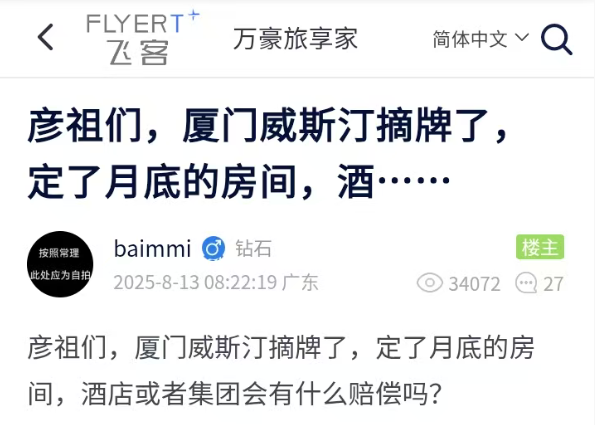
Core Viewpoint - The article discusses the recent trend of foreign hotel brands, particularly in China, facing challenges and withdrawing from the market, with local brands taking over these properties. This reflects broader issues within the hospitality industry, including financial pressures on property owners and changing market dynamics. Group 1: Recent Developments in Hotel Brand Withdrawals - The Westin Hotel in Xiamen has been delisted, raising questions about compensation for guests with reservations [2][4] - Three Hyatt hotels in Jiangsu, previously under Suning Group, have also been delisted and rebranded as Suning Galaxy International Hotels [8][11] - The Grand Hyatt in Nanchang will stop using the Hyatt brand and is expected to be taken over by a local chain, Walton Hotels [13][14] Group 2: Broader Trends in the Hospitality Industry - The article notes a significant increase in hotel brand withdrawals this year, with both the highest Hyatt and highest Huayi hotels being delisted [20][21] - Many of the delisted hotels are owned by real estate companies facing financial difficulties, indicating a trend of downsizing and cost-cutting in the industry [22][23] - Since 2020, numerous foreign luxury hotels have been put up for sale, but many have not found buyers, leading to a situation where high-end properties are available but not sold [25][26] Group 3: Financial Pressures and Management Costs - The management fees for foreign hotel brands have become burdensome for property owners, contributing to the trend of delisting [29][30] - There is a growing disparity between the expectations of brand owners and property owners, with the latter prioritizing cash flow over brand prestige [32][33] - Local hotel management teams offer lower costs and more flexible processes, making them attractive alternatives for property owners [34][35] Group 4: Future Prospects for Foreign Hotel Brands - Despite the challenges, there is still potential for growth for international hotel brands in China, as indicated by new openings in promising locations [39][40] - Foreign brands are increasingly targeting the mid-range and affordable luxury markets to adapt to economic fluctuations and broaden their customer base [43][44] - The focus is shifting from merely being a city landmark to ensuring profitability and customer service, with a need for brands to balance costs and market expectations [48][49]


希尔顿、万豪们悄悄清算行政酒廊
虎嗅APP· 2025-08-21 14:11
Core Viewpoint - The article discusses the quiet phase-out of executive lounges in Hilton and Marriott hotels, indicating a shift in the hotel industry's approach to amenities in response to changing market conditions and consumer expectations [4][10][27]. Group 1: Changes in Executive Lounges - Recent reports suggest that Hilton Garden Inn hotels may cancel executive lounges, allowing for alternative service options during operational hours [4][5]. - New Hilton Garden Inn hotels have not included executive lounge services, with some locations offering limited alternatives in public areas instead [5][9]. - Marriott has also closed executive lounges in several locations, indicating a broader trend of reducing such amenities across brands [11][12]. Group 2: Market Dynamics and Brand Positioning - The perception that mid-to-high-end international hotels must include executive lounges has been prevalent, driven by competitive differentiation and customer expectations [13][14]. - As economic conditions decline, the operational costs associated with maintaining executive lounges have led to their removal as a cost-cutting measure [16][17]. - The article highlights that brands like Marriott and Hilton have historically over-delivered on amenities, but this is no longer sustainable in the current market environment [18][19]. Group 3: Strategic Adjustments - The cancellation of executive lounges represents a broader commercial reality check for the hotel industry, aligning offerings with brand positioning and market expectations [27][30]. - Some hotels are opting to upgrade their brand positioning rather than maintain underperforming amenities, as seen with Hilton Garden Inn locations transitioning to the Hilton brand [28][29]. - The article suggests that a more selective approach to lounge access, similar to InterContinental Hotels Group's strategy, could help maintain the value of executive lounges for frequent travelers [29][32]. Group 4: Implications for Hotel Operations - The removal of executive lounges may relieve operational pressures on hotel staff, allowing them to focus on core services rather than maintaining additional amenities [30][31]. - The article concludes that while executive lounges may persist in high-end hotels, they are likely to disappear from mid-range brands, reflecting a shift in consumer expectations and operational realities [32][33].
“求师”希尔顿,万豪改名先从万枫着手
3 6 Ke· 2025-08-20 05:55
Core Insights - Marriott has officially rebranded its Four Points hotel chain to "Marriott Four Points," indicating a strategic move to enhance brand recognition and market presence in China [1][4][14] - The rebranding aims to leverage the "Marriott" name to attract more customers and increase pricing power, similar to strategies employed by competitors like Hilton [1][5][14] Brand Strategy - The addition of "Marriott" to the Four Points name is expected to improve brand visibility and consumer understanding of its affiliation with the Marriott Group, addressing previous brand confusion [4][15] - The rebranding aligns with a broader trend in the hospitality industry where brands are increasingly incorporating parent company names to enhance perceived value [5][14] Market Context - The Four Points brand has struggled to gain traction in the Chinese market since its entry in 2016, with only around 200 locations compared to Hilton's 500 for its comparable brand [4][12] - The Chinese mid-to-high-end hotel market is rapidly growing, and Marriott aims to capitalize on this trend by positioning Four Points as a more recognizable option [12][14] Financial Performance - In Q2, Marriott's global hotel revenue grew by 5%, but the Greater China region experienced a decline in RevPAR by 0.5%, indicating challenges in this market [11][12] - The need for Marriott to improve its performance in China is critical, as it currently lags behind other regions in profitability [12][14] Competitive Landscape - The rebranding is partly inspired by the success of Hilton's brands, which have effectively utilized their parent name to enhance market presence [5][17] - Marriott's strategy reflects a deeper understanding of the Chinese consumer market, although it may dilute the luxury perception of the Marriott brand among high-end clientele [18]
头部国际酒店集团Q2财报出炉,大中华区又遇冷了
Sou Hu Cai Jing· 2025-08-20 05:55
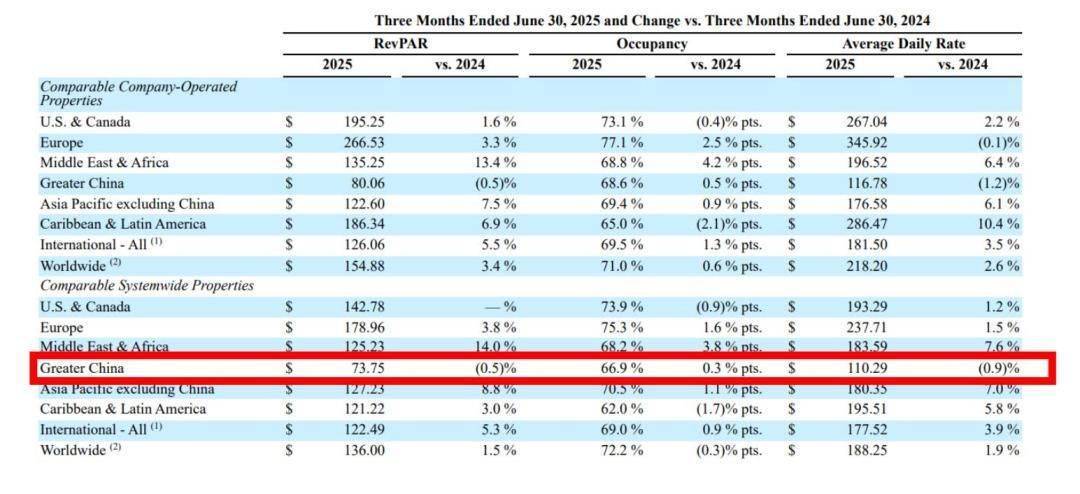
Core Insights - The international hotel groups are experiencing robust global growth, but the Greater China region is showing a decline in performance [1][13]. Group 1: Marriott International - In Q2 2025, Marriott's global hotel revenue increased by 5% to $6.74 billion, with RevPAR at $136, up 1.5% year-over-year [2][4]. - In Greater China, RevPAR decreased by 0.5% to $80.06, while occupancy rose by 0.5 percentage points to 68.6% [3][4]. Group 2: InterContinental Hotels Group (IHG) - IHG's global RevPAR was $91.45, a 0.3% increase, with occupancy at 69.7%, down 0.2 percentage points [4]. - In Greater China, all key metrics declined: RevPAR fell by 3% to $40.49, occupancy decreased to 60%, and ADR dropped by 2.9% to $67.51 [4][5]. Group 3: Hilton Worldwide - Hilton reported a global revenue of $3.14 billion, a 6% increase, with RevPAR at $121.79, down 0.5% [5][6]. - The Asia Pacific region showed a slow recovery, with China underperforming compared to Southeast Asia [6][20]. Group 4: Hyatt Hotels - Hyatt's global RevPAR was $151, up 1.6%, with occupancy at 73.1%, an increase of 0.5 percentage points [7][9]. - In Greater China, RevPAR increased by 2.1% to $85, while ADR decreased by 3.1% to $117 [9]. Group 5: Wyndham Hotels & Resorts - Wyndham's net income reached $87 million, a 1% increase, with global RevPAR at $47.55, down 3% year-over-year [10][11]. - The Chinese market faced challenges, with RevPAR declining by 8% [11][12]. Group 6: Market Challenges in Greater China - The decline in performance for international hotel brands in China is attributed to external factors such as tightened government budgets and increased competition from domestic hotels [15][16]. - Domestic hotels are enhancing service quality and competitive pricing, impacting international brands' market share [17][18]. Group 7: Strategies for Recovery - International hotel groups are focusing on expanding their presence in China and adapting to local market preferences [19][20]. - Strategies include leveraging social media for marketing, enhancing customer engagement through localized loyalty programs, and integrating local cultural elements into service offerings [20].

希尔顿、万豪们悄悄清算行政酒廊
3 6 Ke· 2025-08-19 01:22
Core Insights - The cancellation of executive lounges in foreign hotel brands like Hilton and Marriott reflects a broader trend of cost-cutting in the hospitality industry, particularly in China [2][6][20] - The shift away from executive lounges is not an isolated incident but part of a strategic repositioning of hotel brands in response to changing market conditions [20][24] Group 1: Changes in Hotel Operations - Hilton Garden Inn has been quietly phasing out executive lounges in newly opened hotels, with many locations not offering this service despite initial plans [2][4] - Marriott's Courtyard brand has also permanently closed executive lounges in several locations, indicating a trend of reducing amenities that were once considered standard [4][6] - The experience of executive lounges has diminished, with reports of reduced quality in offerings, leading to a perception that these spaces are no longer exclusive or valuable [4][5] Group 2: Market Dynamics - The perception that mid-to-high-end international hotels must include executive lounges has been shaped by years of competitive differentiation and over-provisioning during economic growth [7][10] - As economic conditions have worsened, the demand for such amenities has decreased, making executive lounges one of the first areas to be cut [9][10] - The shift reflects a broader trend of value return in the hotel industry, where brands are reassessing their offerings based on market realities [10][20] Group 3: Brand Positioning and Strategy - Brands like Hilton and Marriott are reconsidering their market positioning, with some properties upgrading to full Hilton branding to align with consumer expectations [21][23] - The approach of IHG (InterContinental Hotels Group) to limit access to executive lounges based on membership criteria serves as a potential model for maintaining exclusivity and quality [23] - The decision to retain or eliminate executive lounges ultimately hinges on whether they are core to a brand's identity or merely a superficial addition [24]
“三无酒店”时代来临:希尔顿、万豪们取消行政酒廊
Hu Xiu· 2025-08-19 00:28
Core Viewpoint - The recent discussions about the potential cancellation of executive lounges in Hilton Garden Inn hotels reflect a broader trend in the hotel industry, where many mid-range international hotel brands are reevaluating their service offerings in response to changing market conditions and cost pressures [1][10][17]. Group 1: Changes in Executive Lounge Offerings - There are reports that some Hilton Garden Inn hotels have received notifications allowing for the cancellation of executive lounges, with alternative services provided in public areas like the lobby bar [1][2][5]. - New Hilton Garden Inn hotels have been opening without executive lounge services, indicating a shift in operational standards [3][4]. - The trend of removing executive lounges is not unique to Hilton, as Marriott has also permanently closed executive lounges in several of its hotels [11][13][14]. Group 2: Market Dynamics and Brand Positioning - The perception that mid-to-high-end international hotels must include executive lounges has been prevalent, but this is changing as economic conditions shift [18][22]. - The previous strategy of "over-provisioning" amenities to attract customers is becoming unsustainable in a down market, leading to the removal of executive lounges as a cost-saving measure [20][21][23]. - Brands like Hilton Garden Inn and Marriott are reassessing their positioning, with some properties upgrading to full Hilton branding to better align with market expectations [39][40]. Group 3: Customer Experience and Brand Strategy - The experience of executive lounges has diminished, with complaints about the quality of offerings, leading to a perception that they are no longer valuable [15][16][30]. - The shift away from executive lounges may also reflect a broader strategy to streamline operations and reduce costs, particularly as hotel owners face financial pressures [34][36]. - The future of executive lounges in mid-range hotels appears uncertain, with a likelihood of their continued existence in high-end hotels but a decline in mid-range offerings [51].