Northrop Grumman(NOC)

Search documents
The Truth According to Truth Social: How a President’s Posts Move Markets (and Mountains of Mortgage Bonds)
Stock Market News· 2026-01-10 06:00
Defense Sector - The defense sector experienced significant volatility following President Trump's announcement of a proposed military budget increase to $1.5 trillion for fiscal 2027, a 50% increase from the $962 billion requested for 2026, leading to a surge in defense stocks [3][4] - Lockheed Martin's shares rose 4.3% on January 8, followed by a 4.2% increase on January 9, closing at $542.78, while Northrop Grumman and RTX also saw gains [3] - Smaller companies like Kratos Defense experienced a remarkable 13.8% increase, and defense-focused ETFs outperformed the broader market [3] Housing Market - President Trump's proposal to ban large institutional investors from purchasing single-family homes caused a decline in major stock indices, with the Dow Jones Industrial Average dropping 0.9% and the S&P 500 slipping 0.3% [5] - Shortly after, Trump announced a directive for federal agencies to purchase $200 billion in mortgage bonds to lower mortgage rates, which led to a rally in housing stocks, with Rocket Companies surging 9.65% and homebuilders like Lennar and D.R. Horton also experiencing significant gains [6][8] - Analysts expressed concerns that while bond purchases might lower mortgage yields, they could also increase housing demand, complicating the affordability issue [7] Energy Sector - The capture of Venezuelan President Nicolás Maduro and Trump's announcement of a $100 billion oil investment plan for Venezuela positively impacted major stock indexes, with energy stocks like Chevron and Exxon Mobil seeing gains [10] - However, by January 7, oil prices fell due to concerns over the long-term implications of Trump's plan to refine and sell Venezuelan crude, indicating a mixed market reaction [11] Tariffs and Legal Uncertainty - The market showed anxiety ahead of a Supreme Court ruling on Trump's tariffs, with Wall Street futures dipping as uncertainty persisted regarding the legality of these policies [13] - Kevin Hassett's expectation that the Supreme Court would side with the Trump administration on tariffs adds another layer of speculation to the ongoing legal battle, highlighting the tension between executive power and trade norms [14] Market Dynamics - The overall market remains highly reactive to Trump's pronouncements, with significant fluctuations observed across various sectors, including defense, housing, and energy, reflecting the interplay between presidential policy and economic fundamentals [15][16] - On January 9, major indices were on track for weekly gains, with the S&P 500 reaching a new all-time high of 6,966, indicating a volatile yet upward trend in the market [16]




Truist Downgrades Northrop Grumman Citing Valuation and Margin Risks
Financial Modeling Prep· 2026-01-09 22:10
Core Viewpoint - Northrop Grumman has been downgraded to Hold from Buy by Truist Securities, reflecting concerns over stock valuation despite the company's strong position in defense contracting [1] Group 1: Company Position and Prospects - Northrop Grumman is expected to maintain its leading prime contractor positions across the nuclear triad and other high-demand defense platforms [1] - Potential upside is anticipated from increased B-21 bomber unit volumes, a possible win on the F/A-XX program, and the company's role in the Integrated Battle Command System within the Golden Dome initiative [1] Group 2: Valuation and Financial Outlook - The stock's valuation and recent performance are believed to already reflect much of the potential upside, with concerns about margin pressure and free cash flow risks [2] - The initial 2026 outlook for the company is expected to be largely reaffirmed, with limited scope for further financial improvement over the next 12 to 24 months [2] Group 3: Comparative Valuation - Northrop Grumman shares are trading at approximately a 20% premium to prime defense peers on a price-to-free-cash-flow basis and a 28% premium relative to its own historical average free cash flow multiple [3] - Due to these valuation factors, the stock is expected to be a relative underperformer in 2026 [3]

Defense ETFs in 2026: Trump's Spending Push & Other Key Tailwinds
ZACKS· 2026-01-09 18:01
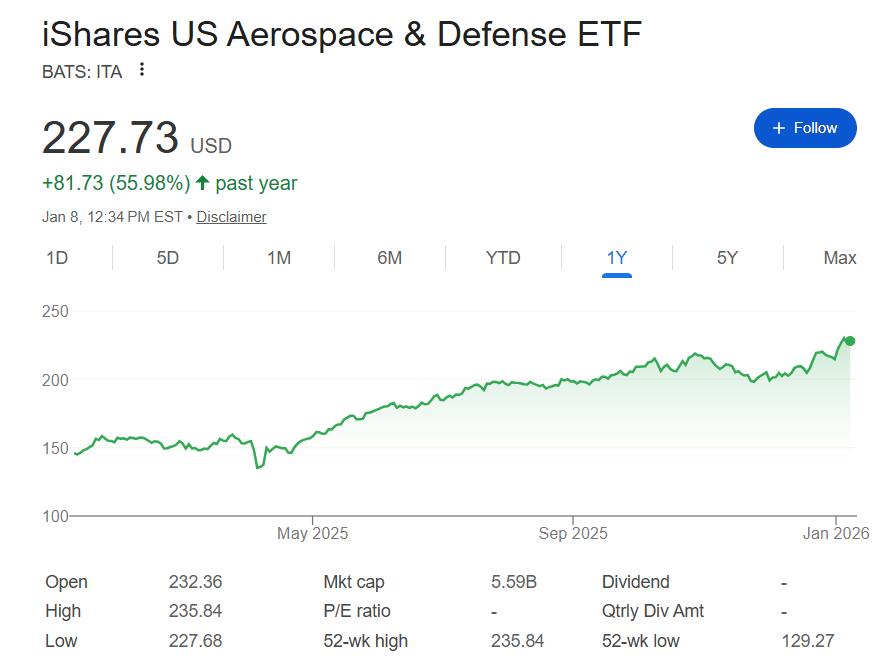
Group 1: Defense Spending and Market Impact - President Trump's proposal for a $500 billion increase in annual defense spending has led to a rally in defense stocks globally, with European defense stocks rising by as much as 3.8% on January 8, 2026, and a weekly advance of approximately 13% [1][2] - Global military spending reached a record $2.718 trillion in 2024, marking the 10th consecutive year of growth, with a 37% increase since 2015 and a 9.4% rise in 2024, the largest annual increase since at least 1988 [4] - Following geopolitical tensions, all 32 NATO members increased their defense budgets in 2024, with 18 countries meeting or exceeding the 2% of GDP target set by the bloc [5] Group 2: Executive Actions and Industry Outlook - An executive order signed by Trump mandates major U.S. defense contractors to suspend stock buybacks, halt dividend payments, and cap executive pay at $5 million annually, directing more capital towards factory expansion and weapon development [6] - The S&P 500 earnings for the December quarter are projected to rise by 62.3% year-over-year, with the aerospace sector expected to show the highest earnings growth among 16 sectors [7] Group 3: Valuation and Performance Metrics - The Zacks Aerospace-Defense industry ranks 95, placing it in the top 39% of over 250 Zacks industries, while the aerospace sector holds a strong Zacks Sector Rank of 3 [8] - The aerospace sector's debt-to-equity ratio stands at 0.19X, significantly lower than the S&P 500 average of 0.57X, indicating a more conservative financial structure [9] - The iShares US Aerospace & Defense ETF (ITA) has increased by about 55% over the past year, compared to a 17% rise in the SPDR S&P 500 ETF Trust (SPY), although the industry now trades at a forward P/E of 22.97X, higher than the S&P 500's 18.58X [12]

ETFs to Consider Amid Geopolitical Woes and Higher US Military Budget
ZACKS· 2026-01-09 17:35
Geopolitical Landscape and Defense Spending - Recent U.S. military operations in Venezuela and Trump's focus on acquiring Greenland indicate a fragile geopolitical landscape, supporting higher defense spending [1] - Trump proposed a $1.5 trillion military budget for 2027, significantly up from the current $901 billion [2] Defense Stocks Performance - The proposal for increased military spending led to a rebound in defense stocks, with Northrop Grumman, Lockheed Martin, and RTX Corporation seeing gains of 2.39%, 4.34%, and 0.78% respectively [3] Budget Concerns and Debt Implications - The proposed military budget increase requires congressional authorization, raising concerns about U.S. debt, which is currently around $38 trillion [4][5] Defense Sector Outlook - The S&P 500 Aerospace & Defense Index has increased by 59.87% over the past year, outperforming the broader S&P 500, which rose by 16.95% [6] - Global defense spending is projected to exceed $3.6 trillion by 2030, a 33% increase from 2024 levels, supported by robust order pipelines and modernization efforts [7] Investment Opportunities in ETFs - Investing in Aerospace and Defense ETFs is recommended due to their strong performance during heightened military activity [8] - Suggested ETFs include iShares U.S. Aerospace & Defense ETF (ITA), Invesco Aerospace & Defense ETF (PPA), and Global X Defense Tech ETF (SHLD) [9] Cybersecurity Sector Growth - The rise in geopolitical tensions has highlighted the importance of cybersecurity, with the global defense cybersecurity market expected to grow at a CAGR of 16.1%, reaching $63.38 billion by 2032 [12][14] - Recommended cybersecurity ETFs include First Trust NASDAQ Cybersecurity ETF (CIBR) and Amplify Cybersecurity ETF (HACK) [14] Artificial Intelligence in Defense - AI is becoming central to military strategy, enhancing real-time data processing and decision-making, with potential benefits for AI-related firms from increased military budgets [15][16] Manufacturing and Space ETFs - Manufacturing ETFs may benefit from Trump's push for increased production in defense companies, with suggested funds including Industrial Select Sector SPDR Fund (XLI) [17] - The evolution of warfare is driving investment in space-based systems, with recommended space ETFs like Procure Space ETF (UFO) and ARK Space & Defense Innovation ETF (ARKX) [18][19]

Northrop Grumman (NOC) Just Flashed Golden Cross Signal: Do You Buy?
ZACKS· 2026-01-09 15:35
Core Viewpoint - Northrop Grumman (NOC) is showing potential for investment due to its recent technical movements and positive earnings revisions [1][4]. Technical Analysis - NOC has reached a significant support level and recently broke through the 20-day moving average, indicating a short-term bullish trend [1]. - The 20-day simple moving average is a key trading tool that helps smooth out price fluctuations and provides trend reversal signals [2]. - The stock has moved 5.5% higher over the last four weeks, suggesting a potential for further gains [4]. Earnings Estimates - NOC has experienced positive earnings estimate revisions, with one revision higher for the current fiscal year and none lower, leading to an upward movement in the consensus estimate [4]. - The company currently holds a Zacks Rank of 3 (Hold), indicating a neutral outlook [4]. Investment Outlook - Given the key technical level and positive earnings revisions, NOC may be a stock to watch for potential gains in the near future [5].

Northrop Grumman: Be Careful Chasing The $1.7 Trillion Defense Budget News (NYSE:NOC)
Seeking Alpha· 2026-01-09 12:45
Group 1 - The article emphasizes the advantages of a dividend-focused value investment strategy, highlighting capital preservation and steady income growth as key benefits [1] - The author discusses a diversified dividend stock portfolio that prioritizes high-quality value stocks, which are expected to provide meaningful growth and long-term safety [1] Group 2 - The author has disclosed a beneficial long position in several defense and aerospace companies, including NOC, LMT, RTX, LHX, and GD, indicating a personal investment interest in these stocks [2] - The article is presented as a personal opinion and does not involve compensation from the companies mentioned, suggesting an independent analysis [2]

美国曾经辉煌的两大军工巨头,如今已经边缘化了!
Sou Hu Cai Jing· 2026-01-09 06:05
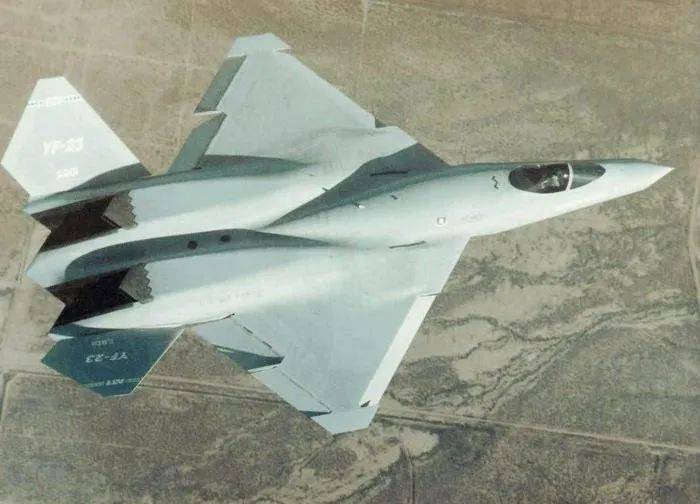
Core Viewpoint - The article discusses the historical rise and challenges faced by major players in the U.S. aerospace industry, particularly Lockheed Martin and Northrop Grumman, highlighting their successes, failures, and the competitive landscape of the industry. Group 1: Lockheed Martin's Dominance - Lockheed Martin emerged as the leading company in the U.S. aerospace industry due to significant government contracts won in key competitions at the turn of the century [1][4] - The company's growth from a marginal player during World War II to a dominant force in the aerospace sector is noted, indicating a challenging journey that led to the decline of other companies [4] Group 2: Northrop Grumman's Struggles - Northrop Grumman, formed from the merger of Northrop and Grumman, faced significant challenges, including the failure of the YF-23 project, which led to a loss of competitive edge [3][12] - Grumman's historical significance is highlighted, particularly its contributions during World War II with aircraft like the F4F Wildcat and F6F Hellcat, which played crucial roles in naval aviation [5][6][10] - The company struggled in the jet age, with its first jet fighter, the F9F Panther, underperforming against competitors, leading to a decline in confidence and market position [13] Group 3: Current Industry Challenges - Both Lockheed Martin and Northrop Grumman are facing challenges in adapting to new technological demands, with Lockheed's F-22 and F-35 programs encountering issues that require substantial resources for resolution [12] - The upcoming competition for sixth-generation fighter jets involves Lockheed Martin, Northrop Grumman, and Boeing, but the future winner remains uncertain due to unclear technical specifications [12] - A significant challenge for the U.S. aerospace industry is the shortage of skilled talent, exacerbated by deindustrialization, raising concerns about the ability to develop a new generation of engineers and technicians [12]
Stock Market Today, Jan. 8: Defense Stocks Rally and Tech Retreats
The Motley Fool· 2026-01-08 22:20
Group 1 - Defense stocks rallied following President Trump's announcement of a $1.5 trillion defense budget for 2027, increasing investor interest in major contractors [3][2] - Northrop Grumman advanced by 2.43% due to the defense budget push and a new $94 million U.S. Navy contract, while Lockheed Martin and RTX also saw gains [2] - The Dow Jones Industrial Average gained 0.55% as defense and staples outperformed other sectors, contrasting with the S&P 500 and Nasdaq's performance [1][3] Group 2 - The Nasdaq Composite declined by 0.44% amid a cautious mood affecting tech stocks, with Goldman Sachs warning of fading growth tailwinds [4] - Alphabet surpassed Apple in market capitalization, becoming the second-most-valuable company globally, while Nvidia and Meta experienced declines [5] - Micron and Sandisk saw significant pullbacks despite recent gains, with Micron gaining around 15% and Sandisk approximately 40% over the past five days [5]
Defense Stock Rally Extends as Geopolitics Stays Tense
Yahoo Finance· 2026-01-08 21:29
Core Insights - US defense stocks are experiencing a strong start in 2026, continuing the positive momentum from the previous year due to rising geopolitical tensions and increased military spending plans [1][6] Company Performance - Contractors L3Harris Technologies Inc. and Huntington Ingalls Industries Inc. have seen an 11% increase in stock prices during the first five trading days of 2026, partly driven by a rally following the US military operation in Venezuela [2] - Major peers like Northrop Grumman Corp. and Lockheed Martin Corp. have risen approximately 4% or more, while drone manufacturer AeroVironment Inc. has surged over 40% [2] - L3Harris advanced 40% and Northrop gained 22% last year, attracting investors due to the promise of rising global security spending [4] Market Trends - The defense sector has been a focus for investors since the geopolitical landscape shifted following Russia's invasion of Ukraine, with increased emphasis on security spending [6] - The recent gains in defense stocks are supported by a more hawkish US administration and reasonable valuations, presenting an attractive risk-reward scenario for investors [5] Global Market Movement - European defense stocks such as BAE Systems Plc and Rheinmetall AG have also advanced, with shares up 5% and 1.4% respectively, while Asian defense stocks like Hanwha Aerospace Co. and Aerospace Industrial Development Corp. have shown similar upward trends [5]


特朗普创纪录1.5万亿军费要打“世界大战”?军工股大反弹,无人机厂商两位数高涨
Hua Er Jie Jian Wen· 2026-01-08 19:04
Core Viewpoint - President Trump's recent statements have caused significant volatility in the defense sector, with threats to limit dividends and stock buybacks for defense contractors leading to a sharp decline in military stocks, followed by a strong rebound after his proposal to increase military spending to $1.5 trillion for fiscal year 2027, a 50% increase from the current budget of $901 billion [1][2][10]. Group 1: Market Reactions - Following Trump's statements, defense stocks experienced a dramatic rebound, with major companies like Lockheed Martin (LMT) rising over 9%, Northrop Grumman (NOC) nearly 11%, and Raytheon Technologies (RTX) up nearly 6% [5][9]. - The iShares U.S. Aerospace & Defense ETF (ITA) has seen a cumulative increase of over 50% in the past 12 months, reflecting strong performance in the defense sector [2]. - Global defense stocks also rose, with European defense stocks increasing by up to 3.8% on the same day, and notable gains in companies like BAE Systems and Rheinmetall [9]. Group 2: Budget Proposal and Challenges - Trump's proposal to increase the defense budget by 50% is historically rare, with the last similar increase occurring during the Korean War in 1951 [10]. - The feasibility of this budget increase faces challenges, as the Congressional Budget Office (CBO) estimates a budget deficit of 5.5% of GDP for the current year, with projected tax revenues falling short of the anticipated defense spending growth [10][11]. - Political hurdles exist, as the proposed budget would require significant support in the Senate, and there are concerns about whether defense contractors can absorb such a large increase in spending [11]. Group 3: Analyst Perspectives - Analysts generally express cautious optimism regarding the direction of U.S. defense spending, with expectations for higher expenditures amid stricter scrutiny of companies [12][13]. - Some analysts suggest that limiting capital returns could free up billions for capacity expansion or acquisitions, indicating a potential shift in investment strategies within the defense sector [13]. - The geopolitical landscape is driving increased defense spending, with analysts noting that the world is becoming a more dangerous place, further justifying the proposed budget increase [13][14].