Tyson Foods(TSN)

Search documents
泰森关厂冲击波,美国牛肉75年危机,如何波及中国餐桌?
Sou Hu Cai Jing· 2025-12-09 08:37
Core Insights - Tyson Foods announced the closure of its beef processing plant in Lexington, Nebraska, and significant capacity reductions in Texas, resulting in approximately 1,700 job losses and a 4.8% decrease in U.S. beef slaughter volume [1][3] Industry Challenges - Tyson's beef segment has faced increasing losses, with a reported loss of $648 million in FY2023 and projected losses of $291 million in FY2024 and $426 million in FY2025 [3] - The U.S. cattle herd has declined to its lowest level since 1950, with over 100,000 family farms disappearing in the past decade, complicating the beef supply situation [3][5] - The outbreak of screw-worm fly in Mexico has further impacted cattle survival rates, exacerbating the supply issues [5] - Rising costs for live cattle, feed, and agricultural equipment have compressed profit margins across the industry, affecting not only Tyson but also other major players like JBS and Cargill [5] Tyson's Position in China - Tyson has established a strong presence in China since 2001, with significant investments in production facilities and a comprehensive supply chain from cattle farming to processing [7] - The company operates four R&D centers and numerous farms in China, producing 12,000 tons of beef patties annually and maintaining a herd of 30,000 cattle [7] - Tyson's sales strategy includes B2B partnerships with major brands like Haidilao and Starbucks, as well as retail sales through large supermarkets, generating annual e-commerce sales of 1.5 billion yuan [7] Impact of U.S. Plant Closures on China - The closure of Tyson's U.S. plants is not expected to significantly impact the Chinese market, as 85% of the beef sold in China is locally produced, with only 12% coming from U.S. imports [11] - China's beef imports from the U.S. have historically been low, accounting for just 3.2% of total imports in the first eight months of 2025, with Brazil and Argentina being the primary suppliers [11] China's Beef Industry Landscape - China's beef consumption is projected to reach 9.8 million tons by 2024, but domestic production only meets 70% of demand, leading to reliance on imports [14] - Rising prices for imported beef have resulted in increased retail prices domestically, with high-end beef products primarily sourced from Australia and Japan [14] - The Chinese government is investing 5 billion yuan in initiatives to increase beef production and improve breeding efficiency through advanced technologies [14][16] Strategic Responses - Chinese companies are investing in processing facilities in Brazil and Argentina to secure supply chains and mitigate import risks [16] - The introduction of beef futures on the Dalian Commodity Exchange allows companies to hedge against price volatility [16] - Efforts to improve domestic beef quality include the introduction of Australian Angus cattle, resulting in a 30% improvement in the quality of domestic snowflake beef [16] Conclusion - Tyson's plant closures reflect broader cyclical adjustments in the global beef industry influenced by geopolitical factors, highlighting the need for China to develop a balanced beef supply system that combines imports, self-sufficiency, and technological control [16]



全球肉业巨头将关停核心牛肉加工厂,牛肉产业的苦日子要来了?
Sou Hu Cai Jing· 2025-12-01 10:36
Core Points - Tyson Foods announced the closure of a major beef processing plant in Lexington, Nebraska, and plans to reduce production at a Texas facility, affecting approximately 1,700 workers [1] - The closed plant employs around 3,200 workers and processes about 5,000 cattle daily, representing 4.8% of the U.S. daily beef slaughter [1] - The beef segment is crucial for Tyson Foods, contributing $21.623 billion to the company's total revenue of $54.44 billion for fiscal year 2025 [1] Financial Performance - Tyson Foods reported a $426 million operating loss in its beef segment for fiscal year 2025, marking an increase in losses compared to the previous year [2] - The beef segment has been the only loss-making division for Tyson Foods, with total losses reaching $648 million in fiscal year 2023 [2][3] - The company anticipates further losses in the beef segment, estimating a loss of $400 million to $600 million for fiscal year 2026 [2] Market Conditions - The ongoing losses in the beef segment are attributed to tight cattle supply in the U.S., exacerbated by tariffs affecting imports from countries like Brazil and Australia, and rising costs for feed and farming equipment [4] - The U.S. cattle herd has reached a 75-year low, with over 100,000 family farms exiting the industry in the past decade, limiting the ability to expand cattle numbers [4] - Tyson Foods' COO indicated that the industry may be in the early stages of a cattle herd recovery, but supply constraints are expected to persist in the short term [4][5] Impact on the Industry - Tyson Foods' decision to reduce beef production capacity may have implications for the broader beef industry, including potential impacts on the Chinese market where Tyson has established operations [7] - Tyson Foods has a significant presence in China, with a comprehensive supply chain that includes processing plants and research centers, which may mitigate the impact of U.S. plant closures on the Chinese beef market [9] - Despite the company's established operations in China, the overall tightness in global beef supply could pose risks to the domestic market, as China relies heavily on imports for beef supply [11]
Jim Cramer Says “It’s Not Clear That the Beef Tariffs Helped Tyson”
Yahoo Finance· 2025-11-29 17:53
Company Overview - Tyson Foods, Inc. (NYSE:TSN) produces a variety of meat and prepared food products, including beef, pork, chicken, and ready-to-eat meals [2]. Investment Perspective - Jim Cramer expressed a favorable view on Tyson Foods, highlighting that the stock has performed better than Hormel despite trading sideways for years. Tyson has managed its challenges more effectively and has shown steady earnings growth since a significant reset in 2022 [1].
Layoffs slam transport, logistics, manufacturing sectors ahead of the holidays
Yahoo Finance· 2025-11-26 13:30
Summary of Layoffs Across Industries Group 1: Overall Layoff Trends - Recent layoffs across various sectors, including automotive, food processing, logistics, and manufacturing, total at least 11,934 workers, with the actual number likely higher due to phased cuts and incomplete reporting [1] Group 2: Specific Company Layoffs - Kroger plans to lay off over 1,000 employees as it closes three automated fulfillment centers in January 2026 to enhance e-commerce profitability and streamline operations [2] - Baker & Taylor will cease operations by the end of the year, resulting in approximately 1,500 layoffs, including staff at distribution centers in Georgia, New Jersey, and North Carolina [3] - General Motors is set to permanently lay off 1,140 employees at its Factory Zero site in Detroit effective January 5, due to production schedule adjustments linked to slower electric vehicle adoption [4] - GM will also temporarily lay off 710 employees at its Ultium Cells battery plant in Spring Hill, Tennessee, starting January 5, due to declining demand for electric vehicles, with expectations for production to resume by mid-2026 [5] - Yanfeng will close its production facility in Romulus, Michigan, resulting in 192 layoffs by the end of January, as production is shifted to other facilities [6] - Frito-Lay is closing two facilities in Orlando, Florida, leading to approximately 500 layoffs, with immediate cuts to 454 manufacturing employees and 46 warehouse employees scheduled for May 9 [7] - Tyson Foods is closing its large beef plant in Lexington, Nebraska, and eliminating one shift at its Amarillo, Texas, beef plant, citing a national cattle shortage and losses in its beef business [8]

Tyson Foods to close major beef plant, scale back operations as cattle supplies decline
Fox Business· 2025-11-24 20:35
Core Viewpoint - Tyson Foods is closing a major beef plant in Nebraska and scaling back operations in Texas due to declining U.S. cattle supplies, which has led to record-high beef prices [1][2][6]. Company Actions - The closure of the Lexington plant in Nebraska will affect approximately 3,200 employees, while the Amarillo plant will move to a single full-capacity shift, impacting around 1,700 workers [1][2]. - Tyson Foods plans to increase production at other facilities to meet customer demand and is committed to supporting affected employees through job placement and relocation benefits [2][5]. Industry Context - The U.S. cattle inventory has dropped to its lowest level in 70 years, contributing to a surge in beef prices, with beef and veal prices up 14.7% year-over-year [3][6][8]. - Despite rising prices, consumer demand for beef remains strong, with Americans spending over $40 billion on fresh beef in 2024, accounting for over half of all fresh-meat sales [12]. Financial Performance - Tyson's beef business reported adjusted losses of $426 million in the 12 months ending September 27, with projections of losses between $400 million to $600 million for the 2026 fiscal year [11].
Tyson Foods To Shut Down Major Beef Plant In Nebraska Weeks After Trump Launched Probe On Meatpackers - Tyson Foods (NYSE:TSN)
Benzinga· 2025-11-24 08:38
Core Insights - Tyson Foods Inc. has announced the closure of its beef plant in Lexington, Nebraska, to position itself for long-term success amid historic cattle lows [1][2] - The decision to close the plant is driven by the lowest U.S. cattle supplies in nearly 75 years, leading to a scaling back of operations at the Amarillo, Texas facility [2] - Tyson Foods plans to increase production at other facilities to meet customer demand despite the impact of these closures on team members and local communities [3] Industry Context - The U.S. beef industry is facing significant challenges, including a shortage of cattle and rising prices, attributed to various factors including alleged price manipulation by major meatpacking companies [4] - The "Big Four" meat packers, including Tyson Foods, dominate 85% of the U.S. beef processing market, which has drawn scrutiny from the government [5] - The Trump Administration's decision to eliminate tariffs on certain Brazilian exports aims to address rising grocery prices, including beef, amid ongoing trade negotiations with Brazil [6] Company Performance - Despite challenges in the beef sector, Tyson Foods maintains financial stability through its chicken business, with projected sales growth of 2%–4% by 2026, outpacing analyst expectations [7] - Tyson Foods is ranked in the 16th percentile for quality and the 44th percentile for growth, indicating average performance, with a year-to-date stock decline of 7.7% [8]
Economic Headwinds Intensify: Job Cuts, Plummeting Sentiment, and Widening Wealth Disparities Signal Mounting Challenges
Stock Market News· 2025-11-23 03:38
Economic Overview - The U.S. economy is facing multiple challenges, including significant job cuts by major corporations, plummeting consumer confidence, and a historic freight company's bankruptcy [2][4] - The wealth gap is widening, with older demographics holding a significant portion of household equities [7][9] Corporate Restructuring and Job Losses - Tyson Foods is restructuring its beef operations, closing a major plant in Lexington, Nebraska, resulting in approximately 3,200 job losses, and reducing operations in Amarillo, Texas, affecting another 1,700 workers [3][8] - The company projects losses between $400 million and $600 million for its beef segment in fiscal year 2026 due to declining cattle supplies and high beef prices [3] Consumer Confidence and Job Market - U.S. consumer sentiment has dropped to 50.3 in October, the second-lowest level recorded, indicating widespread pessimism among households [5][8] - Job loss expectations among 18-34-year-olds are near record highs, with a 6.6% unemployment rate for new college graduates over the past year [6][8] Bankruptcy and Industry Strain - Port Elizabeth Terminal & Warehouse Corp., a 101-year-old freight company, has filed for Chapter 11 bankruptcy, citing surging business costs as a primary driver [4][8] - The logistics industry is experiencing a "Great Freight Recession," characterized by reduced shipping demand and rising operational expenses [4] International Travel Disruptions - Air China plans to significantly reduce flights between Chinese and Japanese cities, citing "plane availability," but this decision may also be influenced by rising political tensions [10]


泰森食品:关闭内布拉斯加工厂,牛肉业务亏4.26亿美元
Sou Hu Cai Jing· 2025-11-22 18:21
Core Points - Tyson Foods is closing a major beef processing plant in Lexington, Nebraska, and scaling down operations at a Texas facility due to losses in its beef processing business [1][2] - The Nebraska plant processes approximately 5,000 cattle daily, accounting for 4.8% of the U.S. daily beef slaughter volume, while the Texas facility has a daily capacity of about 6,000 cattle [1][2] - The company's latest financial report indicates that the beef processing segment is the only loss-making division for the fiscal year 2025, with an adjusted operating loss of $426 million [1][2] Company Actions - Closure of the Nebraska beef processing plant and reduction of production at the Texas facility [1][2] - Tyson Foods is the first among the top four meat processing companies in the U.S. to close a major beef processing plant [1][2] Financial Impact - The beef processing division reported an adjusted operating loss of $426 million for the fiscal year 2025 [1][2]
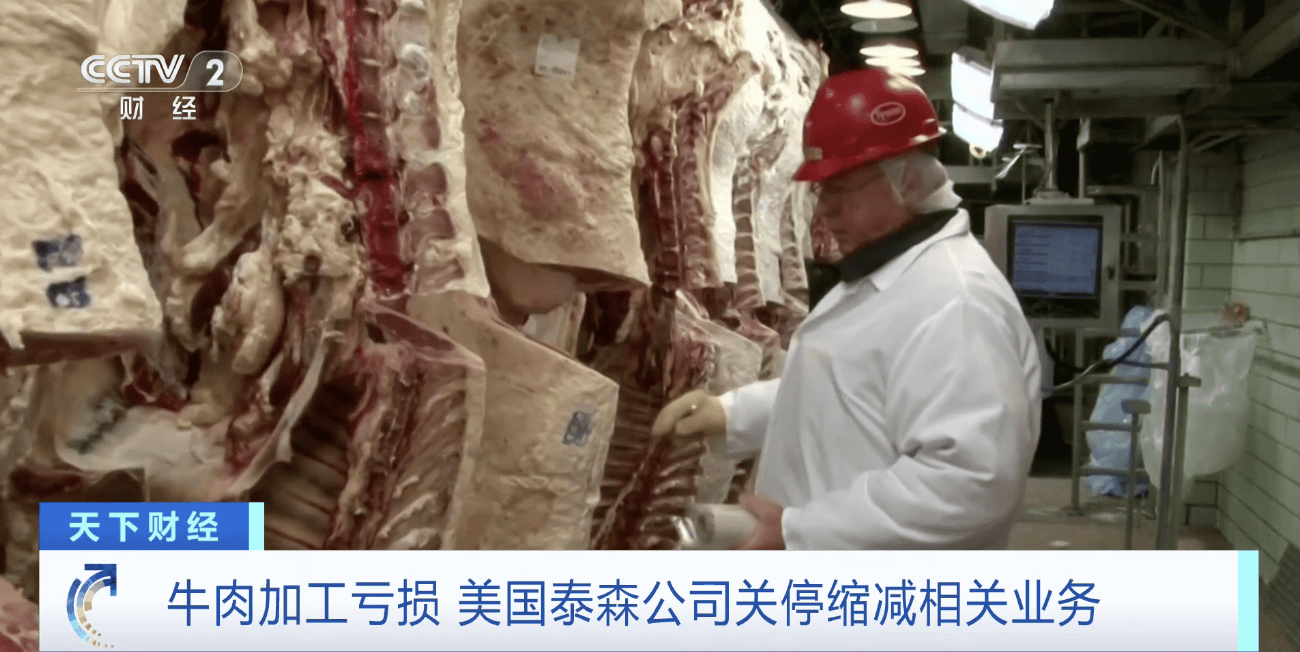
牛肉加工亏损 美国泰森公司关停缩减相关业务
Sou Hu Cai Jing· 2025-11-22 13:23
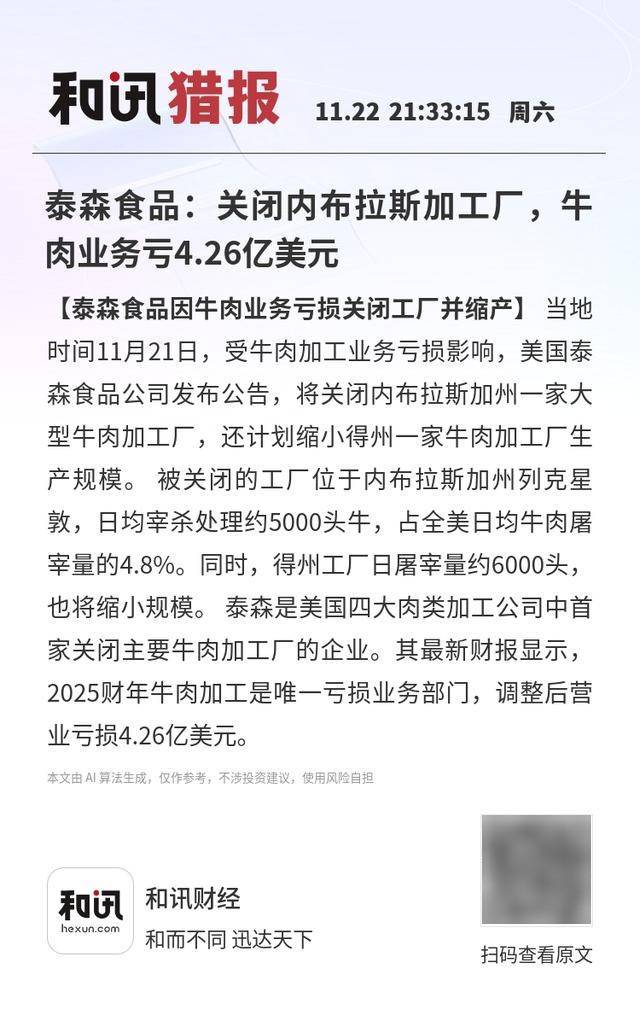
Core Viewpoint - Tyson Foods announced the closure of a major beef processing plant in Nebraska and plans to scale down operations at another facility in Texas due to losses in its beef processing segment, which is the only loss-making division in its latest financial report [1][3]. Group 1: Company Actions - The plant being closed is located in Lexington, Nebraska, with a daily capacity to process approximately 5,000 cattle, accounting for about 4.8% of the U.S. daily beef slaughter [3]. - The Texas facility, which will see a reduction in production, has a daily capacity of around 6,000 cattle [3]. - The adjustments will impact approximately 5,000 jobs across the two facilities [3]. Group 2: Financial Performance - In the latest financial report, Tyson Foods reported an adjusted operating loss of $426 million for its beef processing segment for the fiscal year 2025 [3]. - The beef processing division is the only segment showing losses, highlighting significant challenges within this area of the business [3]. Group 3: Industry Context - Nebraska has a strong cattle industry, ranking second in the U.S. for cattle herd size, following Texas [5]. - The local cattle industry is facing survival challenges due to prolonged drought and rising feed costs, leading to a decline in the cattle herd to a 75-year low [5].
Corporate Shifts and Global Economic Pressures: Tyson Foods, Airbnb, and International Trade in Focus
Stock Market News· 2025-11-22 06:38
Corporate Operations and Executive Moves - Tyson Foods announced the permanent closure of its beef processing facility in Lexington, Nebraska, effective January 20, 2026, resulting in approximately 3,000 job losses and a reduction of operations at its Amarillo, Texas plant affecting an additional 1,700 workers, as the company aims to "right-size its beef business" due to significant losses linked to the smallest U.S. cattle herd in decades [2][6] - Airbnb's Chief Technology Officer, Aristotle Balogh, will step down in December 2025 after seven years, but will remain in an advisory role until at least February 2026 to ensure a smooth transition [3][6] Global Trade and Commodity Markets - China Mineral Resources Group has expanded its restrictions on BHP Group iron ore, now including "Jinbao fines" in addition to "Jimblebar Blend Fines," amid ongoing negotiations for annual contracts for 2026, which is seen as a strategic move to secure better pricing terms [4][6] Government Actions and Economic Impact - Federal judges in the U.S. have blocked the Trump administration's attempts to cut hundreds of millions in Department of Homeland Security grants and over $11 billion in public health funding cuts to states, citing likely legal violations [5][6] Emerging Market Challenges - Pakistan's poverty rate has risen to 25.3% in 2024, a 7 percentage point increase over three years, with an estimated 1.9 million more people falling into poverty due to rapid population growth and economic challenges [7][6] Investor Sentiment and Market Outlook - Investors are debating the long-term viability of certain companies, with traditional department stores like JCPenney and Kohl's frequently cited as at risk due to declining foot traffic, while there is a growing interest in high-growth areas such as cryptocurrencies and big-cap technology stocks [8]