
two(TWOA)

Search documents
谷歌云深化与Palo Alto Networks合作,签署近100亿美元AI安全大单
Hua Er Jie Jian Wen· 2025-12-19 17:22
Core Insights - Google Cloud has expanded its strategic partnership with Palo Alto Networks by signing a nearly $10 billion multi-year contract, marking the largest security service deal for Google Cloud to date [1] - The collaboration will focus on the development of AI-driven security services, responding to the increasing demand for such solutions as generative AI tools are increasingly used in cyberattacks [1][2] Partnership Details and Funding Usage - The $10 billion contract will be executed in phases, with part of the funding allocated to migrating existing services to Google Cloud and the majority directed towards developing new AI-based security services [2] - The demand for security services has surged due to AI advancements, with Palo Alto's president comparing the current situation to the early days of cloud computing, highlighting new security threats [2] AI Reshaping Cybersecurity Landscape - Cyberattacks are increasingly utilizing generative AI tools, which are also key technologies for security service providers to enhance defenses [2] - Both Google and Palo Alto Networks are significantly investing in AI security solutions, with Google awaiting regulatory approval for its $32 billion acquisition of security firm Wiz, and Palo Alto having launched AI-driven security services and announced a $3.35 billion acquisition of software company Chronosphere [2] Strategic Partnership History and Competitive Advantage - Google Cloud and Palo Alto Networks have had a strategic partnership since 2018, with Palo Alto's CEO previously serving as a Google executive [3] - The new collaboration highlights Google Cloud's differentiated advantage in the AI-driven competitive landscape compared to other major cloud service providers like Amazon and Microsoft, marking a significant breakthrough in the enterprise AI security service market [3]


2026 网络设备展望:数据中心需求强劲,园区设备更新持续-Americas Technology_ Hardware_ 2026 networking equipment outlook_ Robust data center demand, ongoing campus refresh
2025-12-19 03:13
Summary of Conference Call Notes Industry Overview - **Industry**: Networking Equipment - **Key Focus**: AI infrastructure and data center networking Core Insights and Arguments 1. **Market Performance**: In 2025, networking coverage increased by approximately 37% year-over-year, outperforming the S&P 500, which grew by 16% [1][9] 2. **Key Players**: - **Celestica (CLS)**: Stock price increased by 213% and is positioned as a leading provider of AI infrastructure equipment [2][9] - **Arista Networks (ANET)**: Valued at a premium P/E of approximately 39X, expected to benefit from AI infrastructure growth [2][4] - **Cisco (CSCO)**: Maintains a neutral stance but is expected to participate in AI infrastructure projects [1][2] 3. **AI Ethernet Switch Market**: Projected to grow from approximately $8 billion in 2025 to around $59 billion by 2029, driven by complex networking requirements for AI data centers [1][4] 4. **Hyperscale Capex Growth**: Expected to grow by approximately 32% year-over-year in 2026, reaching nearly $550 billion, supporting demand for data center networking [2][14] 5. **Data Center Infrastructure**: Major AI players like Meta, OpenAI, and Microsoft are expected to drive continued investment in data center infrastructure, with cloud provider capex projected to grow from approximately $294 billion in 2024 to $1.4 trillion by 2029 [14][18] Additional Important Insights 1. **Campus Networking**: The campus switching market is expected to grow by 6% year-over-year in 2026, driven by device refreshes and modernization efforts [5] 2. **XPU Diversification**: Increasing interest in custom ASICs and alternatives to NVIDIA GPUs is anticipated to create demand for bespoke networking equipment [4][42] 3. **Scale-Up and Scale-Across Opportunities**: - Scale-up networking revenue is expected to grow to approximately $10.7 billion in 2026, while the DCI market is projected to grow by 25% year-over-year to $3.8 billion [4][47] - Ethernet-based scale-out networks are expected to see spending growth of approximately 126% year-over-year in 2026 [47] 4. **Market Share Dynamics**: Celestica and Arista are leading in the backend AI Ethernet data center networking market, with shares of 29% and 22% respectively [52] 5. **Emerging Trends**: Full-rack integrated solutions combining networking and compute are gaining traction, with companies like Celestica and Cisco ramping up offerings [45][46] Conclusion The networking equipment industry is poised for significant growth driven by AI infrastructure demands, with key players like Celestica, Arista, and Cisco positioned to capitalize on emerging opportunities. The focus on custom solutions and the expansion of data center capabilities will be critical in shaping the market landscape through 2026 and beyond.



电信与网络设备 -2026 展望:网络效应-Telecom & Networking Equipment-2026 Outlook Network Effect
2025-12-18 02:35
Summary of Telecom & Networking Equipment Conference Call Industry Overview - The conference call focused on the **Telecom & Networking Equipment** industry in **North America** with a specific emphasis on the **AI trade** and **optical componentry** market [1][3][4]. Key Points 1. Performance Metrics - Networking returns in 2025 were concentrated in AI and optical trades, with a **100% return YTD** for optical [1]. - The overall networking universe returned approximately **55% YTD**, outperforming NASDAQ by about **35%** [3]. - AI names saw a **110% increase** in returns, building on an **85% return** from the previous year [3]. 2. AI Trade and Optical Market - The AI trade has broadened beyond semiconductor names, positively impacting infrastructure, particularly in optical [3]. - Optical components led the AI basket performance with a **155% increase** and **40% estimate revisions** [3]. - The expectation is that the AI trade will continue, especially in optical, through the first half of 2026, but selectivity will be necessary for full-year returns [4]. 3. Investment Recommendations - Upgrades were made for **MSI** to Overweight (OW), with continued OW ratings for **AXON**, **CSCO**, and **ANET** [1][4]. - Companies expected to attract excess returns from the AI trade include **GLW**, **CIEN**, **LITE**, and **COHR** [4]. - Core networking names like **CSCO** and **ANET** are highlighted as attractive opportunities due to Ethernet's growing market share [5][9]. 4. Caution on Pricing and Market Dynamics - There is caution regarding the sustainability of pricing in the optical market due to increased competition and capacity investments [4]. - If capital expenditure (capex) data points continue to be revised positively, expectations for optical names may hold throughout the year [4]. 5. Public Safety Sector - The public safety sector, particularly companies like **AXON** and **MSI**, is viewed as well-positioned for growth due to high public safety budgets and the impact of OBBBA funding [10][60]. - Despite recent underperformance, there is optimism for recovery in public safety names as demand conditions improve [10][11]. 6. Company-Specific Insights - **Cisco (CSCO)** is expected to benefit from a multi-year campus upgrade cycle and increased AI contributions, with a price target raised to **$91** [34][37]. - **AXON** is projected to maintain a durable growth opportunity with a price target of **$713**, reflecting a strong market position in public safety [50][56]. - **MSI** was upgraded to OW with a price target of **$436**, citing reasonable valuation levels and growth drivers in public safety [60][71]. - **Ciena (CIEN)** is experiencing strong demand but is currently trading at a premium, leading to a cautious outlook despite positive near-term demand [72][74]. 7. Risks and Considerations - Risks include potential tariff impacts, macroeconomic uncertainties, and the timing of public safety spending [56][71]. - The optical component market faces challenges from increased competition and supply chain issues, which could affect pricing and margins [95][96]. Conclusion The conference call highlighted a robust outlook for the Telecom & Networking Equipment industry, driven by AI and optical components, while also emphasizing the need for selectivity in investments due to market dynamics and pricing pressures. The public safety sector remains a focal point for growth, with several companies positioned to capitalize on favorable funding and demand conditions.
华赢集团AXG 宣布接入 Canton Network,与全球顶级金融机构共建数字资产基础设施
Ge Long Hui· 2025-12-17 10:32
Core Insights - AlloyX Group (AXG) has officially joined the Canton Network, a collaborative blockchain network for institutional digital assets involving top global financial institutions and capital market infrastructure providers [1][2] - The integration aims to enhance AXG's capabilities in tokenized services and facilitate seamless cross-institutional collaboration in compliance with regulatory standards [2] Group 1: Company Overview - AlloyX Group operates across traditional finance and digital ecosystems, offering services in digital currency payments, asset tokenization, digital brokerage, wealth management, and on-chain financial infrastructure [3] - The company is focused on integrating traditional brokerage services, banking payment systems, and blockchain technology to provide secure, efficient, and auditable digital financial solutions [3] Group 2: Industry Context - The Canton Network is gaining traction among institutions globally, with notable participants including BNP Paribas, Goldman Sachs, HSBC, Tradeweb, and Broadridge, which are advancing their digital asset and capital market projects [1] - The demand in the industry is shifting from whether assets can be tokenized to how tokenized assets can be collaboratively used by multiple institutions under compliance and privacy controls [2] - The Asian market is becoming a hub for regulated digital asset innovation, with AXG positioned at the forefront of this trend [2]
硬件与网络 - 2026 年展望:AI 将持续带来红利;盈利增速或超投资者预期;首选标-ANEHardware & Networking-2026 Outlook AI Genie Will Keep Giving Boons; Look to EPS Upside Relative to Investors Pricing in Only Modest Acceleration; Top-Picks ANET, APH
2025-12-17 03:01
Summary of J.P. Morgan's Hardware & Networking Sector Outlook Industry Overview - The report focuses on the **Hardware & Networking** sector, particularly the impact of **AI** on company performance and market dynamics leading into **2026** [1][38]. - The sector has experienced a **multi-year outperformance**, particularly driven by AI tailwinds starting in **2024** and continuing into **2025** [39]. Core Insights 1. **AI Valuation Premiums**: - The average AI company is trading at a **26% premium** to its historical multiples, indicating conservative investor expectations of **26% medium-term earnings growth** driven by AI [2][57]. - Initial outlooks suggest potential earnings growth acceleration of **60%-80%**, significantly higher than what is currently priced in [5][58]. 2. **Earnings Growth Expectations**: - Earnings acceleration of **60%-80%** is not fully reflected in current valuations, with investors pricing in only a **30% sustainable capex growth** [5][65]. - AI revenue exposure for average AI-levered suppliers is expected to rise from **27% in 2024** to **48% in 2027** [6][66]. 3. **Market Performance**: - The sector's share price performance has been significantly influenced by AI, with **AI companies outperforming non-AI companies** in both **2024** and **2025** [47]. - In **2024**, AI stocks saw a **73% increase** in share prices, with a **27% re-rating** contributing to this performance [10]. 4. **Investment Recommendations**: - Top picks for **2026** include **Arista (ANET)**, **Amphenol (APH)**, and **Celestica (CLS)**, with a focus on companies that leverage AI for growth [8][19][20]. - **Arista** is highlighted for its strong position in networking growth, while **Amphenol** benefits from increased fiber adoption in data centers [19][20]. 5. **Concerns and Risks**: - Investor skepticism regarding AI capex sustainability may limit valuation multiple re-rating, but earnings momentum is expected to drive share price outcomes [7][9]. - The report expresses caution regarding non-AI and cyclical companies, which may struggle due to prioritization of AI spending and supply chain constraints [16][17]. Additional Insights - **Capex Growth**: The report anticipates **52% capex growth** for AI companies in **2026**, driven by robust data center announcements from hyperscalers [11][12]. - **Networking vs. Compute Growth**: There is an expectation that networking growth will catch up to compute growth, with networking becoming a larger beneficiary of AI investments [14][15]. - **Memory Costs**: The impact of rising memory costs is noted, particularly affecting traditional infrastructure, while AI infrastructure is expected to be less price elastic [17][18]. Company Ratings and Price Targets - **Amphenol (APH)**: Overweight, target price **$160.00** by December **2026** [3]. - **Arista (ANET)**: Overweight, target price **$175.00** by December **2026** [3]. - **Hewlett Packard Enterprise (HPE)**: Overweight, target price **$30.00** by December **2026** [3]. - **Ingram Micro (INGM)** and **Insight Enterprises (NSIT)**: Downgraded to Underweight due to unfavorable enterprise spending outlook [17][18]. Conclusion - The Hardware & Networking sector is poised for continued growth driven by AI, with significant earnings upside expected in **2026**. Investors are encouraged to focus on companies with strong AI leverage while remaining cautious about non-AI sectors and potential supply chain challenges.



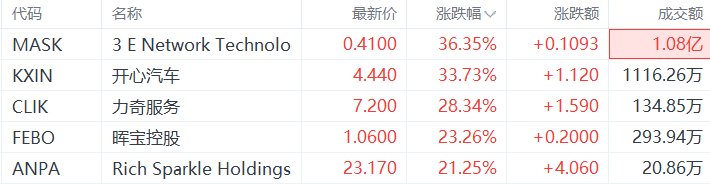
美股异动丨3 E Network Technolo涨36.35%,为涨幅最大的中概股



Ge Long Hui· 2025-12-16 00:10
Group 1 - The top gainers among Chinese concept stocks include 3 E Network Technology, which rose by 36.35%, followed by Happy Auto with a 33.73% increase, and Liqi Services with a 28.34% rise [1] - 3 E Network Technology's latest price is 0.4100, with a gain of 0.1093 and a trading volume of 108 million [1] - Happy Auto's latest price is 4.440, showing an increase of 1.120 with a trading volume of 11.1626 million [1] Group 2 - Liqi Services has a latest price of 7.200, reflecting a gain of 1.590 and a trading volume of 1.3485 million [1] - Huibao Holdings increased by 23.26%, with a latest price of 1.0600, gaining 0.2000 and a trading volume of 2.9394 million [1] - Rich Sparkle Holdings saw a rise of 21.25%, with a latest price of 23.170, an increase of 4.060, and a trading volume of 208.6 thousand [1]

大摩:网络安全仍具潜在的投资机会,予Okta、Palo Alto Networks等多股“增持”评级
Ge Long Hui· 2025-12-15 02:39
Core Insights - Morgan Stanley's analysis indicates that perpetual funds, which select companies and assets based on Environmental, Social, and Governance (ESG) criteria, have lower allocations in the cybersecurity sector compared to the MSCI All Country World Index. This gap is even larger when compared to core AI-related companies, suggesting significant investment opportunities in cybersecurity [1] Group 1: Market Trends - The growth momentum of AI and cybersecurity is expected to provide long-term growth catalysts for cybersecurity companies, highlighting their investment value [1] - The total addressable market for cybersecurity is projected to grow from approximately $270 billion to $377 billion by 2028, representing a compound annual growth rate (CAGR) of about 12% over three years [1] - Cloud security is identified as the fastest-growing area within cybersecurity [1] Group 2: Company Ratings - Analysts have assigned "overweight" ratings to several companies in the cybersecurity sector, including Netskope, Okta, Palo Alto Networks, Varonis Systems, and Zscaler [1] - Among cyber insurance companies, preference is given to Beazley, which is headquartered in London [1]



大行评级丨大摩:网络安全仍具潜在的投资机会,予Okta、Palo Alto Networks等多股“增持”评级
Ge Long Hui· 2025-12-15 02:35
Core Insights - Morgan Stanley's analysis indicates that perpetual funds, which select companies and assets based on Environmental, Social, and Governance (ESG) criteria while seeking financial returns and positive social impact, have a lower allocation in the cybersecurity sector compared to the MSCI All Country World Index [1] - The gap in allocation is even larger when compared to core AI-related companies, highlighting the potential investment opportunities in cybersecurity [1] - The growth momentum of AI and cybersecurity is expected to provide long-term growth catalysts for cybersecurity companies, further emphasizing their investment value [1] Industry Summary - The total addressable market for cybersecurity is projected to grow from approximately $270 billion to $377 billion by 2028, representing a compound annual growth rate (CAGR) of about 12% over three years [1] - Cloud security is identified as the fastest-growing area within cybersecurity [1] Company Ratings - Analysts have given "overweight" ratings to several companies in the cybersecurity sector, including Netskope, Okta, Palo Alto Networks, Varonis Systems, and Zscaler [1] - Among cybersecurity insurance companies, preference is given to Beazley, which is headquartered in London [1]
硬件与网络_AI 需求向数据中心外拓展,带来跨规模与多链路机遇;预计总潜在市场规模超 100 亿美元-Hardware & Networking_ AI Demand Expanding Outside the DC with Scale-Across and Multi-Rail Opportunities; Estimate $10 bn+ TAM
2025-12-08 15:36
Summary of J.P. Morgan Research on AI Data Center Opportunities Industry Overview - The report discusses the expanding demand for AI data centers and the associated networking technologies, particularly focusing on the data center interconnect (DCI) market, which is estimated to have a total addressable market (TAM) of over $10 billion [1][13]. Key Concepts - **Scale-Up**: Refers to XPU-to-XPU connectivity within a tightly coupled node or local cluster. - **Scale-Out**: Involves the fabric linking multiple nodes across racks and pods within a single data center. - **Scale-Across**: Focuses on enabling distributed training between geographically separated data centers. - **Multi-Rail**: Increases fiber density to expand DCI capacity and support new use cases [1]. Market Opportunities - The report estimates that Scale-Across and Multi-Rail opportunities could represent a combined TAM of over $10 billion for the DCI market, matching the current DCI TAM [1]. - A specific example of Scale-Across involves a U.S. hyperscaler interconnecting two data centers over approximately 100 km, enabling 20-25 Pb/s of aggregate AI training traffic [5][7]. Financial Projections - The DCI content for Scale-Across opportunities could range from $300 million to $500 million per DCI connection, excluding optical fiber cable and connectors [11]. - The revenue opportunity per DCI connection is broken down as follows: - **Coherent Pluggable Modules**: 55,000 units at an ASP of $4,000 to $6,000. - **Reconfigurable Line Systems (RLS)**: 860 units at an ASP of $20,000 to $50,000. - **Ethernet Switches**: 1,720 units at an ASP of $700 to $1,000 [11][12]. Company Positioning - Companies best positioned for the DCI opportunity include: - **Networking**: Arista and Cisco. - **Optical**: Ciena, Coherent, Corning, Fabrinet, and Lumentum [15]. Infrastructure Challenges - Increasing fiber density requirements are driving the need for innovation in existing infrastructure rather than simply adding more equipment [17]. - Traditional in-line amplifier (ILA) huts are becoming bottlenecks due to their limited capacity, necessitating the development of multi-rail technology to increase fiber pair capacity from 16 to 128 or even 256 pairs [23][33]. Future Projections - Lumen's ambitious plan to expand its network fiber miles from 12 million in 2022 to 47 million by 2028 could represent a significant opportunity, with an estimated total revenue opportunity of $200 million to $300 million for the incremental Lumen opportunity alone [29][33]. Conclusion - The report highlights significant growth potential in the AI data center market, driven by technological advancements and increasing demand for high-capacity interconnect solutions. Companies involved in networking and optical technologies are well-positioned to capitalize on these emerging opportunities [1][15].



中国通信-行业上涨速评:谷歌 TPU 优势支撑更明确的前景与确定性-China Networking-Quick Thoughts On Sector Rally; Better Visibility and Certainty Backed By GoogleTPU Strength
2025-11-27 02:17
Summary of Key Points from the Conference Call Industry Overview - The conference call discusses the **Chinese optical transceiver industry**, highlighting a recent rally in stock prices of optical transceiver companies, which increased by approximately **5%-13%** due to a more positive outlook for transceivers driven by advancements in **Google's Gemini 3.0** and its AI infrastructure [1][1]. Core Insights - **Demand Forecast**: There is an anticipated increase in demand for **1.6T transceivers**, with projections indicating a potential growth of **80-100%+** by **2027**. The expected demand for **35 million+ 1.6T transceivers** in **2026** is supported by factors such as higher attach rates, cloud upgrades, and larger cluster sizes [1][1]. - **Google's Influence**: Demand from Google for transceivers is expected to more than double by **2027**, attributed to the success of **Gemini 3.0** and **TPU** [1][1]. - **Company Ratings**: - **Eoptolink Technology** has a target price of **Rmb472**, based on a **24.0x FY26E** valuation, reflecting strong growth prospects in the **800G/1.6T cycle** and ASIC opportunities [3][3]. - **Suzhou TFC Optical Communication** has a target price of **Rmb196**, based on a **36.0x FY26E PE**, indicating robust long-term earnings growth potential [5][5]. Risks Identified - **Eoptolink Technology**: Risks that could hinder stock performance include: - Slower-than-expected data center investments - Lower-than-expected optical network capital expenditures by telecoms and governments in China - Margin pressures from price competition - Slower expansion of new customers - Ongoing China-US tech disputes [4][4]. - **Suzhou TFC Optical Communication**: Risks include: - Slower new product development - Slower global AI development - Delays in AI infrastructure and data center investments - Ongoing China-US tech disputes [6][6]. Additional Insights - The report emphasizes the importance of **Google's supply chain** in shaping the demand landscape for optical transceivers, suggesting that companies within this supply chain may benefit significantly from the anticipated growth [1][1]. - The analysis reflects a cautious optimism regarding the optical transceiver market, driven by technological advancements and increasing demand from major players like Google, while also highlighting the potential risks that could impact growth trajectories [1][1][4][6].

