
UnitedHealth(UNH)

Search documents
The Best Stocks to Invest $1,000 in This February
The Motley Fool· 2026-02-17 01:44
Core Viewpoint - The healthcare market is expected to normalize in 2026, presenting a buying opportunity for health insurance stocks that have seen significant declines in 2025 due to rising healthcare costs and other challenges [1][2]. Group 1: Oscar Health - Oscar Health has experienced a decline of over 60% in stock value, attributed to fears over expiring subsidies and rising healthcare costs, leading to losses [2][6]. - The company has grown its insurance membership from 400,000 in 2020 to 3.4 million as of February 2026, indicating strong market share growth despite current challenges [6]. - Revenue is projected to increase from $11.7 billion in 2025 to as high as $19 billion in 2026, with operating earnings expected to range from $250 million to $450 million, making the current stock price attractive given its market cap of $3.6 billion [7]. Group 2: UnitedHealth Group - UnitedHealth Group's stock has decreased by 53.6% from its highs, facing multiple headwinds including cybersecurity issues and legal challenges [2][8]. - The company anticipates generating $439 billion in revenue and $24 billion in operating earnings in 2026, supported by rate repricings for customer premiums [10]. - Trading at a market cap of approximately $266 billion, UnitedHealth is valued at just over 10 times its expected operating income, suggesting potential for significant growth in the coming years [11].




Is Wall Street Bullish or Bearish on UnitedHealth Stock?
Yahoo Finance· 2026-02-16 10:08
Core Insights - UnitedHealth Group Incorporated (UNH) has a market capitalization of $265.6 billion and operates organized health systems, providing employee benefit programs globally [1] Performance Overview - UNH shares have underperformed the broader market, declining 44.8% over the past year, while the S&P 500 Index has increased by nearly 11.8% [2] - In 2026, UNH's stock fell 11.2%, contrasting with a slight dip in the S&P 500 on a year-to-date basis [2] - Compared to the iShares U.S. Healthcare Providers ETF (IHF), which declined about 12.1% over the past year and 3.5% year-to-date, UNH's underperformance is evident [3] Financial Results - On January 27, UNH shares dropped 19.6% following the release of fiscal 2025 Q4 results, where revenue increased by 12.3% year-over-year to $113.22 billion, driven by growth in Optum and enrollment in UnitedHealthcare's government programs, but slightly below consensus expectations [5] - Adjusted EPS was approximately $2.11, meeting expectations, but underlying profitability weakened due to high medical utilization and care costs compressing insurance margins, particularly in Medicare Advantage [5] - The company incurred $1.6 billion in charges related to Optum portfolio realignment and business optimization, impacting reported earnings and segment margins [5] Analyst Expectations - For the current fiscal year ending in December, analysts project UNH's EPS to rise by 8.2% to $17.69 on a diluted basis [6] - UNH has a mixed earnings surprise history, beating consensus estimates in two of the last four quarters while missing forecasts in two others [6] - Among 26 analysts covering UNH stock, the consensus rating is a "Moderate Buy," with 16 "Strong Buy" ratings, two "Moderate Buys," seven "Holds," and one "Strong Sell" [6] - The analyst configuration has become more bullish, with 15 analysts now suggesting a "Strong Buy" [7]
陆家嘴财经早餐2026年2月14日星期六
Sou Hu Cai Jing· 2026-02-14 01:14
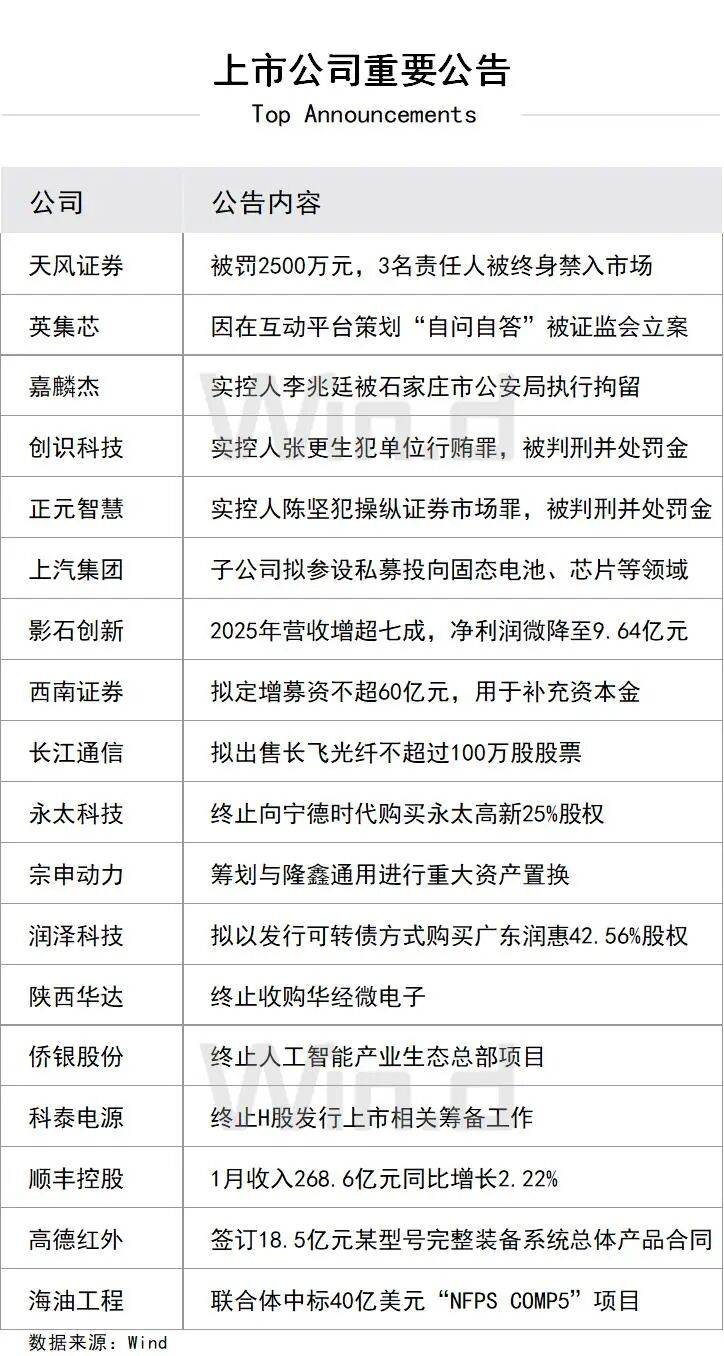
Financial Data - In January, China's social financing increased by 7.22 trillion yuan, up by 166.2 billion yuan year-on-year, while RMB loans rose by 4.71 trillion yuan, with a total balance of 276.62 trillion yuan, reflecting a year-on-year growth of 6.1% [1] - The weighted average interest rate for new corporate loans in January was approximately 3.2%, down by about 20 basis points year-on-year, while the rate for personal housing loans remained stable at 3.1% [3] - The M2 money supply grew by 9% year-on-year, and M1 increased by 4.9% [1] Real Estate Market - Data from the National Bureau of Statistics indicated that the month-on-month decline in second-hand housing prices in 70 cities narrowed, with first, second, and third-tier cities seeing reductions of 0.4, 0.2, and 0.1 percentage points respectively [1] - Year-on-year, new and second-hand housing prices in 70 major cities continued to decline, with the rate of decrease further widening [1] Stock Market Performance - The A-share market showed a positive trend in the post-Spring Festival period, with the Shanghai Composite Index rising by 4.85% in the first five trading days of 2024, marking the highest increase in nearly a decade [2] - The Shanghai Composite Index closed down by 1.26% at 4082.07 points on the last trading day before the Spring Festival, with a total market turnover of 2 trillion yuan [4] Regulatory Developments - The China Securities Regulatory Commission (CSRC) imposed strict penalties on Tianfeng Securities for illegal financing and information disclosure violations, with fines totaling 25 million yuan [4] - The State Administration for Market Regulation and the Ministry of Commerce announced enhanced supervision of cross-border e-commerce retail imports, focusing on recall regulations [3] Corporate News - Meituan projected a loss of over 23 billion yuan for the previous year, with continued losses expected in the first quarter of this year, primarily due to a significant decline in operating profit in its core local business segment [6] - The Hong Kong Stock Exchange is considering expanding the scope of confidentiality applications beyond technology and biotech sectors to include traditional industries [5]





大西洋月刊:美国还没准备好迎接人工智能对就业的影响
美股IPO· 2026-02-13 03:27
Core Argument - The article discusses the profound impact of artificial intelligence (AI) on the job market, suggesting that the U.S. is unprepared for the potential disruptions it may cause to employment and economic stability [1]. Group 1: Historical Context and Current Trends - The establishment of the U.S. Bureau of Labor Statistics (BLS) aimed to measure labor conditions and create fair outcomes amidst industrial changes, highlighting the importance of data in understanding economic realities [5][6]. - The BLS has documented significant job growth in various sectors, such as a 907% increase in mobile food service jobs since 2000, indicating a dynamic labor market [6]. - However, the BLS is limited in its predictive capabilities, particularly regarding the impact of emerging technologies like AI on the workforce [7]. Group 2: AI's Impact on Employment - AI is rapidly transforming job functions, enabling tasks to be completed more efficiently than ever before, which raises concerns about job displacement [8][9]. - Predictions from industry leaders suggest that AI could lead to a 10% to 20% increase in unemployment rates and potentially eliminate half of entry-level white-collar jobs within the next decade [10]. - A Reuters/Ipsos survey indicates that 71% of Americans fear AI will lead to permanent job losses, reflecting widespread anxiety about the future of work [9]. Group 3: Economic Resilience and Job Creation - Economists argue that capitalism has a strong resilience, often leading to job creation following technological advancements, as seen with ATMs and software like Excel [8]. - The BLS forecasts a 3.1% employment growth rate over the next decade, which, while lower than previous years, still represents the addition of 5 million jobs [8]. Group 4: The Role of Policy and Corporate Responsibility - There is a growing concern that corporate leaders are prioritizing automation and efficiency over employee welfare, leading to potential mass layoffs [22][23]. - The article suggests that CEOs are under pressure to demonstrate the benefits of AI quickly, often resulting in job cuts rather than exploring ways to integrate AI while supporting their workforce [22][23]. - Proposals for policies such as retraining programs and a robot tax to support displaced workers are discussed, but there is skepticism about their implementation [33][28]. Group 5: Political and Social Implications - The political landscape is characterized by a lack of proactive measures to address the challenges posed by AI, with many lawmakers adopting a hands-off approach [26][27]. - The article emphasizes the need for a coordinated response to the potential upheaval caused by AI, suggesting that without intervention, the consequences could be severe for both the economy and society [30][31].




UnitedHealth: 3 Reasons Not To Buy (Revisited)
Seeking Alpha· 2026-02-12 13:56
Core Insights - The article discusses the author's extensive experience in executive management, particularly in the insurance and reinsurance sectors, as well as knowledge in climate change and ESG [1]. Group 1 - The author has 36 years of experience in executive management, focusing on insurance/reinsurance and global markets [1]. - The author's educational background includes an honours degree in economics and politics, emphasizing economic development [1]. - The author invests personally, indicating a hands-on approach to investment [1].

Mizuho Lowers UnitedHealth Group Incorporated (UNH) Target to $350, Maintains Outperform Rating
Insider Monkey· 2026-02-12 00:38
Core Insights - Artificial intelligence (AI) is identified as the greatest investment opportunity of the current era, with a strong emphasis on the urgent need for energy to support its growth [1][2][3] - A specific company is highlighted as a key player in the AI energy sector, owning critical energy infrastructure assets that are essential for meeting the increasing energy demands of AI technologies [3][7] Investment Opportunity - Wall Street is investing hundreds of billions into AI, but there is a looming question regarding the energy supply needed to sustain this growth [2] - The company in focus is positioned to benefit from the surge in demand for electricity driven by AI data centers, making it a potentially lucrative investment [3][8] Energy Infrastructure - The company owns significant nuclear energy infrastructure assets, which are crucial for America's future power strategy [7] - It is one of the few global firms capable of executing large-scale engineering, procurement, and construction projects across various energy sectors, including oil, gas, and renewables [7] Financial Position - The company is noted for being completely debt-free and holding a substantial cash reserve, amounting to nearly one-third of its market capitalization [8] - It also has a significant equity stake in another AI-related company, providing investors with indirect exposure to multiple growth opportunities without the associated premium costs [9] Market Perception - The company is described as undervalued, trading at less than seven times earnings, which is attractive given its ties to the rapidly growing AI and energy sectors [10] - There is a growing interest from hedge fund managers, indicating that this stock is gaining attention among sophisticated investors [9][10] Future Trends - The article emphasizes the importance of AI as a disruptor in traditional industries, suggesting that companies that adapt to AI will thrive [11] - The influx of talent into the AI sector is expected to drive continuous innovation and advancements, reinforcing the long-term potential of investments in this area [12] Conclusion - The time to invest in AI and the associated energy infrastructure is now, with the potential for significant returns in the near future [13][15]

UnitedHealth: After The Collapse
Seeking Alpha· 2026-02-10 20:27
Core Insights - UnitedHealth Group Incorporated's (UNH) outlook for 2026 emphasizes cash strength over revenue growth, indicating a focus on efficient asset utilization and internal capital generation [1] - The revenue guidance for UNH is described as easier, suggesting a more manageable growth trajectory [1] - Optum's integrated care, pharmacy, and data platform are highlighted as key components supporting the company's cash strength [1] Financial Performance - The emphasis on cash strength suggests that UNH is prioritizing liquidity and operational efficiency rather than aggressive revenue expansion [1] - The mention of efficient asset use indicates a strategic approach to capital allocation, which may enhance long-term financial stability [1] Strategic Focus - The integrated care and pharmacy services provided by Optum are positioned as critical to maintaining strong cash flow, reflecting a strategic focus on comprehensive healthcare solutions [1]

Here’s What Happened to UnitedHealth Group (UNH)
Yahoo Finance· 2026-02-10 12:57
Core Insights - Sequoia Strategy achieved a return of 9% in Q4 2025, outperforming the S&P 500 Index which returned 2.7% during the same period [1] - For the entire year of 2025, Sequoia Strategy delivered a return of 21.9%, compared to 17.9% for the S&P 500 Index [1] - The Strategy focuses on investing in high-quality, fundamentally and financially strong businesses at reasonable prices, covering a wide range of sectors, business styles, and regions [1] Company Performance - UnitedHealth Group Incorporated (NYSE:UNH) negatively impacted the Strategy's performance in Q4 2025, with a one-month return of -17.44% and a 12-month decline of 48.36% [2] - As of February 9, 2026, UnitedHealth Group's stock closed at $275.70 per share, and the company has a market capitalization of $249.74 billion [2] - The investments in UnitedHealth Group and Elevance Health were initiated opportunistically, with UnitedHealth shares purchased during a price drop in 2019 due to "Medicare for All" concerns [3]
千亿级景林密集调仓换股
Shang Hai Zheng Quan Bao· 2026-02-10 04:56
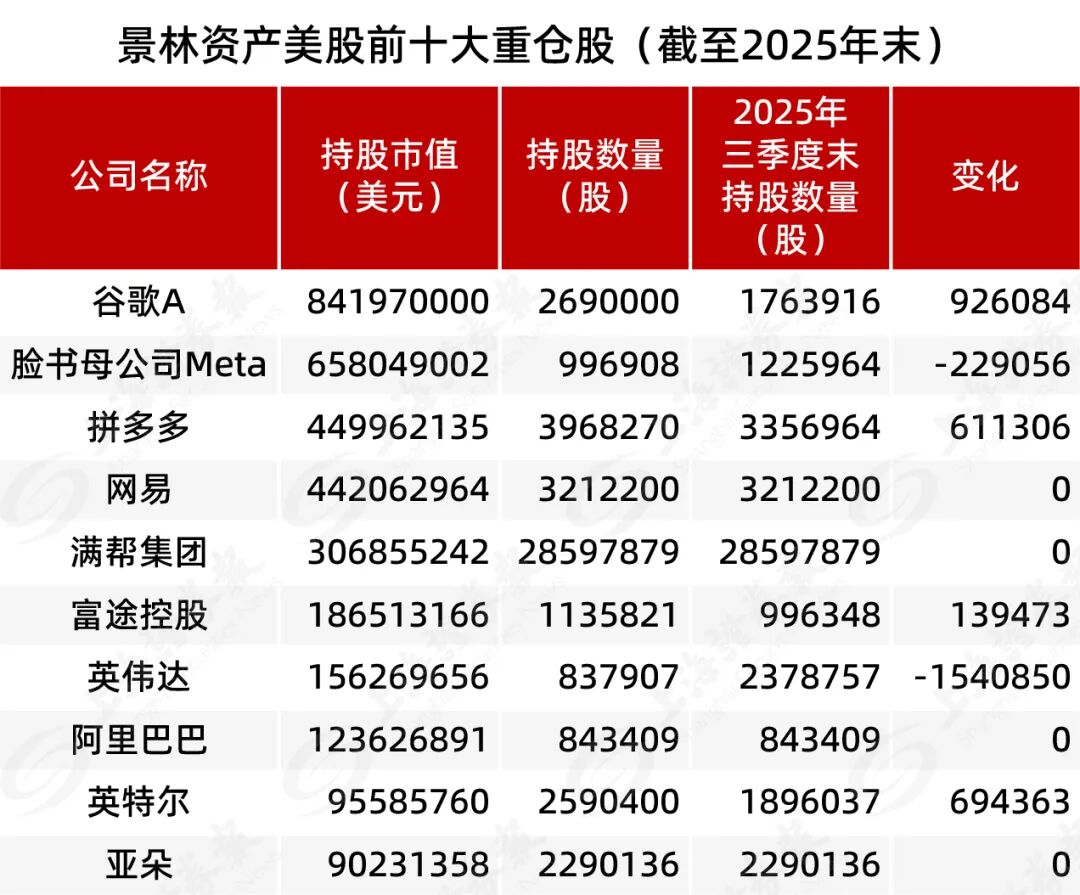
Core Viewpoint - Jinglin Asset has made significant adjustments to its stock holdings in the fourth quarter of 2025, increasing its positions in key technology stocks while reducing exposure to others, reflecting a strategic focus on sectors like AI and new energy [1][6][9]. Group 1: Stock Holdings and Changes - As of the end of 2025, Jinglin Asset held stocks in 28 companies in the US market, with a total market value exceeding $4 billion [1]. - The top ten holdings include Google A, Meta, Pinduoduo, NetEase, Manbang Group, Futu Holdings, NVIDIA, Alibaba, Intel, and Atour, with Chinese stocks still dominating the portfolio [1][10]. - The largest holding shifted from Meta to Google A, with Google A valued at approximately $841.97 million, reflecting an increase of 926,084 shares from the previous quarter [2][3][10]. Group 2: Investment Strategy and Focus Areas - Jinglin Asset is focusing on sectors such as AI, new energy, smart driving, and humanoid robots, believing these areas will continue to see rapid growth and investment from both China and the US [1][9]. - The firm emphasizes a balanced global investment strategy, selecting companies with strong valuations and cash flows to mitigate risks while capitalizing on growth opportunities [9]. - The CEO highlighted the importance of major AI application platforms like Google, Apple, ByteDance, Tencent, and OpenAI, predicting that 2026 could be a pivotal year for AI agents [9]. Group 3: Recent Trading Activity - In Q4 2025, Jinglin Asset increased its holdings in Intel by 694,363 shares and in Futu Holdings by 139,473 shares, while also initiating a position in Broadcom [6]. - The firm significantly reduced its holdings in NVIDIA by 1.54 million shares and in Meta by 229,056 shares, alongside partial reductions in other stocks like TSMC and UnitedHealth [6].



UnitedHealth Stock: Is the Market Overreacting to Lower-Than-Expected Medicare Rates?
Yahoo Finance· 2026-02-09 15:20
Shares of UnitedHealth Group (NYSE: UNH) have been falling rapidly after the company reported its latest earnings numbers. This is even after an already tough year in 2025, when the health insurance giant lost 35% of its value. The market has been especially bearish on the stock due to concerns about lower-than-expected increases in Medicare Advantage rates. Is this an overreaction, and has UnitedHealth Group stock become an incredibly cheap buy, or is it in danger of going even lower? Where to invest $1, ...