
Willis Towers Watson(WTW)

Search documents
AI颠覆潮席卷金融业:Insurify新工具上线,美国保险经纪股遭遇“黑色星期一”
智通财经网· 2026-02-09 23:27
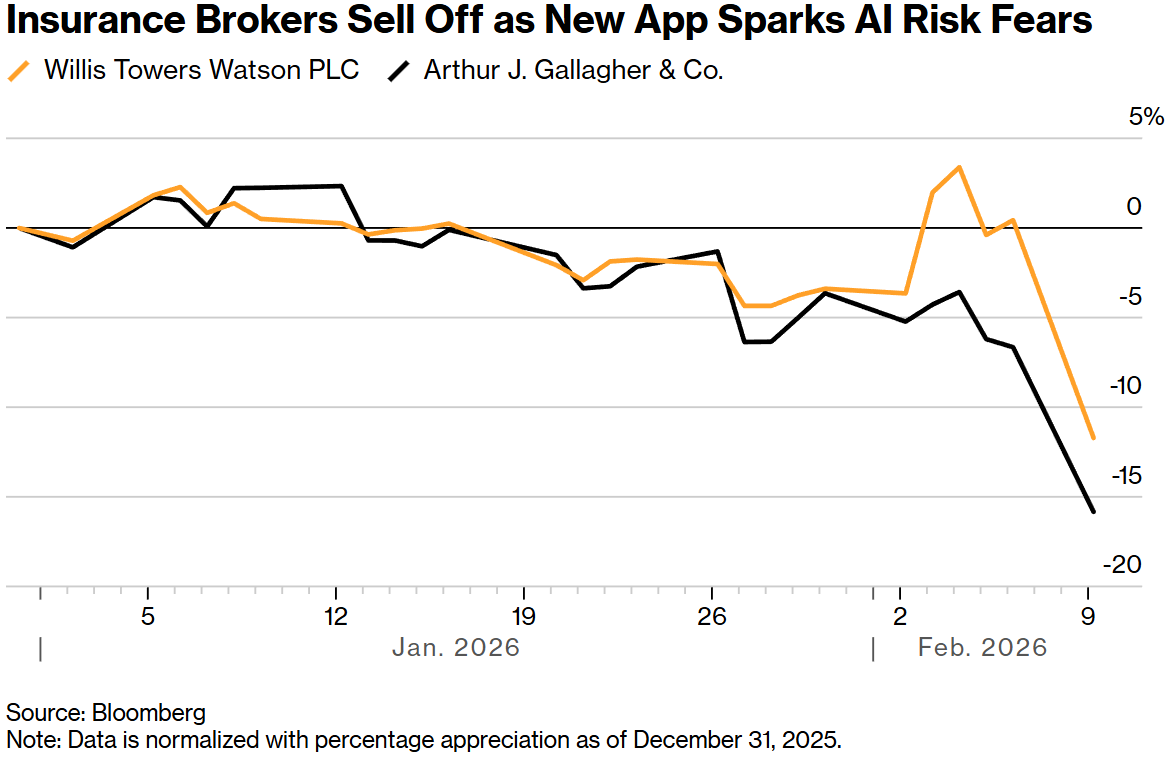
Group 1 - The core concern is the market's reaction to Insurify's launch of an AI tool, which has raised fears of disruption in the insurance industry, leading to significant stock sell-offs among U.S. insurance brokerage firms [1][4] - The S&P 500 insurance sector index closed down 3.9%, marking the largest decline since October of the previous year [1] - Willis Towers Watson PLC experienced the worst performance, with a closing drop of 12%, the most severe trading day since November 2008 [1] Group 2 - Following Willis Towers Watson, Arthur J Gallagher & Co. and Aon Group saw declines of 9.9% and 9.3%, respectively [1] - Analyst Matthew Palazola noted that while the new AI tools may pose a threat to some consulting aspects of insurance brokerage firms, they are more likely to act as "efficiency multipliers" rather than existential threats [4] - Insurify's application, which utilizes ChatGPT to compare auto insurance rates based on various inputs, was launched on February 3 [4]


Global pension assets rise by nearly 10%, reaching new high
Globenewswire· 2026-02-09 15:32
Core Insights - Global pension assets reached a record USD 68.3 trillion in 2025, marking a year-on-year increase of 9.6% driven by defined contribution (DC) savings [1] - The US remains the largest pensions market, accounting for 66% of the Top 22 globally, while Canada has overtaken Japan to become the second largest pensions market with a 12% year-on-year growth [4] - The UK pension market has experienced weak growth of only 1.4% per annum over the last decade, resulting in a drop from the second largest to the fourth largest pensions market [5] Global Market Performance - In 2025, global markets showed sustained recovery with strong investor sentiment, leading to the creation of USD 6.0 trillion in pension asset value [2] - The allocation to equities in the seven largest pensions markets has decreased by nine percentage points to 48% of total assets, while bonds and other asset classes have increased [7] - Most major asset classes delivered positive returns in 2025, with equities performing particularly well [8] Market Trends and Future Outlook - The UK pension market is undergoing a structural shift, with defined benefit (DB) schemes maturing and de-risking, while DC schemes are expanding, now representing around 40% of UK pension assets [6] - Looking ahead, the 2026 outlook will be influenced by policy decisions, technological innovation, and global dynamics, with fiscal support and AI-related investments expected to drive growth [9] - The adoption of a 'Total Portfolio Approach' is becoming increasingly important due to the uncertain and complex investment environment [10]

Global pension assets rise by nearly 10%, reaching new high
Globenewswire· 2026-02-09 15:32
Core Insights - Global pension assets reached a record USD 68.3 trillion in 2025, marking a 9.6% year-on-year increase driven by defined contribution (DC) savings [1] - The US remains the largest pensions market, constituting 66% of the Top 22 globally, while Canada has overtaken Japan to become the second largest pensions market with a 12% year-on-year growth [4] - The UK pension market has experienced weak growth of only 1.4% per annum over the last decade, resulting in a drop from the second largest to the fourth largest pensions market [5] Global Market Overview - In 2025, global markets showed sustained recovery with strong investor sentiment, leading to the creation of USD 6.0 trillion in pension asset value [2] - Among the top seven global pensions markets, DC assets now account for 63% of total assets, with Australia and the US having the highest allocations at 90% and 72% respectively [2] Growth Trends - Over the past decade, Australia, the US, and Canada have seen above-average growth rates in their predominantly DC markets, with annual growth rates of 6.6%, 7.7%, and 5.3% respectively [3] - South Korea, Switzerland, and Hong Kong also experienced growth rates exceeding 8% per annum over the last ten years [3] Structural Changes - The UK pension market is undergoing a structural shift, with defined benefit (DB) schemes maturing and de-risking, while DC schemes are expanding, now representing around 40% of UK pension assets, up from 18% in 2020 [6] Asset Allocation Trends - Over the last 20 years, the overall allocation to equities in the seven largest pensions markets has decreased by nine percentage points to 48%, while bonds and other asset classes have increased by three and six percentage points respectively [7] Market Performance - 2025 saw broad-based gains across global markets, with equities performing particularly well and fixed income also posting gains due to global rate cuts and narrowing credit spreads [8] Future Outlook - The outlook for 2026 is expected to be influenced by policy decisions, technological innovation, and shifting global dynamics, with fiscal support and AI-related investments identified as key growth drivers [9] - A 'Total Portfolio Approach' is becoming increasingly important in the current uncertain and complex investment environment, enabling faster and more coordinated decision-making [10]

WTW releases next-generation U.S. Library models in RiskAgility Financial Modeler, delivering full VM-22 capability for life insurers
Globenewswire· 2026-02-09 14:00
Core Insights - WTW has launched the next generation of its U.S. Library models within RiskAgility FM, which fully incorporates Valuation Manual 22 (VM-22) requirements for non-variable annuity products, providing insurers and reinsurers with a robust platform for compliance [1][2][3] Group 1: Product Features - The updated RiskAgility FM U.S. Library models offer an end-to-end modeling environment that aligns with VM-22, facilitating a smooth transition for companies [2][3] - The new model suite enhances asset and liability modeling capabilities, delivering comprehensive VM-22 reserving functionalities [3][8] - RiskAgility FM features an intuitive modeling environment, integrated AI assistance, and governance features such as version control and workflow automation [4] Group 2: Market Impact - The launch of the VM-22-ready model suite is positioned as a pivotal moment for the U.S. annuity market, enabling insurers to meet new standards with precision [3] - WTW's Insurance Consulting and Technology business aims to innovate and transform the insurance industry, providing solutions for risk and capital management [5][6] Group 3: Company Overview - WTW serves a global client base, including leading insurance groups, with over 1,000 client companies utilizing its specialist insurance software [6][7] - The company operates in 140 countries, leveraging local expertise to enhance organizational resilience and performance [7]
全球养老金金融观察——2025年第四季度(英)
WTW· 2026-02-09 06:40
Investment Rating - The report indicates a positive investment rating for the pension index across all major regions in the fourth quarter of 2025, with notable increases in the pension index driven by positive investment returns and decreases in liabilities in most regions [1][3]. Core Insights - The Global Pension Finance Watch highlights the impact of capital market performance on defined benefit pension plan financing, emphasizing the importance of monitoring pension funded status and financial metrics for informed business decisions [2][5]. - The WTW Pension Index reflects the ratio of market value of assets to projected benefit obligations (PBO) for benchmark plans, showing significant increases in the index across various regions [3][60]. - Positive investment returns were observed across all countries in Q4 2025, contributing to the overall increase in pension indices [15][22][26][30][34][38][42][46]. Summary by Region Brazil - The pension index increased by 0.2% in Q4 2025, with investment returns of 3.9% and a liability growth factor of 3.7% [3][22]. Canada - The pension index rose by 2.2% in Q4 2025, with investment returns of 1.2% and a liability decrease of 1.0% [3][26]. Eurozone - The pension index increased by 5.8% in Q4 2025, with investment returns of 2.6% and a liability decrease of 2.9% [3][30]. Japan - The pension index saw a 7.2% increase in Q4 2025, with investment returns of 2.5% and a liability decrease of 4.5% [3][34]. Switzerland - The pension index increased by 3.3% in Q4 2025, with investment returns of 1.3% and a liability decrease of 1.9% [3][38]. United Kingdom - The pension index rose by 0.2% in Q4 2025, with investment returns of 5.6% and a liability increase of 5.4% [3][42]. United States - The pension index increased by 2.8% in Q4 2025, with investment returns of 2.1% and a liability decrease of 0.6% [3][46].
Truist Financial Sets $400 Price Target for Willis Towers Watson PLC (NASDAQ:WTW)
Financial Modeling Prep· 2026-02-04 21:07
Core Viewpoint - Truist Financial has set a price target of $400 for Willis Towers Watson PLC, indicating a potential increase of approximately 18.04% from its current stock price of around $338.86 [1][5] Financial Performance - WTW reported a 6% organic revenue growth in Q4 2025, driven by a strategic focus on Risk and Broking, along with investments in talent and innovation [2][5] - The adjusted operating margin increased by 80 basis points to 36.9%, reflecting improved efficiency and profitability [2][5] - The company's adjusted earnings per share rose by 13% year-over-year to $8.12, excluding contributions from TRANZACT, supported by recent acquisitions [3][5] Stock Performance - WTW's stock is currently priced at $337.35, showing a slight increase of 0.67% or $2.25, with fluctuations between $337.05 and $344.99 on the day [4] - Over the past year, the stock reached a high of $352.79 and a low of $292.97, with a market capitalization of approximately $32.91 billion [4]

Willis Towers Q4 Earnings & Revenues Beat Estimates on Lower Expenses
ZACKS· 2026-02-03 16:26
Core Insights - Willis Towers Watson (WTW) reported fourth-quarter 2025 adjusted earnings of $8.12 per share, exceeding the Zacks Consensus Estimate by 2.5%, with a year-over-year increase of 2% [1] - The quarterly results were supported by expanded operating margins in the Health, Wealth & Career and Risk & Broking segments, along with reduced expenses [1] Operational Update - WTW's adjusted consolidated revenues were $2.9 billion, reflecting a 3% decline year over year on a reported basis, but a 6% increase on an organic basis; the top line also beat the Zacks Consensus Estimate by 2.5% [2] - Total service costs decreased by 10% year over year to $1.9 billion, attributed to lower operating expenses, amortization, and transaction costs [2] Financial Performance - Adjusted operating income was $1 billion, down 1% year over year, with a margin expansion of 80 basis points to 36.9% [3] - Adjusted EBITDA was $1.12 billion, a 3% decrease year over year, with an adjusted EBITDA margin of 38.2%, which expanded by 30 basis points [3] Segment Performance - Health, Wealth & Career segment revenues totaled $1.6 billion, down 11% year over year, but beat estimates by 0.6%; organic growth was driven by strong client retention and healthcare inflation [4] - Wealth segment saw organic revenue growth from robust Retirement work and new product offerings, while Career segment growth was fueled by demand for advisory services and compensation benchmarking [5] - Risk & Broking segment revenues rose 10% year over year to $1.2 billion, exceeding estimates by 4.9%, driven by new business activity and strong client retention [6][8] Financial Update - As of December 31, 2025, cash and cash equivalents were $3.1 billion, a 65.7% increase from the end of 2024; long-term debt rose 8.4% to $5.7 billion [10] - Free cash flow for 2025 increased by 22% year over year to $1.55 billion, primarily due to operating margin expansion [11] Future Outlook - WTW anticipates a 10 cents dilution to adjusted EPS in 2026 from the Newfront acquisition, with projected post-close revenues of $250 million and an adjusted EBITDA margin of 26% [12] - The company expects continued annual margin expansion at the enterprise level, with a foreign currency tailwind on adjusted diluted EPS of 30 cents in 2026 [13] - Share repurchases of $1.0 billion or more are planned, subject to market conditions [14] Full-Year Highlights - For the full year, adjusted earnings were $17.08 per share, beating estimates by 1.2%, with total revenues declining 2% year over year to approximately $9.7 billion, also exceeding estimates by 0.6% [15]

Willis Towers Watson (WTW) Earnings Transcript
Yahoo Finance· 2026-02-03 15:38
Core Insights - The company achieved adjusted diluted earnings per share (EPS) of $17.08 for the full year, reflecting a 13% increase year over year when excluding the contribution from TRANZACT [1][20] - For 2025, the company reported organic growth of 5% and expanded adjusted operating margin by 130 basis points to 25.2% [1][19] - The fourth quarter saw a 6% organic growth in health, wealth, and career segments, with a notable 10% growth in career services [2][23] Financial Performance - Adjusted EPS for the fourth quarter was $8.12, marking a 13% increase year over year when excluding TRANZACT [2][19] - The company generated free cash flow of $1.5 billion for the year, an increase of $279 million from the previous year, resulting in a free cash flow margin of 15.9% [34] - The adjusted operating margin for the fourth quarter was 36.9%, an 80 basis point improvement year over year [32] Segment Performance - Health, wealth, and career revenue grew 6% in the fourth quarter, with health business achieving 4% growth [20][21] - The corporate risk and broking (CRB) segment recorded 8% organic growth in the fourth quarter, continuing a trend of high single-digit growth [5][27] - The wealth segment saw strong growth driven by increased retirement work globally, with expectations for high single-digit growth in 2026 [22][66] Strategic Initiatives - The company is focused on enhancing efficiency through its enterprise delivery organization and investments in technology, which are expected to drive further margin expansion [2][11] - Recent acquisitions, including Newfront, Cushion, and Flowstone Partners, are aimed at optimizing the company's portfolio for growth and profitability [2][13] - The company plans to allocate at least $1 billion to share repurchases in 2026, reflecting a balanced capital allocation approach [36][71] Market Outlook - The company anticipates continued strong demand across its global business, driven by healthcare inflation and employers' focus on managing costs while maintaining competitive employee benefits [21][62] - For 2026, the company expects mid-single-digit organic growth across its segments, supported by ongoing investments in talent and technology [17][50] - The company is optimistic about its position in the market and the potential for synergies from recent acquisitions over the next three years [15][17]
Compared to Estimates, Willis Towers Watson (WTW) Q4 Earnings: A Look at Key Metrics
ZACKS· 2026-02-03 15:31
Core Insights - Willis Towers Watson (WTW) reported a revenue of $2.94 billion for the quarter ended December 2025, reflecting a decrease of 3.3% year-over-year, while EPS was $8.12, slightly down from $8.13 in the previous year [1] - The revenue exceeded the Zacks Consensus Estimate of $2.86 billion by 2.51%, and the EPS also surpassed the consensus estimate of $7.92 by 2.47% [1] Revenue Breakdown - Health, Wealth and Career segment revenue was $1.65 billion, slightly above the average estimate of $1.64 billion, but down 11.1% year-over-year [4] - Reimbursable expenses and other revenue reached $31 million, exceeding the estimated $26.16 million, but showed a significant decline of 24.4% compared to the previous year [4] - Total segment revenue was reported at $2.9 billion, surpassing the average estimate of $2.84 billion, with a year-over-year decline of 4.4% [4] - Risk and Broking segment revenue was $1.25 billion, exceeding the average estimate of $1.19 billion, and showed a year-over-year increase of 9.8% [4] Operating Income - Segment Operating Income for Risk and Broking was $435 million, higher than the estimated $408.38 million [4] - Segment Operating Income for Health, Wealth and Career was reported at $729 million, slightly above the average estimate of $719.31 million [4] Stock Performance - Over the past month, shares of Willis Towers Watson have returned -5.4%, contrasting with the Zacks S&P 500 composite's +1.8% change [3] - The stock currently holds a Zacks Rank 3 (Hold), indicating potential performance in line with the broader market in the near term [3]

Willis Towers Watson(WTW) - 2025 Q4 - Earnings Call Transcript
2026-02-03 15:02
Financial Data and Key Metrics Changes - In Q4 2025, the company achieved 6% organic growth, with adjusted operating margin expanding by 80 basis points to 36.9% [7][19] - Adjusted EPS for Q4 was $8.12, a 13% increase year-over-year when excluding TRANZACT [7][19] - For the full year, organic growth was 5%, with adjusted operating margin expanding by 130 basis points to 25.2% and adjusted diluted EPS of $17.08, also up 13% year-over-year excluding TRANZACT [7][19] Business Line Data and Key Metrics Changes - Health, Wealth and Career (HWC) segment saw organic growth accelerate to 6% in Q4, with a full-year growth of 4% [7][20] - Risk and Broking (R&B) generated 7% organic growth in Q4, with corporate Risk and Broking achieving 8% growth, marking the 12th consecutive quarter of high single-digit growth [8][25] - The insurance consulting and technology business experienced a 1% decline in Q4, contrasting with 11% growth in the prior year [26] Market Data and Key Metrics Changes - The international market drove growth in the health business, with strong performance in Europe and new business acquisitions [21][22] - The corporate Risk and Broking business saw significant contributions from construction, surety, marine, and credit risk solutions [25] - The company expects high single-digit growth in the health segment for 2026, driven by healthcare inflation and demand for competitive employee benefits [21][64] Company Strategy and Development Direction - The company is focused on optimizing its portfolio for growth and profitability, with recent acquisitions including Newfront, Cushon, and FlowStone Partners [5][16] - A specialization strategy in Risk and Broking is driving new business momentum and enhancing efficiency [4][8] - The company plans to integrate Newfront's technology and team into its operations to enhance client service and drive growth [15] Management's Comments on Operating Environment and Future Outlook - Management expressed confidence in the company's position and outlook for 2026, expecting mid-single-digit organic growth and continued margin expansion [17][30] - The political and regulatory environment is seen as a driver for clients seeking advice and solutions [17] - While monitoring potential headwinds, management remains optimistic about the company's competitive advantages and market momentum [17] Other Important Information - The company generated free cash flow of $1.5 billion for the year, with a free cash flow margin of 15.9% [30] - Share repurchases totaled $439 million in Q4, with plans to allocate at least $1 billion to share repurchases in 2026 [31][32] - The company expects foreign exchange to be a tailwind of approximately $0.30 to adjusted EPS for 2026 [29][50] Q&A Session Summary Question: Drivers of organic growth within R&B - Management highlighted strong organic growth in R&B, with significant contributions from various specialty lines and a focus on specialization strategy [36][38] Question: Mid- to high-single-digit guidance for R&B in 2026 - Management acknowledged potential pricing improvements but emphasized that growth is driven by high retention rates and new business [40][43] Question: Impact of talent on organic growth in 2026 - Management confirmed that strategic talent investments have been key to driving organic growth and will continue to be a focus [52][53] Question: Changes in Medicare influencing BD&O growth - Management expects modest headwinds from Medicare changes but anticipates strong demand in the retiree marketplace [58][59] Question: AI's impact on consulting services - Management views AI as an opportunity rather than a threat, focusing on regulatory-driven recurring services [72]