华帝股份

Search documents
一文读懂华之杰:09W2026周报
CAITONG SECURITIES· 2026-03-03 07:25
最近 12 月市场表现 -8% -2% 5% 11% 17% 23% 家用电器 沪深300 分析师 孙谦 SAC 证书编号:S0160525060001 sunqian@ctsec.com 分析师 于雪娇 SAC 证书编号:S0160525080005 yuxj@ctsec.com 相关报告 1. 《2026 春节期间消费数据及家电相关情 况追踪:08W2026 周报》 2026-02-24 2. 《索尼FY2025 Q3季报梳理:06W2026 周报》 2026-02-10 3. 《惠而浦 4Q25 及年报:新品驱动份额 提升 05W2026 周报》 2026-02-03 一文读懂华之杰:09W2026 周报 家用电器 证券研究报告 行业投资策略周报 / 2026.03.02 投资评级:看好(维持) 核心观点 核心观点 ❖ 周度研究聚焦:一文读懂华之杰 请阅读最后一页的重要声明! ❖ 公司简介:公司定位于智能控制行业,致力于以锂电池电源管理、智能控制、 无刷电机驱动和控制等技术为核心,主要为锂电电动工具、消费电子领域提 供有效的电源管理和动力驱动方面的系统解决方案。经过二十余年的经营发 展和积累,公司顺应锂 ...
华帝股份:截至2026年2月13日公司合并普通账户和融资融券信用账户为37350户
Zheng Quan Ri Bao Wang· 2026-02-26 08:54
证券日报网讯2月26日,华帝股份(002035)在互动平台回答投资者提问时表示,截至2026年2月13日, 公司合并普通账户和融资融券信用账户为37350户。 ...

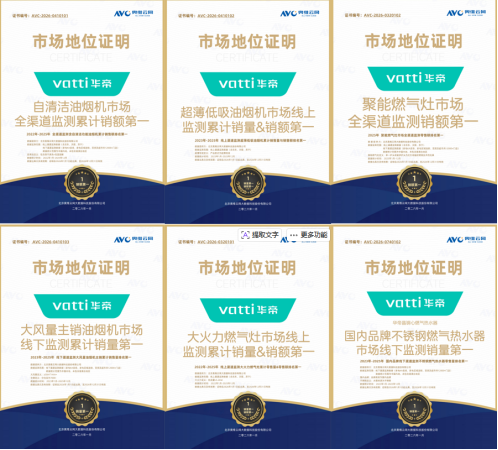
华帝四大品类齐登销量TOP1,用权威认证印证厨电领军实力
Xin Lang Cai Jing· 2026-02-25 06:45
厨电行业已经步入发展的"深水区"。这一阶段内,企业要想顺利渡河,首先要苦修内功,打造出更高 效、更有力的创新引擎。 能在爆点缺乏的行业背景下取得如此不俗的成绩,侧面证明了华帝高端化战略已取得了阶段性成果,其 所倡导的"净洁厨房"体系在消费市场的影响力正在快速提升。 忠于用户,赢得用户 过去一年里,"厨电三杰"之一的华帝在创新引领上表现尤为突出。近期奥维云网(AVC)公布了2025年 厨电市场的监测结果,数据显示,华帝在多个细分赛道上摘得魁首:超薄低吸款式油烟机线上渠道累计 销量第一,销售额第一;含蒸汽清洗和高温溶解功能的自清洁油烟机,全渠道累计销售额排名第一;风 量≥30m³/min+的大风量油烟机线下渠道累计销售量第一;聚能燃气灶全渠道零售额第一;不锈钢燃气 热水器零售量第一...... 此次获得的各项认证,数据监测范围覆盖京东、天猫、苏宁等主流线上平台,以及家电KA卖场、区域 连锁、百货超市等12000+线下门店,统计范围涵盖中国内地全域,确保结果客观权威。 "用户至上"是华帝走过三十余年发展历程,做大做强的关键推动力。如今年轻消费者对厨房的诉求不再 局限于"能炒菜就行",他们希望厨房承载丰盈的情感,疗愈 ...

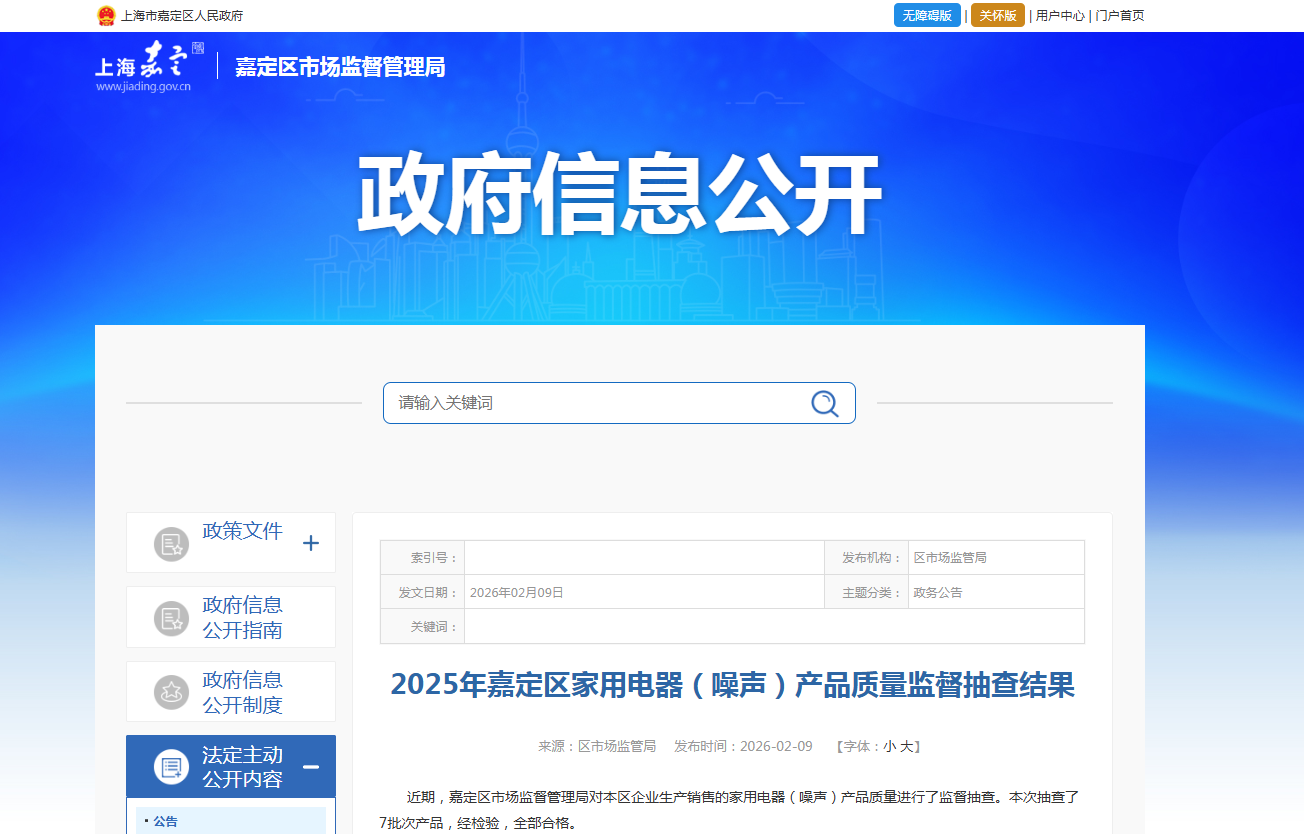
2025年上海市嘉定区家用电器(噪声)产品质量监督抽查结果公布
Zhong Guo Zhi Liang Xin Wen Wang· 2026-02-14 04:23
Core Viewpoint - The recent quality supervision inspection results for household electrical appliances (noise) in Jiading District, Shanghai, indicate that all sampled products passed the quality tests, reflecting positively on the local manufacturing standards and compliance with regulations [4]. Group 1: Inspection Results - The Jiading District Market Supervision Administration conducted a quality inspection on household electrical appliances (noise) and tested a total of 7 batches of products, all of which were found to be compliant [4]. - The inspection was based on the implementation guidelines SHJDSSXZ0004-2025 for quality supervision of household electrical appliances (noise) in Shanghai's Jiading District [4]. Group 2: Sampled Products - The inspected products included various types of household appliances such as fans, washing machines, range hoods, and microwaves, with notable brands like Midea and Vatti represented [5]. - Specific products that passed the inspection include: - Table fan from Wenzhou Jiayou Electric Factory - Floor fan from Shanghai Jingteng Electric Co., Ltd. - Fully automatic washing machines from Wuxi Little Swan Electric Co., Ltd. and Hefei Midea Washing Machine Co., Ltd. - Range hoods from Vatti and Guangdong Vanward Electric Co., Ltd. - Microwave from Guangdong Midea Kitchen Appliances Manufacturing Co., Ltd. [5].
2025 年 12 月厨电品类零售数据点评:25H2 厨电换新高基数压力渐显,26 年补贴聚焦核心品类
Shenwan Hongyuan Securities· 2026-02-13 07:09
Investment Rating - The report maintains a positive outlook on the home appliance industry, with a focus on the "buy" and "outperform" ratings for specific companies within the sector [10]. Core Insights - The "old-for-new" policy implemented in 2024 has significantly stimulated the home appliance market, expanding the subsidy scope to include eight categories, resulting in notable retail growth for certain products [4]. - The report highlights a divergence in performance among kitchen appliance categories, with traditional products facing declining sales while emerging categories show mixed results [4]. - The 2026 "old-for-new" policy is expected to benefit leading brands with superior energy efficiency and performance, particularly in the kitchen appliance sector [4]. Summary by Sections Retail Data Analysis - In 2024, the retail sales of kitchen appliances are projected to reach CNY 362 billion for range hoods (up 14.9% YoY), CNY 204 billion for gas stoves (up 15.7% YoY), CNY 236 billion for electric water heaters (up 1.3% YoY), and CNY 296 billion for gas water heaters (up 8.8% YoY) [4]. - For 2025, the overall retail sales of kitchen and bathroom appliances are expected to decline to CNY 1,613 billion (down 8.5% YoY), with a total volume of 89.77 million units (down 5.3% YoY) [4]. Market Share Insights - In the offline market, leading brands like Boss and Fotile dominate with nearly 60% market share in range hoods and gas stoves, while online competition is intensifying with brands like Midea and Xiaomi rapidly gaining market share [4]. - The report notes that in the dishwasher category, Boss and Fotile each hold close to 20% market share, disrupting the previous dominance of Siemens [4]. Investment Recommendations - The report recommends investing in established brands such as Boss Electric and Huashang Co. in traditional categories, and Wanhe Electric in the water heater segment, which are expected to benefit from the new subsidy policies [4].


2025年12月厨电品类零售数据点评:25H2厨电换新高基数压力渐显,26年补贴聚焦核心品类
Shenwan Hongyuan Securities· 2026-02-13 05:44
行 业 及 产 业 行 业 研 究 / 行 业 点 相关研究 证 券 研 究 报 告 证券分析师 刘正 A0230518100001 liuzheng@swsresearch.com 刘嘉玲 A0230522120003 liujl@swsresearch.com 联系人 刘嘉玲 A0230522120003 liujl@swsresearch.com 家用电器 2026 年 02 月 13 日 25H2 厨电换新高基数压力渐显, 26 年补贴聚焦核心品类 本期投资提示: 请务必仔细阅读正文之后的各项信息披露与声明 本研究报告仅通过邮件提供给 中庚基金 使用。1 评 - ⚫ 24 年以旧换新激活家电消费市场。2024 年"以旧换新"政策落地后,家电品类补贴范 围扩容,拉动需求成效显著:除了 09 年已经涉及的彩电、冰箱、洗衣机、空调、电脑 5 个补贴品类外,新增热水器、家用灶具、吸油烟机 3 个品类,共计补贴 8 大品类。根 据奥维云网推总数据,2024 年油烟机实现零售额 362 亿元,同比增长 14.9%,燃气灶 实现零售额 204 亿元,同比增长 15.7%,电热实现零售额 236 亿元,同比增长 1. ...
申万宏源证券晨会报告-20260212
Shenwan Hongyuan Securities· 2026-02-12 02:58
Core Insights - The report highlights the emergence of "high prosperity spillover" in the AI sector, suggesting that while the fundamental elasticity may not match the high prosperity itself, there is still potential for elasticity in spillover markets [2][11] - It emphasizes the importance of basic bottom-line requirements for spillover markets, indicating that the prosperity cycle needs to confirm a clear bottom [11] - The report suggests that the valuation structure of high prosperity can break through historical averages, but the spillover structure may face challenges [11] Industry Summaries AI Sector - The report identifies specific industries benefiting from AI price spillover, recommending attention to fiberglass and optical fiber due to their favorable valuations and visible price increases [2][11] - Fiberglass is noted for its strong bargaining power in the global supply chain, with a valuation slightly above historical averages, indicating a favorable risk-reward profile [11] - The optical fiber sector is experiencing a recovery in traditional segments alongside expectations for AI business advancements, presenting a high short-term success rate [11] Real Estate - The report indicates that the most challenging period for the real estate sector may be over, with signs of marginal improvement in supply and demand dynamics [11] - Data shows a narrowing decline in key indicators, with a significant reduction in the year-on-year decline of second-hand housing transactions [11] - Policy measures are being implemented to stabilize the real estate market, focusing on risk management and ensuring the protection of livelihoods [11] Consumer Electronics - The report discusses the impact of the "old-for-new" policy on the home appliance market, noting significant sales volumes and revenue generated from this initiative [15][18] - It highlights the performance of various appliance categories, with a focus on the kitchen appliance sector, which is experiencing varied performance amid high base pressures [18] - The report anticipates that the 2026 "old-for-new" policy will continue to benefit leading brands with superior product efficiency and performance [18] Tourism and Hospitality - The report outlines the expected surge in domestic tourism during the extended Spring Festival holiday, predicting a significant increase in passenger transport volumes [21] - It notes a shift in consumer preferences towards high-quality accommodations and diverse travel experiences, driven by family and senior travelers [21] - The report suggests that the tourism market is experiencing a multi-faceted explosion, with emerging destinations gaining popularity [21]

申万宏源研究晨会报告-20260212
Shenwan Hongyuan Securities· 2026-02-12 00:42
Group 1: AI High Prosperity Spillover - The report reviews the storage and lithium battery market since September 2025, summarizing the basic rules of the "high prosperity spillover" trend, indicating that while the fundamental elasticity may not be as strong as the high prosperity itself, spillover trends can still exhibit elasticity [2][11] - It highlights that the spillover trend has basic bottom-line requirements, necessitating a clear confirmation of the prosperity cycle's bottom, including manageable demand risks and sufficient supply clearance [11] - The report suggests focusing on industries experiencing AI price spillover, recommending fiberglass due to its reasonable valuation and visible price increases, and optical fiber due to traditional recovery and short-term AI business progress [2][11] Group 2: January Policy Tracking - The report notes that the longest Spring Festival holiday in 2026 is expected to boost consumer spending, which is crucial for driving domestic demand in the first quarter and solidifying the foundation for economic recovery throughout the year [2][10] - It emphasizes the collaborative efforts of multiple ministries to accelerate support for the economy, particularly in consumption, equipment investment, and the private sector, with significant increases in government bond financing [10][13] - Local governments are proactively deploying economic work, moving away from a wait-and-see attitude, with many regions advancing their annual work deployment to early January [10][13] Group 3: January Inflation Analysis - The report discusses the January inflation data released by the National Bureau of Statistics, indicating a CPI increase of 0.2% year-on-year, down from 0.8% previously, and a PPI decrease of 1.4% year-on-year, with a month-on-month increase of 0.4% [3][12] - It identifies the divergence in inflation as being influenced by the timing of the Spring Festival, external factors, and weak demand, with a notable narrowing of the PPI decline primarily driven by rising copper prices [12][16] - The report also highlights that the CPI remains weak overall, with significant declines in food prices and core commodity CPI, reflecting ongoing challenges in the economy [12][16] Group 4: Home Appliance Industry Insights - The report indicates that the home appliance sector has seen significant sales through the "old-for-new" policy, with over 6.81 million units sold in January, generating substantial revenue [15][18] - It notes that the home appliance market is facing high base pressure in 2025, with a focus on core categories for subsidies, which are expected to benefit leading brands [18] - The report highlights the competitive landscape in the home appliance market, with leading brands gaining market share, particularly in the offline market, while online competition is intensifying [18][19] Group 5: Tourism and Service Industry Outlook - The report anticipates a significant increase in travel during the 2026 Spring Festival, with a projected 95 million passengers expected to travel by air, marking a 5.3% increase year-on-year [21] - It emphasizes the diverse recovery in the domestic tourism market, with family and senior travelers driving demand for high-quality accommodations and unique travel experiences [21][20] - The report suggests that the tourism sector is poised for a strong recovery, with a focus on cross-border travel and differentiated experiences becoming key growth drivers [21][20] Group 6: Banking Sector Analysis - The report discusses the recent approval for a major shareholder of Nanjing Bank to increase their stake above 15%, which is expected to unlock significant incremental capital for the bank [22][23] - It highlights the bank's strong performance, with a projected revenue growth of 10.5% and a net profit growth of approximately 8.1% for 2025, indicating a positive outlook for 2026 [22][23] - The report recommends Nanjing Bank as a buy due to its solid performance, high dividend yield, and the potential for valuation recovery driven by major shareholder support [22][23]
家用电器行业投资策略周报:索尼FY2025Q3季报梳理:06W2026周报-20260210
CAITONG SECURITIES· 2026-02-10 12:40
Core Insights - The report focuses on Sony's FY2025 Q3 earnings, highlighting a slight increase in sales and a significant 22% year-on-year growth in operating profit, driven by its gaming, music, and image sensor segments, all achieving record performance for the third quarter [4][8] - The gaming segment's profit growth is attributed to favorable exchange rates, strong performance in network services, and game software sales, with a strategic shift towards monetizing existing users and new game releases planned for future growth [4][9] - The music segment saw robust growth in sales and operating profit, primarily from streaming revenues, live performances, and popular works from SMG artists, with notable successes in global music charts [4][13] - The film segment experienced a decline in performance, prompting Sony to sign a groundbreaking global exclusive premiere agreement with Netflix to stabilize long-term revenue [4][18] - The electronics segment faced a decline in sales and operating profit, mainly due to weak performance in the Chinese market, but global demand for interchangeable lens cameras remains strong [4][20] - The image sensor segment achieved record sales and operating profit, benefiting from a recovery in the smartphone market and an increase in the proportion of high-end sensors [4][24] - Sony raised its full-year forecasts for FY2025, increasing sales, operating profit, and cash flow expectations, while also announcing a significant increase in its stock buyback program to enhance shareholder returns [4][26][27] Segment Summaries Gaming and Network Services (G&NS) - G&NS reported sales of 1,613.6 billion yen, a 4% year-on-year decline, but operating profit reached 140.8 billion yen, a 19% increase, driven by favorable exchange rates and growth in network services and first-party game software sales [9][10] - PlayStation's monthly active users reached 132 million, a 2% increase year-on-year, with record software revenue driven by major third-party IPs and new blockbuster games [9][10] Music Segment - The music segment achieved sales of 542.4 billion yen, a 13% year-on-year increase, with operating profit of 106.4 billion yen, a 9% increase, driven by growth in streaming revenues and successful releases from SMG artists [13][14] - Notable successes included Rosalía's album topping global charts and multiple Grammy nominations for SMG artists [13] Film Segment - The film segment reported sales of 353.3 billion yen, an 11% year-on-year decline, with operating profit of approximately 30.9 billion yen, a 9% decrease, primarily due to high comparative figures from the previous year [18][19] - A new agreement with Netflix aims to provide a stable revenue base for future film releases [18] Electronics Segment - The electronics segment saw sales and operating profit decline, with significant pressure from the Chinese market, but strong global demand for interchangeable lens cameras was noted [20][22] - A joint venture with TCL aims to enhance competitiveness in the home entertainment sector [22] Image and Sensor Solutions (I&SS) - I&SS achieved sales of 604.3 billion yen, a 21% year-on-year increase, with operating profit of 132 billion yen, a 35% increase, driven by mobile image sensor sales and higher unit prices [24][25] Full-Year Outlook - Sony raised its FY2025 sales forecast to approximately 12.3 trillion yen, an increase of 3%, and operating profit to 1.54 trillion yen, an 8% increase [26][27]

家电行业2025年报业绩前瞻:以旧换新催化延续,海外产能陆续达产出口链盈利改善
Shenwan Hongyuan Securities· 2026-02-10 09:31
Investment Rating - The report maintains a positive outlook on the home appliance industry, particularly for major players in the white goods sector, indicating a favorable investment environment for 2025 [3][5][6]. Core Insights - The home appliance sector is expected to benefit from the continuation of the "trade-in" policy and improvements in overseas production capacity, leading to enhanced profitability in the supply chain [2][5]. - The report highlights three main investment themes: 1. **Dividend**: Major white and black appliance companies are characterized by low valuations, high dividends, and stable growth, providing a high margin of safety and significant elasticity in stock prices [6][7]. 2. **Technology**: Core component manufacturers are transitioning into emerging tech fields such as robotics and semiconductor cooling, seeking cross-industry growth [7]. 3. **Export**: Recovery in export demand and sustained domestic sales of new products, particularly in the small appliance sector, are expected to drive growth [7]. Summary by Sections 1. White Goods and Components - In 2025, the air conditioning sector is projected to produce 195.37 million units, a 3% year-on-year decline, while sales are expected to reach 198.39 million units, down 1% year-on-year, with domestic sales increasing by 1% [5][13]. - The average price of white goods is declining due to high base effects from the trade-in policy, with air conditioning prices dropping by 13% year-on-year [23][24]. 2. Kitchen Appliances - The kitchen appliance sector is experiencing a recovery driven by real estate and trade-in policies, with online sales of range hoods and gas stoves increasing by 7.9% and 1.7% respectively in 2025 [33][34]. - Major companies like Boss Electric and Vatti are leveraging trade-in policies to boost sales, with Boss Electric maintaining a leading market share in range hoods [35][36]. 3. Small Appliances - The small appliance sector is seeing a revival due to the trade-in policy, with significant growth in cleaning appliances, although overall market consumption remains subdued [6][7]. - Companies like Roborock and Ecovacs are expected to benefit from high demand for new products, with projected revenue growth of 34% and 12% respectively in Q4 2025 [5][7]. 4. New Displays and Lighting - The emerging display sector is at a turning point, while the lighting industry is anticipated to see growth as it awaits market recovery [6][7]. - Companies like Hisense and OP Lighting are expected to experience revenue declines in Q4 2025, with projections of -10% and -2% respectively [6][7]. 5. Investment Highlights - The report recommends a combination of leading white goods companies such as Haier, Midea, and Gree, along with Hisense, as they are currently undervalued and offer stable growth prospects [6][7]. - The report also emphasizes the importance of component manufacturers adapting to new technologies and markets, with companies like Huaxiang and Sanhua expected to see significant growth in their respective sectors [7][29][30].