戴德梁行

Search documents
豪宅成交创历史新高!香港上调交易印花税,业内称冲击有限
Guo Ji Jin Rong Bao· 2026-02-27 13:14
2月26日,香港政府针对豪宅交易的印花税调整正式实施,该项印花税调整预案源自2026—2027财政年度政府财政预算案。 两天前,香港财政司司长陈茂波在财政预算案演讲中宣布,价值超过1亿港元(约合1280万美元)的住宅物业交易印花税将由4.25%上调至6.5%。陈 茂波表示,这项新措施预计将影响香港约0.3%的住宅物业交易,每年带来约10亿港元的税收收入。 香港新盘外立面 孙婉秋/摄 成交火热 此次新政出台的背景是去年以来香港楼市显著复苏,豪宅市场交易活跃。 中原地产数据显示,2025年全港私人住宅成交60346宗,增长近两成。其中,1亿港元以上的交易262宗,这一交易量也打破了2021年228宗记录,创历 史新高,226宗豪宅交易涉及金额超过531亿港元,增长22%。新房依然亿元豪宅交易的主战场,全年成交179宗,占比近七成。 这个势头在2026年持续攀升。 中原地产山顶南区、港岛南岸、愉景湾及离岛区高级资深营业董事何兆棠还观察到,内地新贵在一手亿元豪宅的选择上,更倾向带装潢的样板房、新 晋豪宅板块的大平层单位,而在二手豪宅市场,优质核心地段的物业则更受青睐。 预期乐观 对于印花税上调对豪宅市场的影响,业内普 ...


戴德梁行:发展北都或可容许强积金部分投资长期债券 善用市场效率与创新能力
Zhi Tong Cai Jing· 2026-02-25 07:45
不过,其关键亦在于政府如何清晰界定公共与商业角色,确保长远产业发展目标、土地用途及回报分配 的透明度,以吸引私人市场参与。若配合清晰规划、分阶段落实及严谨监管,公私营合作模式将能成为 推动北部都会区产业化的重要工具。 该行提出,政府可考虑锁定及引入战略性的"锚机构",并避免各个片区产业功能模糊的局面,以确立片 区定位和提升片区吸引力,期望政府能尽快落实并公布相关大学及科技产业进驻的细节,增强发展商对 于落户北都及片区开发的信心。同时乐见政府采纳其早前建议,落实北都地价缴付弹性安排,有助纾缓 企业开发土地的现金流压力,提升公私营合作模式与产业导入的可行性与速度。 根据积金局数据,截至2025年12月底,强积金总资产升至约1.55万亿港元,突破历史新高。若香港政府 容许运用一定比例资产(例如10%)投资于北部都会区发展的长期债券,既能为北都建设提供稳定的资金 来源,亦能为强积金成员提供多一个风险相对较低、回报较为稳定的投资选项,达致双赢局面。 戴德梁行又指,在北都推动公私营合作模式,可提升执行效率及减轻政府财政压力,有助加快及落实北 都发展,亦能善用市场效率与创新能力。 戴德梁行香港董事总经理萧亮辉就2026/2 ...
昔日卡拉OK公司引爆物流股,卷入“AI恐慌交易”
Xin Lang Cai Jing· 2026-02-13 08:33
Core Viewpoint - The logistics sector experienced a significant sell-off due to fears of AI disruption, triggered by a small company transitioning from karaoke to AI logistics, leading to a sharp decline in major logistics stocks [1][2]. Group 1: Market Reaction - The Russell 3000 freight index dropped by 6.6%, with Robinson Global Logistics falling by 15% and reaching an intraday low of 24% [1]. - European logistics stocks also suffered, with DSV down 11%, Swiss logistics firm DSV down 13%, and DHL Group down 4.9% [1][4]. - The overall market sentiment turned risk-averse, with the Nasdaq 100 index declining by 2% [1]. Group 2: Company Specifics - Algorhythm Holdings, previously a karaoke company, rebranded as an AI logistics firm and reported a revenue of less than $2 million with a net loss of nearly $3 million as of September 30 [3]. - Following the announcement of its AI platform, Algorhythm's stock surged by 30% to $1.08, with an intraday peak increase of 82% [3]. Group 3: Analyst Perspectives - Analysts expressed skepticism about the company's ability to disrupt the logistics industry, with Citigroup's analyst Ariel Rosa highlighting the high likelihood of eventual disruption [3]. - Barclays analyst Brandon Oglenski defended companies like Robinson, arguing that the market's reaction was disproportionate to the actual risks posed by AI [5]. - Market strategists noted that the current sell-off may be an emotional overreaction, emphasizing the need for more information before making investment decisions [5]. Group 4: Broader Implications - The AI disruption fears have extended beyond logistics to other sectors such as real estate, software, private credit, and insurance brokerage [1][2]. - Investors are speculating on which sector might be the next target of the "AI panic trading," indicating a broader concern across various industries [6].
多只地产服务商一夜暴跌 AI“狼人杀”还没结束:点谁谁崩
Feng Huang Wang· 2026-02-13 02:14
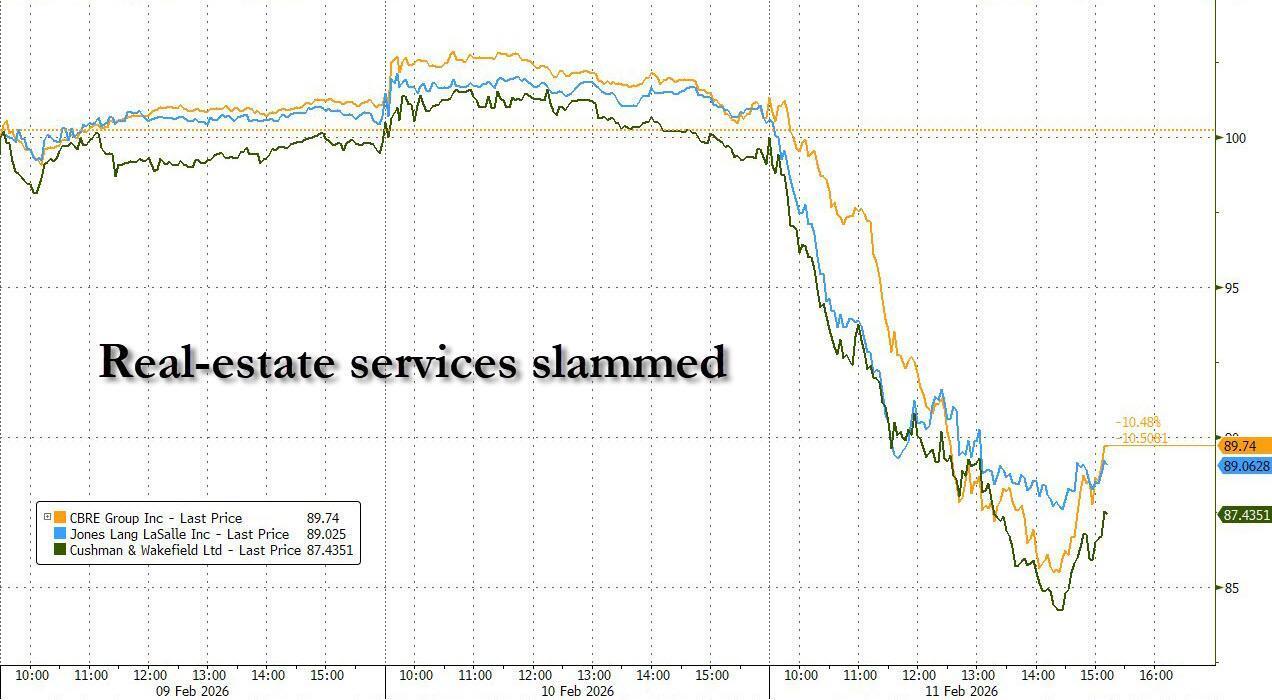
Core Viewpoint - The recent sell-off in the U.S. stock market, particularly affecting real estate service stocks, is driven by investor fears regarding the disruptive potential of AI applications in various industries [1][3]. Group 1: Market Impact - Several real estate service stocks, including CBRE Group and JLL, experienced significant declines, with CBRE dropping 12% and JLL falling 14%, marking their largest single-day drops since the COVID-19 pandemic [3]. - The commercial real estate sector is facing renewed challenges, exacerbated by the pandemic's impact on office demand and high interest rates affecting transaction volumes [3]. - Investors are increasingly withdrawing from high-fee, labor-intensive business models perceived as vulnerable to AI disruption, as noted by analysts [3][4]. Group 2: Broader Industry Concerns - The sell-off has extended beyond real estate, affecting SaaS, insurance brokerage, and wealth management stocks, indicating a widespread concern about AI's potential to disrupt various sectors [4][5]. - Companies like CBRE and JLL are attempting to mitigate downward pressure by diversifying into property management and valuation across various sectors, including hotels and life sciences [4]. - Analysts express that the recent stock price declines may be overreactions, as the risks associated with AI disruption have been present for some time and are not new [4][5]. Group 3: AI Disruption Debate - The introduction of AI tools, such as those by Anthropic, has intensified fears of industry-wide disruption, leading to a "sell first, ask questions later" mentality among investors [4][6]. - Concerns about AI's impact on employment and commercial real estate demand are prevalent, but some analysts argue that the actual threat to leasing and capital markets is limited [4][6]. - The market's reaction reflects a broader anxiety about potential reversals in stock valuations, driven by recent AI spending and a resilient U.S. economy [6][7].
凌晨突发,重挫670点!黄金白银,闪崩暴跌
Zhong Guo Ji Jin Bao· 2026-02-13 00:23
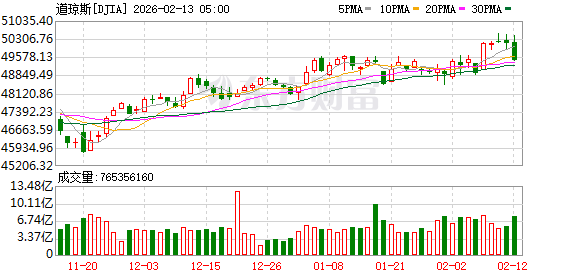
中国基金报记者 伊万 美东时间2月12日,美国CPI数据公布前,市场对于人工智能颠覆性影响的担忧蔓延至各个板块,美股 全线大跳水,三大指数均跌超1%,其中道指重挫超600点,纳指大跌超2%。 截至收盘,道指跌1.34%,跌669.42点,报49451.98点;标普500指数跌1.57%,报6832.76点;纳指跌 2.03%,报22597.15点。 思科跌超12%,迪士尼跌逾5%,领跌道指。大型科技股集体走低,苹果重挫5%,创2025年4月以来最大 日跌幅;脸书跌近3%,英伟达跌超1%。 | 思科(CISCO) | 75.000 -12.32% | | | --- | --- | --- | | CSCO.O | | | | 迪士尼(WALT DISI | 102.373 | -5.32% | | DIS.N | | | 【导读】美股暴跌,道指重挫近670点;商业地产暴跌,金、银大跳水 黄金再失守5000美元白银暴跌11% 美东时间2月12日,市场风险偏好明显降温,资金进一步涌入被视为"避风港"的美国国债,贵金属则遭 抛售。 | 苹果(APPLE) | 261.730 | -5.00% | | --- | - ...

道指重挫逾600点!AI抛售潮重燃 思科暴泻12% 商业地产遭遇“黑色星期四”
Di Yi Cai Jing· 2026-02-12 23:27
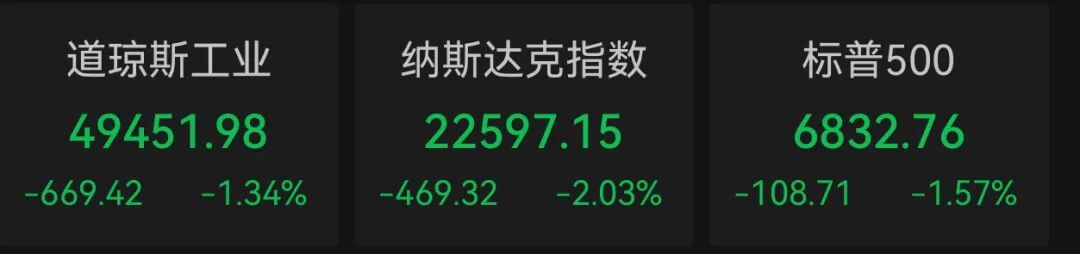
Market Overview - US stock market experienced a significant decline, driven by concerns over the accelerated penetration of artificial intelligence impacting the software industry and office space demand, leading to pressure on commercial real estate and tech sectors [2] - The Dow Jones Industrial Average fell by 669.42 points, a decrease of 1.34%, closing at 49,451.98 points; the S&P 500 dropped by 108.71 points, down 1.57%, closing at 6,832.76 points; the Nasdaq Composite decreased by 469.32 points, a decline of 2.03%, closing at 22,597.15 points [2] Popular Stocks Performance - Major tech companies faced significant losses, with Apple plunging 5%, marking its largest single-day drop since April 2025, following claims by the US Federal Trade Commission regarding Apple's suppression of conservative content [3] - Other notable declines included Meta Platforms down 2.82%, Amazon down 2.20%, Tesla down 2.62%, Nvidia down 1.64%, Microsoft down 0.63%, and Google C shares down 0.63% [3][4] Commercial Real Estate and Financial Services - The current sell-off in the US stock market is primarily focused on commercial real estate and related financial services, with fears that increased use of AI tools may structurally weaken demand for office space, impacting leasing and valuation [5] - Major commercial real estate service companies saw significant stock price drops, with CBRE Group down 8.8%, JLL down 7.6%, and Colliers International down 11.5% [5] - Analysts noted that the discussion around AI reducing office demand has been ongoing, but the recent sell-off in brokerage stocks has led investors to reassess commercial real estate risks more directly [5] Transportation and Logistics Sector - The trucking and logistics sector also faced notable pressure, with the Dow Jones Transportation Average dropping over 4%, marking its worst day since the US announced tariff increases in April of last year [6] - Among the 20 component stocks of the Dow Jones Transportation Average, 17 experienced declines, with Landstar System and C.H. Robinson seeing drops of 15.6% and 14.5%, respectively [6] - Concerns were heightened following Algorhythm Holdings' disclosure that its SemiCab division increased customer freight volumes by 300% to 400% without a corresponding increase in workforce, raising fears about AI's potential to reduce labor demand in logistics [6] Labor Market Data - Recent labor market data showed that initial jobless claims fell by 5,000 to 227,000, indicating overall stability in the job market [7] Bond Market Reaction - US Treasury yields fell, with the 10-year Treasury yield decreasing by 8.1 basis points to 4.102%, marking the largest single-day drop in October; the 2-year yield fell by 4.8 basis points to 3.464% [8] Commodity Market Performance - International oil prices saw a significant decline, with light crude oil futures for March delivery dropping by $1.79 to $62.84 per barrel, a decrease of 2.77%; Brent crude futures for April fell by $1.88 to $67.52 per barrel, down 2.71% [10] - Precious metals also faced pressure, with spot gold down 3.26% to $4,918.36 per ounce and silver down 10.89% to $75.0942 per ounce [10]


道指重挫逾600点!AI抛售潮重燃,商业地产遭遇“黑色星期四”
Di Yi Cai Jing· 2026-02-12 23:24
Market Overview - US stock market experienced a significant decline, driven by concerns over the accelerated penetration of artificial intelligence impacting the software industry and office space demand [1] - The Dow Jones Industrial Average fell by 669.42 points, a decrease of 1.34%, closing at 49,451.98 points; the S&P 500 dropped by 108.71 points, down 1.57%, closing at 6,832.76 points; the Nasdaq Composite decreased by 469.32 points, a decline of 2.03%, closing at 22,597.15 points [1] Technology Sector Performance - Major tech stocks faced pressure, with Apple experiencing a sharp decline of 5%, marking its largest single-day drop since April 2025, following claims by the US Federal Trade Commission regarding Apple's suppression of conservative content [3] - Other tech giants also saw declines: Meta Platforms down 2.82%, Amazon down 2.20%, Tesla down 2.62%, Nvidia down 1.64%, Microsoft down 0.63%, and Alphabet's Class C shares down 0.63% [3][4] Commercial Real Estate Impact - The sell-off in the US stock market focused on commercial real estate and related financial services, with fears that increased use of AI tools could structurally weaken demand for office space, impacting leasing and valuation systems [5] - Major commercial real estate service companies saw significant stock price drops, with CBRE Group down 8.8%, JLL down 7.6%, and Cushman & Wakefield down 11.5% [6] - Analysts noted that the discussion around AI reducing office demand has been ongoing, and the recent sell-off in brokerage stocks has led investors to reassess commercial real estate risks more directly [6] Transportation and Logistics Sector - The transportation and logistics sector also faced significant pressure, with the Dow Jones Transportation Average dropping over 4%, marking its worst day since the US announced tariff increases in April of last year [6] - Among the 20 components of the Dow Jones Transportation Average, 17 stocks declined, with Landstar System and C.H. Robinson experiencing the largest drops of 15.6% and 14.5%, respectively [7] - Concerns were heightened following Algorhythm Holdings' disclosure that its SemiCab division increased customer freight volumes by 300% to 400% without a corresponding increase in workforce, raising fears about AI's impact on labor demand in the logistics industry [7] Global Market Reactions - The impact of the US market decline extended to European markets, with Swiss logistics group Kuehne + Nagel's stock falling by 13% and Danish logistics firm DSV A/S dropping over 10% [8] Economic Data and Interest Rates - Recent labor market data showed a smaller-than-expected decline in initial jobless claims, leading to fluctuating market expectations regarding the Federal Reserve's interest rate path for the year [8] - The yield on 10-year US Treasury bonds fell by 8.1 basis points to 4.102%, marking the largest single-day drop since October, while the yield on 2-year bonds decreased by 4.8 basis points to 3.464% [8] Commodity Market Performance - International oil prices saw a notable decline, with light crude oil futures for March dropping by $1.79 to $62.84 per barrel, a decrease of 2.77%, and Brent crude oil futures for April falling by $1.88 to $67.52 per barrel, down 2.71% [9] - Precious metals also faced pressure, with spot gold down 3.26% to $4,918.36 per ounce and silver down 10.89% to $75.0942 per ounce [9]

道指重挫逾600点!AI焦虑抛售潮重燃,思科暴泻12%,商业地产遭遇“黑色星期四”
Di Yi Cai Jing Zi Xun· 2026-02-12 23:03
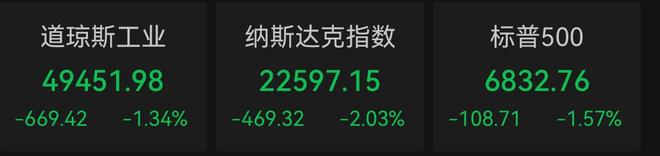
Market Overview - The U.S. stock market experienced a significant decline, with concerns about the impact of artificial intelligence on the software industry and office space demand leading to a sell-off in commercial real estate and tech sectors [1] - The Dow Jones Industrial Average fell by 669.42 points, a decrease of 1.34%, closing at 49,451.98 points; the S&P 500 dropped by 108.71 points, down 1.57%, closing at 6,832.76 points; and the Nasdaq Composite decreased by 469.32 points, a drop of 2.03%, closing at 22,597.15 points [1] Technology Sector Performance - Major tech stocks faced pressure, with Apple experiencing a 5% drop, marking its largest single-day decline since April 2025, following claims by the U.S. Federal Trade Commission regarding content suppression [2][3] - Other tech giants also saw declines: Meta Platforms down 2.82%, Amazon down 2.20%, Tesla down 2.62%, Nvidia down 1.64%, Microsoft down 0.63%, and Alphabet (Google) down 0.63% [2][3] Commercial Real Estate Impact - The commercial real estate sector faced a sharp sell-off, with major service companies like CBRE Group down 8.8%, JLL down 7.6%, and Cushman & Wakefield down 11.5% [4] - Analysts noted that the discussion around AI reducing office demand has been ongoing, and the recent sell-off in brokerage stocks has led investors to reassess risks in commercial real estate [4] Transportation and Logistics Sector - The transportation and logistics sector also suffered, with the Dow Jones Transportation Average dropping over 4%, marking its worst day since the U.S. announced tariff increases in April of last year [5] - 17 out of 20 stocks in the Dow Jones Transportation Average declined, with Landstar System and C.H. Robinson falling by 15.6% and 14.5%, respectively, due to concerns over AI reducing labor demand in logistics [6] Economic Data and Interest Rates - Recent labor market data showed a smaller-than-expected decline in initial jobless claims, leading to fluctuating expectations regarding the Federal Reserve's interest rate cuts for the year [6] - The yield on 10-year U.S. Treasury bonds fell by 8.1 basis points to 4.102%, marking the largest single-day drop since October [7] Commodity Market Performance - International oil prices saw a notable decline, with light crude oil futures dropping by $1.79 to $62.84 per barrel, a decrease of 2.77% [8] - Precious metals also faced pressure, with spot gold down 3.26% to $4,918.36 per ounce and silver down 10.89% to $75.0942 per ounce [8]
华尔街新交易逻辑:先卖了再说!
Xin Lang Cai Jing· 2026-02-12 08:42
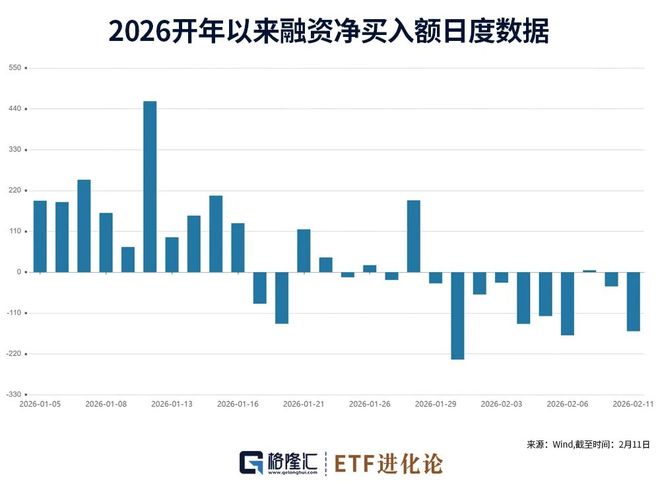
Group 1 - The core trading logic on Wall Street has shifted from identifying AI winners to indiscriminately selling potential AI losers, driven by fears of traditional business models being disrupted by AI advancements [1][2][3] - The recent sell-off has affected various sectors, including SaaS software, insurance brokerage, wealth management, and real estate services, with notable declines such as a 14% drop for JLL and a 12% drop for CBRE, marking their largest single-day declines since the pandemic [1][2] - Gabelli Funds' manager John Belton highlighted that any company with potential disruption risk is facing indiscriminate selling [3] Group 2 - In the A-share market, leveraged funds have begun to reduce their positions after a period of aggressive buying, with net selling occurring on 9 out of the last 10 trading days, totaling 974 billion yuan in sales [3][10] - Major companies experiencing net selling include Kweichow Moutai, Industrial Fulian, and Zhongji Xuchuang, with net selling amounts of -27.88 billion yuan, -23.49 billion yuan, and -23.27 billion yuan respectively [7][8] - Despite the reduction in positions in broad-based ETFs, there has been significant buying in specific ETFs such as Hai Futong Zhongzheng Short Bond ETF and E Fund Zhongzheng Overseas Internet ETF [10] Group 3 - The market is showing a strong interest in sectors related to economic recovery and domestic demand improvement, with significant inflows into the chemical sector and other related industries [17][18] - The recent price increases across various sectors, including upstream resources and consumer goods, indicate a potential inflationary trend, with PPI data showing a month-on-month increase of 0.4% and a narrowing year-on-year decline to -1.4% [21][22] - The upcoming Spring Festival is expected to boost consumer spending, with major companies launching significant promotional campaigns and government initiatives to stimulate the economy [26][27]
AI恐慌交易席卷美国地产服务板块,头部企业股价暴跌12%-14%,创2020年以来最大单日跌幅
Jin Rong Jie· 2026-02-12 03:32
Group 1 - The U.S. real estate services sector has been significantly impacted by the latest wave of AI-induced panic selling, with major companies like CBRE and JLL experiencing stock price drops of 12% and 14% respectively, marking their largest single-day declines since the COVID-19 pandemic began in 2020 [1] - The commercial real estate industry in the U.S. has been struggling to recover due to the pandemic's disruption of office space demand and high interest rates suppressing transaction volumes, despite some growth in niche areas like data centers and high-end office leasing driven by the AI boom [1] - Investors are increasingly wary of the potential impact of AI technology on the industry, fearing that automation and streamlined transaction processes could disrupt high-fee, labor-intensive business models, leading to a shift away from real estate service firms perceived as vulnerable to AI disruption [1] Group 2 - Barclays analyst Brendan Lynch noted that the recent stock price declines appear "excessive" given that there were no significant negative developments in the news, indicating that the associated risks have not changed [2] - Jefferies analyst Joe Dickstein believes that the threat of AI to leasing and capital markets is limited, asserting that firms like CBRE will maintain their positions as large leasing and transaction intermediaries due to their scale advantages in data accumulation and industry relationships [2] - The panic selling triggered by AI concerns has spread across multiple sectors, including SaaS, insurance brokerage, and wealth management, with significant stock pressure observed following the launch of AI-based applications in these industries [2]