
欧莱雅集团

Search documents
多家国际知名企业宣布参加第六届消博会
Xin Lang Cai Jing· 2026-02-14 10:21
Group 1 - The sixth China International Consumer Products Expo (CICPE) will be held from April 13 to 18, 2024, at the Hainan International Convention and Exhibition Center, with several international companies confirming their participation [1] - Volkswagen Group will showcase multiple brands including Volkswagen, Bentley, Lamborghini, and Audi, aiming to deepen connections with Chinese consumers and expand its market presence [1] - L'Oréal Group, a leading global beauty company, has confirmed its participation, focusing on enhancing interactions with the Chinese market and exploring innovative retail models [3] Group 2 - OSIM, a high-end health lifestyle brand from Singapore, will participate for the sixth consecutive year, highlighting its deep connection with Chinese consumers and the importance of the Chinese market for its global development [3] - SK-II, a premium skincare brand under Procter & Gamble, will debut as an independent exhibitor at the expo, emphasizing its commitment to the Chinese market and the demand for high-end skincare solutions [4] - The CICPE is recognized as the largest consumer goods exhibition in the Asia-Pacific region, providing a significant platform for brands to showcase their strengths and enhance market communication [4]


重启上市!透过林清轩再冲“高端第一股”,看国货美妆突围困局仍未破?
Sou Hu Cai Jing· 2026-02-03 02:13
Core Viewpoint - Lin Qingxuan's IPO plan has been suspended due to the failure to complete the hearing within six months of submitting its prospectus, but it has since reinitiated its listing process with a new target date [1][3]. Financial Performance - Lin Qingxuan is experiencing a significant revenue growth period, with a projected 98% year-on-year increase in revenue for 2024, and a gross margin of 82% for its core product, camellia oil, which exceeds the average in the beauty industry [3]. - The company's revenue heavily relies on a single product, the camellia oil priced at 599 yuan for 30ml, which accounts for nearly 60% of total revenue, raising concerns about its risk resilience [3]. Marketing and Cost Structure - Lin Qingxuan's marketing expenses are substantial, with sales and distribution costs reaching 688 million yuan in 2024, representing 56.9% of revenue, and a 100.2% increase in marketing expenses in the first half of 2025, outpacing revenue growth [3][8]. - The company's growth model is heavily dependent on online sales, which increased from 45.2% in 2022 to 65.4% in the first half of 2025, but this has led to rising customer acquisition costs, which doubled from 180 yuan to 320 yuan per effective customer [8]. Brand and Market Positioning - The high-end beauty market in China is growing rapidly, with a compound annual growth rate of 15.3% from 2020 to 2024, but domestic brands like Lin Qingxuan face challenges in gaining consumer acceptance at higher price points due to a lack of brand heritage compared to international brands [4][5]. - Lin Qingxuan's reliance on KOLs and live streaming for sales has created a fragile growth model, as any negative publicity or decline in traffic can directly impact revenue [9]. Regulatory and Compliance Issues - Lin Qingxuan faced a fine of 21,000 yuan in 2023 for misleading advertising regarding its anti-aging claims, highlighting weaknesses in compliance management that could hinder its IPO process [3][7]. Expansion and Control Challenges - The company has expanded its retail presence significantly, with 506 stores by the end of 2024, but over 30% of these are franchise stores, which can dilute brand control and lead to inconsistent customer experiences [11][12]. - The franchise model has resulted in high closure rates and operational inconsistencies, undermining the brand's high-end positioning [11][12]. Valuation and Investment Concerns - Lin Qingxuan's valuation has seen significant increases, reaching 3.846 billion yuan before its IPO, but this high valuation lacks support from substantial assets or R&D investments, raising doubts about its long-term sustainability [13][14]. - The company's focus on marketing over R&D has led to a misalignment between its valuation logic and long-term value, as seen in the practices of other successful beauty brands that prioritize research and brand integrity [14].

国际高端美妆龙头有何变化
2026-01-26 15:54
Summary of Key Points from the Conference Call Industry Overview - The international high-end beauty market in China achieved high single-digit growth in 2026, but the compound growth rate only returned to 2023 levels, indicating challenges in regaining double-digit growth in the future. The growth drivers include channel recovery and consumer confidence restoration [1][2][3]. Core Insights and Arguments - **Channel Recovery**: The shopping mall channel returned to double-digit growth in 2026, driven by enhanced entertainment experiences and strategic site selection. Online channels, particularly Tmall, saw growth through adjustments in the Double Eleven mechanism, while JD.com performed well with VIP customers. However, Douyin's performance was average due to its business model [1][4][5]. - **Pricing and Promotions**: High-end brands, including Estée Lauder, have increased prices annually but intensified promotional efforts, especially in duty-free channels. This has affected actual demand, leading to a gradual tightening of promotional strategies to improve profit margins [1][6][7]. - **Profit Margins**: Estée Lauder's profit margins in China are higher than the global average, but retail weakness and pandemic impacts have hindered expected improvements. The company aims for healthier growth and increased profit margins moving forward [1][7]. - **8T Strategy**: The new CEO's 8T strategy focuses on stabilization and cost efficiency, but sustained growth remains a challenge. The brand matrix is less robust compared to L'Oréal, relying heavily on La Mer and Estée Lauder, with significant dependence on promotions in online channels [1][7][8]. Additional Important Insights - **Brand Performance**: La Mer is performing well globally, while Estée Lauder faces challenges with brand aging and customer attrition. The company needs to restore growth to offset declines in other brands [1][9][10]. - **Sales and Revenue**: In 2025, Estée Lauder's total revenue was approximately $14 billion, with Estée Lauder and La Mer accounting for 70-75% of total revenue [1][10]. - **Product Innovation Challenges**: Estée Lauder faces significant product aging issues and has been slow in innovation compared to competitors. The new CEO emphasizes product innovation as a key strategy to improve market conditions [1][16][17]. - **Market Dynamics**: The high-end skincare segment is expected to continue growing, while color cosmetics face pressure from domestic brands. The fragrance segment is slowing down, and the competitive landscape is changing rapidly [1][5][33][36]. Future Outlook - The growth of international high-end beauty brands in China over the next 2-3 years will depend on the ability to attract new customers and adapt to changing consumer preferences. High-end skincare products are expected to perform well, while entry-level products may face challenges [1][5][33]. - The online channel's expansion will not be significant, focusing instead on improving the ROI of existing e-commerce operations for sustainable growth [1][24][25]. Conclusion - The international high-end beauty market in China is recovering but faces numerous challenges, including competition from domestic brands, reliance on promotions, and the need for product innovation. Companies like Estée Lauder must navigate these dynamics carefully to achieve sustainable growth and profitability in the evolving market landscape [1][5][33][36].

离春节不到1个月,有人预测4类东西将涨价,早做准备不花冤枉钱
Sou Hu Cai Jing· 2026-01-26 15:35
Group 1 - Major companies are planning to raise prices after the Spring Festival, affecting various products from packaging to snacks and skincare items [1][3] - The paper industry is experiencing a collective price increase, with leading companies announcing a price hike of 200 yuan per ton for white cardboard starting from late February or early March 2026 [3][10] - The increase in paper prices is driven by rising operational costs and reduced supply, with major manufacturers like Jiu Long Paper and Lin Sheng Pulp Paper planning maintenance that will decrease market supply by approximately 120,000 tons [8][10] Group 2 - The price increase strategy is timed to coincide with the post-holiday market recovery, creating urgency for downstream customers to purchase before prices rise [12][14] - The cost of packaging materials is expected to rise, impacting the prices of consumer goods, particularly popular snacks like nuts, which have already seen price adjustments ranging from 0.2 to 10 yuan [16][20] - The beverage industry, particularly high-end liquor brands, is also expected to raise prices following the Spring Festival, as maintaining brand image is crucial for premium products [27][31] Group 3 - International beauty brands are anticipated to adjust prices in the post-Spring Festival period, with average increases typically ranging from 10% to 30% [37][38] - Brands like Estée Lauder and L'Oréal are likely to raise prices on numerous products, with significant price hikes reported for individual items [40][42] - The rationale behind these price increases includes rising raw material costs, increased operational expenses, and currency fluctuations, as companies face pressure to improve profit margins amid declining sales [42][43]

又一位意大利设计大师去世,他是时尚界的末代皇帝
Di Yi Cai Jing· 2026-01-21 00:55
Core Viewpoint - The passing of Valentino Garavani, the founder of the Valentino brand, marks a significant loss for the fashion industry, following the recent death of another Italian fashion icon, Giorgio Armani [1][3]. Group 1: Valentino's Legacy - Valentino Garavani was a prominent figure in Italian fashion, known for creating iconic pieces for celebrities such as Princess Diana and Audrey Hepburn, and his signature "Valentino Red" became a staple on red carpets [3][4]. - The brand expanded from haute couture to ready-to-wear, accessories, and fragrances, symbolizing Italian craftsmanship and artistry [3][4]. - Valentino's retirement in 2008 followed a successful career spanning over 45 years, during which he emphasized that haute couture is an art rather than a business [6][10]. Group 2: Brand Ownership and Financial Performance - In 2012, Valentino was acquired by Mayhoola, a Qatari investment firm, and in 2023, Kering, the parent company of Gucci, purchased approximately 30% of the brand for about €1.7 billion, with an option to acquire the remaining shares by 2029 [10][12]. - Valentino's revenue for 2024 is projected to be €1.311 billion, reflecting a year-on-year decline of 2.74%, with a total decrease of approximately €107 million since 2022 [10][12]. - The brand's mid-range positioning may make it more sensitive to demand fluctuations, particularly in key markets like China and the U.S., where consumer spending has weakened [10][12]. Group 3: Future Developments - Alessandro Michele, former creative director of Gucci, joined Valentino as the new creative director in April 2024, bringing a fresh perspective to the brand [12]. - Valentino's beauty products, developed in partnership with L'Oréal since 2019, have faced challenges in a competitive market, leading to a planned exit from the South Korean market by the end of 2025 [12].

免税巨头又出手了,中国中免拟以近28亿收购DFS港澳业务
Nan Fang Du Shi Bao· 2026-01-20 14:23
Core Viewpoint - China Tourism Group Duty Free Corporation (China Duty Free) has announced a partnership with LVMH and DFS Group to acquire DFS's travel retail business in Hong Kong and Macau for up to $395 million, enhancing its market presence in the Greater China region [2][3]. Group 1: Acquisition Details - China Duty Free will acquire 100% of DFS Cotai Limitada and all operational assets of DFS stores in Hong Kong and Macau, excluding the City of Dreams store in Macau [3]. - The acquisition includes exclusive rights to a series of brands and intellectual properties under DFS in the Greater China region [2]. - LVMH and Robert Miller will subscribe to new H-shares issued by China Duty Free as part of the transaction, which will be a small portion of the proceeds from the sale [3]. Group 2: Strategic Cooperation - A strategic cooperation memorandum has been signed between China Duty Free and LVMH to establish a partnership in retail sectors aligned with their strategic interests [5]. - This collaboration aims to leverage the strengths of both companies to deepen cooperation in the Greater China region and achieve mutual benefits [5]. Group 3: Financial Performance and Market Context - DFS reported a revenue of 2.754 billion yuan and a net profit of 133 million yuan from its Hong Kong and Macau operations in the first three quarters of the 2025 fiscal year [6]. - China Duty Free's revenue for the same period was 39.86 billion yuan, a decline of 7.34% year-on-year, with a net profit of 4.42 billion yuan, down 18.89% [6]. - The luxury goods market is projected to recover, with a forecasted growth of 3% to 5% in 2026, following a slight decline in 2025 [8].


健康即新奢侈:奢侈品牌奔赴下一片蓝海
2 1 Shi Ji Jing Ji Bao Dao· 2026-01-16 22:25
Core Insights - The luxury market is shifting focus from material possessions to health investments, with health becoming a new symbol of luxury lifestyle [1][2] - The global health products and services market is projected to reach $2 trillion in 2024 and grow to $2.5 trillion by 2028, indicating significant potential for luxury brands [1][2] Group 1: Market Trends - The luxury goods industry has experienced fluctuations, while the health market has shown consistent growth, making it a stable sector for investment [2] - High-net-worth individuals are increasingly prioritizing health, with 84% of American consumers and 94% of Chinese consumers placing health as a top concern [2] Group 2: Strategic Moves by Luxury Brands - Kering's sale of its beauty business to L'Oréal for €4 billion and the establishment of a joint venture to explore the health and longevity sector reflects a strategic shift towards health [3] - Luxury brands are leveraging their strengths to penetrate the health market through cross-industry collaborations, physical experiences, and product innovations [2][3] Group 3: Innovative Health Experiences - Christian Dior has opened approximately 10 spa centers globally, marking a transition from service-based offerings to independent health-focused experiences [3] - Brands like Golden Goose and Alo Yoga are creating multi-functional spaces that combine health services with brand culture, enhancing consumer engagement [4] Group 4: Product Development - Luxury brands are launching health-themed product lines, such as Celine's Pilates series and Prada's Linea Rossa, which blend fitness equipment with luxury aesthetics [4] Group 5: Challenges and Risks - Entering the health sector poses risks due to high demands for professionalism and safety, requiring brands to ensure scientific backing and quality control [5] - Balancing the accessibility of health services with the exclusivity of luxury branding presents a challenge for companies [5] - The potential for consumer fatigue regarding health trends could impact brand marketing effectiveness [5] Group 6: Future Outlook - The integration of health and luxury is expected to grow as life expectancy increases and lifestyles evolve, potentially redefining luxury consumption in the next century [6]
从被抛售到市值超3000亿,欧莱雅再加持的高德美,能否逆袭全球美妆十强?
Sou Hu Cai Jing· 2026-01-16 02:34
Core Insights - Despite challenges faced by global beauty giants, Galderma has achieved significant growth and is on track to enter the top ten global beauty companies, with a projected net sales of approximately 32 billion RMB in 2024 [1][3]. Group 1: Company Performance - Galderma ranked 11th among global beauty companies in 2024, with net sales of approximately 32 billion RMB, just behind Puig Group [3]. - In the first three quarters of 2025, Galderma reported net sales of 3.737 billion USD (approximately 26.615 billion RMB), reflecting a year-on-year growth of 15% [3][11]. - The skin treatment segment showed the fastest growth, with net sales reaching 804 million USD in the first three quarters of 2025, a 40.4% increase year-on-year [11][31]. Group 2: Investment and Valuation - Galderma's valuation surged from over 50 billion RMB to over 340 billion RMB, marking an increase of over 500% since its sale by L'Oréal in 2014 [4][9]. - L'Oréal increased its stake in Galderma to 20% after acquiring an additional 10% in December 2025, following an earlier purchase in August 2024 [3][13]. Group 3: Business Structure and Strategy - Galderma operates a three-pronged business model encompassing pharmaceutical, aesthetic, and cosmetic sectors, creating a unique vertical integration in skin science [26]. - The company has established a strong presence in the aesthetic injection market, contributing over 50% of its revenue, with key products including hyaluronic acid fillers and botulinum toxin [14][27]. Group 4: Market Challenges - Despite its leading position in skin science, Galderma faces challenges in growth structure, with its aesthetic injection business showing signs of slowing growth [27][28]. - The company’s revenue heavily relies on the aesthetic segment, which accounted for approximately 51% of total revenue in the first half of 2025, but growth rates have declined compared to previous years [27][29]. Group 5: Future Outlook - Galderma aims to enhance its direct consumer engagement to convert its professional authority into brand loyalty among end consumers, which is crucial for its ambition to enter the top ten global beauty companies [37].


进口美妆品牌在华市场份额持续下滑
3 6 Ke· 2026-01-15 00:28
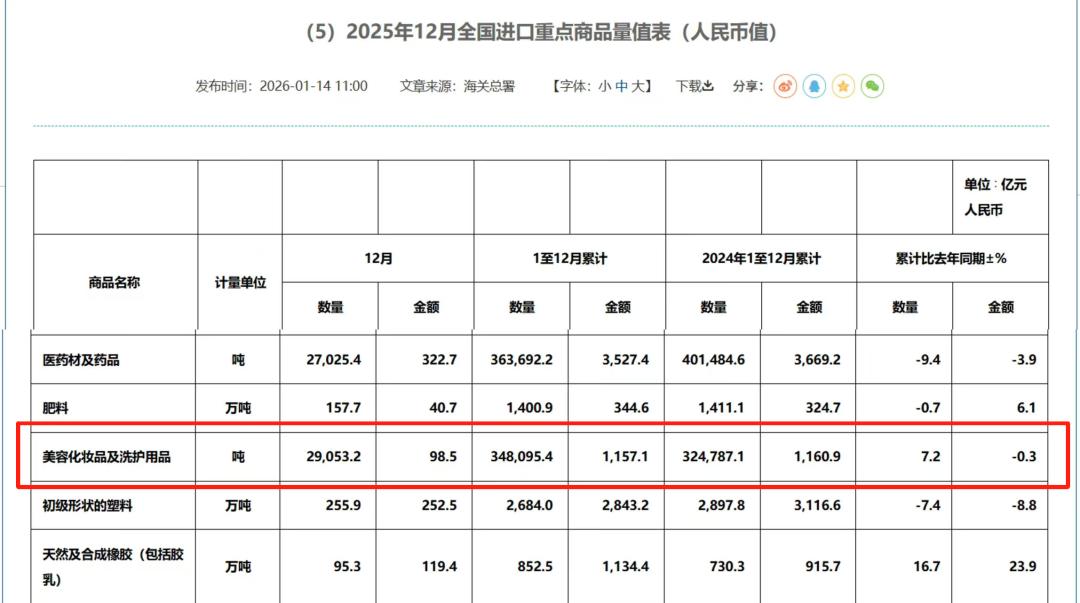
Core Insights - The overall trend of China's import and export market is positive, but the beauty and cosmetics sector shows a contrasting pattern with "cold imports and hot exports" [1][3] - In 2025, the export value of cosmetics increased by 10.4% year-on-year, while the import value slightly decreased by 0.3% [1][2] Import and Export Data - In 2025, the total import quantity of cosmetics reached 348,095.4 tons, a year-on-year increase of 7.2%, while the import value was 115.71 billion yuan, a slight decrease of 0.3% [2][4] - The import quantity of cosmetics has been on a downward trend since 2021, with 2025's figure of 34.8 tons being only slightly higher than 2024's [4][6] - The import value of cosmetics in 2025 was the lowest in nearly six years, indicating a significant decline in international beauty brands' market share in China [8][12] Market Dynamics - The decline in import value contrasts with the continuous growth of domestic cosmetics exports, which have seen a consistent increase for four years [15][31] - The top five countries for China's cosmetics exports in the first half of 2025 were the United States, the United Kingdom, Indonesia, the Netherlands, and Japan, with exports to Indonesia growing by 94.34% [21][24] Competitive Landscape - International beauty brands are facing challenges in the Chinese market, with many brands from Japan and South Korea experiencing significant sales declines [13][14] - Domestic brands are increasingly capturing market share, with some successfully expanding overseas through e-commerce and brand acquisitions [29][30] - The shift in consumer preferences and the competitive pressure from local brands are reshaping the market dynamics, indicating a need for international brands to adapt [12][31] Future Outlook - The ongoing adjustments in the global beauty market suggest that Chinese beauty brands are moving from domestic market competition to international expansion [31][32] - The ability to build global brand influence while leveraging supply chain advantages will be crucial for the future success of the Chinese beauty industry [32][33]
“十全大补”面膜神话落幕:又一外资护肤品撤离中国
Guan Cha Zhe Wang· 2026-01-08 04:45
Core Insights - Filorga, a well-known French skincare brand, announced its withdrawal from the Chinese market, closing its Tmall flagship store on January 31, 2026, along with its 3.03 million followers and popular products like the "Ten Full Nourishing Mask" [1] - The exit of Filorga is part of a broader trend, with over 60 foreign beauty brands leaving the Chinese market between 2024 and 2025, indicating a significant retreat of foreign skincare brands [1] - Domestic beauty brands have gained market share, surpassing foreign brands for the first time in 2023, with Proya becoming the first domestic brand to exceed 10 billion yuan in revenue [1] Group 1: Filorga's Market Performance - Filorga entered the Chinese market in 2015 and quickly gained popularity, achieving a sales record of over 1 billion yuan during the 2018 Double Eleven shopping festival, with a year-on-year growth of 148% [2] - However, growth slowed significantly after 2020, attributed to ineffective pricing strategies and a lack of competitive advantage against domestic brands [2][3] - The brand's high-priced star product, the mask priced at 599 yuan, failed to maintain its premium image due to frequent discounts, while domestic competitors offered more affordable alternatives [2] Group 2: Challenges in Channel Operations - Filorga's online sales performance was poor, with only 2.5 million to 5 million yuan in sales on Douyin in 2025, indicating a lack of effective online marketing strategies [3] - The closure of physical stores resulted in a loss of high-end brand image and direct consumer engagement opportunities [3] - In contrast, other brands under the L'Oréal group, such as La Roche-Posay and Kiehl's, maintained strong market positions through effective product offerings and operational strategies [3] Group 3: Broader Industry Trends - The withdrawal of Filorga aligns with Colgate's global strategy to streamline operations, as the company's personal care segment saw a 2.05% decline in net sales in the first half of 2025 [4] - Similar strategic adjustments are occurring across the foreign beauty sector, with brands like Shiseido and LVMH also closing stores or withdrawing from the market due to declining performance [5] - Domestic brands like Proya and Winona have shown significant growth, with Proya achieving over 10.778 billion yuan in revenue in 2024, marking a year-on-year increase of over 20% [5] Group 4: Future Outlook - Analysts suggest that the challenges faced by foreign brands are not solely due to their foreign status but rather their inability to adapt to the Chinese market and consumer preferences [6] - L'Oréal's success is attributed to its localized operations, contrasting with Filorga's failure to establish a coherent market strategy in China [6] - The Chinese high-end beauty market is expected to continue facing challenges, but opportunities remain for brands that can effectively engage with local consumers [6]