Cheniere Energy

Search documents
Cheniere Energy Partners: Strong Income Play, With Potential For More In The Future
Seeking Alpha· 2025-12-22 13:30
Core Insights - Cheniere Energy Partners (CQP) is a partnership formed by Cheniere Energy, focusing primarily on the assets at Sabine Pass, which is a strategic LNG facility [1] Company Overview - Cheniere Energy is recognized as one of the largest energy companies in the United States [1] - The partnership CQP is specifically involved with the operations and assets related to liquefied natural gas (LNG) [1] Analyst Background - The analyst has over a decade of experience in financial markets, primarily in hedge funds, with a focus on sectors like technology, particularly SaaS and cloud businesses [1] - The analyst emphasizes rigorous standards in investment decisions and conducts independent research [1]



液化天然气因美国出口热潮转向供应过剩
日经中文网· 2025-11-27 02:53
Core Viewpoint - The article discusses the significant increase in U.S. LNG exports, reaching 9.9 million tons in October, and the implications for global natural gas prices and domestic U.S. prices as supply is expected to exceed demand in the near future [2][4]. Group 1: U.S. LNG Export Growth - U.S. LNG exports reached 9.9 million tons in October, nearing the 10 million tons mark for the first time [4]. - Venture Global exported 2.14 million tons from the Plaquemines LNG facility in Louisiana, a 38% increase from September [6]. - Cheniere Energy's Corpus Christi facility also set a record with exports of 1.55 million tons in October [6]. Group 2: Market Implications - The global LNG market is shifting from a supply shortage to a supply surplus, leading to a downward trend in LNG prices [2][7]. - The JKM price is projected to drop to $8.8 per million BTU by mid-2028, approximately 20% lower than current prices [7]. - Japan, heavily reliant on LNG imports, stands to benefit from lower electricity costs as LNG prices decline [7]. Group 3: Domestic Price Impact - Increased LNG exports are expected to raise domestic natural gas prices in the U.S., with Henry Hub futures recently reaching an 8-month high of about $4.4 per million BTU [8][10]. - Historically, U.S. natural gas prices were one-third of those in Asia and Europe, but rising exports may lead to a convergence of prices [10]. - There is a potential risk that the U.S. may prioritize domestic price stability over exports if domestic prices continue to rise [10].

美国 LNG 出口量激增,或将拉动页岩气产能迎增长潮
Sou Hu Cai Jing· 2025-08-23 14:41
Core Insights - The U.S. LNG export volume is expected to surge at an annual rate of approximately 10% until 2030, with energy companies planning to double their LNG production capacity, providing a boost to the maturing shale industry facing growth slowdowns and rising costs [4]. Group 1: LNG Export Growth - The U.S. is projected to increase its LNG export volume from a record 11.9 billion cubic feet per day in 2024 to 21.5 billion cubic feet per day by 2030, driven by the growing global demand for this fuel [4]. - The development of new terminals for liquefying natural gas is underway to meet the increasing energy consumption and the global shift away from coal-fired power plants [4]. Group 2: Shale Production Forecast - Morgan Stanley forecasts a 41% increase in natural gas production in the Haynesville shale from 2024 to 2027, while the Permian Basin in Texas and New Mexico is expected to see a 21% increase [4]. - The Marcellus and Utica shales across Pennsylvania, Ohio, and West Virginia are estimated to experience a 9% production growth [4]. Group 3: Business Expansion and Investments - U.S. natural gas producers and investment firms are preparing to expand operations in the Haynesville region, supported by favorable federal licensing policies under the Trump administration [5]. - Major companies like Venture Global LNG and Cheniere Energy are advancing their LNG export facilities in Louisiana and Texas, respectively, indicating a robust pipeline of new projects [5].
Cheniere Energy: Best LNG Stock Should Warrant A Premium Valuation
Seeking Alpha· 2025-08-14 12:21
Group 1 - Cheniere Energy is recognized as the leader in LNG exports in the US and is expected to trade at a premium compared to peers, with an EV/EBITDA multiple between 11x and 12x [1] - The projected EBITDA for Cheniere Energy in 2026 is at least $7.2 billion, indicating strong future financial performance [1] Group 2 - The analyst has a beneficial long position in shares of VG and LNG, indicating confidence in the performance of these stocks [2] - The article reflects the author's personal opinions and is not influenced by any business relationships with the companies mentioned [2]
市销率超过70!如此妖股结局都不太好,Palantir能例外吗?
Hua Er Jie Jian Wen· 2025-06-06 12:34
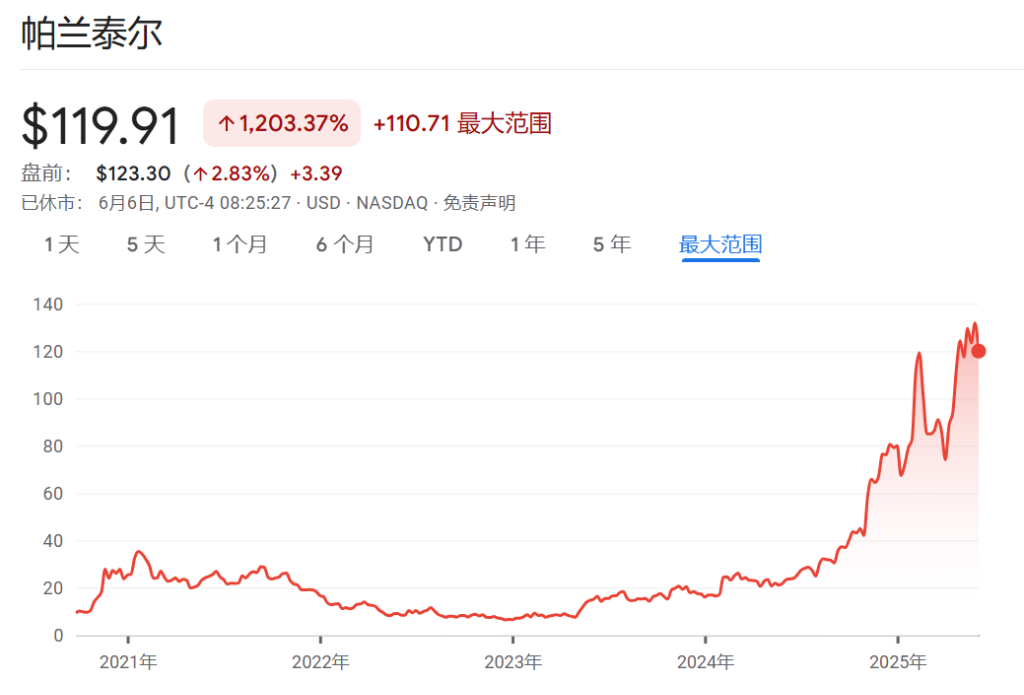
Core Insights - Palantir is at a critical valuation juncture, with a market capitalization of $314 billion and a price-to-sales ratio of 79.9, making it one of the highest-valued large-cap stocks in U.S. history [1][4] - The company's static price-to-earnings ratio is 565, while the dynamic ratio stands at 228, indicating extreme valuation levels [1] - Historical data suggests that a price-to-sales ratio exceeding 70 is often indicative of either a transformative tech giant or an impending bubble [10] Valuation Context - Trivariate Research's report highlights that only six U.S. companies have previously surpassed Palantir's current price-to-sales ratio, including MicroStrategy and Moderna [4] - The majority of companies on this "death list" faced dire outcomes, with Comverse Technology going bankrupt and Moderna's stock dropping 94% from its pandemic peak [5] Historical Precedents - Extremely high forward valuations have only been seen during the internet bubble and the pandemic's "free money" era [11] - Stocks reaching a 30 times price-to-sales ratio have historically underperformed the S&P 500 by an average of 22.5 percentage points in the following year [12] Market Dynamics - The upcoming rebalancing of the S&P 500 index is expected to increase Palantir's weight, prompting active managers to reassess its valuation [13] - Historical data indicates that no company can sustain growth rates sufficient to justify such extreme valuations, with many companies having faster growth expectations than Palantir [13]
Kayne Anderson Energy Infrastructure Fund Provides Unaudited Balance Sheet Information and Announces Its Net Asset Value and Asset Coverage Ratios as of May 31, 2025
Globenewswire· 2025-06-03 23:00
Core Insights - Kayne Anderson Energy Infrastructure Fund, Inc. reported its net assets as of May 31, 2025, totaling $2.3 billion, with a net asset value per share of $13.79 [2][4] - The company's asset coverage ratio under the Investment Company Act of 1940 was 740% for senior securities and 530% for total leverage [2][4] Financial Summary - Total assets amounted to $3,201.9 million, with investments constituting $3,184.4 million [4] - Total liabilities were reported at $332.1 million, including notes of $388.2 million and preferred stock of $153.6 million [4] - The company had 169,126,038 common shares outstanding as of May 31, 2025 [4] Investment Composition - Long-term investments were primarily in Midstream Energy Companies (94%), with smaller allocations to Other (4%) and Utility Companies (2%) [5] - The ten largest holdings included The Williams Companies, Inc. ($359.7 million, 11.3%), Energy Transfer LP ($319.4 million, 10.0%), and Enterprise Products Partners L.P. ($313.6 million, 9.8%) [5]

Does Cheniere Energy Benefit From Alaska Pipeline?
Zacks Investment Research· 2025-06-03 08:59
what's up everybody dave Bartoziac here and I've got another chart of the day This time talking about Shener Energy ticker LNG I give you two seconds to guess what it is these guys do That's right liqufied natural gas So uh they've got a big transport center down there in New Orleans basically right or terminal rather I guess is the the word for it Now there's been this news about the uh this Alaskan pipeline that the Trump administration wants to build and I wanted to take a look at the impact on this And ...

Long-Term Prosperity: Investing in America's Economic Pillars
The Motley Fool· 2025-05-28 10:15
Group 1: Cheniere Energy and LNG Industry - The U.S. has become the largest liquefied natural gas (LNG) exporter, exporting 11.9 billion cubic feet per day (Bcf/d) in 2024, surpassing Qatar and Australia [2] - Cheniere Energy exported 2.33 trillion British thermal units (TBtu) in 2024, equating to 6.37 Bcf/d, and has a total production capacity of 45 million tonnes per annum (mtpa) across its terminals [3] - The current administration supports LNG growth, and Cheniere's CEO believes there is a strategic imperative to secure permits for future capacity expansion to over 90 mtpa [5] Group 2: GE Aerospace and Aerospace Industry - GE Aerospace is a market leader in commercial aerospace and defense engines, with its joint venture CFM International producing the LEAP engine, which powers the Boeing 737 MAX and is one of two options for the Airbus A320neo family [7] - GE's GE9X engine is the sole option for the Boeing 777X, and its GEnx engine dominates orders for the Boeing 787, indicating strong market presence [8] - The next generation of engines, RISE, is expected to achieve a 20% improvement in fuel efficiency over the LEAP, potentially ensuring GE's leadership in commercial aerospace engines for decades [9] Group 3: Tesla and Electric Vehicle Industry - Tesla's Model Y is the best-selling car globally and is set to improve sales with refreshed production lines in 2025 [10] - Upcoming catalysts for Tesla include the launch of its robotaxi in June 2025 and the mass production of the Cybercab in 2026, alongside lower-cost models [11] - Tesla has significantly reduced its cost of goods per vehicle, falling below $35,000 by the end of 2024, which enhances profit margins and competitiveness in the EV market [12][13] - CEO Elon Musk has positioned Tesla as a leader in the SUV market, and the company's advancements in EVs and robotaxis suggest a strong future in the industry [15]

燃气对话持续升温 第29届世界燃气大会拓展全球绿色共识
Zhong Guo Neng Yuan Wang· 2025-05-23 00:09
Group 1 - The 29th World Gas Conference highlighted the importance of natural gas as a key support for economic and social development, with China accounting for one-third of global natural gas consumption growth over the past decade [1] - China is committed to enhancing gas infrastructure, ensuring safety, and promoting intelligent transformation in the gas industry to improve operational efficiency and service quality [1] - The Asia-Pacific region is identified as the core engine for global natural gas demand growth, with expectations for natural gas consumption to peak around 2035 under the "dual carbon" goals [1] Group 2 - Qatar has significantly increased its position in the global natural gas market, particularly in LNG exports, and plans to expand its LNG production capacity from 77 million tons to 126 million tons [3] - Qatar emphasizes the foundational role of natural gas in the energy structure, despite the strong momentum of renewable energy, and aims to build a robust supply assurance system [3] - Qatar is actively expanding its downstream industry and enhancing global supply chain resilience through partnerships, including the delivery of 128 LNG carriers to China [3][4] Group 3 - Cheniere Energy has established stable partnerships with over 36 countries, achieving a daily transportation volume of two LNG vessels, and emphasizes the need for stable production capacity and flexible supply structures to meet diverse regional demands [5] - Hong Kong and China Gas has served over 43 million households and is advancing urban energy structure diversification through solar systems, green methanol, and waste management [6] - Nigeria is accelerating its "gas-driven development" strategy to address infrastructure and affordability challenges, aiming for a clean energy transition by 2030 [6]
3 American Companies Investors Need to Know Amid Trump's Tariff Wars
The Motley Fool· 2025-05-21 22:32
Group 1: Freeport-McMoran - Freeport-McMoran dominates the domestic copper market, providing 70% of the U.S. refined copper production, while the U.S. imports 45% of its refined copper consumption [2][5] - The U.S. Chamber of Commerce supports including copper as a critical metal eligible for tax credits, advocating for increased domestic minerals and metals production [3] - Freeport-McMoran is well-positioned to meet domestic demand with potential projects in Arizona and initiatives to extract copper from existing stockpiles [4] - The threat of tariffs on copper imports has led to a 13% premium for U.S. copper, potentially resulting in an $800 million financial benefit for Freeport if maintained [5][7] Group 2: Whirlpool - Whirlpool faces challenges due to high interest rates affecting the housing market, which in turn impacts discretionary appliance purchases [8][9] - The company has $4.8 billion in long-term debt, and its forecast for free cash flow is uncertain, raising questions about the sustainability of its $380 million dividend [9] - Management believes that closing loopholes allowing Asian competitors to avoid tariffs could significantly improve Whirlpool's competitive position, potentially resulting in a $70 cost disadvantage per product [10][11] Group 3: Cheniere Energy - Cheniere Energy benefits from the resumption of LNG export approvals under the current administration, contrasting with the previous pause [13] - The company is the largest LNG producer in the U.S., owning significant stakes in major LNG terminals and continuing to invest in capacity expansion [14][15] - The business model focuses on purchasing natural gas domestically and processing it into LNG for global export, aligning with the administration's push for increased LNG exports [15] Group 4: Overall Market Impact - The current administration's tariff policies aim to enhance the competitive positioning of U.S. companies, with a focus on copper, appliance manufacturing, and LNG exports [16]