Figure AI

Search documents
indie Semiconductor(INDI) - 2025 Q4 - Earnings Call Transcript
2026-02-19 23:02
Financial Data and Key Metrics Changes - The company reported Q4 revenue of $58 million, exceeding the midpoint of the outlook by $1 million, representing an 8% sequential growth and flat compared to the prior year period [5][15] - Full year revenue reached $217.4 million, with non-GAAP operating loss of $10.1 million, an improvement from $11.3 million in the previous quarter and $14.2 million a year ago [15] - The company exited the quarter with total cash and cash equivalents of $155.7 million, a decrease of $15.5 million from the third quarter [16] Business Line Data and Key Metrics Changes - The radar business is gaining traction with a Tier 1 partner, with initial shipments starting in December and expected demand exceeding 50 million units annually [9][10] - The vision portfolio is seeing momentum with design wins for image signal processor SoCs, including the IND880, and new design wins in e-mirror and camera mirror systems [10][11] - The company secured a design win with a leading electric vehicle manufacturer in China for a camera mirror system, expected to ramp in mid-2026 [11] Market Data and Key Metrics Changes - The automotive industry is transitioning towards standardization of ADAS features, creating opportunities for the company to leverage its technology investments [5][6] - The humanoid robotics market is transitioning from research to real-life applications, presenting new opportunities for the company [6][7] - The company is also gaining traction in the quantum communications and sensing market, with significant bookings for LXM lasers [12] Company Strategy and Development Direction - The company aims to capitalize on the structural transformation in the automotive market by focusing on software-defined intelligence and scalable sensor technology [5][6] - Plans to expand activities in humanoid robotics and enhance radar and vision technologies to maintain competitive advantages [8][10] - The company is actively managing supply chain constraints and expanding production capabilities to meet growing demand [9][13] Management's Comments on Operating Environment and Future Outlook - Management expressed optimism about the future, expecting revenue from core business to grow by 20% sequentially in Q1 2026, despite a decline in revenue from Wuxi due to reduced EV subsidies [18][19] - The company anticipates a steady ramp in radar revenue through 2026 and beyond, with increasing visibility on design wins and OEM traction [20][41] - Management acknowledged ongoing supply chain constraints but is confident in their ability to manage through 2026 [37][38] Other Important Information - The company is in the process of selling its equity interest in Wuxi Indie Micro for approximately $135 million, with the transaction expected to close by late 2026 [17] - Non-GAAP operating expenses for Q1 2026 are expected to be $37 million, relatively flat compared to Q4 2025 [18] Q&A Session Summary Question: What was the Wuxi revenue for Q4? - The revenue was around $29.7 million [23] Question: What are the reasons for the sequential decline in revenue? - The decline is primarily due to the upcoming Chinese New Year shutdown and reduced EV subsidies [24] Question: What is expected for the ramp in Q2? - A recovery is expected in Q2, although the business is in the process of being sold [25] Question: Can you provide an update on radar program ramp? - The company has made significant progress and expects strong traction with OEMs [26] Question: What impact do supply chain constraints have in Q1? - There was a trailing impact into Q1, with some demand still questionable due to supply issues [27] Question: Any updates on design wins and traction for core business? - The company is performing well across all regions, with exposure to OEMs in Europe, Asia, and India [33] Question: What is the size of the opportunity in robotics and quantum space? - The robotics market is expected to grow significantly, while quantum traction is also increasing, with a projected tripling of optical product shipments [35][36] Question: What is the timeline for resolving supply chain constraints? - The tightness is driven by AI demand, and while improvements are being made, full resolution may not occur until 2027 [37][38] Question: What are the expected radar revenues for 2026? - Radar revenue is expected to remain in the $30 million-$50 million range, with strong momentum from newer OEMs [41]

大涨150%!机器人,刷屏!宇树科技最新发声
Xin Lang Cai Jing· 2026-02-17 09:41
Core Insights - The popularity of robots showcased during the Spring Festival Gala has translated into significant sales, with JD.com reporting a search volume increase of over 300% and a 150% surge in orders within two hours of the event [1][2][10] Group 1: Sales and Market Response - The Spring Festival Gala featured a record number of robots, contributing to a 150% increase in orders and a 460% rise in customer inquiries [2][10] - New orders for robots were placed across more than 100 cities in China, indicating widespread demand from both major cities and smaller counties [2][10] Group 2: Technological Advancements - Yushutech's robots demonstrated groundbreaking capabilities, achieving multiple global firsts in performance, including advanced acrobatic maneuvers and rapid positioning [2][11] - The company employs a high-concurrency cluster control system and self-developed AI algorithms to ensure precise coordination among multiple robots, overcoming challenges in motion accuracy during performances [11] Group 3: Future Projections - Yushutech aims to lead the humanoid robot market with a projected shipment of 10,000 to 20,000 units in 2026, focusing on both practical service robots and exploratory products [3][11] - The industry is expected to see accelerated commercialization, with humanoid robots expanding into high-end customization and emerging applications such as medical assistance and space exploration [6][14] Group 4: Industry Trends - Recent developments indicate a shift in the robotics industry towards practical applications, moving from demonstration to real-world execution, as seen in the performances at the Spring Festival Gala [12][13] - The robotics sector is experiencing increased investment activity, with several companies, including Tesla and domestic firms, advancing their humanoid robot projects [15]

Here's Why Tesla Is Now Diving Headfirst All the Way Into Robots, Solar, Robotaxis, and More
The Motley Fool· 2026-02-15 11:05
Core Insights - Tesla's core electric vehicle (EV) business is facing stagnation, prompting the company to accelerate the development of various side projects [1][4] - The company plans to diversify its offerings by adding solar panels, advancing robotaxi technology, and introducing humanoid robots priced between $20,000 and $30,000 by the end of 2027 [2][3] Electric Vehicle Business Challenges - Tesla's average per-vehicle production costs have decreased, but this has not restored the profit margins seen before the EV price wars that began in early 2023 [5] - The net profit per vehicle has dropped to just over $4,000 as of the end of last year, down from more than $10,000 in 2022 [6] - Competitors like BYD, Volkswagen, and General Motors have captured the growth in the EV market, leaving Tesla with stagnant sales [8] Market Position and Brand Perception - Tesla, once the leading brand in the EV market, is losing its appeal, which is concerning as over 70% of its revenue still comes from battery-powered vehicles [9] - The company is exploring new markets, including robotics and solar energy, but faces significant competition from other players in these sectors [14] Future Prospects and Risks - The potential for solar energy and autonomous taxis is significant, with projections indicating a $190 billion market for robotaxis by 2034 [11] - However, there are concerns about Elon Musk's history of overpromising on timelines, which could affect the development of new technologies [15] - Tesla's stock is currently priced at over 200 times the expected earnings per share of $2.06, indicating that the market is expecting high growth that may not materialize [16][20] Conclusion - Tesla appears to be shifting focus from its core EV business to explore new opportunities, which may indicate underlying challenges in its primary revenue stream [19]



2025商用具身智能白皮书
艾瑞咨询· 2026-02-15 00:08
Core Insights - Embodied intelligence has gained significant traction globally, with Figure achieving a valuation of $39 billion despite zero revenue, while domestic players are securing commercial orders and projecting substantial revenue growth [1][4] - The Chinese government has integrated embodied intelligence into its key industrial strategies, indicating a robust market potential that is not merely speculative [1][9] - The competition between China and the U.S. in embodied intelligence is intensifying, with both nations striving to innovate and apply this technology across various sectors [6][11] Definition and Understanding - Embodied intelligence is recognized as a crucial development in artificial intelligence, characterized by agents that interact with their environment through a physical body, showcasing autonomy and adaptability [2] - It represents a convergence of machine learning, computer vision, and robotics, marking a significant step towards practical AI applications [2] Commercial Applications - Different forms of embodied intelligent robots are evolving to meet diverse needs across retail, dining, manufacturing, logistics, education, and healthcare [4] - Commercial applications focus on enhancing service experiences and operational flexibility in dynamic environments, while industrial applications emphasize precision and stability in structured settings [4] Strategic Importance - Embodied intelligence is pivotal for upgrading technology supply chains and fostering new industries, contributing to the competitive edge of nations [6] - The breakthroughs in this field are essential for China's long-term economic benefits and technological self-reliance [6] Policy Support - The Chinese government has actively promoted the development of embodied intelligence through various action plans and funding initiatives, facilitating industry growth [9][8] Development Stages - The evolution of embodied intelligence can be categorized into three phases: conceptual development (1950s), technological accumulation (2000-2020), and application expansion driven by large models (2020 onwards) [11] - The competition between China and the U.S. is evident in foundational models, computational power, and practical applications [11] Bottlenecks and Challenges - The industry faces challenges such as data scarcity, high costs of core components, and the need for improved training efficiency and commercial viability [13][16] - The lack of high-quality multimodal data and the maturity of technologies like dexterous hands are significant hurdles [13][25] Data Acquisition and Solutions - Current data acquisition methods include remote operation, simulation, motion capture, and internet video, but high-quality data remains scarce [16] - The industry is exploring solutions like "world models" and data collection training grounds to alleviate data challenges [19] Model Evolution - The VLA model is emerging as a consensus for development, integrating large language model reasoning with real-world perception and action capabilities [21] - This evolution is expected to lead to a significant leap in embodied intelligence capabilities [21] Commercialization Trends - The commercialization of embodied intelligence is progressing through various dimensions, with initial applications focusing on low-complexity, high-ROI scenarios [31] - The business model is shifting from hardware sales to service subscriptions and performance-based payments [35] Global Market Predictions - The global market for embodied intelligence is projected to reach 19.2 billion RMB by 2025, with a compound annual growth rate of 73% over the next five years [46] - China's market is expected to grow from 2.1 billion RMB in 2025 to over 280 billion RMB by 2035, indicating a hundredfold increase in a decade [50] International Expansion - Chinese companies are accelerating their international presence, transitioning from core capabilities to localized applications in global markets [53] - Successful case studies illustrate the feasibility of Chinese embodied intelligence in high-standard international markets [53] Competitive Landscape - The competition in embodied intelligence features three main players: AI-native challengers like Figure, traditional industrial players like ABB, and cross-industry giants like Tesla [55] - The industry is witnessing early signs of product homogenization, suggesting an impending consolidation phase [57] Startup Strategies - Startups must leverage their agility and innovation to survive against established giants, focusing on strategic partnerships and long-term value creation [59]

Humanoid robot startup Apptronik has now raised $935M at a $5B+ valuation
Yahoo Finance· 2026-02-11 14:00
Core Insights - Apptronik, a University of Texas spinout, has reopened its Series A funding round to raise a total of $935 million, indicating strong investor interest in its humanoid robotics technology [1][2] - The company's post-money valuation has reached approximately $5.3 billion, reflecting a significant increase from its initial Series A valuation of around $1.75 billion [2][3] - Apptronik has successfully raised an additional $520 million from existing investors, including Google, Mercedes-Benz, and B Capital, as well as new investors, showcasing robust demand for its shares [2][5] Funding Details - The Series A round was initially set at $350 million but was expanded to $415 million due to high demand, followed by the recent additional funding [2] - The company has not actively sought funding but has responded to inbound interest, which has led to the current funding situation [4] Industry Context - Apptronik's partnership with Google DeepMind and other industry players positions it well in the field of embodied AI, which focuses on robots that can perceive and act in their environments [6] - The company has a long history in humanoid robotics, dating back to 2013, and has maintained a partnership with NASA, indicating its established presence in the industry [7]
中美人形机器人的路径对决:实用主义VS理想主义
Robot猎场备忘录· 2026-02-10 07:59
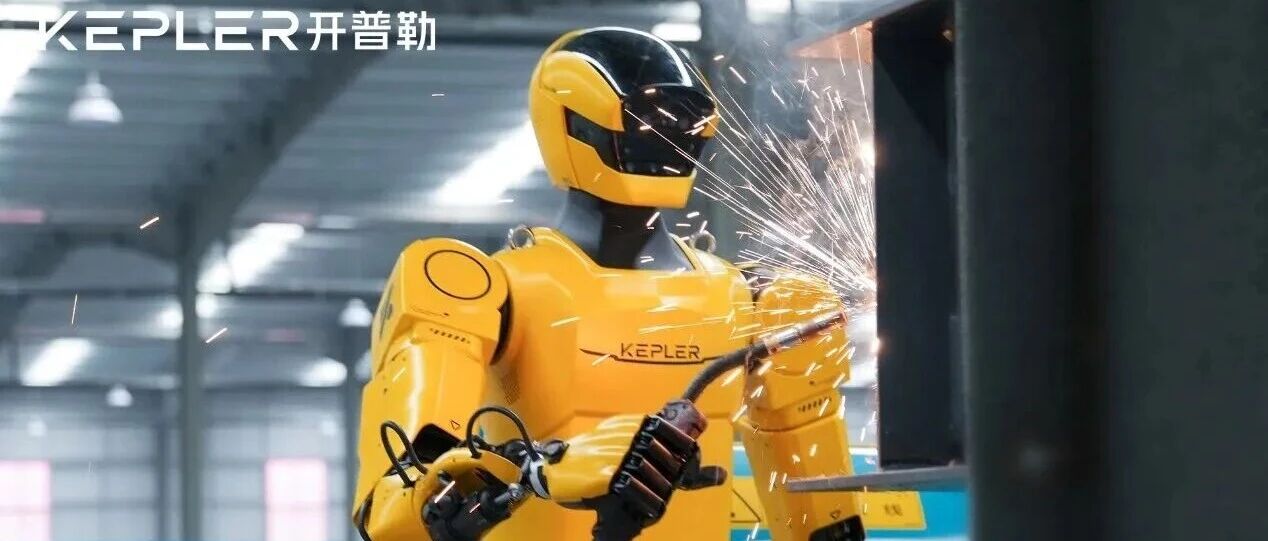
Core Viewpoint - The article highlights the competitive landscape of humanoid robots, emphasizing the practical application and commercial viability of Kepler Robotics' K2 "Bumblebee" in industrial settings, contrasting it with North American counterparts that focus on technological demonstrations rather than real-world deployment [12][27][41]. Group 1: Industry Overview - Kepler Robotics' K2 "Bumblebee" is actively engaged in high-altitude welding tasks, showcasing its capabilities in real industrial environments [2][17]. - The humanoid robot industry is experiencing a shift from experimental models to practical applications, with Kepler leading the way in China by focusing on real-world scenarios and operational efficiency [12][14][41]. Group 2: Competitive Analysis - North American companies like Boston Dynamics and Tesla are still in the experimental phase, with their humanoid robots struggling to achieve continuous operation in industrial environments [11][15][41]. - Kepler's K2 "Bumblebee" has established a significant advantage in load capacity (30 kg) and operational endurance (8 hours) compared to competitors like Tesla's Optimus and Figure 03, which have lower specifications [32][34]. Group 3: Technological Innovations - The K2 "Bumblebee" utilizes a unique hybrid architecture combining planetary roller screw actuators and rotary actuators, ensuring both high load capacity and precision [33][34]. - Kepler's self-developed immersive remote control system allows operators to control the robot with high precision, significantly reducing deployment time and enhancing safety in hazardous environments [18][20]. Group 4: Market Applications - The K2 "Bumblebee" has successfully penetrated key sectors such as automotive manufacturing, logistics, and 3C production, achieving high operational success rates (up to 99.4%) [21][22][26]. - The robot's ability to operate continuously for extended periods (up to 450 days) in complex environments demonstrates its reliability and scalability for industrial applications [26][27]. Group 5: Policy and Industry Support - The Chinese government is actively promoting the development of humanoid robots through policies that encourage innovation and application in industrial settings, aligning with Kepler's business model [14][27]. - Kepler is also fostering collaboration with educational institutions to integrate humanoid robotics into academic research and training, further solidifying its position in the industry [28].
蚂蚁投了一家上海具身智能公司
量子位· 2026-02-10 07:00
Core Viewpoint - The article discusses the rapid development and investment activities in the field of embodied intelligence, highlighting a significant investment by Ant Group in a Shanghai-based startup, Daxiao Robotics, marking a notable entry into this sector for 2026 [2][5][6]. Investment Activities - Ant Group has led a financing round for Daxiao Robotics, which has gained attention in both academic and industrial circles [2][3][8]. - The funding round included participation from various investors such as Qiming Venture Partners, JinJing Capital, and others, with the capital aimed at advancing Daxiao's ACE embodied full-stack R&D paradigm and accelerating the development of its Kairos 3.0 world model [8][9]. Market Trends - The investment events in the embodied intelligence sector surged from 173 in the previous year to 447 in 2025, with total funding increasing from 13.7 billion to 55.4 billion yuan, representing year-on-year growth rates of over 250% and 400%, respectively [5]. Daxiao Robotics' Approach - Daxiao Robotics has introduced the ACE embodied full-stack R&D paradigm, which emphasizes a human-centered approach, contrasting with the traditional robot-centric development paths [11][10]. - The ACE paradigm focuses on environmental data collection as a foundational capability, utilizing multi-modal hardware to gather diverse information for training embodied models [13]. Technological Innovations - The Kairos 3.0 model aims to create a unified understanding framework across robotic entities, integrating physical laws and human behavior patterns to enhance the system's predictive capabilities [14][16]. - Daxiao Robotics is addressing common challenges in the field, such as data scarcity and generalization difficulties, by prioritizing data entry and world modeling before advancing to the deployment of embodied brain modules [18]. Team Composition - Daxiao Robotics boasts a strong leadership team, including Xiaogang Wang, a top-ranked computer scientist, and Da Cheng Tao, a distinguished professor with significant contributions to AI [19][21][27][31]. - The founding team includes researchers from prestigious institutions, enhancing the company's capability to tackle advanced AI challenges [33].

投资者:产品必须围绕场景落地 三条技术路线并行竞速,各有瓶颈
Mei Ri Jing Ji Xin Wen· 2026-02-09 15:19
Core Viewpoint - The humanoid robot industry is shifting focus from entertainment to practical applications, with a significant increase in production expected in the coming years, driven by the need for robots to demonstrate real-world value rather than just perform on stage [1][3][4]. Industry Trends - The humanoid robot market is projected to see a shipment increase of over 650% in 2025, reaching approximately 18,000 units, and is expected to rise to 62,500 units in 2026 [3]. - The industry is moving past a phase of "wild growth," where mere performance was sufficient for sales, to a more mature phase where practical applications and real-world scenarios are essential for success [4][14]. Technology Development - Three main technical routes are emerging in the humanoid robot sector: VLA (Visual Language Action) model, world model, and layered decision-making with hardware-software collaboration, each with distinct advantages and challenges [7][9][10]. - The VLA model aims for general intelligence, relying on vast data for training, while the world model focuses on simulating physical environments to predict actions [9][10]. - The layered decision-making approach breaks down complex tasks into manageable components, enhancing reliability and efficiency in real-world applications [9][10]. Market Demand - There is a growing demand for robots that can operate in specific scenarios, such as factories and logistics, where they can perform tasks like assembly and packaging, thus providing tangible economic value [13][14]. - Users are increasingly looking for robots that can reduce production costs and alleviate humans from repetitive or hazardous tasks, indicating a shift towards practical applications [13][14]. Investment Focus - Investors are prioritizing companies that can demonstrate viable application scenarios and tangible products, moving away from those that lack a clear path to market [4][5]. - The consensus among investors is that companies must integrate their technology with real-world applications to avoid being sidelined in a competitive landscape [4][5]. Future Outlook - The next 3 to 5 years are critical for the practical deployment of humanoid robots, with expectations that they will increasingly complement human labor rather than replace it [13][19]. - The industry is expected to see rapid technological advancements, with a focus on improving the stability and reliability of robots in various operational environments [18][19].
投资者:产品必须围绕场景落地 三条技术路线并行竞速 各有瓶颈
Mei Ri Jing Ji Xin Wen· 2026-02-09 15:10
在2025年央视"春晚"舞台上,当宇树科技研发的人形机器人身着大红棉袄,扭起秧歌,全球为之沸腾。 2026年央视"春晚"舞台上的焦点之一将仍然是人形机器人。 在2025年"春晚"舞台上,宇树科技研发的机器人穿着大红袄扭秧歌,带动了人形机器人行业的热度。在 此背景下,有报告指出,2025年国内人形机器人出货量预计激增650%以上。 如今,只会跳舞的人形机器人,还能得到投资人和行业认可吗?近期,《每日经济新闻》记者对话人形 机器人投资者、人形机器人核心产品负责人等。他们认为,当前行业重心已放在场景落地。"只会跳舞 的卖不动了,得有真实场景才能活。"一投资者坦言,那种仅靠三五个人、十来个人就拼凑起来的公 司,张口就要估值、要融资,这类公司他们根本不碰。 从"刷屏表演者"向"实干劳动者"转型,机器人的技术能力能否支撑这一跨越?受访者在交流中并未强调 更细分的人形,而是讨论整个智能机器人。 机器人三条技术路线竞速已进入白热化。Figure AI(美国人形机器人初创公司)、智元的"通用智 能"VLA(视觉语言动作)模型能否应对工厂流水线?特斯拉推崇的"世界模型"如何靠仿真数据降低成 本?波士顿动力式的分层决策怎样保障机器 ...
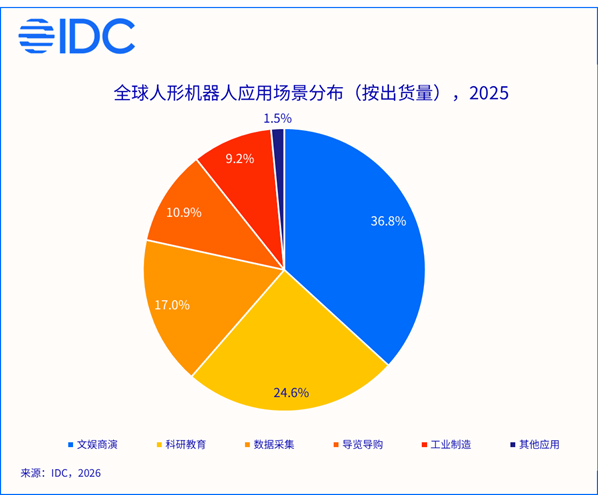
IDC:2025年全球人形机器人出货量接近1.8万台 同比增长约508%
Zhi Tong Cai Jing· 2026-02-09 05:50
Core Insights - The global humanoid robot market is set to reach a significant scale in 2025, with an expected shipment of nearly 18,000 units, representing a year-on-year growth of approximately 508%, and sales revenue projected at around $440 million [1] - Chinese manufacturers are leading the market with a robust manufacturing system, rapid iteration capabilities, and cost advantages, establishing a dominant position globally [2] - The market is primarily driven by bipedal humanoid robots, which contribute 66.3% of the total sales revenue, with full-sized bipedal robots accounting for 41.6% of the sales [3] Market Dynamics - In 2025, the demand for humanoid robots is mainly driven by applications in entertainment, education, and data collection, emphasizing display effects and interactive experiences [4] - The industry is transitioning from one-time hardware sales to a model that includes Robot as a Service (RaaS), operational services, and a platform ecosystem, creating conditions for scalable applications and sustained revenue [6] Technological Advancements - Humanoid robots are advancing towards engineering and scalable applications, with a focus on enhancing intelligent collaboration capabilities [7] - The integration of upper limb dexterity and the fusion of cognitive models are key breakthroughs that will enhance autonomous operations and human-robot collaboration [7]