HeyGen

Search documents
谷爱凌,去Benchmark做投资人了?
36氪· 2026-02-16 04:11
Core Viewpoint - The article discusses the significant announcement of Olympic champion Gu Ailing joining the renowned VC firm Benchmark as a Senior Associate, highlighting her potential impact on the investment landscape, particularly in sectors like sports technology, artificial intelligence, and youth consumption [4][7]. Group 1: Gu Ailing's Role and Background - Gu Ailing will not hold a ceremonial position but will actively engage in project due diligence, transaction execution, and post-investment management, focusing on emerging sectors that Benchmark is prioritizing [4]. - Her background as an Olympic champion and Stanford graduate positions her uniquely within the VC industry, raising questions about her qualifications for a Senior Associate role despite her non-financial academic background [7][8]. - The article emphasizes that her experience in high-pressure sports environments equips her with a mindset suitable for venture capital, where risk assessment and decision-making are crucial [8][9]. Group 2: Benchmark's Investment Strategy - Benchmark, established in 1995, is known for its "small but precise" investment approach, focusing on early-stage technology projects rather than broad diversification [17][18]. - The firm has a history of successful investments, including Uber, Twitter, Instagram, and Zoom, which have significantly influenced their respective industries [18]. - Recently, Benchmark has shifted its investment strategy to show increased interest in high-quality projects with Chinese backgrounds, driven by the rise of AI technology and China's growing tech capabilities [21][20]. Group 3: Gu Ailing's Unique Value Proposition - Gu Ailing's understanding of East Asian studies allows her to grasp cultural differences and market pain points, which is valuable for Benchmark's global investment strategy, especially in the Chinese market [9][10]. - Her extensive global network and awareness of emerging trends in youth consumption and technology provide her with insights that align with Benchmark's investment focus [11][10]. - The article suggests that her unique combination of skills and experiences justifies her rapid ascent to a Senior Associate position, a rarity for someone of her age and background in the VC industry [14][13]. Group 4: Benchmark's Historical Context - Benchmark has traditionally focused on the U.S. market, with minimal engagement in Asian markets until recent years, when it began to recognize the potential of Chinese tech firms [20]. - The firm’s cautious approach during the period of U.S.-China tensions reflects its commitment to strategic investment rather than opportunistic moves [20]. - The article concludes by noting that Gu Ailing's entry into Benchmark may symbolize a new era for the firm, potentially leading to innovative investment opportunities in the evolving tech landscape [16].


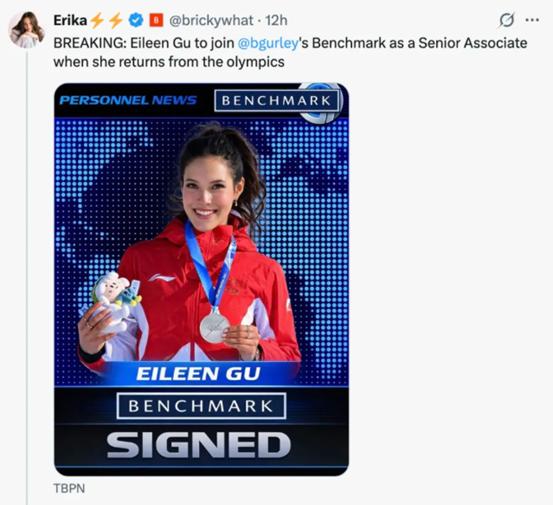
全球顶级VC重磅官宣:谷爱凌加盟
3 6 Ke· 2026-02-14 04:04
Core Insights - The news highlights that Olympic champion Gu Ailing is set to join the legendary VC firm Benchmark as a Senior Associate, marking a significant career shift from sports to venture capital [1][3] - Gu Ailing's role will not be honorary; she will engage in hands-on investment work, focusing on sectors like sports technology, artificial intelligence, and youth consumption, which are key areas for Benchmark [1][4] Group 1: Gu Ailing's Background and Qualifications - Gu Ailing's transition into venture capital has sparked curiosity and debate, particularly regarding her non-financial background and young age of 22 [3][4] - Benchmark's decision to hire her directly into a senior position reflects her unique skill set, which aligns with the VC industry, rather than merely leveraging her celebrity status [4][9] - Her experience in freestyle skiing, which involves risk assessment and decision-making under pressure, parallels the nature of venture capital investing [4][8] Group 2: Benchmark's Investment Strategy - Benchmark is known for its precise investment approach and has historically avoided leveraging celebrity status for marketing, focusing instead on strategic talent acquisition [4][9] - The firm has a distinctive investment model, concentrating on early-stage technology projects rather than broad diversification, which sets it apart from larger VC firms [11][12] - Benchmark's recent shift towards investing in Chinese market opportunities, particularly in AI, is driven by the rapid growth of the sector and the emergence of competitive Chinese companies [13][14] Group 3: The Role of Senior Associate - The Senior Associate position is critical within the VC hierarchy, serving as a key link between partners and frontline projects, allowing for significant involvement in project selection and management [7][8] - Gu Ailing's appointment as a Senior Associate at such a young age is rare and indicates Benchmark's high regard for her capabilities [8][9] Group 4: Gu Ailing's Unique Value Proposition - Gu Ailing's academic background in psychology and East Asian studies provides her with insights into cultural differences and market needs, which is valuable for Benchmark's global strategy [5][6] - Her extensive global network and understanding of youth trends in consumption, particularly in sports technology and AI, position her well to identify investment opportunities in these emerging fields [6][12]
ToB商业大变局,谁是新王?
3 6 Ke· 2026-01-26 06:05
Core Insights - The growth logic of China's enterprise services has relied on two main advantages: low-cost engineering talent and affordable sales and implementation teams. However, these advantages are rapidly diminishing due to demographic changes and rising wage levels [1][10] - The traditional To B business model is facing structural failure, necessitating a fundamental change in production relationships to sustain growth [1][10] - The evolution of enterprise services can be segmented into three eras: 1.0, 2.0, and the emerging 3.0, with each representing a shift in business models and operational strategies [1][2] Group 1: Era 1.0 - Control-Centric Approach - In the 1.0 era, companies like Yonyou and Glodon dominated the market by focusing on control over finances, inventory, and personnel, using a military-like organizational structure to capture market share [3][5] - Yonyou leveraged the widespread adoption of computerized accounting to establish a comprehensive distribution system, effectively creating a "ground army" for market penetration [5][6] - Glodon achieved deep market penetration in the construction sector by tying its software to national pricing standards, thus gaining significant pricing power and market dominance [6][7] Group 2: Era 2.0 - SaaS Aspirations and Challenges - The 2.0 era saw a shift towards SaaS models, with companies like Fenshangxiaoke and Beisen attempting to replicate successful Western models by leveraging capital and internet strategies [11][12] - Fenshangxiaoke's aggressive customer acquisition strategy faced challenges due to the rational decision-making of enterprise owners, leading to high customer churn rates [13][16] - Beisen adopted an integrated approach by offering a comprehensive suite of HR solutions, which successfully built a competitive moat but also significantly increased operational costs [14][15] Group 3: Era 3.0 - AI-Driven Transformation - The 3.0 era is characterized by companies like HeyGen and Manus, which utilize AI to redefine labor delivery models, moving away from traditional human resource dependencies [2][19] - HeyGen exemplifies extreme efficiency, achieving over $35 million in ARR with a small team, demonstrating that AI can replace traditional labor-intensive processes [22][36] - Manus represents a shift towards software functioning as a digital employee, capable of independently completing tasks, thus opening up new revenue streams by targeting labor budgets rather than IT budgets [23][39] Group 4: Changes in Business Models and Market Dynamics - The delivery model has shifted from providing tools to delivering results, eliminating the need for extensive training and reducing implementation friction [30][32] - The efficiency of 3.0 companies is starkly higher, with HeyGen achieving a revenue per employee of $1 million, compared to traditional SaaS companies that struggle to exceed $46,000 [33][36] - The market focus has transitioned from IT budget "rent" to labor budget "wages," significantly expanding the potential market size for AI-driven solutions [38][40] Group 5: Future Outlook - The future of China's To B market is expected to feature a bimodal structure, with established players like Glodon maintaining their market position while new entrants like HeyGen leverage AI for competitive advantage [41][42] - Companies in the middle ground, relying on outdated models, are at risk of being squeezed out as they cannot compete with either the efficiency of AI-driven firms or the entrenched advantages of legacy players [42] - The key for future entrepreneurs is to identify niches where AI can fully replace human labor, creating specialized tools that address specific problems [42]


聊聊硅谷AI视频技术与社交运营最新趋势
Nan Fang Du Shi Bao· 2026-01-16 09:13
Core Insights - The article discusses the evolving strategies of AI companies in Silicon Valley, focusing on user engagement and community-driven growth in social media platforms. Group 1: User Engagement Strategies - AI video companies are shifting from brand exposure to deeper user value exploration, with user education becoming a core focus. For instance, HeyGen's YouTube tutorial matrix has seen popular tutorials surpass 500,000 views, leading to a 23% increase in trial conversion rates [1]. - Community operations are crucial for user retention. Synthesia's TikTok campaign SynthesiaMagic generated over 80 million views, resulting in a 65% increase in daily active users, with 37% of marketing materials sourced from the community [1]. Group 2: Targeted User Segmentation - HeyGen employs a tiered operation on Discord, offering basic tutorials for regular users and dedicated channels for paid users, achieving a conversion rate 2.8 times higher than the industry average for enterprise clients [2]. Group 3: Feedback and Product Iteration - Social platforms serve as feedback channels for product iteration. Creatify's Instagram feature voting led to a 50% increase in production efficiency and a 92% satisfaction rate. Synthesia reduced its iteration cycle from 30 days to 14 days by responding to high-frequency issues within 24 hours [3]. - HeyGen's launch of a virtual host feature included a LinkedIn summit with 10 clients, attracting over 5,000 decision-makers and resulting in 32 orders signed on the spot [3]. Group 4: Data-Driven Marketing - Synthesia identified that 28% of its customers are in education and subsequently launched an educational template library on Pinterest, resulting in a 120% increase in lead volume. HeyGen's white paper on AI video improving CTR was downloaded 15,000 times, contributing to a 45% growth in paying customers [4]. - The closed-loop operations of leading companies have reduced customer acquisition costs by 35% and increased customer lifetime value by 60% [4]. Group 5: Industry Trends and Tools - The industry is trending towards long narratives and physical realism, with SaaS subscriptions and API fees becoming mainstream. However, stricter regulations on copyright and misinformation have led many tools to incorporate watermarks for traceability [4]. - Key tools in the market include Runway Gen-2 for generating 4K videos, Pika Labs for solving frame transitions, and OpenAI's Sora for creating complex scenes with near-realistic effects [4].
8个月干到1亿美金,盘点全球最赚钱9家AI应用,AI 商业逻辑彻底变了
3 6 Ke· 2026-01-08 13:07
Group 1 - The core point of the article is the rapid growth of AI companies achieving over $100 million in Annual Recurring Revenue (ARR), highlighting a shift in business models from selling capabilities to selling results [1][2][30] - Manus was acquired by Meta for $2 billion, and its ARR reached $125 million shortly before the acquisition, marking it as one of the fastest companies to reach this milestone [1][25] - Nine AI application companies have joined the "1 billion ARR club" this year, including notable names like Cursor, Lovable, and Perplexity, showcasing a trend of rapid commercialization in the AI sector [1][2] Group 2 - The speed of growth among these companies is striking, with Lovable achieving $100 million ARR in just 8 months, Cursor in 12 months, and Perplexity in 14 months [2][28] - The shift in commercial value is evident as companies focus on delivering credible results rather than just capabilities, indicating a fundamental change in how success is measured in the AI industry [2][30] - Investors are increasingly prioritizing single customer revenue over traditional profit margins as a key metric for evaluating AI companies, suggesting a new standard for what constitutes a successful AI business [2][28][37] Group 3 - Perplexity, valued at $20 billion, operates a subscription-based model with various tiers, and its ARR has shown significant growth, reaching $120 million by May 2025 [5][9] - ElevenLabs, valued at $6.6 billion, has a diverse client base and achieved $100 million ARR within 22 months, with plans to reach $300 million by the end of 2025 [7][9] - Lovable, also valued at $6.6 billion, reached $100 million ARR in 8 months and aims to double that figure within a year [10][11] Group 4 - Replit, valued at over $3 billion, transitioned from traditional code completion to a more integrated platform, achieving $150 million ARR in 18 months [12][13] - Suno, an AI music generation tool, reached over $100 million in annual revenue within three years, indicating strong market demand [15][16] - Gamma, an AI presentation tool, achieved $100 million ARR in a relatively short time, demonstrating effective monetization strategies [18][19] Group 5 - The article emphasizes that the fastest-growing companies are those that effectively transition from consumer to enterprise markets, enhancing their average revenue per user (ARPU) [29][30] - The trend indicates that AI companies are increasingly starting from consumer markets, which allows them to scale more rapidly [30][31] - The article also raises concerns about the sustainability of growth, as some companies face significant losses despite high ARR figures, highlighting the need for a deeper understanding of what constitutes a successful AI business [33][34][36]

这里还有8个“Manus”:1亿美元ARR,都是ToC
量子位· 2026-01-03 10:00
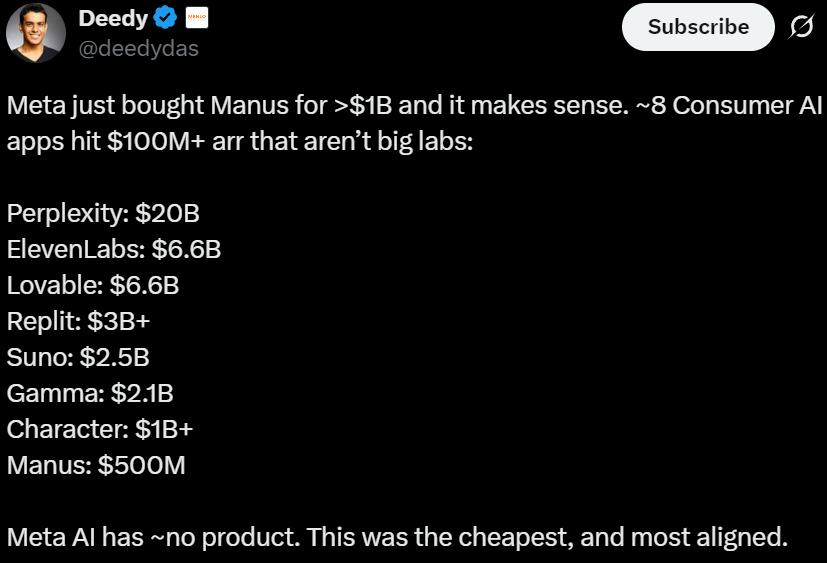
Core Insights - The article discusses the emergence of the "1 Billion ARR Club" in the AI sector, highlighting companies that have achieved significant annual recurring revenue (ARR) and their implications for the industry [1][3][4]. Group 1: Definition and Importance of ARR - ARR stands for Annual Recurring Revenue, representing stable, repeatable income generated by a product within a year [5]. - It reflects a critical question for AI companies: whether users are willing to pay for AI services long-term [6]. Group 2: Notable Companies in the 1 Billion ARR Club - Companies achieving over $1 billion ARR include: - Perplexity: $20 billion - ElevenLabs: $6.6 billion - Lovable: $6.6 billion - Replit: over $3 billion - Suno: $2.5 billion - Gamma: $2.1 billion - Character: over $1 billion - Manus: $500 million - HeyGen: over $500 million [7][8]. Group 3: Categories of Business Models - The companies can be categorized into five main business paths: 1. AI Search/Information Services (e.g., Perplexity) [12][13]. 2. Audio/Voice Infrastructure Products (e.g., ElevenLabs) [15][16]. 3. Vibe Coding/Development Tools (e.g., Replit and Lovable) [17][18]. 4. Content/Office Efficiency Tools (e.g., Gamma) [20][21]. 5. Generative Entertainment Content (e.g., Suno and HeyGen) [23][24]. Group 4: Trends and Market Dynamics - The shift from foundational models to consumer products is a significant trend, with the consumer (ToC) sector emerging as a new goldmine [9][30]. - The AI 2.0 era is characterized by high user tolerance for product iterations, allowing companies to receive rapid feedback and adjust quickly [32][37]. Group 5: Challenges and Considerations - Despite the growth, user stickiness is low, leading to potential churn as users switch to better products [34]. - AI-Native applications face unique cost structures, where each interaction incurs computational costs, necessitating a focus on sustainable revenue models [40][46]. - Companies must balance user growth with the costs of AI processing to ensure long-term viability [47][49]. Group 6: Strategic Acquisitions - Meta's acquisition of Manus illustrates the value of established AI products with proven user bases, as it allows Meta to leverage existing capabilities rather than developing new products from scratch [58][62]. - The acquisition not only brings a product but also a talented team capable of enhancing Meta's AI offerings across its platforms [66].

Meta数十亿美元买走中国AI团队,我们该鼓掌还是警醒?
Sou Hu Cai Jing· 2025-12-30 11:26
Core Viewpoint - Meta's acquisition of Manus, a Chinese AI company, marks a significant move in the tech competition between the US and China, highlighting the importance of AI in Meta's strategy and the global dynamics of talent and technology [4][5][10]. Group 1: Acquisition Details - Meta announced the acquisition of Manus for several billion dollars, making it the third-largest acquisition in the company's history [2]. - The entire Manus team will join Meta, with founder Xiao Hong becoming the Vice President in charge of AI agent technology [3]. - Manus will continue to operate independently in Singapore, maintaining its products and services [4]. Group 2: Strategic Importance - Meta has invested $54 billion in AI infrastructure in 2025, indicating the priority of AI within the company [6]. - Manus fills a critical gap for Meta, providing a general-purpose AI agent that achieved an accuracy of 86.5% in the GAIA standard test, surpassing similar products from OpenAI [8]. - The acquisition allows Meta to enhance its capabilities in automating content and advertising, leveraging its nearly 4 billion monthly active users [10]. Group 3: Implications for China - The acquisition reflects the capabilities and talents of Chinese AI innovators, as Manus was recognized and acquired by a leading global tech company [11][12]. - Early investors like ZhenFund see this as a successful exit, potentially encouraging more investment in AI startups [13]. - The move raises concerns about the outflow of top AI talent from China, as key personnel from Manus will now work for Meta [15][16]. Group 4: Challenges and Considerations - Manus's relocation to Singapore was influenced by international political pressures and the need for compliance with US regulations, highlighting the challenges faced by Chinese tech companies [17][19]. - The company faced difficulties in accessing high-performance AI chips due to US export controls, which affected its product development [19][20]. - The strategic decision to move to Singapore was also driven by the need for a more favorable environment for AI development and investment [21][22]. Group 5: Broader Industry Reflections - The acquisition raises critical questions about talent retention and the ecosystem for innovation in China, emphasizing the need for an environment that nurtures and retains top talent [24]. - It highlights the challenges of balancing technological independence with global integration in the AI sector [25]. - The relationship between capital and innovation is underscored, as the demands of foreign investors can influence the operational choices of tech companies [26]. Group 6: Future Outlook - Meta's acquisition of Manus serves as a microcosm of the complex interplay between technology, capital, international politics, and individual aspirations in the current era [27]. - It acts as a wake-up call for the Chinese AI industry, indicating the need for improvements in infrastructure and ecosystem to maintain competitive advantages [28]. - The future of competition will hinge not only on specific technologies but also on the overall ecosystem and its resilience [29][30].
速递|单图生成实时视频分身:扩散模型AI助手Lemon Slice获YC、Matrix等1050万美元投资
Z Potentials· 2025-12-25 03:39
数字头像生成公司 Lemon Slice 正致力于通过新型扩散模型为聊天场景增添视频维度——该技术仅需单张图像即可生成动态数字形象。 这个名为 Lemon Slice-2 的模型能够创建基于知识库运行的数字化身,可扮演 AI 智能体所需的任何角色,例如解答客户咨询、协助完成作业问 题,甚至担任心理健康支持顾问。 "在生成式人工智能的早期阶段,我的联合创始人开始尝试各种视频模型,我们明显意识到视频将走向交互化。 像 ChatGPT 这类工具之所以引人注 目,正是因为它们的交互性——我们希望视频也能具备这种特质。"联合创始人莉娜·科卢奇表示。 Lemon Slice 称该模型拥有 200 亿参数,仅需单张 GPU 即可实现每秒 20 帧的视频直播流生成。公司通过 API 和可嵌入小组件提供服务,企业仅需 一行代码就能将其集成至网站。创建数字化身后,用户可以随时变更角色背景、风格样式与外观形态。 除了拟人化形象,该公司还着力开发能够生成非人型角色的技术,以满足多元化需求。这家初创企业正运用 ElevenLabs 的技术为这些数字化身生 成语音。 Lemon Slice 由 Lina Colucci 、 Sidney ...

用人工假装 AI 的 AI 笔记,现在 10 亿美金估值了
投资实习所· 2025-11-16 04:35
Core Insights - The article discusses the contrasting fates of two AI-related companies, Builder AI and Fireflies, highlighting the importance of genuine AI integration over manual processes in achieving success [1]. Group 1: Company Performance - Builder AI raised over $400 million with a valuation of $1.5 billion but ultimately went bankrupt due to reliance on manual labor instead of true AI technology [1]. - Fireflies, an AI note-taking product, has successfully transitioned to a genuine AI solution, achieving a valuation of $1 billion and growing its user base to 20 million across over 500,000 institutions globally [1][2]. - Fireflies experienced an 8-fold increase in users over the past 1.5 years and has maintained over 100% annual revenue growth for the last four years, achieving profitability since 2023 [1]. Group 2: Product Development Journey - Initially, Fireflies operated without any AI, relying solely on manual note-taking by its founders during meetings, charging $100 per month for this service [3][2]. - The founders conducted over 100 meetings manually to generate enough revenue to cover their expenses, which allowed them to develop a fully automated AI product by 2017 [3][6]. - The early manual approach helped the founders identify real user needs, which informed the development of their AI capabilities [7][6]. Group 3: Market Validation Strategies - The article emphasizes the value of validating product ideas through direct engagement with the market, as demonstrated by Fireflies' initial manual operations [6][8]. - Similar strategies were employed by HeyGen, which initially offered AI-generated video services while presenting them as traditional services, allowing them to capture early customers through cost and efficiency advantages [8].

在全球最大的科技峰会现场,他们用DeepSeek养出迷你“独角兽”
虎嗅APP· 2025-11-15 09:17
Core Insights - The article discusses the emergence of new AI startups at the Web Summit, highlighting the potential for innovation in various countries beyond traditional tech hubs like Silicon Valley and Beijing [2][3][7]. Group 1: AI Startup Landscape - The Web Summit has become a platform for showcasing AI startups from diverse regions, including Brazil, Turkey, and Poland, which are skipping traditional SaaS models to enter the AI-native era [5][8]. - Many startups are focusing on niche problems within their local markets, demonstrating a trend where AI applications are tailored to specific user needs [5][9]. - The rise of AI is evident in sectors like sales and programming, with AI agents becoming increasingly specialized and integrated into business processes [5][28]. Group 2: Global AI Adoption - Smaller countries are leveraging AI to revitalize their economies, with examples like Lovable in Sweden achieving rapid growth and user adoption [7][8]. - The article notes that many startups are self-funded and not as reliant on external financing, indicating a different approach to growth compared to their counterparts in the US and China [5][9]. - AI is reshaping organizational structures, with many startups operating with minimal full-time staff and relying on freelance talent [17][19]. Group 3: Innovative Applications - Several startups are developing unique AI applications, such as Hablla in Brazil, which utilizes WhatsApp for personalized marketing, and Lyway in South Korea, focusing on AI-driven language testing [14][15]. - The article highlights the importance of product understanding and user engagement in the AI space, as seen with companies like Headway, which has successfully gamified learning experiences [24][25]. - AI applications are increasingly being designed to address specific industry needs, such as manufacturing and sales, showcasing the versatility of AI technology [28].