Manus

Search documents
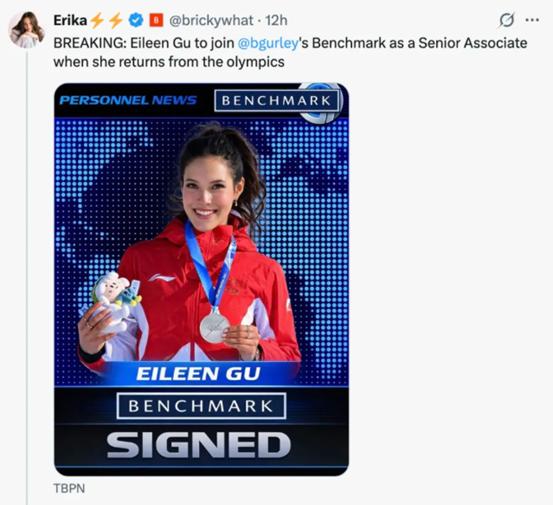
谷爱凌,去Benchmark做投资人了?
36氪· 2026-02-16 04:11
Core Viewpoint - The article discusses the significant announcement of Olympic champion Gu Ailing joining the renowned VC firm Benchmark as a Senior Associate, highlighting her potential impact on the investment landscape, particularly in sectors like sports technology, artificial intelligence, and youth consumption [4][7]. Group 1: Gu Ailing's Role and Background - Gu Ailing will not hold a ceremonial position but will actively engage in project due diligence, transaction execution, and post-investment management, focusing on emerging sectors that Benchmark is prioritizing [4]. - Her background as an Olympic champion and Stanford graduate positions her uniquely within the VC industry, raising questions about her qualifications for a Senior Associate role despite her non-financial academic background [7][8]. - The article emphasizes that her experience in high-pressure sports environments equips her with a mindset suitable for venture capital, where risk assessment and decision-making are crucial [8][9]. Group 2: Benchmark's Investment Strategy - Benchmark, established in 1995, is known for its "small but precise" investment approach, focusing on early-stage technology projects rather than broad diversification [17][18]. - The firm has a history of successful investments, including Uber, Twitter, Instagram, and Zoom, which have significantly influenced their respective industries [18]. - Recently, Benchmark has shifted its investment strategy to show increased interest in high-quality projects with Chinese backgrounds, driven by the rise of AI technology and China's growing tech capabilities [21][20]. Group 3: Gu Ailing's Unique Value Proposition - Gu Ailing's understanding of East Asian studies allows her to grasp cultural differences and market pain points, which is valuable for Benchmark's global investment strategy, especially in the Chinese market [9][10]. - Her extensive global network and awareness of emerging trends in youth consumption and technology provide her with insights that align with Benchmark's investment focus [11][10]. - The article suggests that her unique combination of skills and experiences justifies her rapid ascent to a Senior Associate position, a rarity for someone of her age and background in the VC industry [14][13]. Group 4: Benchmark's Historical Context - Benchmark has traditionally focused on the U.S. market, with minimal engagement in Asian markets until recent years, when it began to recognize the potential of Chinese tech firms [20]. - The firm’s cautious approach during the period of U.S.-China tensions reflects its commitment to strategic investment rather than opportunistic moves [20]. - The article concludes by noting that Gu Ailing's entry into Benchmark may symbolize a new era for the firm, potentially leading to innovative investment opportunities in the evolving tech landscape [16].


全球顶级VC重磅官宣:谷爱凌加盟
3 6 Ke· 2026-02-14 04:04
Core Insights - The news highlights that Olympic champion Gu Ailing is set to join the legendary VC firm Benchmark as a Senior Associate, marking a significant career shift from sports to venture capital [1][3] - Gu Ailing's role will not be honorary; she will engage in hands-on investment work, focusing on sectors like sports technology, artificial intelligence, and youth consumption, which are key areas for Benchmark [1][4] Group 1: Gu Ailing's Background and Qualifications - Gu Ailing's transition into venture capital has sparked curiosity and debate, particularly regarding her non-financial background and young age of 22 [3][4] - Benchmark's decision to hire her directly into a senior position reflects her unique skill set, which aligns with the VC industry, rather than merely leveraging her celebrity status [4][9] - Her experience in freestyle skiing, which involves risk assessment and decision-making under pressure, parallels the nature of venture capital investing [4][8] Group 2: Benchmark's Investment Strategy - Benchmark is known for its precise investment approach and has historically avoided leveraging celebrity status for marketing, focusing instead on strategic talent acquisition [4][9] - The firm has a distinctive investment model, concentrating on early-stage technology projects rather than broad diversification, which sets it apart from larger VC firms [11][12] - Benchmark's recent shift towards investing in Chinese market opportunities, particularly in AI, is driven by the rapid growth of the sector and the emergence of competitive Chinese companies [13][14] Group 3: The Role of Senior Associate - The Senior Associate position is critical within the VC hierarchy, serving as a key link between partners and frontline projects, allowing for significant involvement in project selection and management [7][8] - Gu Ailing's appointment as a Senior Associate at such a young age is rare and indicates Benchmark's high regard for her capabilities [8][9] Group 4: Gu Ailing's Unique Value Proposition - Gu Ailing's academic background in psychology and East Asian studies provides her with insights into cultural differences and market needs, which is valuable for Benchmark's global strategy [5][6] - Her extensive global network and understanding of youth trends in consumption, particularly in sports technology and AI, position her well to identify investment opportunities in these emerging fields [6][12]
泡泡玛特2025年全品类销量突破4亿只,聚焦港股通消费ETF华夏(513230)布局窗口
Mei Ri Jing Ji Xin Wen· 2026-02-13 03:18
Group 1 - The core sales data for 2025 from Pop Mart indicates that global sales of all IP and product categories have exceeded 400 million units, with THEMONSTERS category alone surpassing 100 million units [1] - Pop Mart's founder Wang Ning announced that by 2025, the company will have over 10,000 global employees, more than 100 million registered members, and LABUBU's annual sales will exceed 100 million units [1] - The company operates in over 100 countries and regions, with more than 700 global stores and six major supply chain bases [1] Group 2 - Huaxi Securities predicts that the high prosperity of emotional consumption will continue into 2026, with the Z generation gradually shifting from product consumption to a combination of product and emotional consumption [2] - The report highlights that service consumption is becoming a crucial driver for domestic demand, with policies emphasizing the potential of service consumption in areas like elderly care, childcare, tourism, and duty-free shopping [2] - The commercial application of AI is expected to accelerate, as evidenced by Meta's acquisition of the Chinese AI company Manus for billions, indicating a potential new wave of development in AI and consumer services [2] Group 3 - The Hong Kong Stock Connect Consumption ETF from Huaxia tracks the CSI Hong Kong Stock Connect Consumption Theme Index, which includes leading companies in traditional service industries as well as high-elasticity assets like Pop Mart and others [2]

DeepAgent与DeepSearch双双霸榜,答案指向openJiuwen这一新兴开源项目
3 6 Ke· 2026-02-12 07:06
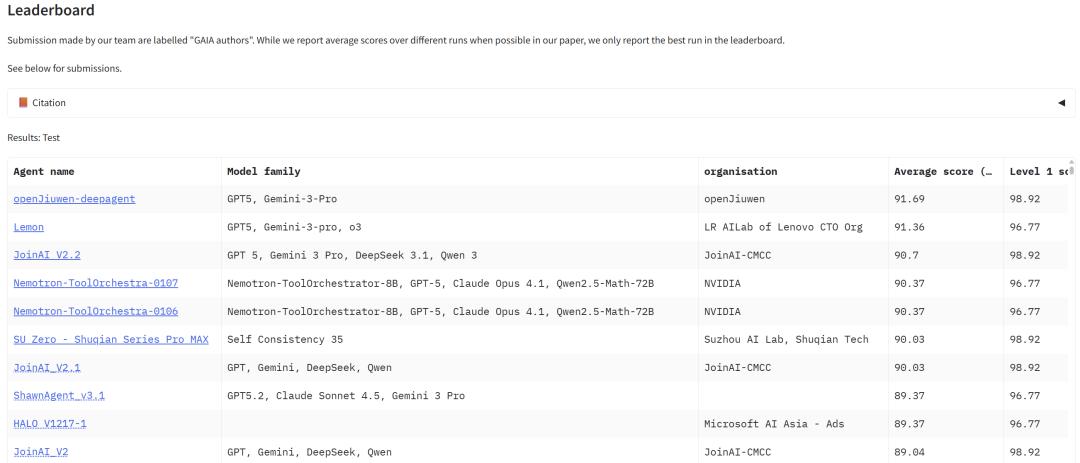
Core Insights - The article highlights the emergence of advanced AI agents, particularly focusing on DeepAgent and DeepSearch, which have achieved top rankings in the GAIA and BrowseComp-Plus benchmarks respectively, indicating a significant leap in AI capabilities [1][20]. Group 1: GAIA Benchmark Insights - DeepAgent, built on the openJiuwen platform, achieved a score of 91.69%, surpassing competitors like NVIDIA's Nemotron, showcasing its superior capabilities in general agent tasks [2][10]. - GAIA is a rigorous benchmark designed to evaluate AI agents on 12 core competencies, including long-term task planning and multi-modal understanding, with a scoring system that emphasizes real-world task execution [6][4]. - The average success rate for human participants in GAIA is around 92%, while leading AI models like GPT-4 only achieve about 15%, highlighting the benchmark's challenging nature [6][10]. Group 2: DeepAgent's Capabilities - DeepAgent's design allows it to dynamically adjust plans based on real-time feedback, ensuring task completion even in changing environments [12][13]. - It features a multi-layered context engine that maintains cognitive consistency and traceability throughout complex tasks, enhancing the reliability of its outputs [15]. - The agent employs an asynchronous tool orchestration system, enabling efficient and reliable execution of diverse tasks by coordinating various external tools [16][17]. Group 3: BrowseComp-Plus Benchmark Insights - DeepSearch, also based on openJiuwen, achieved an accuracy of 80% in the BrowseComp-Plus benchmark, demonstrating its strength in deep search and web interaction capabilities [20][24]. - BrowseComp-Plus evaluates agents on their ability to perform multi-hop retrieval and cross-source information integration, making it a critical measure of an agent's practical capabilities [23][24]. - The benchmark employs a fixed human-validated corpus to ensure fairness and reproducibility in its assessments, avoiding biases from real-time web dynamics [23]. Group 4: Technological Foundation - Both DeepAgent and DeepSearch leverage the openJiuwen platform, which provides a comprehensive framework for developing high-precision, high-efficiency AI agents [30][31]. - openJiuwen supports multi-agent collaboration and self-evolution, allowing agents to continuously improve their performance through a closed-loop optimization process [31][32]. - The platform has already been commercialized in various sectors, including finance and manufacturing, indicating its broad applicability and potential for future growth [31].
AI Agent:超级助手,重塑人类生活和商业
泽平宏观· 2026-02-04 16:06
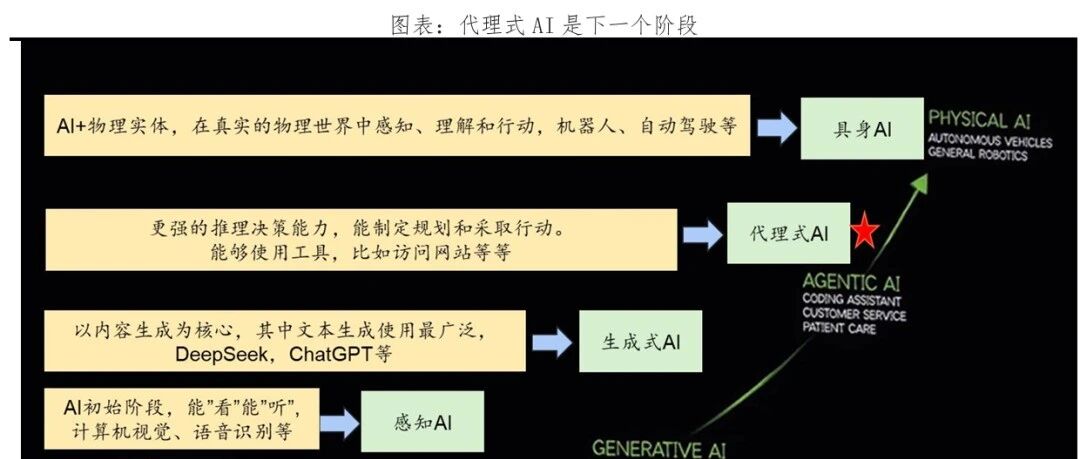
Core Viewpoint - The article discusses the emergence of AI Agents as a transformative force in the digital landscape, moving beyond traditional AI chatbots to systems capable of executing complex tasks autonomously, thereby revolutionizing user interaction with technology [2][10][11]. Group 1: Definition and Functionality of AI Agents - AI Agents are defined as systems that not only generate content but also take action, functioning as executors that can automate tasks across various applications [4][10]. - The operational capabilities of AI Agents include planning, tool utilization, and memory, allowing them to break down complex tasks into manageable steps and execute them seamlessly [13][10]. - Examples of AI Agents in action include Alibaba's Tongyi Qianwen AI, which can autonomously place orders based on user preferences, and Google's Jarvis, which can manage browser tasks like booking flights [5][7]. Group 2: Industry Landscape and Competitive Dynamics - The acquisition rumors surrounding Manus by Meta highlight the competitive landscape for AI Agents, as Meta seeks to enhance its user engagement capabilities through advanced task execution [17]. - Major players like OpenAI, Microsoft, and Google are launching their own AI Agent systems, such as OpenAI's Operator and Microsoft's Windows 365 for Agents, indicating a race to establish dominance in this emerging market [18][19]. - Domestic companies like ByteDance and Alibaba are also making significant strides in the AI Agent space, with ByteDance focusing on platform tools and Alibaba leveraging its extensive ecosystem for service integration [20][33]. Group 3: Technological Trends and Standardization - The article identifies two key technological trends: the MCP protocol, which standardizes AI tool integration, and the A2A protocol, which facilitates direct communication between Agents [22][26]. - The MCP protocol, likened to a Type-C interface, allows for seamless interaction between AI models and external tools, significantly enhancing operational efficiency [24]. - The establishment of these protocols marks the beginning of a standardized era for AI Agents, enabling a more interconnected digital ecosystem [27]. Group 4: Future Outlook and Challenges - The article outlines potential future changes, including the obsolescence of traditional apps as AI Agents take over backend operations, leading to a redefined user experience [14][15]. - However, the successful implementation of AI Agents faces significant challenges, particularly in terms of existing business models and the interests of major tech companies, which may resist the shift towards Agent-driven interactions [31][32]. - The future may see a new economic model emerge, where apps provide "Agent-specific paid interfaces," altering the dynamics of user engagement and monetization in the digital space [34].





中美AI行业的关键时刻
虎嗅APP· 2026-01-29 14:10
Core Insights - The article discusses the significant developments in the AI industry in 2025, highlighting the emergence of Chinese AI companies like Deepseek, Manus, and Qwen, which are gaining global recognition and challenging the dominance of Silicon Valley giants [7][8]. Group 1: Key Events in AI Development - The Chinese AI company Deepseek made a notable impact during the Spring Festival of 2025, showcasing engineering capabilities that impressed Silicon Valley [10][11]. - Manus secured a $75 million investment from Benchmark, raising its valuation to $500 million, indicating a growing interest from U.S. investors in Chinese AI projects [13][15]. - The emergence of the "Reverse CFIUS" regulation has created a cautious environment for U.S. investments in Chinese AI companies, leading to a "chilling effect" among investors [18][19]. Group 2: Investment Trends - The AI application era has officially begun, with U.S. venture capitalists becoming more active in funding Chinese AI projects, driven by the success of models like Deepseek and Qwen [16][22]. - The article notes that investments exceeding $100 million require a clear separation from Chinese affiliations, as U.S. funds navigate the complexities of geopolitical tensions [23][24]. - The sentiment in the Chinese primary market is optimistic, with significant cash flow observed in the embodiment intelligence sector, driven by government support and market demand [30][33]. Group 3: Challenges and Opportunities - The article highlights the challenges faced by Chinese entrepreneurs in Silicon Valley, including cultural differences and the need for patience in adapting to the U.S. market [25][26]. - The success of Hygen, a Chinese AI startup, illustrates a potential pathway for other entrepreneurs, emphasizing the importance of capital isolation and market focus [27][28]. - The article discusses the rapid changes in the AI landscape, where the window for securing top projects is shrinking, making it increasingly difficult for investors to identify and fund disruptive innovations [50][51]. Group 4: Competitive Landscape - The competition among major AI players, particularly between OpenAI and Google, is intensifying, with both companies striving for dominance in the foundational model space [58][59]. - The article notes that NVIDIA continues to play a pivotal role in the AI ecosystem, forming strategic partnerships and acquiring key assets to maintain its competitive edge [62][64]. - Meta's recent acquisition of Manus reflects a strategic shift towards building strong AI agents, indicating a potential new direction for the company amidst its challenges in foundational models [70][71].
从个人IP到商业系统,一人公司正在成为下一种公司形态
3 6 Ke· 2026-01-29 10:49
Core Insights - The emergence of the "One Person Company" (OPC) model is transforming entrepreneurship, leveraging AI and automation to enable individuals to operate with the efficiency of a team [1][2][3] - The trend is supported by data showing that independent founders accounted for 36.3% of new companies by mid-2025, a significant increase from 23.7% in 2019, indicating a shift towards solo entrepreneurship [2][3] - This structural change is driven by technological advancements, policy support, and validated success stories of solo entrepreneurs [3][4] Group 1: Structural Changes in Entrepreneurship - The rise of one-person companies is not a fleeting trend but a result of multiple structural forces, including the reduction of startup costs due to AI tools and subscription services [3][4] - Policies are increasingly favoring individual-controlled structures, as seen in initiatives like Shanghai's "Super Individual 288 Action" and support for OPCs in various regions [3][4] - Successful solo entrepreneurs have demonstrated that it is possible to start and validate business ideas independently before scaling, challenging traditional notions of team-based startups [3][4] Group 2: AI's Role in Reshaping Organizational Logic - The proliferation of AI agents is enabling individuals to function as multi-threaded organizations, allowing them to manage various tasks and workflows autonomously [5][6] - AI tools are evolving from task execution to autonomous process management, fundamentally changing how work is organized and executed [5][6] - The traditional model of collaboration is being replaced by a system where individuals can leverage AI to complete complex tasks without the need for a large team [6][7] Group 3: Building a Sustainable One-Person Ecosystem - Successful one-person companies require a systematic approach, transitioning from being mere content creators to effective business operators [8][9] - Key challenges include unclear positioning, fragmented processes, and uncontrolled client structures, which can hinder the sustainability of one-person businesses [9][10] - A sustainable one-person company must integrate three systems: a mental framework for self-identity and client understanding, a content system for effective communication, and a service system for standardized delivery [10][11] Group 4: The Future of One-Person Companies - The shift towards one-person companies represents a broader organizational logic transformation, where individuals can leverage AI to manage their operations effectively [13][14] - The future will not see individuals replacing companies but rather more people managing their own businesses in a structured manner [14][15] - AI serves as a platform while individuals act as nodes, redefining the concept of a company beyond just a legal entity to a choice of organizational structure [15]
资本验证下的路径分野:中国AI公司港股上市的“通与专”
Sou Hu Cai Jing· 2026-01-28 06:23
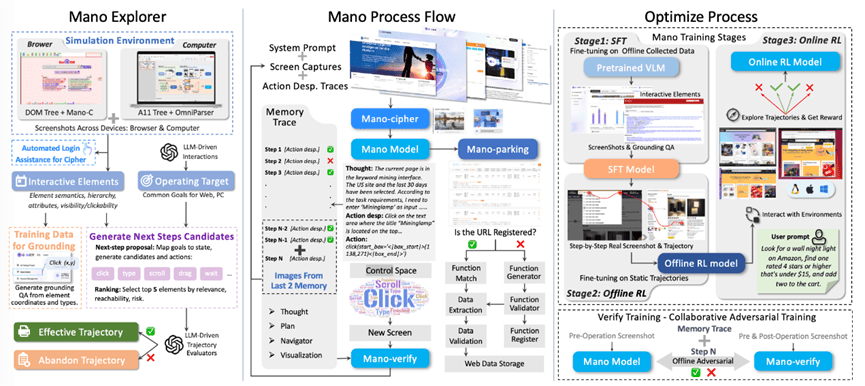
作者:闫滟 来源:科技最前线 (kejizqx) 2025年底,Meta宣布以数十亿美元收购AI智能体公司Manus,迅速点燃了科技界对Agent赛道的无限想象。然而在这场属于硅谷的喧嚣之外,一段更早的 产业伏笔却鲜被提及:Manus创始人肖弘的上一家创业公司"夜莺科技",早在几年前就已被中国AI公司明略科技收入麾下。 这并非一次偶然的资本操作,而是一次对技术路线的早期锚定——明略科技很早之前,就在思考如何让AI从擅长对话的"思考者",进化为能执行复杂任 务、创造真实价值的"行动者"。 当基础大模型展现的通用潜力已被充分讨论,行业目光正从"知道什么"转向"能做到什么"——如何让AI在企业中变得言必有据、行必有果?对此,明略科 技以自身实践给出了一个清晰的回答:成为深耕于企业真实场景的 "AI专才"。 "通才"与"专才": 中国AI生态的百花齐放 具体而言,明略的核心优势体现在其DeepMiner平台所构建的 "执行层"能力,尤其是在浏览器使用能力(BUA)与计算机使用能力(CUA)上表现抢眼。 这一能力由其专有的"AI灵巧手"Mano模型所驱动,该模型在全球权威GUI操作基准测试中达到顶级水平,确保了AI在图 ...
Meta to test premium subscription plans for Instagram, Facebook and WhatsApp
CNBC· 2026-01-27 02:35
Group 1 - Meta's $2 billion acquisition of AI startup Manus is under review by Chinese officials for potential technology control violations [1] - Meta is planning to introduce new subscription models across its platforms, including Instagram, Facebook, and WhatsApp, aimed at enhancing user productivity and creativity [2][3] - The subscription plans will include access to expanded AI capabilities and features from the recently acquired Manus suite of AI agents [2] Group 2 - The new subscription model may help Meta recoup its significant investments in AI talent and acquisitions made in the previous year [3] - Features of the subscription plans may include full access to the AI-powered short-form video experience Vibes, which will still offer a free basic version [4] - The subscription service will be distinct from Meta Verified, which provides content creators and businesses with various benefits, and Meta intends to gather user feedback during the rollout [5]