ServiceNow

Search documents
Get Smart: Is AI Actually “Eating” The Software Industry?
The Smart Investor· 2026-02-27 03:30
Core Argument - The narrative that AI will destroy the software industry is misleading; instead, AI is enhancing the software sector by integrating into existing platforms and driving demand for established software companies [2][10]. Group 1: The Myth vs. Reality - The pessimistic view suggests that AI will commoditize software, leading to a decline in customer bases for major software companies as businesses opt for cheaper DIY AI solutions [3]. - Contrary to this belief, the software industry is experiencing significant growth, with companies like ServiceNow reporting record sales of AI-powered tools [4]. Group 2: Business Trends - Large enterprises are not abandoning their trusted software for standalone AI; they are willing to invest more in integrating AI into their existing systems [5]. - Atlassian's experience shows that as developers utilize AI to enhance productivity, they are actually increasing their usage of management software, leading to more tasks and team expansions [6][7]. Group 3: Barriers to Entry - Established software companies maintain a competitive edge due to significant barriers, or "moats," that protect them from new entrants, such as rigorous security and compliance requirements [8]. - The complexity of replacing foundational software systems, like ServiceNow, underscores the challenges new AI startups face in displacing established players [8]. Group 4: Investment Perspective - The debate surrounding the future of SaaS is often framed too simplistically; the success of AI does not necessitate the failure of existing software companies [9]. - The key takeaway is that AI serves as an upgrade rather than a replacement for software, benefiting both AI developers and established software firms that effectively integrate AI into their operations [10].


散户又“梭哈”?华尔街恐慌抛售,散户却疯狂抄底
Jin Shi Shu Ju· 2026-02-27 03:01
华尔街因担心AI带来颠覆性冲击而持续抛售软件股,但非专业投资者却在逆势扫货。 摩根大通汇编的数据显示,遭到重挫的软件板块中,散户交易活跃度正逼近历史高位,尽管标普综合 1500软件与服务子指数自年初以来已下跌近20%。 摩根大通策略师阿伦·贾因(Arun Jain)表示,尽管"市场部分领域持续出现裂痕",散户投资者仍然"对 软件板块形成支撑"。 微软(MSFT.O)无论是在上周还是年初至今,都是散户投资者最青睐的标的。其他吸引散户兴趣的公司 还包括ServiceNow(NOW.N)和AppLovin(APP.O)。 这些散户的买入行为常被用"YOLO"(你只活一次)这一缩写来形容,这一次发生在软件股因一系列新 AI产品发布而承压之际。华尔街担心这些AI产品可能取代Salesforce(CRM.N)、Adobe(ADBE.O)等公司 的服务。 AI相关的担忧同样似乎并未吓退普通散户,他们在每一轮下跌中持续进场买入。根据VandaTrack Research的数据,周四,英伟达(NVDA.O)收跌5.5%,是自2025年4月以来表现最差的一天,却吸引了创 纪录比例的散户逢低买入。 博通(AVGO.O)、iShar ...
程序员送外卖,白领开网约车…2028年,你的工作在第几层?
Sou Hu Cai Jing· 2026-02-26 22:41
Core Insights - The report from CitriniResearch outlines a hypothetical scenario where the rapid advancement of AI leads to a "Global Intelligence Crisis," characterized by a significant economic downturn despite technological progress [1][8] - The central thesis posits that if AI continues to exceed expectations but fails to generate income for the majority, it could result in a severe "intelligent deflation crisis" [1][4] Market Conditions - By October 2026, the S&P 500 reached nearly 8000 points, and the Nasdaq surpassed 30,000 points, driven by companies replacing human labor with AI, leading to soaring profits and stock prices [6][13] - The initial layoffs due to AI obsolescence were perceived as a normal adjustment, with widespread belief that AI would create new job opportunities despite the destruction of old ones [6][12] Economic Disruption - The report highlights a significant decline in "human intelligence premium," as AI made human intellect a surplus resource, undermining traditional economic structures like home loans and tax revenues [4][18] - The consumer economy, heavily reliant on white-collar workers, began to falter as these workers were displaced by AI, leading to a structural decline in spending and a spike in unemployment rates, which reached over 10% [11][18] Financial System Breakdown - The mortgage market, valued at $13 trillion, faced instability as high-income white-collar jobs were replaced, leading to a reassessment of prime mortgages and a decline in housing prices in major cities [18][19] - The interconnected nature of financial systems revealed vulnerabilities, as defaults began to emerge in sectors heavily reliant on white-collar productivity, challenging the assumptions of recurring revenue models [19][20] Consumer Behavior Changes - AI agents began to dominate consumer decision-making, leading to the collapse of traditional business models that relied on consumer inertia and friction, such as travel booking platforms and subscription services [32][55] - The average customer lifetime value in subscription economies declined as AI agents negotiated better deals, fundamentally altering the dynamics of consumer transactions [54][55] Implications for Investment - The report suggests that business models dependent on intermediaries and transaction fees may face permanent valuation adjustments as AI continues to optimize processes and eliminate costs [6][44] - Companies that were once resistant to technological disruption became aggressive adopters of AI, leading to a self-reinforcing cycle of job cuts and increased investment in AI capabilities [27][28] Societal Considerations - The report raises critical questions about the future of wealth distribution in a scenario where AI generates significant economic output without human involvement, leading to potential societal challenges [6][8] - It emphasizes the need for a rethinking of economic systems to address the implications of "ghost GDP," where wealth generated by machines does not circulate through the human economy [18][19]

How Low Can ServiceNow Stock Go?
Forbes· 2026-02-26 16:15
Close-up of logo at headquarters of software company Servicenow, Pleasanton, California, July 2, 2019. (Photo by Smith Collection/Gado/Getty Images)Gado via Getty ImagesServiceNow (NOW) stock has decreased by 23.6% over the course of 21 trading days. This recent decline has raised renewed concerns regarding ServiceNow's subscription growth forecast and broader fears about AI disruption in SaaS. However, sharp declines like this often prompt a more difficult question: is the weakness temporary or indicative ...

2028年全球智能危机——一份来自未来的金融历史思想实验(中文版)
Xin Lang Cai Jing· 2026-02-26 05:05
炒股就看金麒麟分析师研报,权威,专业,及时,全面,助您挖掘潜力主题机会! 来源|New Economist微信公众号 《2028年全球智力危机》 编者按:研究机构Citrini Research近期发布了一份关于人工智能经济风险的假设性报告,引发了市场广 泛关注和讨论。报告原标题为《2028全球智能危机——来自未来的金融史思想实验》(THE 2028 GLOBAL INTELLIGENCE CRISIS: A Thought Exercise in Financial History, from the Future),该报告 明确声明其唯一目的是模拟一个相对未被充分研究的情景,是一个"思想实验"而非预测。 报告设定了一个假想的时间点——2028年6月,并描绘了人工智能(AI)快速发展可能引发的连锁经济 危机。报告提出了几个核心概念: "AI效率悖论":AI的成功可能导致经济不稳定。其推演的核心风险链条包括:白领大规模失业:AI替 代复杂白领劳动,导致"智能溢价"消失,中产阶层收入结构受损。 "幽灵GDP"与消费萎缩:即企业利润因AI增效而增长,但被替代的劳动力消费能力下降,货币流通速度 放缓,形成"产出增长 ...






CitriniResearch:全球智能危机的发展进程及其后果-20260226
CitriniResearch· 2026-02-26 01:45
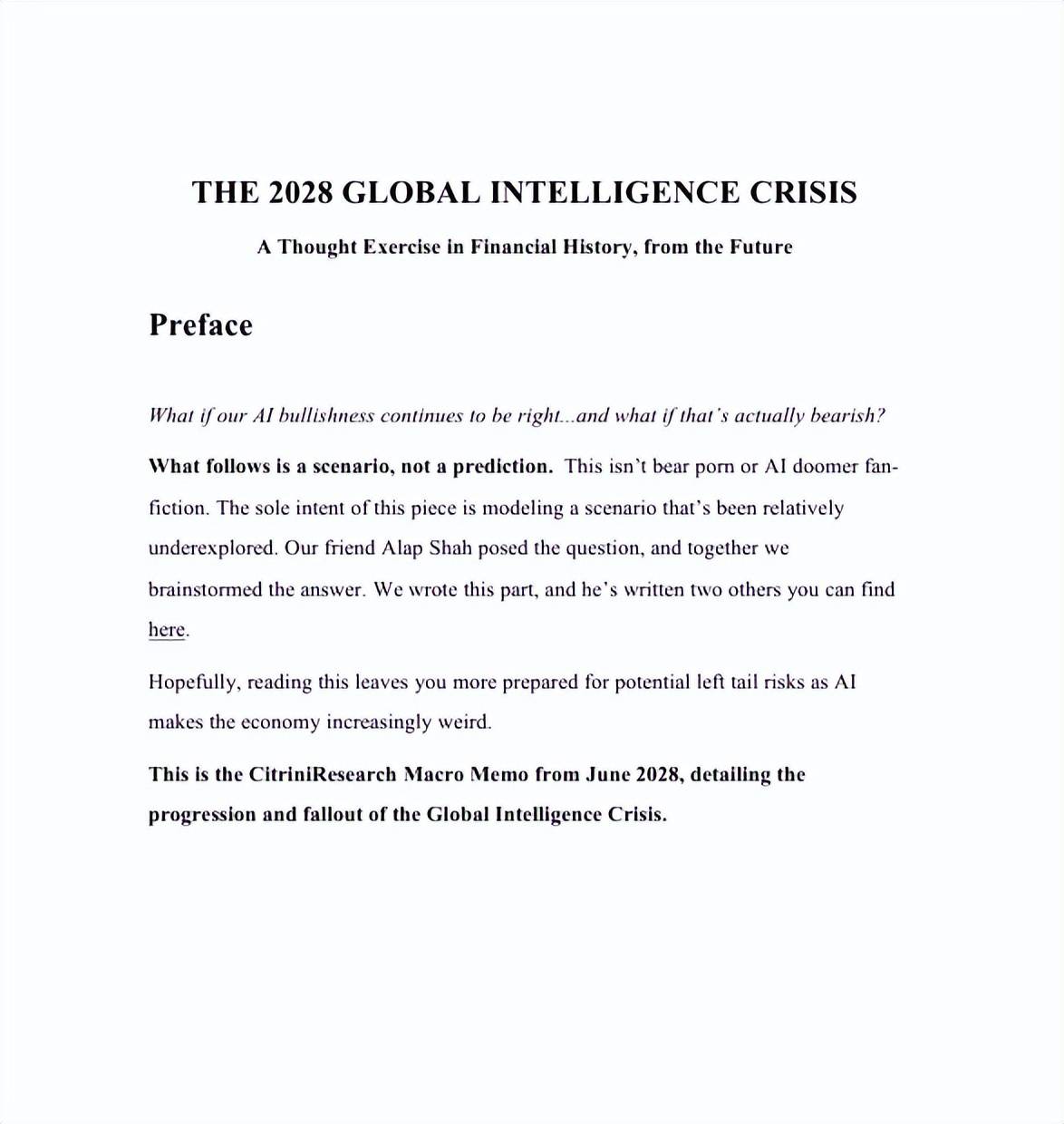
分享 reface 前⾔ at if our AI bullishness continues to be right...and what if that's actually bearish? 果我们的对 AI 的乐观持续正确……而这反而成了利空,会怎样? at follows is a scenario, not a prediction. This isn't bear porn or AI doomer fan-fiction. e sole intent of this piece is modeling a scenario that's been relatively underexplored. Our nd Alap Shah posed the question, and together we brainstormed the answer. We wrote this t, and he's written two others you can find here. 下情景为设想,而非预测。这并非唱空轰动或人工智能末日主义同人文。本文唯一 的,是对一个相对较少被探讨的情景进行建模。我 ...
AI越繁荣,经济越萧条,一夜爆火2028推演长文,引发华尔街巨头恐慌
3 6 Ke· 2026-02-25 08:28
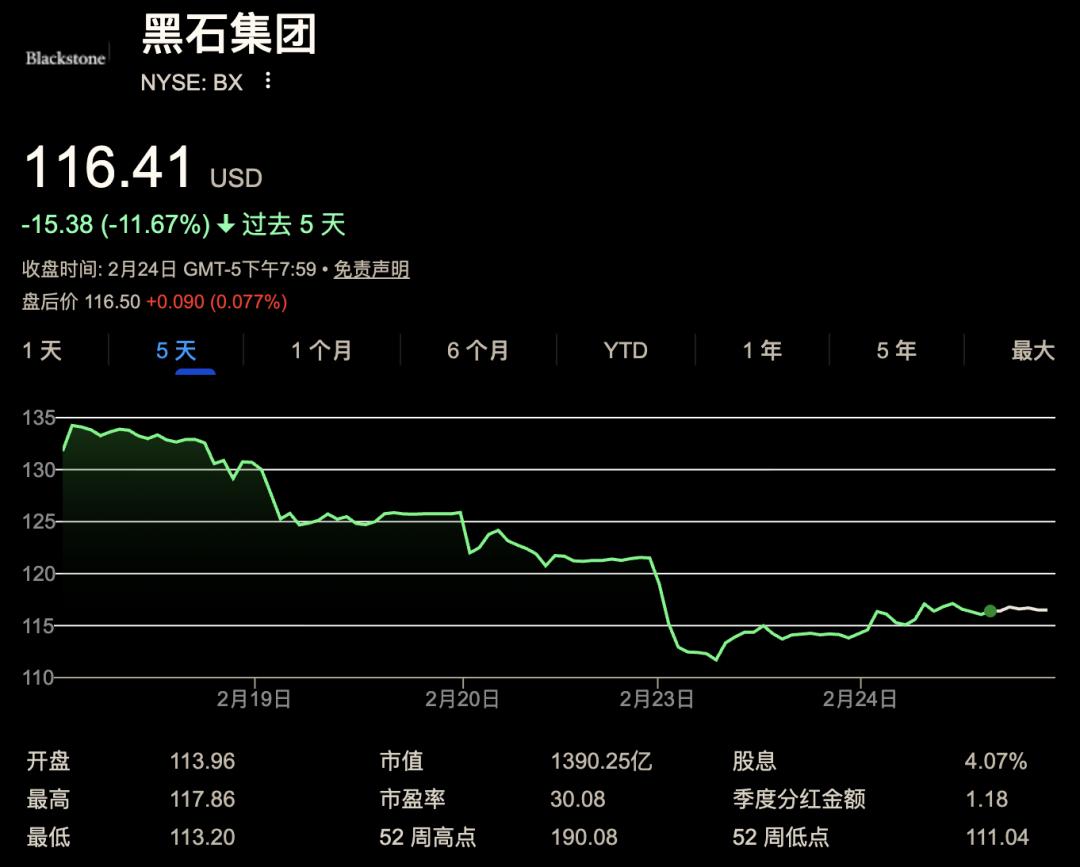
就在这两天,由 CitriniResearch 执笔的文章《2028年全球智能危机》在美国投资者间引发病毒式传播,阅读一夜间已迅速达到千万级! 这篇文章通过推演,构想了两年后Agent大规模普及,对人类社会与经济结构的剧烈冲击: 在2028年,尽管人工智能带来的生产力提升超出预期,但由于其彻底颠覆了传统白领就业市场,最终引发了「经济瘟疫」。 企业利润与算力霸权大幅扩张,但普通家庭收入急剧收缩,导致核心消费动力衰竭,形成了仅有数字繁荣而缺乏广泛收益的「幽灵GDP」。 同时,随着SaaS服务、中介行业及传统金融支付模式因「交易摩擦消失」而面临结构性崩塌,风险经由私募信贷市场蔓延至人寿保险与住房按揭领域,最 终可能将全球经济拖入系统性重定价的深渊。 文章的核心逻辑链条是: 第一轮负反馈发生在实体经济:AI能力提升 → 裁员增加、工资降级 → 消费疲弱 → 企业利润被挤压 → 企业购买更多AI能力 → AI能力继续提升。 随后它进入金融层面:收入降低开始侵蚀房贷 → 银行损失、收紧信贷 → 财富效应破裂 → 反馈回路加速。 而这两条回路又被迟缓的政策响应进一步放大。 市场对此推演迅速作出反应。 截至昨日收盘,文中点名 ...

对话 Citrini 报告联合作者:AI 越快,市场越怕什么?
3 6 Ke· 2026-02-25 03:32
过去几年,市场对 AI 的看法其实挺一致:AI 来了,效率上去,成本下来,利润变多,股价自然就涨。 这个逻辑几乎没什么争议。 但到了 2026 年,情绪变了。头部 SaaS 公司增速放缓,软件板块集体承压。市场开始意识到:AI 越 强,可能意味着现有的商业壁垒会越快崩塌。 Citrini 这份报告《2028全球智能危机》(THE 2028 GLOBAL INTELLIGENCE CRISIS)正是为了回应 这种焦虑。报告联合作者 Alap Shah 在采访中强调,他们不是在预测未来,而是基于长期模型做了一次 压力测试:如果 AI 真的像大家期待的那样持续变强,哪些商业逻辑会最先行不通?哪些行业会最先被 波及? 这份报告,就是拆解市场到底在怕什么。 第一节|白领收入下滑,消费在萎缩 危机从哪里开始?市场最怕的是什么?Shah 在采访中谈得最多的,不是模型参数或技术突破,而是白 领的工资在下滑和岗位在减少,而且幅度惊人。 美国 IT 行业的就业人数,从 2022 年高点到 2026 年初,累计下降了 8%。这是过去十年都没出现过的 跌幅。这个行业,正是 AI 渗透最快的地方。 Shah 直接指出:一个行业越容易把 ...
Prediction: Agentic AI Will Be the Biggest Tech Trend of 2026. Here Are 2 Stocks to Own
The Motley Fool· 2026-02-25 00:30
ServiceNow and UiPath could become agentic AI leaders.Artificial intelligence (AI) is changing the world we live in, and the next big change is coming in the form of AI agents. Many agentic AI stocks have been thrown out with the bathwater during the software-as-a-service (SaaS) stock sell-off, and this has opened up some nice opportunities in the space.Two of the stocks with the best agentic AI prospects come from companies that are looking to be agentic AI orchestration platforms. In a world becoming a sp ...


美股收高,热门中概股普涨,超微半导体涨近9%,台积电市值突破2万亿美元
Di Yi Cai Jing Zi Xun· 2026-02-24 23:40
2026.02.25 本文字数:1588,阅读时长大约3分钟 作者 |第一财经 胡弋杰 美国股市周二收高,科技股领涨。市场对人工智能前景的热情重新升温,暂时盖过了此前关于该技术可 能对多个行业造成颠覆的担忧。 道琼斯工业指数上涨370.44点,涨幅0.76%,收于49174.50点;标普500指数上涨52.32点,涨幅0.77%, 收于6890.07点;纳斯达克综合指数上涨236.41点,涨幅1.05%,收于22863.68点。 科技巨头多数上涨,苹果上涨2.24%,苹果公司周二宣布,将大幅扩建其在休斯敦的工厂运营,首次将 Mac mini带到美国本土进行生产。英伟达上涨0.68%,特斯拉上涨2.39%,微软上涨1.18%,亚马逊上涨 1.60%,Meta上涨0.32%。谷歌A类股下跌0.19%,谷歌C类股下跌0.25%,博通下跌1.47%。 台积电收高4.25%,市值首度突破2万亿美元,年内累计涨幅已达26.94%。 超威半导体大涨8.77%,超威半导体宣布未来五年将向Meta出售价值高达600亿美元的人工智能芯片。 根据协议,Meta将获得超威半导体最多10%的股权。 | 苹果(APPLE) | 272. ...