INNOVENT BIO(01801)

Search documents
智通港股通持股解析|2月23日
智通财经网· 2026-02-23 00:31
Group 1 - The top three companies by Hong Kong Stock Connect holding ratio are Haotian International Investment (71.36%), China Telecom (71.32%), and Green Power Environmental (68.88%) [1][2] - Tencent Holdings, Xiaomi Group-W, and Meituan-W have seen the largest increases in holding amounts over the last five trading days, with increases of +1.391 billion, +983 million, and +931 million respectively [1][2] - The companies with the largest decreases in holding amounts over the last five trading days include WuXi Biologics (-481 million), Zijin Mining (-447 million), and Southern Hengsheng Technology (-344 million) [1][4] Group 2 - The latest holding ratios for the top 20 companies in Hong Kong Stock Connect show Haotian International Investment with 7.919 billion shares, China Telecom with 9.900 billion shares, and Green Power Environmental with 0.279 billion shares [2] - The top 10 companies with the largest increases in holding amounts over the last five trading days include China Petroleum & Chemical Corporation (+315 million) and Zhaoyi Innovation (+309 million) [2][4] - The top 10 companies with the largest decreases in holding amounts include Pop Mart (-294 million) and SenseTime-W (-277 million) [4]




中国创新药出海交易额暴涨10倍破千亿美元!信达生物88.5亿美元合作震撼全球
Jin Rong Jie· 2026-02-16 13:56
Core Insights - The IBI EXPO 2026 Biopharmaceutical Innovation Conference will provide a high-level platform for communication and collaboration in the innovative drug industry [1] - Recent favorable news in the innovative drug sector includes a significant increase in licensing agreements, with Chinese companies signing $137.7 billion in deals in 2025, nearly a tenfold increase from 2021 [1][2] - The trend of Chinese biopharmaceutical companies entering international licensing agreements is accelerating, with major collaborations such as the $8.85 billion deal between Innovent Biologics and Eli Lilly [1][5] Market Focus - The IBI EXPO 2026 conference serves as a catalyst for the innovative drug sector, highlighting the substantial growth in licensing agreements and the transition from research investment to commercial realization [2] - The number of licensing agreements reached 186 in 2025, with a total transaction value of $137.7 billion, marking a record high for the past decade [3][5] - Companies like Innovent Biologics and Rongchang Biopharma are transitioning from loss to profit, indicating a clear improvement in the overall profitability of the industry [2][3] Broker Insights - Open Source Securities notes that the period from 2017 to 2026 is a "golden decade" for Chinese pharmaceutical companies, with licensing agreements skyrocketing from $2.562 billion in 2017 to $137.7 billion in 2025 [3] - The overall revenue growth in innovative drugs is evident, with over 70% of companies reporting positive revenue growth in 2025, showcasing strong commercial capabilities [3] - The innovative drug sector has seen a price correction over the past two quarters, but long-term prospects remain positive, suggesting an increase in sector allocation [3] Related Industries - The innovative drug sector is transitioning from a research investment phase to a commercialization phase, with significant implications for the CXO (Contract Research Organization) industry, which is expected to benefit from increased orders [5] - The new business model of external licensing is expected to enhance the early-stage research pipeline, benefiting companies involved in drug discovery and clinical trials [4][5] - The trend of Chinese innovative drugs "going global" is becoming systematic, with major collaborations indicating a shift towards international development [5] Industry Chain Companies - Heng Rui Medicine is a representative company in the domestic chemical innovative drug sector, with a diverse pipeline and ongoing internationalization efforts [7] - Sanofi Biopharma has received approval for its self-developed monoclonal antibody, further enriching its commercial product pipeline [7] - Companies like Rongchang Biopharma and Ailis are demonstrating strong revenue growth and successful international collaborations, indicating a positive trend in the innovative drug sector [7][8]



中国创新药对外授权年交易额突破千亿美元,4年增长近10倍
YOUNG财经 漾财经· 2026-02-14 09:10
Core Insights - The annual transaction value of China's innovative drug licensing has surpassed $100 billion, marking a nearly tenfold increase over four years, with a total of $137.7 billion in licensing deals signed in 2025 [2] - Major global pharmaceutical companies, including Novartis, AstraZeneca, and GSK, have signed significant agreements with Chinese firms, indicating a strong interest in China's next-generation innovative drug development pipelines [3] - The average transaction size for licensing deals involving Chinese biopharmaceutical companies has significantly increased this year, with an average deal size of $1.3 billion, a 76% increase from 2025 and six times the average size in 2021 [4] Group 1 - In 2025, there were 186 licensing transactions involving Chinese companies, reflecting a growing trend in the biopharmaceutical sector [2] - The average upfront payment for licensing deals this year is $77.7 million, double that of 2025 and three times the average in 2021 [4] - Notable recent agreements include a strategic partnership between Innovent Biologics and Eli Lilly worth $8.85 billion, and a potential $18.5 billion collaboration between AstraZeneca and CSPC Pharmaceutical Group [4] Group 2 - Macquarie Capital predicts that oncology drugs will continue to attract global pharmaceutical companies, highlighting China's strong capabilities in chemical drug development [5] - Multinational companies are increasingly viewing China as a critical part of their global R&D infrastructure, especially as they face patent cliffs and seek to reduce costs [5] - Vision Lifesciences reports that China leads the world in specific molecular types, with Chinese companies accounting for nearly 90% of global licensing transactions for antibody-drug conjugates (ADCs) [5]


中国创新药对外授权年交易额突破千亿美元,4年增长近10倍
Di Yi Cai Jing· 2026-02-14 06:37
Core Insights - Many multinational companies are increasingly viewing China as a crucial part of their global R&D infrastructure, especially as they face patent cliffs and seek to cut costs [1][4] - The value of licensing agreements for new drugs from Chinese biopharmaceutical companies is expected to reach a historic high of over $100 billion by 2025, with a total of $137.7 billion in licensing deals signed in 2025, nearly a tenfold increase from 2021 [1][4] Group 1 - Global pharmaceutical giants, including Novartis, AstraZeneca, and GSK, signed multiple significant agreements with Chinese companies last year [3] - Tom Barsha, head of Asia-Pacific M&A at Bank of America Securities, predicts that the total value of these licensing deals could double again in the next 18 to 24 months, as global companies focus on finding next-generation innovative drug pipelines in China [3] - There have been nearly 40 licensing transactions involving Chinese biopharmaceutical companies this year, with average deal sizes significantly higher than last year [3] Group 2 - The average deal size for licensing agreements from Chinese pharmaceutical companies this year has reached $1.3 billion, a 76% increase from 2025 levels and approximately six times the average from 2021 [4] - The average upfront payment this year is $77.7 million, doubling from $38.8 million in 2025 and tripling from the average in 2021 [4] - Macquarie Capital's Asia healthcare research department predicts that a class of drugs considered foundational for cancer treatment will continue to attract global pharmaceutical interest [4] Group 3 - Many multinational companies are recognizing China's strength in chemical fields, allowing them to obtain promising molecular licenses at lower costs compared to internal R&D [4] - Vision Lifesciences' report highlights that China is a world leader in specific molecular types, with Chinese companies accounting for nearly 90% of global licensing deals for antibody-drug conjugates (ADCs) [4]

大健康风向标〡跨越千亿美元门槛:中国分子站在全球化起点
Jing Ji Guan Cha Wang· 2026-02-13 07:06
Core Viewpoint - The keyword for the stock market in 2025 is expected to be "innovative drugs," with significant stock price increases driven by the potential of in-development innovative drugs and BD (business development) transactions rather than traditional revenue from already marketed drugs [1] Group 1: BD Transactions - In 2025, China's innovative drug BD transaction total exceeded $100 billion, with notable orders reaching $10 billion, and upfront payments from multinational pharmaceutical companies reaching a new high of $1.25 billion [1] - Landmark transactions include a $13 billion collaboration between Qihuang Dejian and Biohaven/AimedBio in January, marking a milestone for China's ADC technology [2] - In May, 3SBio's deal with Pfizer exceeded $6 billion, setting a record for upfront payments in China at $1.25 billion, highlighting the value of both first-in-class and fast-follow drugs [2] - In July, a $12 billion strategic partnership between Hengrui Medicine and GlaxoSmithKline showcased the depth of early-stage pipelines in leading Chinese pharmaceutical companies [2] - In October, Innovent Biologics and Takeda's collaboration worth $11.4 billion included a cost-sharing model for global R&D, enhancing operational capabilities for future international ventures [2] Group 2: Milestone Payments and Emerging Fields - Several past BD transactions reached milestone payments in 2025, including a $300 million payment to China National Pharmaceutical's subsidiary from Merck and a $250 million payment to Bairui Tianheng from Bristol-Myers Squibb [3] - The focus of BD transactions is shifting from oncology to other therapeutic areas, with autoimmune diseases, metabolism, and central nervous system disorders emerging as new hot fields [3] - Notable deals include the global rights licensing of BTK inhibitor Orelabrutinib for multiple sclerosis by Nocera Biopharma, with a potential total transaction value exceeding $2 billion [3] - The metabolic field is gaining traction, driven by global weight loss trends, with several companies entering into licensing agreements for GLP-1 targeted drugs [3] Group 3: Independent Clinical Trials and Regulatory Approvals - Numerous innovative drug companies in China are advancing their own overseas clinical trials, achieving significant progress [4] - In early 2025, Dize Pharmaceutical's lung cancer targeted drug received priority review from the FDA and was approved in July, becoming the first globally innovative drug independently developed in China to gain approval in the U.S. [4] - Other advancements include breakthrough therapy designations for CS0159 by Kexi Kedi and a Phase III trial approval for a recombinant human albumin injection by Heyuan Biopharma [4] - These developments indicate that the Chinese innovative drug industry is becoming a significant force in global innovation, transitioning from fast-following to original innovation and integrating deeply into the global value chain [4]


一周医药速览(02.09-02.13)
Cai Jing Wang· 2026-02-13 06:53
Group 1 - Xinda Biopharmaceutical announced a strategic collaboration with Eli Lilly to advance global R&D of innovative drugs in oncology and immunology, with a total potential value of up to $88.5 billion [1] - Under the agreement, Xinda will receive an upfront payment of $350 million and may earn up to approximately $8.5 billion in milestone payments related to R&D, regulatory, and commercialization achievements [1] - Xinda retains all rights for the projects in Greater China, while Eli Lilly obtains exclusive development and commercialization rights outside this region [1] Group 2 - Kangtai Biological announced the termination of its collaboration with AstraZeneca to establish a joint venture in the vaccine sector, which was initially planned to be set up in Beijing with a registered capital of approximately 345 million yuan (about $50 million) [2] - The decision to terminate was made due to significant market changes and increased investment risks in the vaccine industry, with no adverse impact on Kangtai's operations [2] Group 3 - China Resources Pharmaceutical announced plans to sell approximately 17.87% of its stake in Tianmai Biotechnology for a base price of about 1.42 billion yuan [3] - The sale will be conducted through a public listing, and as of the announcement date, China Resources holds less than 30% of Tianmai's shares [3] Group 4 - Dong'e Ejiao plans to invest 1.485 billion yuan to construct a health consumer goods industrial park, with a construction period of approximately 22 months [4] - The project aims to support the high-quality development of the health consumer goods business, including the production of food and health products [4] Group 5 - WuXi Biologics expects a revenue increase of approximately 16.7% to 21.79 billion yuan for the fiscal year ending December 31, 2025, with a projected profit growth of 45.3% to 5.733 billion yuan [5] - The growth is attributed to successful execution of its "Follow and Win" strategy, expansion of service offerings, and increased utilization of production capacity [7] Group 6 - Kintor Pharmaceutical signed a strategic cooperation agreement to expand its CAR-T cell therapy production base in Shanghai, with a total investment of up to 370 million yuan [8] - This initiative aligns with the commercialization of multiple CAR-T products and aims to enhance production capacity to support global competitiveness [8]


信达生物获摩根大通增持58.59万股 每股作价约79.23港元
Xin Lang Cai Jing· 2026-02-13 00:02
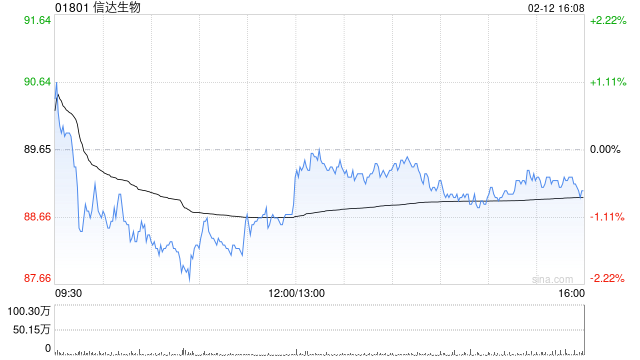
Group 1 - Morgan Stanley increased its stake in Innovent Biologics (01801) by 585,900 shares at a price of HKD 79.232 per share, totaling approximately HKD 46.422 million [1] - After the increase, the total number of shares held by Morgan Stanley is approximately 87,217,600, representing a stake of 5.02% [1]
摩根大通增持信达生物(01801)58.59万股 每股作价约79.23港元
Zhi Tong Cai Jing· 2026-02-12 11:40
Core Viewpoint - JPMorgan Chase increased its stake in Innovent Biologics (01801) by acquiring 585,900 shares at a price of approximately HKD 79.23 per share, totaling around HKD 46.42 million, resulting in a new holding of approximately 87.22 million shares, representing a 5.02% ownership stake [1] Group 1 - JPMorgan Chase's acquisition of 585,900 shares indicates a strategic investment in Innovent Biologics [1] - The purchase price of HKD 79.23 per share reflects the current market valuation of Innovent Biologics [1] - The total investment amount of HKD 46.42 million signifies JPMorgan's confidence in the company's future prospects [1] Group 2 - Following the acquisition, JPMorgan's total shareholding in Innovent Biologics reached approximately 87.22 million shares [1] - The updated ownership percentage of 5.02% positions JPMorgan as a significant stakeholder in Innovent Biologics [1]

摩根大通增持信达生物58.59万股 每股作价约79.23港元
Zhi Tong Cai Jing· 2026-02-12 11:25
Core Viewpoint - Morgan Stanley increased its stake in Innovent Biologics (01801) by purchasing 585,900 shares at a price of HKD 79.232 per share, totaling approximately HKD 46.422 million, raising its ownership to about 87.2176 million shares, which represents a 5.02% stake [1] Group 1 - Morgan Stanley's recent purchase of shares indicates a positive outlook on Innovent Biologics' future performance [1] - The total investment made by Morgan Stanley in this transaction is approximately HKD 46.422 million [1] - Following the acquisition, Morgan Stanley's total shareholding in Innovent Biologics is now approximately 87.2176 million shares [1]
国联民生证券:小核酸重构减肥逻辑 INHBE与ALK7靶点初步验证
智通财经网· 2026-02-12 06:43
Core Viewpoint - The report from Guolian Minsheng Securities highlights the synergistic effects of small nucleic acid drugs and GLP-1 class drugs in the weight loss sector, suggesting they could become a "golden duo" for weight management [1][4]. Group 1: Drug Efficacy and Development - Arrowhead has reported promising initial weight loss results from two small nucleic acid drugs targeting INHBE and ALK7, with ARO-INHBE showing an average fat reduction of 9.9% and liver fat reduction of up to 38.6%, alongside a 3.6% increase in lean tissue [1]. - ARO-ALK7 demonstrated a dose-dependent average reduction of ALK7 mRNA by 88%, confirming the TRiM platform's ability to inhibit fat cell gene expression [1]. - Wave Life's WVE-007 targeting liver INHBE showed a 9.4% reduction in visceral fat and a 4.5% overall fat reduction after three months, with a 3.2% increase in lean body mass [3]. Group 2: Market Trends and Collaborations - Major pharmaceutical companies are increasingly investing in small nucleic acid drugs, with Eli Lilly committing $1.2 billion in collaboration with Saint Inbiotech for RNAi candidate drug development for metabolic diseases [3]. - Eli Lilly also invested $1 billion in HAYA's lncRNA platform for obesity and related metabolic disease treatments, while Novo Nordisk partnered with Replicate Bioscience for a $550 million project targeting obesity and type 2 diabetes [3]. - The speed of Chinese pharmaceutical companies in developing small nucleic acid drugs for weight loss is nearly on par with international counterparts, with several companies like Hengrui Medicine and Innovent Biologics actively pursuing this area [5]. Group 3: Investment Recommendations - The report suggests focusing on companies involved in small nucleic acid weight loss targets, including Hengrui Medicine, Chengdu Xian Dao, China National Pharmaceutical Group, East China Pharmaceutical, and others [6].