YYTH(600096)

Search documents
推荐炼油炼化、钾肥、磷化工、SAF投资方向
Zhong Guo Neng Yuan Wang· 2026-01-05 01:42
Core Viewpoint - The petrochemical industry is currently facing significant "involution" competition, leading to a situation where companies are experiencing increased production without corresponding profit growth. The industry's overall operating revenue profit margin has declined from 8.03% in 2021 to an expected 4.85% in 2024. However, since 2025, some sub-industries have begun to recover, with a year-on-year net profit growth of 10.56% in the first three quarters, indicating a gradual stabilization and recovery in industry profitability [1][2]. Supply Side - The cumulative fixed asset investment in the chemical raw materials and chemical products manufacturing industry turned negative starting June 2025, with capital expenditures in the SW basic chemical industry and several sub-industries declining for multiple consecutive quarters. The current expansion cycle in the industry is nearing its end. In September, policies aimed at stabilizing growth in the petrochemical industry were introduced to address low-price disorderly competition and promote the orderly exit of backward production capacity. Sub-industries such as silicone, caprolactam, and PTA polyester have responded by developing or drafting industry guidelines to combat "involution." It is anticipated that there will be stricter approvals for new chemical product capacities, and the elimination of backward production capacity (e.g., small scale, high energy consumption, and high pollution) will accelerate, effectively alleviating the issue of supply surplus in the petrochemical industry [2][3]. Demand Side - Traditional demand is expected to see moderate recovery due to global central banks entering a rate-cutting cycle and pausing balance sheet reductions, supported by monetary and fiscal policy stimuli. Emerging demand from sectors such as new energy, SAF (Sustainable Aviation Fuel), and AI continues to drive the need for key chemical materials that support technological upgrades in industries [3]. - The overseas chemical capacity reduction, driven by high energy costs and aging facilities, has led to a wave of plant closures in the European chemical industry since 2025. Currently, China's chemical product sales account for over 40% of the global market. With a complete domestic petrochemical industry chain and many chemical products being highly competitive globally, it is expected that Chinese chemical companies will continue to increase their market share, accelerating the digestion of surplus capacity [3]. Macro and Chemical Product Prices - As of December 2025, the manufacturing PMI index was reported at 50.1%, an increase of 0.9 percentage points from the previous month, indicating expansion. The China Chemical Product Price Index (CCPI) was reported at 3927 points, a decrease of 9.4% from 4333 points at the beginning of the year, reflecting a decline in the ex-factory prices of major chemical products [3]. Oil Prices - In 2025, the international oil market experienced a downward trend, with Brent crude futures averaging approximately $69.15 per barrel and WTI crude futures averaging about $65.87 per barrel. This was influenced by a mix of factors including OPEC+ gradual production increases, geopolitical conflicts, fluctuations in U.S. oil inventories, and macroeconomic sentiment. OPEC+ announced a pause in production increases at the beginning of 2026 after a cumulative increase of 411,000 barrels per day from October to December 2025 to alleviate surplus pressure. The demand from non-OECD countries and aviation fuel, along with petrochemical raw materials, has become a major support for oil prices. Major institutions have narrowed their demand growth expectations for 2025-2026 to between 700,000 and 1.4 million barrels per day [4]. Investment Recommendations - The refining and chemical sector is expected to see a recovery in overall profits due to moderate oil prices and reduced cost volatility. The supply-demand relationship in the refining and chemical industry, particularly in the aromatics industry chain, is expected to continue to optimize. Key recommendations include China Petroleum (601857) and Rongsheng Petrochemical (002493) [5]. - In the potassium fertilizer sector, potassium salt resources are expected to remain scarce, with global supply and demand expected to maintain a tight balance over the next 2-3 years. Key recommendations include Yara International (000893), which has significant potassium salt mining rights in Laos [6]. - In the phosphorus chemical sector, the demand for lithium iron phosphate batteries is expected to enhance the marginal pull on phosphorus ore demand, leading to a revaluation of phosphorus ore. Key recommendations include Chuanheng Co., Ltd. (002895) and Yuntianhua Co., Ltd. (600096) [6]. - In the sustainable aviation fuel (SAF) sector, the EU has mandated a gradual increase in SAF content in aviation fuel, with global SAF demand expected to double to 2 million tons by 2025. Key recommendations include Zhuoyue New Energy, a leading domestic biodiesel company [6].




推荐炼油炼化、钾肥、磷化工、SAF投资方向 | 投研报告
Sou Hu Cai Jing· 2026-01-05 01:33
Core Viewpoint - The petrochemical industry is currently facing significant "involution" competition, leading to a situation where companies are experiencing increased production without corresponding profit growth. The industry's operating revenue profit margin has declined from 8.03% in 2021 to an expected 4.85% in 2024. However, since 2025, some sub-industries have begun to recover, with a year-on-year increase of 10.56% in net profit attributable to the parent company in the first three quarters, indicating a gradual stabilization and recovery in industry profitability [2][3]. Supply Side - Investment in fixed assets in the chemical raw materials and chemical products manufacturing industry has turned negative since June 2025, with capital expenditures in the basic chemical industry and several sub-industries declining for multiple consecutive quarters. The current expansion cycle in the industry is nearing its end. In September, policies aimed at stabilizing growth in the petrochemical industry were introduced to address low-price and disorderly competition and to promote the orderly exit of backward production capacity. Sub-industries such as silicone, caprolactam, and PTA polyester have responded to these "anti-involution" measures by either issuing or formulating industry guidelines. It is anticipated that there will be stricter approvals for new chemical product capacities, and the elimination of backward production capacity (such as small scale, high energy consumption, and high pollution) will accelerate, effectively alleviating the issue of supply surplus in the petrochemical industry [2][3]. Demand Side - Traditional demand is expected to see a moderate recovery due to global central banks entering a rate-cutting cycle and pausing balance sheet reductions, supported by monetary and fiscal policy stimuli. Emerging demand from sectors such as new energy, SAF (Sustainable Aviation Fuel), and AI continues to drive the need for key chemical materials that support technological upgrades in industries [3]. - The overseas chemical capacity reduction, driven by high energy costs and aging facilities, has led to a wave of plant closures in the European chemical industry since 2025. Currently, China's chemical product sales account for over 40% of the global market, with a well-established domestic petrochemical industry chain. As overseas capacity continues to clear and demand is expected to recover, Chinese chemical companies are likely to see an increase in global market share, accelerating the digestion of surplus capacity [3]. Macro and Chemical Product Prices - As of December 2025, the manufacturing PMI index was reported at 50.1%, an increase of 0.9 percentage points from the previous month, indicating expansion. The China Chemical Product Price Index (CCPI) was reported at 3927 points, a decrease of 9.4% from 4333 points at the beginning of the year, reflecting a decline in the ex-factory prices of major chemical products [3]. Oil Prices - In 2025, international oil prices exhibited a fluctuating downward trend, with Brent crude futures averaging approximately $69.15 per barrel and WTI crude futures averaging about $65.87 per barrel. This fluctuation was influenced by a combination of factors, including OPEC+'s gradual production increases, geopolitical conflicts, and macroeconomic sentiment. OPEC+ announced a pause in production increases at the beginning of 2026 to alleviate surplus pressures after a cumulative increase of 411,000 barrels per day from October to December. The demand from non-OECD countries, along with aviation fuel and petrochemical raw material needs, has become a major support for oil prices. Major institutions have narrowed their demand growth expectations for 2025-2026 to a range of 700,000 to 1.4 million barrels per day [4]. Investment Recommendations - The refining and chemical sector is expected to see a recovery in overall profits due to moderate oil prices and reduced cost fluctuations. The industry is also experiencing a shift towards "reducing oil and increasing chemicals," supported by clear anti-involution policy signals. Recommended companies include China Petroleum and Rongsheng Petrochemical [5][6]. - In the potassium fertilizer sector, potassium salt resources are expected to remain scarce, with a tight balance in global supply and demand over the next 2-3 years. Recommended company: Yara International, which holds significant potassium salt mining rights in Laos [6]. - In the phosphorus chemical sector, the demand for lithium iron phosphate in energy storage is expected to enhance the marginal pull on phosphorus ore demand, leading to a revaluation of phosphorus ore. Recommended companies include Chuanheng Co. and Yuntianhua [6]. - In the sustainable aviation fuel (SAF) sector, the EU has mandated a gradual increase in SAF blending ratios, with global SAF demand expected to double to 2 million tons by 2025. Recommended company: Zhuoyue New Energy, a leading domestic biodiesel enterprise [6][7].

基础化工行业行业周报:PX价格上涨触发石化企业行情,行业存长期修复机遇-20260104
Orient Securities· 2026-01-04 11:16
Investment Rating - The industry investment rating is maintained as "Positive" [5] Core Viewpoints - The rise in PX prices has triggered a bullish trend in the petrochemical sector, indicating long-term recovery opportunities for the industry [2][7] - The report highlights that the increase in PX prices, with futures rising over 800 CNY/ton and spot prices up about 340 CNY/ton, has improved profit expectations for refining companies [7] - The report emphasizes that the refining industry has faced prolonged downturns, with major companies encountering challenges such as declining domestic demand for refined oil and stagnant export quotas [7] - The appointment of new leadership at China Petroleum & Chemical Corporation is seen as a potential catalyst for industry recovery [7] Summary by Relevant Sections Investment Recommendations and Targets - Recommended leading companies in the refining sector include Sinopec (600028, Buy), Rongsheng Petrochemical (002493, Buy), and Hengli Petrochemical (600346, Buy) [3] - The report expresses optimism for recovery opportunities across various chemical sub-industries, including MDI leader Wanhua Chemical (600309, Buy) and companies in the PVC sector such as Zhongtai Chemical (002092, Not Rated), Xinjiang Tianye (600075, Not Rated), and Chlor-alkali Chemical (600618, Not Rated) [3] - In the phosphoric chemical sector, companies like Chuanheng Co. (002895, Not Rated) and Yuntianhua (600096, Not Rated) are highlighted due to growth driven by energy storage [3] - The oxalic acid industry recommendations include Hualu Hengsheng (600426, Buy), Huayi Group (600623, Buy), and Wankai New Materials (301216, Buy) [3]



王者归来!化工ETF(516020)盘中涨超2%,标的指数年内累涨超40%!机构:供需改善催生盈利拐点
Xin Lang Cai Jing· 2025-12-30 12:05
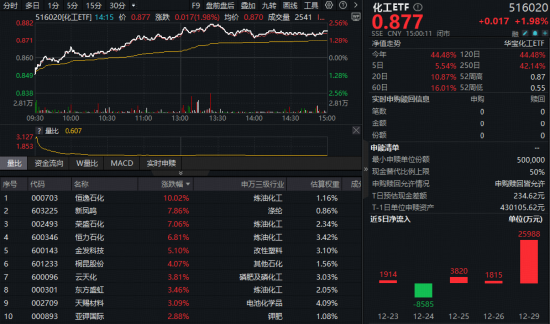
Core Viewpoint - The chemical sector has shown a significant rebound, with the Chemical ETF (516020) reaching a new high since September 2022, reflecting strong performance across various sub-sectors such as petrochemicals, polyester, phosphate chemicals, and lithium batteries [1][9]. Group 1: Market Performance - The Chemical ETF (516020) opened lower but experienced a rise, achieving a maximum intraday increase of 2.56% and closing up by 1.98% [1][9]. - The Chemical ETF's index has recorded a year-to-date increase of 41.4%, outperforming major A-share indices like the Shanghai Composite Index (18.3%) and the CSI 300 Index (18.21%) [1][9]. Group 2: Key Stocks Performance - Notable stocks within the sector include Hengyi Petrochemical, which hit the daily limit, and others like Xin Fengming and Rongsheng Petrochemical, which rose over 7% [1][9]. - Hengli Petrochemical increased by over 6%, while Jinfa Technology, Yuntianhua, and Tianci Materials also showed significant gains [1][9]. Group 3: Industry Trends - The chemical sector's strong performance is attributed to policy support and cyclical recovery, leading to a notable outperformance compared to the broader market [1][9]. - The sector's fixed asset investment growth is slowing, and the "anti-involution" policy is promoting industry self-discipline, which is expected to improve profitability levels [6][13]. Group 4: Future Outlook - The demand for lithium iron phosphate materials is expected to grow significantly, with projections indicating a global output of 5.25 million tons by 2026, a 36% increase year-on-year [4][12]. - The Chemical ETF (516020) is positioned to capture investment opportunities across various sub-sectors, with nearly 50% of its holdings in large-cap leading stocks [6][13].


农化制品板块12月30日涨0.98%,云天化领涨,主力资金净流出1.53亿元
Zheng Xing Xing Ye Ri Bao· 2025-12-30 08:56
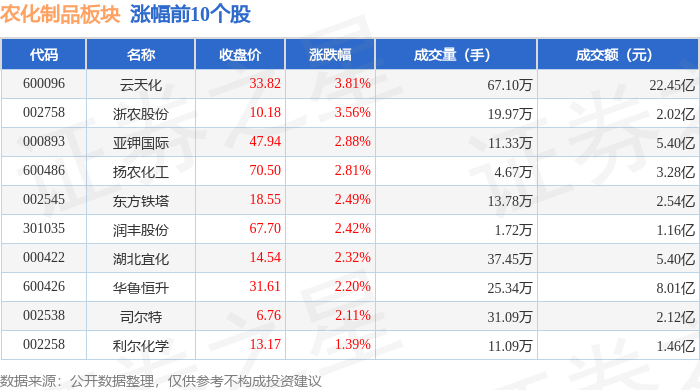
Group 1 - The agricultural chemical sector increased by 0.98% on December 30, with Yuntianhua leading the gains [1] - The Shanghai Composite Index closed at 3965.12, showing no change, while the Shenzhen Component Index rose by 0.49% to 13604.07 [1] - Key stocks in the agricultural chemical sector included Yuntianhua, which rose by 3.81% to a closing price of 33.82, and Zhejiang Yi, which increased by 3.56% to 10.18 [1] Group 2 - The agricultural chemical sector experienced a net outflow of 153 million yuan from institutional investors, while retail investors saw a net inflow of 244 million yuan [2] - Notable declines in the sector included Guoguang Co., which fell by 5.59% to 13.17, and Ying Tai Biological, which decreased by 1.77% to 3.88 [2] - The trading volume for the agricultural chemical sector was significant, with Yuntianhua recording a trading volume of 671,000 shares [1][2] Group 3 - Yuntianhua had a net inflow of 35.64 million yuan from institutional investors, while retail investors had a net outflow of 59.10 million yuan [3] - Other companies like Hongda Co. and Hubei Yihua also saw positive net inflows from institutional investors, indicating varied investor sentiment across the sector [3] - The overall market sentiment reflected a mixed performance, with some stocks gaining while others faced declines [2][3]

ETF盘中资讯|化工板块强势回归!石化、化肥股领涨,化工ETF(516020)上探1.63%!
Jin Rong Jie· 2025-12-30 03:56
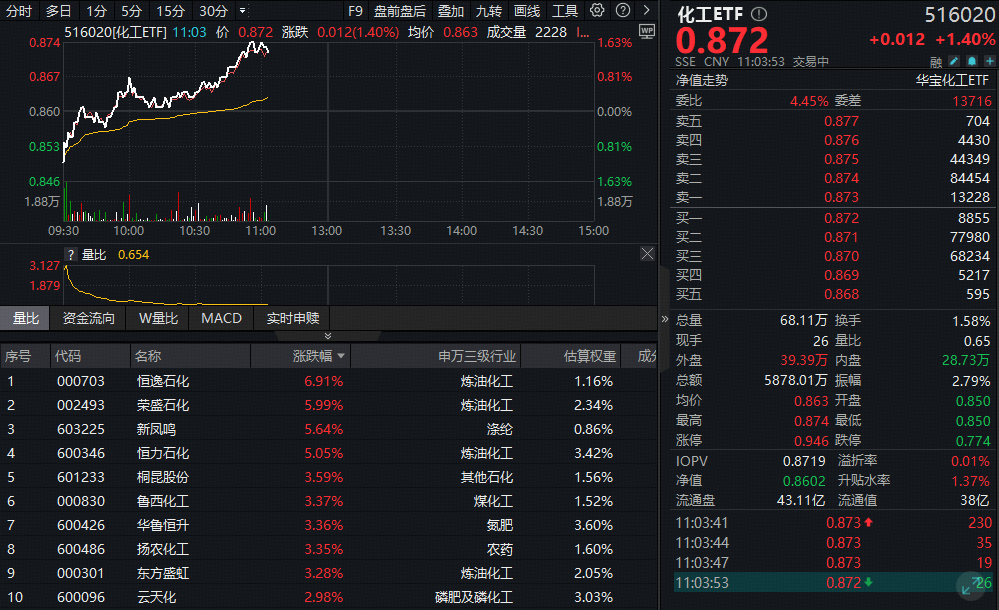
Group 1 - The chemical sector has regained momentum, with the chemical ETF (516020) experiencing a price increase of 1.4% after a low opening, reaching a maximum intraday gain of 1.63% [1] - Key stocks in the sector, including Hengyi Petrochemical, Rongsheng Petrochemical, and Xin Fengming, saw significant gains, with Hengyi Petrochemical rising over 6% and others increasing by more than 5% [1][2] - A recent conference on the high-quality development of the fertilizer industry highlighted the industry's transition towards quality and efficiency, aligning with the "14th Five-Year Plan" and the upcoming "15th Five-Year Plan" [1] Group 2 - According to Huaxin Securities, the chemical industry remains in a weak position overall, with mixed performance across sub-sectors due to past capacity expansions and weak demand, although some sectors like lubricants have exceeded expectations [3] - The chemical ETF (516020) is currently at a price-to-book ratio of 2.57, which is considered relatively reasonable based on historical data, suggesting potential for medium to long-term investment [3] - According to Everbright Securities, the basic chemical industry is expected to see strong demand from new materials, particularly in emerging applications like AI and OLED, which will drive growth in core materials such as photoresists [5] Group 3 - The chemical ETF (516020) tracks the CSI Sub-Industry Chemical Theme Index, covering various sub-sectors and concentrating nearly 50% of its holdings in large-cap leading stocks, which provides an opportunity to capitalize on strong market leaders [5] - The ETF also includes significant positions in sectors like phosphate and nitrogen fertilizers, as well as fluorine chemicals, allowing for a comprehensive approach to investment opportunities in the chemical sector [5]


云天化股价涨1.01%,中邮基金旗下1只基金重仓,持有2.41万股浮盈赚取7953元
Xin Lang Cai Jing· 2025-12-30 02:25
Group 1 - Yunnan Yuntianhua Co., Ltd. reported a stock price increase of 1.01% to 32.91 CNY per share, with a trading volume of 377 million CNY and a turnover rate of 0.64%, resulting in a total market capitalization of 59.995 billion CNY [1] - The company, established on July 2, 1997, and listed on July 9, 1997, is primarily engaged in the production of fertilizers, phosphate mining, and organic chemicals [1] - The revenue composition of the company's main business includes: phosphate fertilizer (27.99%), commodity grain (19.87%), compound (mixed) fertilizer (12.51%), urea (10.28%), trading fertilizers (10.03%), and other segments [1] Group 2 - Zhongyou Fund has a significant holding in Yuntianhua, with the Zhongyou CSI 500 Index Enhanced A Fund (590007) holding 24,100 shares, representing 1.5% of the fund's net value, ranking as the ninth largest holding [2] - The fund has achieved a year-to-date return of 27.42%, ranking 2024 out of 4195 in its category, and a one-year return of 25.77%, ranking 1934 out of 4179 [2] - The fund manager, Wang Gao, has been in position for 5 years and 177 days, with the fund's total asset size at 1.915 billion CNY and a best return of 62.09% during his tenure [3]
云天化:截至2025年12月19日公司股东人数为10.62万户
Zheng Quan Ri Bao Wang· 2025-12-29 13:13
证券日报网讯 12月29日,云天化(600096)在互动平台回答投资者提问时表示,截至2025年12月19 日,公司股东人数为10.62万户。 ...
氟化工概念下跌1.61%,10股主力资金净流出超亿元
Zheng Quan Shi Bao Wang· 2025-12-29 09:28
Group 1 - The fluorochemical sector experienced a decline of 1.61%, ranking among the top losers in concept sectors, with major declines seen in companies like Hongyuan Pharmaceutical, Duofluoride, and Shenzhen New Star [1] - The top gainers in the fluorochemical sector included Hainan Mining, Shangwei Co., and Ankao Intelligent Electric, with respective increases of 3.09%, 3.06%, and 1.36% [1] - The overall market saw significant net outflows from the fluorochemical sector, totaling 4.951 billion yuan, with 50 stocks experiencing net outflows, and 10 stocks seeing outflows exceeding 100 million yuan [1] Group 2 - Duofluoride led the net outflow with 1.114 billion yuan, followed by Tianji Co., Tianqi Materials, and Nanda Optoelectronics with outflows of 1.045 billion yuan, 565 million yuan, and 382 million yuan respectively [1] - The stocks with the highest net inflows included Yuntianhua, Huabang Health, and Zhongmi Holdings, with net inflows of 123 million yuan, 2.05 million yuan, and 800,900 yuan respectively [1] - The fluorochemical sector's outflow leaderboard featured Duofluoride with a decline of 8.06%, Tianji Co. with a slight increase of 0.40%, and Tianqi Materials with a decrease of 3.80% [2]


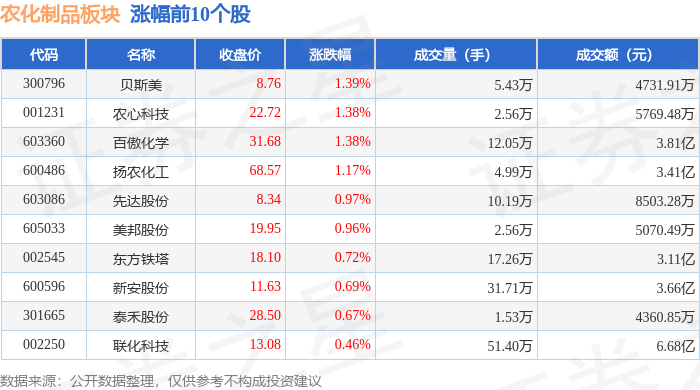
农化制品板块12月29日跌1.48%,润丰股份领跌,主力资金净流出6.37亿元
Zheng Xing Xing Ye Ri Bao· 2025-12-29 08:58
Market Overview - The agricultural chemical sector experienced a decline of 1.48% on December 29, with Runfeng Co., Ltd. leading the drop [1] - The Shanghai Composite Index closed at 3965.28, up 0.04%, while the Shenzhen Component Index closed at 13537.1, down 0.49% [1] Stock Performance - Notable gainers in the agricultural chemical sector included: - Beisimei (300796) with a closing price of 8.76, up 1.39% on a trading volume of 54,300 shares and a turnover of 47.32 million yuan [1] - Nongxin Technology (001231) at 22.72, up 1.38% with a trading volume of 25,600 shares and a turnover of 57.69 million yuan [1] - Baiao Chemical (603360) at 31.68, up 1.38% with a trading volume of 120,500 shares and a turnover of 381 million yuan [1] - Conversely, significant decliners included: - Runfeng Co., Ltd. (301035) at 66.10, down 5.58% with a trading volume of 34,100 shares and a turnover of 228 million yuan [2] - Yanhai Co., Ltd. (000792) at 27.69, down 4.48% with a trading volume of 1,063,600 shares and a turnover of 2.994 billion yuan [2] - Zhejiang Agricultural Co., Ltd. (002758) at 9.83, down 3.91% with a trading volume of 170,200 shares [2] Capital Flow - The agricultural chemical sector saw a net outflow of 637 million yuan from institutional investors, while retail investors contributed a net inflow of 407 million yuan [2] - Key stocks with notable capital flows included: - Yuntianhua (600096) with a net inflow of 12.8 million yuan from institutional investors [3] - Baiao Chemical (603360) with a net inflow of 18.96 million yuan from institutional investors [3] - Runfeng Co., Ltd. (301035) had a net outflow of 30.6 million yuan from institutional investors but a net inflow of 20.74 million yuan from retail investors [3]