YYTH(600096)

Search documents
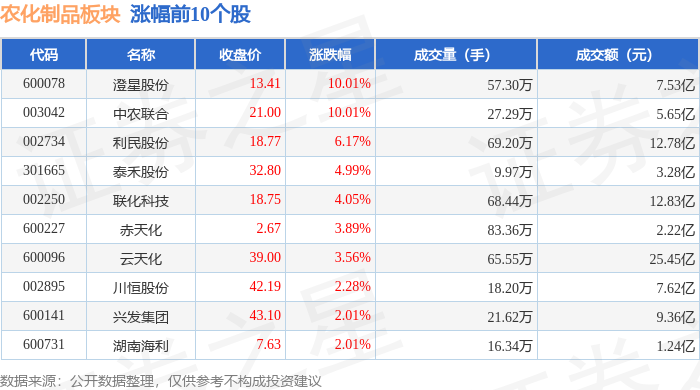
农化制品板块1月26日涨0.77%,澄星股份领涨,主力资金净流出4045.04万元
Zheng Xing Xing Ye Ri Bao· 2026-01-26 09:37
Group 1 - The agricultural chemical sector increased by 0.77% on January 26, with Chengxing Co., Ltd. leading the gains [1] - The Shanghai Composite Index closed at 4132.61, down 0.09%, while the Shenzhen Component Index closed at 14316.64, down 0.85% [1] - Notable gainers in the agricultural chemical sector included Chengxing Co., Ltd. and Zhongnong United, both rising by 10.01% [1] Group 2 - The agricultural chemical sector experienced a net outflow of 40.45 million yuan from institutional investors, while retail investors saw a net inflow of 172 million yuan [2] - The top individual stock performers in terms of net inflow included Yuntianhua with a net inflow of 150 million yuan [3] - The overall trading volume and turnover for the agricultural chemical sector were significant, with Chengxing Co., Ltd. achieving a turnover of 7.53 billion yuan [1][2]



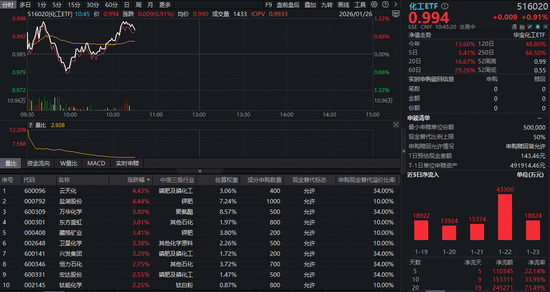
化工强势爆发!化工ETF(516020)上探1.32%,近20日吸金超24亿元!机构:继续看好大化工板块投资机会
Xin Lang Cai Jing· 2026-01-26 03:19
Group 1 - The chemical sector continues to strengthen, with the chemical ETF (516020) experiencing a maximum intraday increase of 1.32% and closing up 0.91% [1][7] - Key stocks in the sector include Yuntianhua and Salt Lake Co., both rising over 4%, while Wanhuacheng, Dongfang Shenghong, and Cangge Mining saw increases of over 3% [1][7] - Recent data indicates that the chemical ETF has attracted over 1.1 billion yuan in net subscriptions over the past five trading days and more than 2.4 billion yuan over the last twenty days [9] Group 2 - The chemical industry is currently at the bottom of a four-year down cycle, with indicators suggesting it has nearly bottomed out, and 2026 is expected to be a turning point for the cycle [3][9] - The China Chemical Product Price Index (CCPI) reported 3930 points on December 31, 2025, a 39% decline from the 2021 peak, indicating the industry is in a historical low range [3][9] - The basic chemical sector achieved a net profit of 112.7 billion yuan in the first three quarters of 2025, reflecting a year-on-year increase of 7.5%, indicating initial stabilization [3][9] Group 3 - In the context of improving fundamentals, the allocation ratio for the chemical sector has shown signs of recovery in Q4, with the expansion cycle nearing its end and profitability still at the bottom of the cycle [3][9] - The chemical ETF (516020) tracks the CSI sub-sector chemical industry theme index, covering popular themes such as AI computing power, anti-involution, robotics, and new energy [3][10] - Investors can also consider the chemical ETF linked funds (Class A 012537/Class C 012538) for exposure to the chemical sector [10]





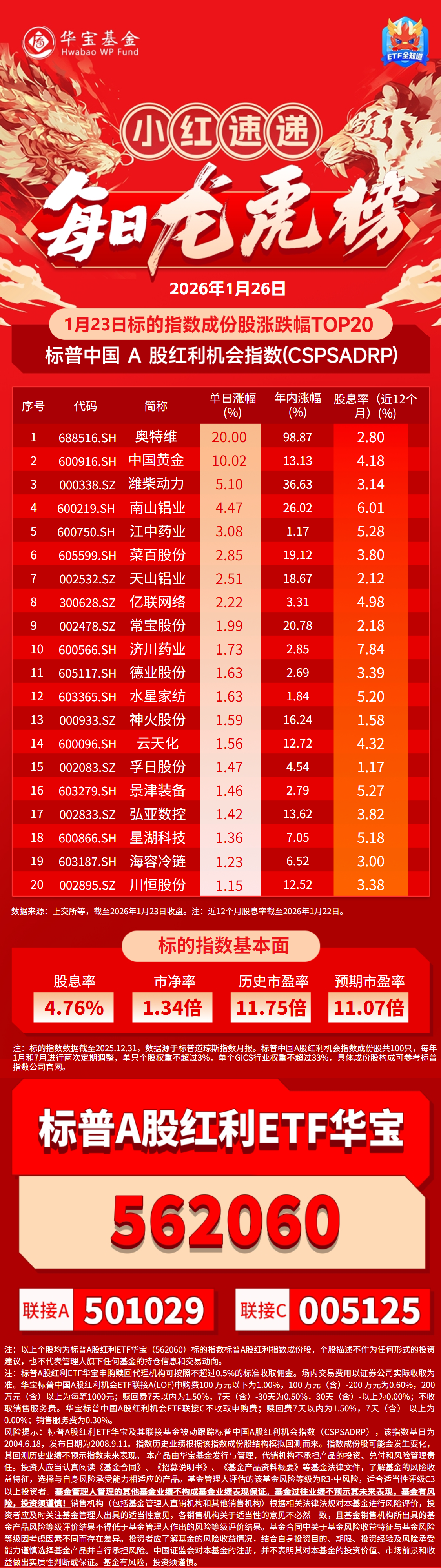
小红日报 | 奥特维20cm涨停!标普A股红利ETF华宝(562060)标的指数收涨0.74%续创新高
Xin Lang Cai Jing· 2026-01-26 01:12
Group 1 - The article highlights the top 20 stocks in the S&P China A-Share Dividend Opportunities Index (CSPSADRP) as of January 23, 2026, showcasing significant price increases and dividend yields [1][11]. - The stock with the highest daily increase is Aotaiwei (688516.CH) at 20.00%, with a year-to-date increase of 98.87% and a dividend yield of 2.80% [1][11]. - Other notable stocks include China Gold (600916.SH) with a daily increase of 10.02% and a year-to-date increase of 13.13%, and Weichai Power (000338.SZ) with a year-to-date increase of 36.63% [1][11]. Group 2 - The fundamental metrics of the index include a historical price-to-earnings ratio of 11.07 times, a price-to-book ratio of 1.34 times, and an expected dividend yield of 4.76% [3][12]. - The index consists of 1009 constituent stocks, with adjustments made biannually in January and July, ensuring no single stock exceeds 3% weight and no GICS sector exceeds 33% weight [4][13].



基础化工行业周报:金浦钛业子公司徐州钛白停产,汇得科技聚氨酯项目开工-20260125
Huafu Securities· 2026-01-25 07:45
Investment Rating - The report maintains a strong rating for the chemical industry, indicating a positive outlook for the sector [5]. Core Insights - The chemical sector has shown resilience with the CITIC Basic Chemical Index rising by 5.73% and the Shenwan Chemical Index increasing by 7.29% this week [13][16]. - Key sub-industries such as soda ash, chlor-alkali, and dyeing chemicals have experienced significant price increases, with soda ash rising by 13.3% [16]. - The report highlights the competitive strength of domestic tire manufacturers and suggests focusing on companies like Sailun Tire and Linglong Tire as potential growth opportunities [4]. - The polyurethane project by Huide Technology, with an annual production capacity of 600,000 tons, has commenced, indicating strategic growth in the new materials sector [3]. - The report emphasizes the tightening supply-demand dynamics in the phosphate chemical sector due to environmental regulations and increasing demand from the new energy sector [4]. Summary by Sections Market Overview - The Shanghai Composite Index increased by 0.84%, while the ChiNext Index decreased by 0.34% [13]. - The overall performance of the chemical sector is positive, with notable gains in various sub-industries [16]. Key Sub-Industry Developments - **Polyurethane**: The price of pure MDI in East China is reported at 17,600 RMB/ton, showing a week-on-week decline of 1.12% [28]. - **Tires**: The operating load for all-steel tires in Shandong is at 62.70%, reflecting a year-on-year increase of 20.70% [49]. - **Fertilizers**: Urea prices are at 1,757.45 RMB/ton, with a week-on-week decrease of 0.4% [63]. - **Vitamins**: The price of Vitamin A is reported at 61.5 RMB/kg, down 1.6% week-on-week [79]. Investment Themes - **Tire Sector**: Domestic tire companies are positioned strongly, with a focus on growth stocks [4]. - **Consumer Electronics**: Recovery in demand is anticipated, benefiting upstream material companies [4]. - **Phosphate Chemicals**: Supply constraints due to environmental policies are expected to tighten the market [4]. - **Vitamin Supply**: Supply disruptions in Vitamin A and E are noted, creating potential investment opportunities [4].





持续看好PVC等高能耗产品价值重估
Orient Securities· 2026-01-24 13:14
Investment Rating - The industry investment rating is maintained as "Positive" [5] Core Viewpoints - The PVC industry is expected to undergo continuous revaluation due to its high energy consumption and carbon emissions, particularly as China approaches its carbon peak during the 14th Five-Year Plan. The supply side may face strict controls, leading to potential reductions in production quotas. The demand for PVC in developing regions such as Africa and Latin America is anticipated to drive growth, despite the challenges posed by domestic production constraints [2][7] - The petrochemical industry is experiencing an upward trend in profitability, driven by significant price increases in key products such as butadiene rubber, PX, PTA, styrene, and ethylene glycol. The market's expectations for improved demand in 2026 are contributing to this positive outlook, with potential adjustments in operational strategies by leading companies likely to reshape supply and demand dynamics [7] Summary by Relevant Sections Investment Suggestions and Targets - The report recommends several companies across various sub-sectors, including: - MDI leader: Wanhua Chemical (600309, Buy) - PVC-related companies: Zhongtai Chemical (002092, Not Rated), Xinjiang Tianye (600075, Not Rated), Chlor-alkali Chemical (600618, Not Rated), Tianyuan Co., Ltd. (002386, Not Rated) - Refining sector leaders: Sinopec (600028, Buy), Rongsheng Petrochemical (002493, Buy), Hengli Petrochemical (600346, Buy) - Phosphate chemical companies benefiting from energy storage growth: Chuanheng Co., Ltd. (002895, Not Rated), Yuntianhua (600096, Not Rated) - Oxalic acid sector: Hualu Hengsheng (600426, Buy), Huayi Group (600623, Buy), Wankai New Materials (301216, Buy) [3]


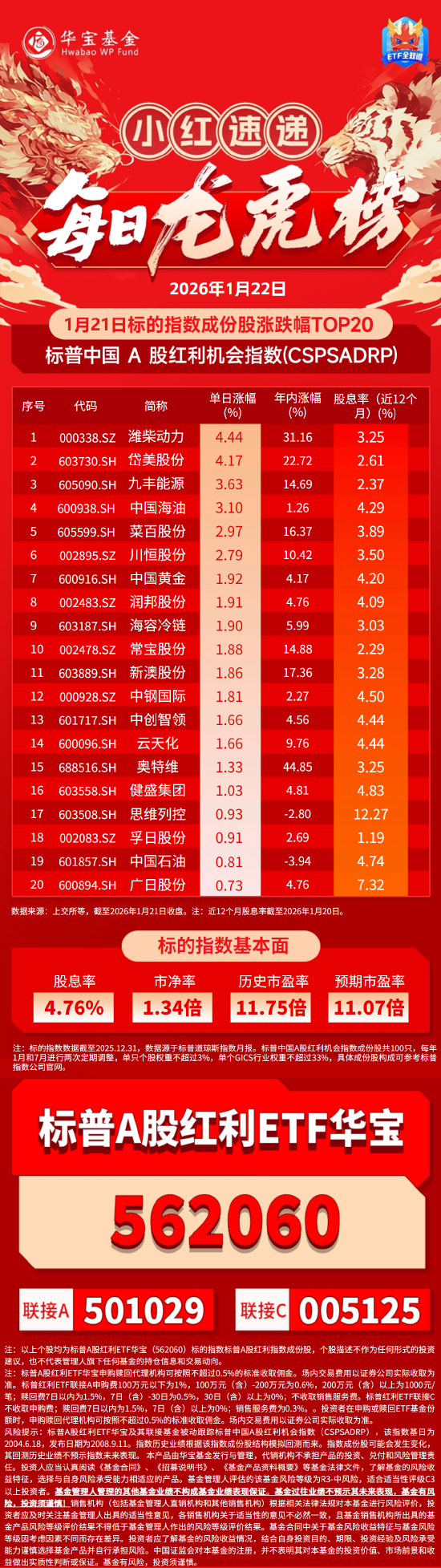
小红日报 | 标普A股红利ETF华宝(562060)标的指数小幅回调,资金持续布局红利资产
Xin Lang Cai Jing· 2026-01-22 01:18
Group 1 - The article highlights the top 20 stocks in the S&P China A-Share Dividend Opportunity Index (CSPSADRP) based on their daily and year-to-date performance as of January 21, 2026 [1][5] - Weichai Power (000338.SZ) leads with a daily increase of 4.44% and a year-to-date increase of 31.16%, with a dividend yield of 3.25% [1][5] - Other notable performers include Daimei Co. (603730.SH) with a daily increase of 4.17% and a year-to-date increase of 22.72%, and Jiufeng Energy (605090.SH) with a daily increase of 3.63% and a year-to-date increase of 14.69% [1][5] Group 2 - The overall dividend yield for the index is reported at 4.76%, with a price-to-book ratio of 1.34 times and a historical price-to-earnings ratio of 11.75 times, while the expected price-to-earnings ratio is 11.07 times [2] - The data is sourced from the Shanghai Stock Exchange and reflects the closing prices as of January 21, 2026, with the dividend yield calculated up to January 20, 2026 [2]



化工大涨,下一个有色出现了?
3 6 Ke· 2026-01-21 02:58
Group 1 - The core viewpoint of the article is that the chemical industry is experiencing a cyclical recovery driven by new demand, with the sustainability of this cycle being a key question for market participants [1][12] - The chemical price index (CCPI) has dropped nearly 40% from its peak in 2021, currently sitting at a historical percentile of just over 20% [1] - The profit margin for the chemical raw materials and products industry is projected to be just over 4% in the first three quarters of 2025, indicating that the industry is still near the bottom of its profit cycle [1] Group 2 - The first signal of recovery is seen in specific products like potassium chloride and lithium carbonate, with companies like Salt Lake Potash showing significant profit increases despite overall declines in production and sales [3][4] - The second signal comes from a contraction in corporate investment behavior, with capital expenditures for petrochemical companies declining by 18.3% and 10.1% in 2024 and the first three quarters of 2025, respectively [5] - The third signal is the shift in market expectations, with the scale of chemical ETFs increasing from 2.5 billion to 25.7 billion, indicating a recovery in investor sentiment [6] Group 3 - The article discusses the global shift in chemical production from high-cost regions like Europe and Japan to lower-cost regions like China, which is filling the gap left by closures in Europe [8][9] - The domestic market is also undergoing a transition from "involution" to "anti-involution," with regulatory measures aimed at reducing low-price competition and promoting quality improvements [10] - Specific examples of product price recovery include organic silicon and polyurethane, where leading companies are collaborating to stabilize prices [11] Group 4 - New demand drivers include the second wave of growth in the renewable energy sector, with significant increases in battery production expected, which will impact the lifecycle of traditional chemical products [12][13] - Innovations driven by AI, semiconductors, and robotics are creating new material demands, with companies transitioning to higher-value products in electronic chemicals and lubricants [14] - The negative impact of old demand is diminishing, leading to a more stable recovery in the chemical sector, characterized by a "slow bull" market rather than rapid fluctuations [15]


黄磷供需向好且或受益于硫磺高价
HTSC· 2026-01-21 02:50
Investment Rating - The industry investment rating is maintained as "Overweight" [2] Core Viewpoints - The demand for yellow phosphorus is expected to improve due to growth in downstream phosphoric acid and terminal materials for new energy, electronic-grade phosphoric acid, and fine phosphates. The high prices of sulfur and sulfuric acid are enhancing the cost competitiveness of thermal phosphoric acid over wet phosphoric acid, which may further boost the demand for thermal process phosphoric acid and yellow phosphorus [5][6] - The supply of yellow phosphorus is strictly controlled in China due to high energy consumption and environmental safety concerns, with only limited new capacity being added through capacity replacement. The dual carbon policy may lead to the elimination of high-energy-consuming existing capacity, which is expected to optimize the supply side [6][7] - The average operating rate of the domestic yellow phosphorus industry is projected to reach approximately 63% in 2025, the highest level since 2017, driven by favorable supply and demand dynamics. The price of yellow phosphorus is showing an upward trend, with a reference price of around 23,000 yuan per ton as of January 19, 2025, reflecting a 2.4% increase from the end of 2025 [7][5] Summary by Sections Demand and Supply Dynamics - The demand for yellow phosphorus is projected to grow by 26% year-on-year in 2024, reaching 850,000 tons, while phosphoric acid consumption is expected to increase by 19% to 2.96 million tons. The five-year CAGR for yellow phosphorus and phosphoric acid is estimated at 5% and 12%, respectively [5][6] - The high prices of sulfur and sulfuric acid, which have reached nearly a decade high, are expected to drive the demand for thermal phosphoric acid and yellow phosphorus. The cost advantage of thermal phosphoric acid over wet phosphoric acid is becoming more pronounced, especially considering the offset from by-products [5][6] Supply Constraints - The domestic yellow phosphorus capacity has decreased from 1.9 million tons in 2013 to 1.41 million tons in 2020, with a slight recovery to 1.58 million tons by the end of 2025, primarily due to capacity replacement. Only ten companies have a capacity of 50,000 tons or more, indicating a highly concentrated industry [6][39] - The dual carbon policy is expected to continue limiting new supply, with high-energy-consuming and inefficient capacities facing elimination pressure [6][7] Price Trends and Market Outlook - The average operating rate for yellow phosphorus is expected to improve, with a projected increase in monthly operating rates throughout 2025. The price of yellow phosphorus is anticipated to be supported by potential supply disruptions and increasing demand from new energy and electronic chemical sectors [7][5] - Companies with integrated operations in the yellow phosphorus value chain, including mining, yellow phosphorus production, and phosphoric acid, are expected to benefit significantly from the favorable market conditions [5][7]

东方证券:聚焦化工行业景气修复 主要看好MDI、石化、磷化工、PVC和聚酯瓶片
Zhi Tong Cai Jing· 2026-01-21 01:49
Core Viewpoint - The chemical industry is experiencing a collective shift in business strategies driven by multiple factors, leading to a recovery in industry prosperity [1] Group 1: Industry Trends - The long-standing focus on market share in China's chemical industry is being transformed, with companies now facing increased barriers to entry due to supply-side reforms, environmental checks, and dual carbon goals [1] - Internal policy adjustments and external anti-dumping investigations are signaling a necessary change in the expectations surrounding market share [2] Group 2: Business Strategy Shifts - Companies are moving towards sacrificing existing market share to enhance short-term return rates, as merely halting expansion is no longer sufficient to address inventory and excess capacity [2] - The change in business strategies is primarily driven by shifts in the mindset of entrepreneurs and management, marking a significant departure from previous industry recovery patterns [2] Group 3: Selection Criteria for Investment - The preferred selection criteria for the industry include the strength of expansion constraints and the depth of leading companies' advantages, with stronger constraints leading to lower expectations for market share-driven growth [3] - The depth of leading companies' advantages not only constrains industry expansion but also determines the potential recovery in industry return rates [3] Group 4: Investment Recommendations - Recommended investment opportunities include: - MDI: Wanhua Chemical (600309) - Petrochemicals: Sinopec (600028), Rongsheng Petrochemical (002493), Hengli Petrochemical (600346) - Phosphate Chemicals: Chuanheng Shares (002895), Yuntianhua (600096), Xingfa Group (600141) - PVC: Zhongtai Chemical (002092), Xinjiang Tianye (600075), Chlor-alkali Chemical (600618), Tianyuan Shares (002386) - Polyester Bottle Chips: Wankai New Materials (301216) [4]




国际油价小幅上涨,丁二烯、环氧丙烷价格上涨
Zhong Guo Neng Yuan Wang· 2026-01-19 06:53
Core Viewpoint - The report highlights the current trends in the chemical industry, focusing on price movements, supply and demand dynamics, and investment opportunities in undervalued leading companies amid a backdrop of geopolitical tensions and changing market conditions [1][4][8]. Industry Dynamics - In the week of January 12-18, 49 out of 100 tracked chemical products saw price increases, while 20 experienced declines, and 31 remained stable. The average monthly price of 49% of products rose compared to the previous month [3]. - The average price of WTI crude oil futures increased by 0.54% to $59.44 per barrel, while Brent crude oil futures rose by 0.66% to $63.76 per barrel during the same week [4]. - As of January 9, U.S. crude oil production averaged 13.753 million barrels per day, a decrease of 58,000 barrels from the previous week but an increase of 272,000 barrels year-on-year. Total U.S. oil demand was 21.009 million barrels per day, up by 178,200 barrels from the previous week [4]. Price Movements - The price of butadiene rose by 4.04% to 9,663 yuan per ton as of January 18, with a month-on-month increase of 25.98% but a year-on-year decrease of 20.8%. The production of butadiene was 109,300 tons, down 2.85% from the previous week [5]. - Epoxy propane prices increased by 8.84% to 8,620 yuan per ton, with a year-on-year rise of 9.88%. The market operating rate was 65.38%, reflecting a 1.51% increase from the previous week [6][7]. Investment Recommendations - As of January 18, the price-to-earnings ratio (TTM) for the SW basic chemical sector is 14.68, at the 59.64% historical percentile, while the price-to-book ratio is 1.54, at the 40.20% historical percentile. The SW oil and petrochemical sector has a TTM P/E ratio of 13.44, at the 39.81% historical percentile [8]. - Investment suggestions include focusing on undervalued leading companies, the impact of "anti-involution" on supply in related sub-industries, and the growing importance of self-sufficiency in electronic materials and certain new energy materials amid rising prices [2][8]. - Recommended stocks include Wanhua Chemical, Hualu Hengsheng, and others, with a focus on sectors like semiconductor materials, OLED materials, and new energy materials [8][9].