
CNRE(600111)

Search documents
全球制造的隐形命脉:关键矿产谁主沉浮?
QYResearch· 2026-02-14 00:48
Group 1 - Critical minerals are essential for new energy, high-end manufacturing, and strategic industries, including lithium, cobalt, nickel, tungsten, and rare earth elements [1] - The global critical minerals market is projected to reach approximately $142 billion by 2025 and $213 billion by 2030, with a CAGR of about 8.5% from 2025 to 2030 [3] - Lithium, cobalt, and nickel account for 55% of the market, driven mainly by the demand from electric vehicle batteries and energy storage [3] Group 2 - China is the most complete supply chain country for critical minerals, with lithium production expected to reach 280,000 tons (lithium carbonate equivalent) by 2025, accounting for about 50% of global production [4] - The demand for critical minerals in downstream applications such as new energy vehicles, energy storage, and smart manufacturing is increasing, leading to higher material content per vehicle or component [4][6] - The global sales of new energy vehicles are expected to reach approximately 22 million units by 2025, with energy storage systems projected to have an installed capacity of 200 GWh [6] Group 3 - The critical minerals industry chain consists of three core segments: upstream (mining and initial beneficiation), midstream (refining and alloying), and downstream (applications) [5] - China holds about 35-50% of global critical mineral reserves and 85-90% of rare earth separation capacity, making it a key processing center [5] - The refining cost of high-nickel battery materials accounts for about 15-20% of the total cost of electric vehicle batteries [5] Group 4 - Major companies in the critical minerals sector include China Northern Rare Earth Group, Rongjie Resources, Tianqi Lithium, and others, with projected revenues for 2025 ranging from approximately 45-48 billion RMB for China Northern Rare Earth Group to 2-3 billion USD for MP Materials [7] - Global efforts are underway to localize critical mineral supply chains, with initiatives from the US, EU, and India to enhance midstream refining and downstream processing capabilities [7] Group 5 - Future industry trends include breakthroughs in high-purity material technology, scaling up critical mineral recycling, and increasing the value of mid-heavy rare earths and high-nickel materials [8] - The strategic importance of critical minerals in high-end manufacturing and new energy industries positions supply chain leaders for competitive advantages in the global market [9] - Companies should focus on enhancing midstream refining technology, developing high-value downstream applications, and exploring recycling and value extraction of mid-heavy minerals for sustainable supply chains [9]




有色矿业ETF招商(159690)开盘跌2.35%,重仓股紫金矿业跌3.75%,洛阳钼业跌2.85%
Xin Lang Cai Jing· 2026-02-13 06:46
Group 1 - The core viewpoint of the article highlights a decline in the performance of the non-ferrous metal mining ETF, with a 2.35% drop in opening price to 2.281 yuan on February 13 [1] - Major holdings within the non-ferrous mining ETF experienced significant declines, including Zijin Mining down 3.75%, Luoyang Molybdenum down 2.85%, and Huayou Cobalt down 3.42% [1] - The ETF's performance benchmark is the CSI Non-ferrous Metals Mining Theme Index, managed by China Merchants Fund Management Co., with a return of 133.39% since its establishment on June 21, 2023, and a 7.86% return over the past month [1]


有色ETF泰康(159163)开盘跌0.88%,重仓股紫金矿业跌3.75%,洛阳钼业跌2.85%
Xin Lang Cai Jing· 2026-02-13 05:38
Group 1 - The core viewpoint of the article highlights the performance of the Nonferrous ETF Taikang (159163), which opened down by 0.88% at 0.900 yuan [1] - Major holdings in the Nonferrous ETF Taikang experienced significant declines, including Zijin Mining down 3.75%, Luoyang Molybdenum down 2.85%, and Northern Rare Earth down 0.70% [1] - The performance benchmark for the Nonferrous ETF Taikang is the CSI Nonferrous Metals Mining Theme Index return, with a return of -9.32% since its establishment on January 27, 2026 [1]
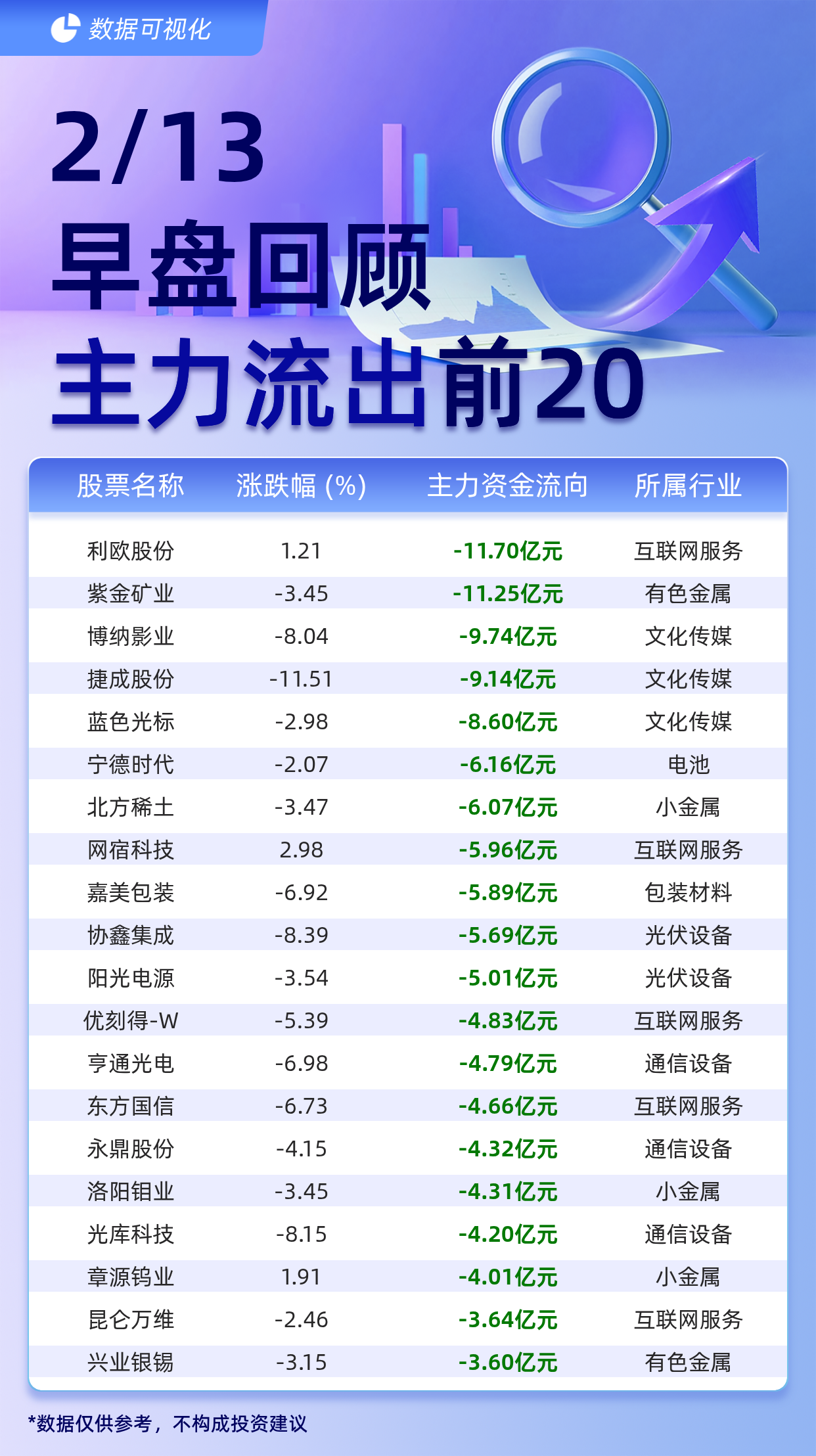
主力个股资金流出前20:利欧股份流出11.70亿元、紫金矿业流出11.25亿元
Jin Rong Jie· 2026-02-13 03:45
Core Viewpoint - The data indicates significant outflows of main funds from various stocks, highlighting potential investment risks in the affected sectors. Group 1: Stock Outflows - The top stock with the largest outflow is Liou Co., with a fund outflow of 1.17 billion [1] - Zijin Mining follows closely with an outflow of 1.125 billion [1] - Bona Film Group experienced an outflow of 974 million [1] - Jiecheng Co. had a fund outflow of 914 million [1] - BlueFocus Media saw an outflow of 860 million [1] Group 2: Sector Analysis - The internet services sector, represented by Liou Co. and Wangsu Science & Technology, shows notable outflows of 1.17 billion and 596 million respectively [1][2] - The cultural media sector, including Bona Film Group and Jiecheng Co., experienced significant outflows totaling 1.888 billion [1][2] - The battery sector, represented by Ningde Times, had an outflow of 616 million, indicating potential concerns in this industry [1][2] - The photovoltaic equipment sector, with companies like Xiexin Integration and Sunshine Power, also faced outflows of 569 million and 501 million respectively [1][2] Group 3: Performance Metrics - Liou Co. had a slight increase in stock price by 1.21% despite the outflow [2] - In contrast, Jiecheng Co. experienced a significant decline of 11.51% alongside its outflow [2] - The overall trend shows that many companies with high outflows also faced negative stock performance, indicating a correlation between fund outflows and stock price declines [2][3]


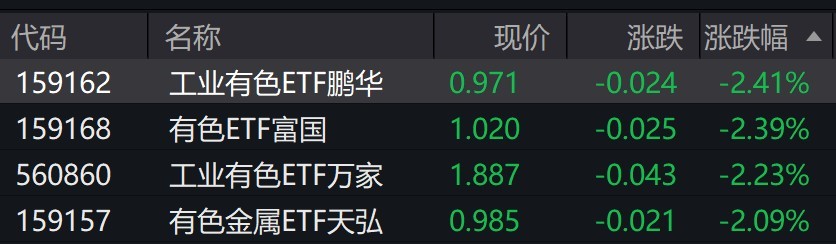
有色概念股走低,工业有色相关ETF跌超2%
Mei Ri Jing Ji Xin Wen· 2026-02-13 03:17
Group 1 - The core viewpoint of the articles indicates a decline in non-ferrous metal stocks, with significant drops in companies such as Xiyeg股份 (over 4%), Northern Rare Earth, and Xiamen Tungsten (over 3%) [1] - Industrial non-ferrous related ETFs have also experienced a decline, with an overall drop exceeding 2% [1] - Despite short-term market fluctuations, brokerages suggest that the long-term outlook for cyclical resource sectors, including industrial non-ferrous metals, remains promising due to industrial structural optimization and sustained demand growth [2] Group 2 - Performance trend models indicate that the current valuation of the industrial non-ferrous sector is reasonable, with potential for a rebound in the future [2] - Investors are advised to focus on the potential performance of these sectors within the supply chain and to seize investment opportunities arising from significant price declines [2]



稀土指数盘初下跌2%,主要成分股普遍走低
Mei Ri Jing Ji Xin Wen· 2026-02-13 01:53
Group 1 - The rare earth index experienced a decline of 2% at the beginning of trading on February 13, indicating a downward trend in the market [1] - Major component stocks such as Northern Rare Earth, Xiamen Tungsten, Shenghe Resources, China Rare Earth, and China Nonferrous Metals saw significant declines, with some of the largest drops in their stock prices [1]


稀土价格指数年内涨超30% 供需共振推动“工业黄金”涨价
Zheng Quan Ri Bao Wang· 2026-02-12 13:12
2026年开年以来,被誉为"工业黄金"的稀土价格强势上涨。根据中国稀土(000831)行业协会2月12日 发布的最新数据,当日稀土价格指数为290,较2025年12月31日的217,上涨33.64%。 稀土价格上涨是供需共振的结果。上海钢联(300226)电子商务股份有限公司(以下简称"上海钢联") 稀贵金属资讯部稀土分析师李聪明在接受《证券日报》记者采访时表示:"近期稀土市场呈现低库存、 强预期状态,在现货流通较为紧张的环境下,部分企业因库存仅够维持短期生产导致预防性备货行为增 多,加剧阶段性供应短缺。同时,部分场外观望资金入场,推动价格加速上行。" 延续去年价格上涨趋势 从细分品种来看,数据显示,2月12日,氧化镨最高价报89万元/吨,较2025年12月31日上涨43.55%;氧 化钕最高价报88万元/吨,较2025年12月31日上涨41.94%;金属钕最高价报106万元/吨,较2025年12月 31日上涨39.47%。 时间拉长来看,稀土价格指数延续了2025年的上行趋势。中国稀土行业协会发布的数据显示,稀土价格 指数从2024年12月31日的164到2025年12月31日的217,涨幅为32.32%。 ...
北方稀土:航天领域对轻、重稀土均有广泛应用
Zheng Quan Ri Bao· 2026-02-12 12:36
Group 1 - The core viewpoint is that rare earth products have significant applications in the aerospace sector, providing essential material support for aerospace engineering technology [2] - Rare earth elements are utilized in both light and heavy applications within the aerospace field due to their excellent properties such as optical, electrical, magnetic, and heat-resistant characteristics [2]
北方稀土:稀土产品价格波动主要受市场供需关系影响
Zheng Quan Ri Bao· 2026-02-12 12:16
Group 1 - The core viewpoint of the article highlights that Northern Rare Earth has established agreements with downstream companies for pricing, with the longest cycle being monthly and the shortest daily [2] - The price fluctuations of rare earth products are primarily influenced by market supply and demand dynamics, as well as market expectations [2] - The demand for rare earth products, particularly those related to magnetic materials, is expected to maintain a growth trend due to the development of downstream industries such as new energy, wind power, and low-altitude economy [2]
北方稀土:稀土产品长协销售一般采用月度定价方式
Zheng Quan Ri Bao Zhi Sheng· 2026-02-12 10:41
Group 1 - The core viewpoint of the article indicates that Northern Rare Earth expects significant price increases for certain rare earth products in 2025, with the price trends in 2026 being influenced by supply and demand dynamics, industry policies, and import-export conditions [1] - The company states that its rare earth products are generally sold under long-term contracts with monthly pricing mechanisms [1] - The outlook for the rare earth industry remains optimistic, with expected growth in the main downstream application areas through 2026 [1]