
JCET(600584)

Search documents
行业投资策略:AI算力自主可控的全景蓝图与投资机遇
KAIYUAN SECURITIES· 2026-01-08 14:22
Group 1 - The semiconductor industry is expected to experience significant growth, with the domestic semiconductor index outperforming the CSI 300 index, showing a cumulative increase of 54.51% as of October 28, 2025, driven by factors such as national subsidies, AI computing demand, and domestic substitution [16][21]. - The AI chip market in China is projected to grow from 142.54 billion yuan in 2024 to 1,336.79 billion yuan by 2029, with a compound annual growth rate (CAGR) of 53.7% from 2025 to 2029, indicating a critical development opportunity for domestic AI chip manufacturers [42][44]. - The global GPU market is expected to grow from $77.39 billion in 2024 to $472.45 billion by 2030, with a CAGR of 35.19%, reflecting strong demand for AI computing [37][40]. Group 2 - The domestic AI chip industry is categorized into three stages: the first stage focuses on the self-sufficiency of computing, storage, and power chips; the second stage emphasizes the self-sufficiency of chip manufacturing processes; and the third stage targets the self-sufficiency of foundational hard technologies such as equipment materials and EDA [5][6]. - The demand for AI computing chips is driven by the rapid growth of generative AI applications, with NVIDIA's data center revenue increasing by 69% year-on-year to $44.1 billion in the first quarter of fiscal 2026, highlighting the accelerating demand for AI computing power [37][44]. - The semiconductor equipment sector is experiencing a significant increase in domestic production capacity, with the domestic semiconductor equipment localization rate expected to rise rapidly, particularly in dry etching and thin film deposition processes [6][15]. Group 3 - The report indicates that the advanced packaging technology, such as CoWoS, is expected to play a crucial role in the evolution of AI computing power, with domestic companies making significant advancements in this area [7][11]. - The semiconductor industry is witnessing a recovery in profitability, with the average gross margin and net profit margin for the semiconductor sector showing improvements in the first half of 2025 [36][34]. - The report highlights the importance of advanced wafer manufacturing as the physical foundation for AI chips, with a long-term demand for advanced foundry services expected to drive growth in this segment [7][11].


芯片人的2025,都好起来了吗?
芯世相· 2026-01-08 04:23
Core Viewpoint - The chip industry in 2025 is experiencing significant fluctuations due to tariff events and supply shortages, leading to price surges and market speculation, with mixed sentiments regarding overall demand growth [3][4]. Original Manufacturers - Domestic analog manufacturers report a 20% decline in consumer segment revenue for 2025 compared to 2024, while industrial segment revenue is expected to double, returning to levels seen in 2020-2022, with a projected 30% growth in 2026 [3][4]. - Overseas chip manufacturers anticipate stable revenue in 2025 compared to 2024, with new opportunities arising in the automotive sector [5]. Distributors - Chip distributors indicate an increase in customer volume and product lines in 2025, but face declining profit margins and extended payment terms, with overall risks increasing [7]. - A distributor focusing on trade reports a stable performance in 2025, with opportunities arising from the storage sector and a cautious outlook for 2026 due to high risks associated with new products [8][15]. Trade - Chip traders report a 50% increase in business in 2025 compared to 2024, driven by demand for ADI and storage products, with a positive outlook for 2026 [18]. - Another trader notes that demand for storage products has improved significantly since March 2025, with expectations of a favorable market in 2026 due to AI server demand and rising raw material costs [19]. Foreign Trade - Foreign trade companies indicate improved performance in 2025, primarily due to business from the Anshi brand, with strong demand from Europe and the US [21][22]. Solution Providers - Chip solution providers report growth in 2025, particularly in the second half of the year, but express concerns about market competition and uncertainty in product development cycles [24][25]. Major Companies Dynamics - TSMC reported a revenue of NT$343.6 billion in November 2025, with a year-on-year increase of 24.5%, and revised its revenue growth forecast for 2025 to mid-thirty percent [28]. - SMIC achieved a revenue of $2.382 billion in Q3 2025, with a year-on-year growth of 17.4%, and plans to raise prices for certain processes by 10% [29]. - Hua Hong Semiconductor reported a revenue of $6.352 billion in Q3 2025, with a utilization rate exceeding 100% for seven consecutive quarters [30]. - Longsys Technology achieved a revenue of NT$100.6 billion in Q3 2025, marking a historical high and a year-on-year increase of 14.8% [31]. - Foxconn reported a 22.07% year-on-year revenue growth in Q4 2025, driven by strong performance in AI-related infrastructure [32]. - Winbond's revenue reached NT$107.93 billion in the first 11 months of 2025, a year-on-year increase of 24.98%, attributed to strong demand in automotive and communication components [34].




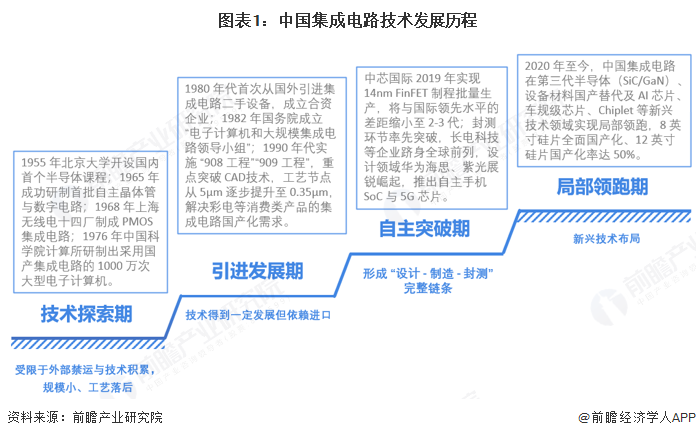
2025年中国集成电路行业技术发展分析 高端国产化率仍然较低【组图】
Qian Zhan Wang· 2026-01-07 06:11
Core Insights - The Chinese integrated circuit industry has evolved from a technology exploration phase to a stage of partial leadership in emerging fields such as third-generation semiconductors and AI chips [1] Group 1: Industry Overview - Major listed companies in the Chinese integrated circuit industry include companies like Chipone (688521.SH), Cambricon (688256.SH), and SMIC (688981.SH/00981.HK) [1] - The development of integrated circuit technology in China has gone through three main phases: foundational exploration (1950s-1978), technology introduction (1978-2000), and independent breakthroughs (2000-2020) [1] Group 2: Core Production Technologies - The integrated circuit technology system focuses on three core areas: design, manufacturing, and packaging/testing [4] - Key design aspects include EDA tools, chip architecture (RISC-V/ARM), and semiconductor IP [4] - Manufacturing focuses on wafer processes (including EUV lithography) and advanced process nodes (such as 7nm and 5nm) [4] - Packaging/testing emphasizes advanced techniques like Chiplet and 3D stacking [4] Group 3: Current Production Status - Chinese companies lead in production volume but lack sufficient autonomy in technology [7] - The design sector has achieved some autonomy in mature process tools and IP, but high-end EDA and core IP still rely on imports [7] - Manufacturing has sufficient capacity for mature processes but faces limitations in advanced processes due to equipment restrictions [7] - The packaging/testing sector is a strength, with leading companies holding significant global market shares [7] Group 4: Market Segmentation - The low-end market (45nm and above) has a self-sufficiency rate exceeding 75%, with companies like Hua Hong Semiconductor leading [10] - The mid-range market (14-28nm) has a domestic production rate of about 35%, with breakthroughs in memory chips [10] - The high-end market (7nm and below) has a self-sufficiency rate of less than 20%, heavily relying on overseas foundries [10] Group 5: Challenges and Future Outlook - The Chinese integrated circuit industry faces challenges such as low domestic production of high-end technologies, risks to industrial security, and the need for improved product quality [13] - Future strategies include focusing on technological breakthroughs, collaborative ecosystem development, and enhancing talent cultivation to support high-quality industry growth [13]



长电科技涨2.06%,成交额9.34亿元,主力资金净流入2068.20万元
Xin Lang Cai Jing· 2026-01-07 02:15
Core Viewpoint - Longji Technology's stock price has shown a positive trend recently, with a year-to-date increase of 6.66% and a 7.13% rise over the past five trading days, indicating strong market interest and potential growth in the semiconductor industry [1]. Financial Performance - For the period from January to September 2025, Longji Technology achieved a revenue of 28.669 billion yuan, representing a year-on-year growth of 14.78%. However, the net profit attributable to shareholders decreased by 11.39% to 0.954 billion yuan [2]. - Cumulatively, since its A-share listing, Longji Technology has distributed a total of 1.533 billion yuan in dividends, with 0.805 billion yuan distributed over the past three years [3]. Shareholder Structure - As of September 30, 2025, the number of shareholders for Longji Technology reached 376,300, an increase of 17.94% from the previous period. The average number of circulating shares per shareholder decreased by 15.21% to 4,755 shares [2]. - The top ten circulating shareholders include significant institutional investors, with Hong Kong Central Clearing Limited holding 52.8334 million shares, a decrease of 48.3210 million shares from the previous period [3].
AI 算力破局关键!52 页先进封装报告逐页拆解(含隐藏机遇)
材料汇· 2026-01-06 16:00
Core Insights - The article discusses the rising costs associated with advanced semiconductor processes, highlighting that the transition from planar FET to FinFET and Nanosheet technologies has led to exponential increases in design and manufacturing costs, making it difficult for small and medium enterprises to invest in advanced processes [8][9]. - The industry is shifting towards higher concentration among leading foundries, while advanced packaging technologies allow smaller companies to participate in high-end chip design without relying on advanced processes [9][11]. - The article emphasizes the importance of heterogeneous integration and the need for tailored architectures based on application scenarios, indicating a trend towards dynamic adjustments in advanced packaging strategies [25][56]. Cost Trends - Design costs have surged from $28 million for 65nm processes to $725 million for 2nm processes, with manufacturing investments also increasing significantly [9]. - The investment required for a 5nm factory is five times that of a 20nm factory, indicating a substantial financial barrier for smaller players in the industry [8]. Architectural Comparisons - The article compares four architectures, noting that smaller systems (like mobile chips) benefit from a "large chip + 3D stacking" approach, while larger systems (like AI servers) favor a "chiplet + 3D stacking" strategy to balance performance and cost [16][24]. - As system complexity increases, the advantages of chiplet-based designs become more pronounced, particularly in terms of cost efficiency [17][23]. Advanced Packaging Technologies - Advanced packaging is evolving to meet the demands of AI and high-performance computing, with technologies like 2.5D and 3D packaging becoming standard for high-end chips [36][72]. - The integration of HBM (High Bandwidth Memory) with 2.5D packaging has become a standard, driven by the need for high memory bandwidth in AI applications [29][36]. Interconnect Technologies - The article highlights the critical role of interconnect technologies in enhancing I/O density, with projections showing a significant increase in interconnect density from 1960s levels of 2/mm² to future levels of 131072/mm² [38]. - Advanced packaging is shifting from being a secondary process to a core component of performance enhancement, with interconnect-related technologies expected to yield higher profit margins than traditional packaging [39][42]. Market Dynamics - The article notes that the demand for advanced packaging is driven by the need for high bandwidth, miniaturization, and low power consumption, particularly in edge AI applications [49][50]. - The automotive sector's transition from distributed ECUs to centralized computing is pushing for higher integration levels, which in turn drives advancements in packaging technologies [53][56]. Technology Evolution - The evolution of packaging technologies is characterized by a shift from single technology optimization to system-level engineering design, necessitating cross-domain integration capabilities [68][70]. - The article outlines a clear roadmap for the evolution of interconnect technologies, indicating that the industry is entering a phase of rapid technological iteration driven by market demands [154][165]. Cost Structure - The cost structure for 2.5D packaging is primarily driven by the interposer (Si/mold/silicon bridge) and packaging substrate, while for 3D packaging, the key cost factor is the bonding process [168][169]. - The differences in cost structures dictate the profitability models for companies, with 2.5D packaging firms needing to manage interposer and substrate costs, while 3D packaging firms focus on optimizing bonding yields and efficiency [169].



研报掘金丨华源证券:维持长电科技“增持”评级,新一轮股权激励计划
Ge Long Hui A P P· 2026-01-06 05:30
Core Viewpoint - Changdian Technology has launched a new round of equity incentive plans, reflecting its confidence in development and aiming to enhance team cohesion and talent stability [1] Group 1: Incentive Plan - The incentive plan is expected to establish and improve the company's long-term incentive mechanism [1] - It aims to strengthen team cohesion and stabilize the talent pool [1] Group 2: Focus Areas - The company focuses on key application areas such as high computing power, AI edge, and automotive sectors [1] - It possesses industry-leading advanced semiconductor packaging technology [1] Group 3: Financial Outlook - With cost reduction and efficiency enhancement measures being solidified, production capacity is gradually being released [1] - The proportion of high-end products is expected to increase, leading to potential profit elasticity in the future [1] Group 4: Market Demand - There is strong demand for advanced packaging in downstream applications like AI computing and automotive [1] - The company continues to invest in technology and expand capacity in the advanced packaging field [1] - The rating of "buy" is maintained based on these factors [1]
国产替代加速!芯片ETF(159995)上涨2.43%,华海清科上涨7.88%
Mei Ri Jing Ji Xin Wen· 2026-01-06 02:29
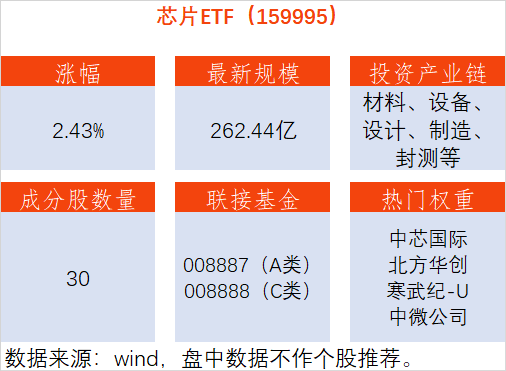
Group 1 - The A-share market saw a collective rise on January 6, with the Shanghai Composite Index increasing by 0.73%, driven by gains in precious metals, brokerage, and basic metals sectors [1] - The chip technology sector continued to strengthen, with the chip ETF (159995) rising by 2.43% as of 10:04 AM, and notable increases in constituent stocks such as Huahai Qingke (+7.88%), Zhongwei Company (+6.80%), and others [1] Group 2 - Changxin announced plans to raise 29.5 billion, allocating 7.5 billion for upgrading the manufacturing line for memory chips, 13 billion for DRAM technology upgrades, and 9 billion for R&D in dynamic random-access memory [3] - SMIC plans to issue 547 million shares at 74.20 yuan per share to acquire a 49% stake in SMIC North, while Huahong Semiconductor intends to issue 191 million shares at 43.34 yuan per share to acquire a 97.4988% stake in Huali Micro [3] - According to Zhongshan Securities, the AI-related industry is expected to maintain a favorable outlook through 2026, with domestic semiconductor opportunities arising from accelerated localization [3] - Predictions indicate that capital expenditure by cloud computing giants may sustain over 40% growth by 2026, with the AI sector remaining robust [3] - The chip ETF (159995) tracks the National Chip Index, comprising 30 leading companies in the A-share chip industry, including SMIC, Cambricon, Changdian Technology, and Northern Huachuang [3]



半导体板块1月5日涨4.27%,凯德石英领涨,主力资金净流入55.41亿元
Zheng Xing Xing Ye Ri Bao· 2026-01-05 08:59
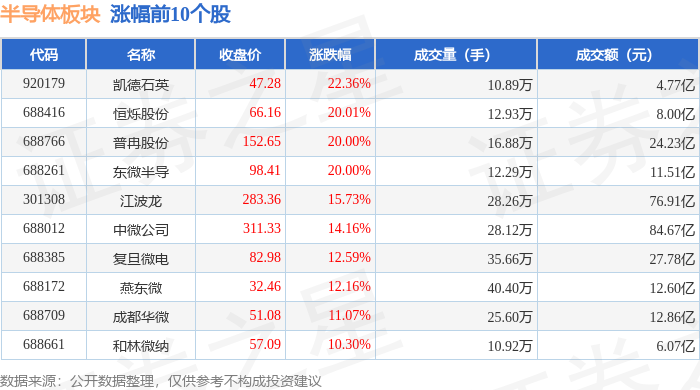
Core Viewpoint - The semiconductor sector experienced a significant increase of 4.27% on January 5, with notable gains from several companies, indicating a positive market sentiment in this industry [1]. Group 1: Market Performance - The Shanghai Composite Index closed at 4023.42, up by 1.38%, while the Shenzhen Component Index closed at 13828.63, up by 2.24% [1]. - Key stocks in the semiconductor sector showed substantial price increases, with KaiDe Quartz leading at a closing price of 47.28, reflecting a rise of 22.36% [1]. Group 2: Individual Stock Performance - Other notable performers included Henghui Co., which closed at 66.16 with a 20.01% increase, and Pushin Co., which also rose by 20% to a closing price of 152.65 [1]. - Jiangbolong saw a 15.73% increase, closing at 283.36, while Zhongwei Company closed at 311.33, up by 14.16% [1]. Group 3: Capital Flow - The semiconductor sector saw a net inflow of 5.541 billion yuan from institutional investors, while retail investors experienced a net outflow of 642 million yuan [2]. - The data indicates a strong interest from institutional investors, contrasting with the outflow from retail investors, suggesting a divergence in market sentiment [2]. Group 4: Detailed Stock Flow - Stocks like Zhaoyi Innovation and SMIC experienced significant net inflows from institutional investors, with Zhaoyi Innovation seeing a net inflow of 1.652 billion yuan [3]. - Conversely, stocks such as Lian Dong Technology and Fengzhi Technology faced net outflows from both institutional and retail investors, indicating potential concerns about their performance [3].


华源证券给予长电科技“增持”评级,发布新一轮股权激励计划,多层次目标彰显发展信心
Sou Hu Cai Jing· 2026-01-05 08:28
每经AI快讯,华源证券1月5日发布研报称,给予长电科技(600584.SH)"增持"评级。评级理由主要包 括:1)完善长期激励机制,绑定核心骨干;2)激励目标覆盖多项经营指标,彰显长期良性发展信心; 3)聚焦高成长领域,加速先进封装产能布局。风险提示:半导体周期波动的风险;贸易摩擦的风险; 汇率波动的风险等。 (记者 曾健辉) 每日经济新闻 免责声明:本文内容与数据仅供参考,不构成投资建议,使用前请核实。据此操作,风险自担。 每经头条(nbdtoutiao)——秒光!1499元飞天茅台上线即空,i茅台App冲上苹果购物榜第一,10万用 户已下单!经销商同价做回馈,1000箱很快卖完 ...
长电科技(600584):发布新一轮股权激励计划,多层次目标彰显发展信心
Hua Yuan Zheng Quan· 2026-01-05 08:22
证券研究报告 电子 | 半导体 非金融|公司点评报告 hyzqdatemark 2026 年 01 月 05 日 证券分析师 葛星甫 SAC:S1350524120001 gexingfu@huayuanstock.com 熊宇翔 xiongyuxiang@huayuanstock.com | 基本数据 | | | | 2025 | 年 | 12 月 | | 日 | 31 | | | | --- | --- | --- | --- | --- | --- | --- | --- | --- | --- | --- | --- | | 收盘价(元) | | | | | | | 36.78 | | | | | | 一 年 最 低 | 最 | 高 | / | | | | | | | 内 | 47.60/28.90 | | (元) | | | | | | | | | | | | | 总市值(百万元) | | | | | | | | | | | 65,814.67 | | 流通市值(百万元) | | | | | | | | | | | 65,814.67 | | 总股本(百万股) | | | | | | | | | | ...