
Caitong Securities(601108)

Search documents
多家金融机构,获新资质
Jing Ji Wang· 2026-01-04 02:27
Core Viewpoint - The announcement by the Interbank Market Dealers Association regarding the evaluation results for member applications to engage in underwriting non-financial corporate debt financing tools for 2025 highlights the approval of several institutions for relevant business qualifications [1][2]. Group 1: Institutions Approved - Institutions such as Huatai United Securities, JPMorgan Chase Bank (China), DBS Bank (China), Shanxi Securities, and Caitong Securities have received qualifications as general underwriters for non-financial corporate debt financing tools [1][2]. - Eight new members, including Caitong Securities and Huatai United Securities, have been designated as general underwriters for non-financial corporate debt financing tools [2]. - Bank of China International Securities has been approved as a special underwriter for technology innovation non-financial corporate debt financing tools [2]. Group 2: Application Process - The evaluation process for the 2025 underwriting business qualifications began on November 14, 2025, with a deadline for applications set for November 28, 2025, during which 37 members submitted their application materials [2]. - The evaluation results were approved by the fifth Bond Market Professional Committee and the fourth Board of Directors of the Association, and subsequently reported to the People's Bank of China [2]. Group 3: Regulatory Requirements - Underwriters are required to establish dedicated departments for underwriting business, appoint specialized personnel, and develop operational procedures, risk management, and internal control systems [4]. - Main underwriters must collaborate with independent main underwriters to conduct underwriting business and can independently engage in underwriting after gaining sufficient experience [4]. Group 4: Membership Classification - The Association classifies underwriters into main underwriters, underwriting members, and intending underwriting members, with main underwriters further divided into general and specialized categories [6][7]. - General main underwriters can engage in all categories of non-financial corporate debt financing tools, while specialized main underwriters can only handle specific categories [6].


18家券商斩获银行间债市“金门票”,固收业务竞争白热化
Xin Lang Cai Jing· 2026-01-04 01:47
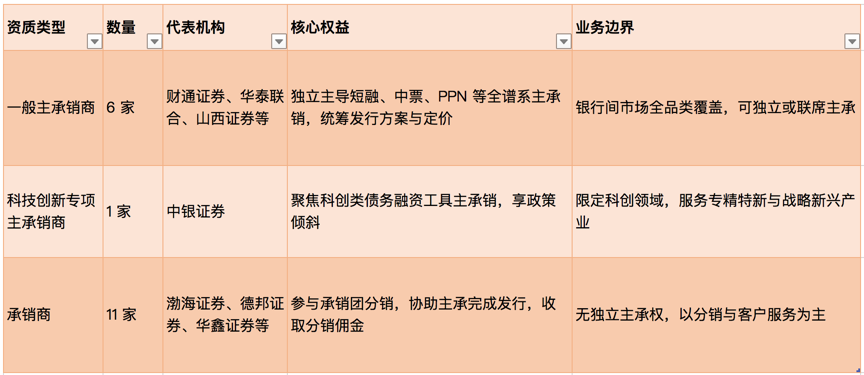
Core Viewpoint - The recent approval of 18 brokerages for non-financial corporate debt financing tool underwriting qualifications marks a significant step in the development of China's bond market, enhancing the service quality for the real economy and increasing direct financing's share [1][5]. Group 1: Qualification Expansion - 18 brokerages have been approved, forming a clear three-tier business structure, reflecting regulatory precision in managing bond underwriting [2][3]. - Six brokerages, including Caitong Securities and Huatai United, have obtained general lead underwriter qualifications, allowing them to independently lead various debt financing products [2][3]. - One brokerage, Zhongyin Securities, has secured a special lead underwriter qualification focused on technology innovation debt financing tools, benefiting from policy support [3][5]. Group 2: Market Dynamics - The entry of these 18 brokerages is expected to disrupt the existing market structure, which has been dominated by large banks and a few leading brokerages, where brokerages previously held less than 30% of the lead underwriting qualifications in the interbank market [5][6]. - The new qualifications enable brokerages to independently participate in the interbank market, previously requiring collaboration with banks, thus allowing them to retain a larger share of underwriting fees [5][6]. Group 3: Business Opportunities - The qualification expansion provides brokerages with broader opportunities in fixed income business, allowing them to build a full-chain service capability from issuance to trading and market-making [7]. - The diverse range of non-financial corporate debt financing tools, including short-term financing bonds and medium-term notes, complements the existing products in the exchange market, enhancing the overall bond service system [7][8]. - The competition in the bond underwriting market is expected to intensify, leading to a more reasonable underwriting fee structure and providing issuers with more options [8]. Group 4: Future Implications - Leading brokerages with strong capital and risk control systems are likely to dominate high-quality projects, while smaller brokerages may need to adopt differentiated strategies to survive [8]. - The approval of qualifications is not a permanent solution; ongoing regulatory oversight will require brokerages to enhance their risk management and pricing capabilities to capitalize on the benefits of their new qualifications [8].

多家金融机构,获新资质!
证券时报· 2026-01-03 10:02
Core Viewpoint - The announcement by the Interbank Market Dealers Association regarding the evaluation results for member applications to engage in underwriting related to non-financial corporate debt financing tools for 2025 highlights the expansion of qualified institutions in this sector [1][4]. Group 1: Qualified Institutions - Several institutions, including Huatai United Securities, JPMorgan Chase Bank (China), DBS Bank (China), Shanxi Securities, and Caitong Securities, have obtained relevant business qualifications [2][4]. - A total of 37 members submitted applications for underwriting qualifications, with 8 new members recognized as general lead underwriters for non-financial corporate debt financing tools [4][5]. - Bank of China International Securities Co., Ltd. has been designated as a lead underwriter for technology innovation non-financial corporate debt financing tools [4]. Group 2: Underwriting Business Regulations - The announcement outlines that lead underwriters and underwriters must establish dedicated departments for underwriting business, appoint specialized personnel, and develop operational procedures, risk management, and internal control systems [7]. - Lead underwriters must collaborate with independently qualified lead underwriters to conduct underwriting business, and may independently engage in underwriting after gaining sufficient experience [7]. - The Association will suspend or revoke underwriting qualifications for lead underwriters or underwriters found guilty of significant legal or regulatory violations [7]. Group 3: Membership Classification - The Association categorizes underwriters into lead underwriter members, underwriting members, and intending underwriting members, with lead underwriter members further divided into general and specialized categories [8][9]. - General lead underwriter members can engage in all categories of non-financial corporate debt financing tool underwriting, while specialized members can only handle specific categories [8]. - Intending underwriting members are those interested in participating in underwriting but are not yet classified as underwriters [9].

食品饮料:千亿成长赛道,变局引领机遇-财通证券
Sou Hu Cai Jing· 2026-01-01 20:27
Group 1 - The core viewpoint of the report highlights the growth opportunities and landscape of China's nutrition and health industry, with a market size expected to reach 260.2 billion yuan by 2024, reflecting a CAGR of 6.3% from 2019 to 2024, indicating significant room for improvement in per capita consumption compared to countries like the US, South Korea, and Australia [1][20][19] - The demand side shows a trend towards "precise segmentation," driven by an aging population expanding the elderly health market, while Generation Z is emerging as a new consumer force due to increased health awareness [1][31][28] - The online channel dominates the distribution, with e-commerce expected to account for 60% of the market share by 2024, and platforms like Douyin experiencing rapid growth, achieving a 53% increase in sales [1][56][62] Group 2 - The category landscape presents a dual-track situation of "traditional steady growth and emerging explosive growth." The traditional category, particularly bone health, is growing at a rate of 18.4%, while new categories like oral anti-aging are projected to reach a market size of 65.4 billion yuan by 2024 [2][70] - The industry chain shows a fragmented competitive landscape at the downstream level, with small and medium brands entering quickly through online channels, while leading brands like Swisse maintain their position through a comprehensive brand matrix [2][10] - The report emphasizes the importance of product innovation and compliance advantages for leading companies like Xianle Health and Baihe Co., which are positioned to benefit from industry growth [2][10][19]

每周股票复盘:财通证券(601108)获准发行150亿公司债券
Sou Hu Cai Jing· 2026-01-01 18:19
Core Viewpoint - The company, Caitong Securities, has received approval from the China Securities Regulatory Commission (CSRC) to publicly issue corporate bonds totaling up to 15 billion yuan to professional investors, with a registration validity of 24 months [1][3]. Group 1: Company Performance - As of December 26, 2025, Caitong Securities' stock closed at 8.67 yuan, reflecting a 1.88% increase from the previous week's closing price of 8.51 yuan [1]. - The stock reached a weekly high of 8.79 yuan on December 25, 2025, and a low of 8.39 yuan on December 24, 2025 [1]. - The company's current total market capitalization is 40.494 billion yuan, ranking 29th out of 50 in the securities sector and 466th out of 5,181 in the A-share market [1]. Group 2: Corporate Announcements - Caitong Securities held its third extraordinary general meeting of 2025 on December 30, 2025, with 576 shareholders and representatives present, representing 38.3544% of the total voting shares [2]. - The meeting approved nine resolutions, including a special resolution to cancel the supervisory board and amend the company's articles of association, with more than two-thirds of the voting shares in favor [2]. - The company also revised several governance documents, including the rules for shareholder meetings, board meetings, and various management systems [2][3].
2026年1月固定收益投资策略:转债市场研判及“十强转债”组合
Guoxin Securities· 2025-12-31 15:22
1. Report's Investment Rating for the Industry - No information provided regarding the industry's investment rating. 2. Core Views of the Report - Bullish on the equity market during the "Spring Rally". With the expected strengthening of underlying stocks and seasonal effects, there is a slight room for convertible bond valuations to increase. When selecting bonds, focus on the performance elasticity of the underlying stocks. For near - maturity convertible bonds, consider participating in the underlying stocks [27]. - In the stock market, in December 2025, the risk appetite was high. Looking ahead, the RMB appreciation expectation is strengthening, and with the end of the year - end ranking assessment of financial institutions, the "Spring Rally" is expected to gradually kick off. In January, if the market adjusts during the intensive performance forecast period, investors can buy on dips and focus on resources, AI computing power, batteries, polyester industry chain, AI edge devices, and securities [27]. - In the convertible bond market, in December 2025, the CSI Convertible Bond Index reached a new high since July 2015. Although the share of convertible bond ETFs continued to decline, the market premium rate increased. In the future, due to seasonal effects, some institutional investors may gradually increase their positions in January, and convertible bond valuations have a slight room for improvement [27]. 3. Summary of Each Section 3.1 2025 December Convertible Bond Market Review - **Stock and Bond Market Review**: In December, the equity market fluctuated upwards, and the bond market generally fluctuated. The Shanghai Composite Index rose for nearly 10 consecutive trading days in the middle and late - December, closing at 3963.68 on December 26, with a monthly increase of 1.27%. The 10 - year Treasury bond yield closed at 1.838% on December 26, up 0.10bp from the beginning of the month, and the 30 - year Treasury bond yield closed at 2.223%, up 3.32bp from the beginning of the month [4][8]. - **Convertible Bond Market Review**: The convertible bond market generally rose following the equity market. The premium rates of convertible bonds in all parity ranges increased, but convertible bond ETFs continued to face outflow pressure. Five convertible bonds announced downward revisions, one more than the previous month, and 10 convertible bonds announced forced redemptions, two less than the previous month. The CSI Convertible Bond Index closed at 493.2 on December 26, up 2.31% [5][8]. - **Industry Performance**: In the Shenwan industry classification, sectors such as national defense and military industry (+12.25%), communication (+10.55%), and non - bank finance (+8.27%) performed well, while sectors such as media (-4.77%), banks (-3.68%), and coal (-3.62%) declined [8]. 3.2 2026 January Convertible Bond Allocation Strategy - **Stock Market Outlook**: The RMB appreciation expectation is strengthening, and the "Spring Rally" is expected to start. In January, if the market adjusts during the performance forecast period, investors can buy on dips. Focus on resources, AI computing power, batteries, polyester industry chain, AI edge devices, and securities [27]. - **Convertible Bond Outlook**: Due to seasonal effects, some institutions may increase their positions in January. Convertible bond valuations have a slight room for improvement. When selecting bonds, relative - return funds should focus on high - probability sectors with a high - beta underlying stocks, and absolute - return funds should focus on high - odds sectors [27][28]. - **Bond Selection Suggestions**: For relative - return funds, focus on sectors such as lithium - battery materials, semiconductor equipment and materials, power semiconductors, high - quality auto parts, anti - involution industries, and securities. For absolute - return funds, focus on industry leaders with low valuations, sectors such as pig farming, power, and water supply, and convertible bond debt - to - equity conversion [28]. 3.3 2026 January "Top Ten Convertible Bonds" Portfolio | Convertible Bond Code | Convertible Bond Name | Underlying Stock Name | Industry | Balance (Billion Yuan) | Convertible Bond Price (Yuan) | Convertible Bond Parity (Yuan) | Conversion Premium Rate (%) | Rating | Recommendation Reason | | --- | --- | --- | --- | --- | --- | --- | --- | --- | --- | | 113043.SH | Caitong Convertible Bond | Caitong Securities | Securities II | 37.99 | 133.52 | 109.71 | 21.70 | AAA | The securities sector will see a double - hit of valuation and profit in a bull market [30]. | | 123254.SZ | EVE Convertible Bond | EVE Energy | Battery | 49.98 | 167.64 | 134.65 | 24.51 | AA+ | The demand for energy storage is strong, and the shipment volume in the third quarter increased significantly year - on - year and quarter - on - quarter [30]. | | 113695.SH | Huachen Convertible Bond | Jiangsu Huachen | Power Grid Equipment | 4.60 | 160.16 | 122.10 | 31.17 | A+ | The company's new production capacity is put into operation just as the demand for energy storage is growing rapidly [30]. | | 113634.SH | Proya Convertible Bond | Proya | Cosmetics | 7.51 | 125.13 | 70.36 | 77.83 | AA | As a domestic beauty leader, its brand and product strength are outstanding, and its valuation at a historical low is expected to be restored [30]. | | 113616.SH | Will Semiconductor Convertible Bond | Will Semiconductor | Semiconductor | 24.32 | 124.07 | 78.35 | 58.36 | AA+ | The company is accelerating its introduction into intelligent driving and emerging markets and has launched new mobile phone products with strong competitiveness [30]. | | 118040.SH | Hongwei Convertible Bond | Hongwei Technology | Semiconductor | 4.30 | 149.72 | 116.17 | 28.88 | A | Power semiconductors benefit from the growth of power supply and energy storage demand [30]. | | 113674.SH | Huashe Convertible Bond | Huashe Group | Engineering Consulting Service II | 4.00 | 129.29 | 89.47 | 44.51 | AA | As a leader in infrastructure design, its main business is stabilizing, and intelligent design and low - altitude economy provide growth points [30]. | | 123222.SZ | Bojun Convertible Bond | Bojun Technology | Auto Parts | 2.44 | 224.63 | 194.72 | 15.36 | A+ | The growth of customer sales and the increase in ASP per vehicle drive up revenue and profit [30]. | | 113666.SH | Aima Convertible Bond | Aima Technology | Motorcycle and Others | 19.99 | 125.11 | 79.63 | 57.12 | AA | The new national standard may promote the market share of the two - wheeled vehicle leader [30]. | | 123247.SZ | Wankai Convertible Bond | Wankai New Materials | Plastics | 19.64 | 172.30 | 150.18 | 14.73 | AA | Under the "anti - involution" of bottle chips, the processing fee is expected to stabilize, and the company is entering the rPET blue - ocean market [30]. |



2025年转债复盘:“攻守兼备”特征凸显
CAITONG SECURITIES· 2025-12-31 10:57
Report Industry Investment Rating - Not provided in the given content Core Viewpoints of the Report - In 2025, convertible bonds performed excellently, with equity characteristics contributing the main revenue. The convertible bond market's performance was the third - highest in terms of revenue since 2010 and the best since 2021. The contribution ratio of the underlying stocks and valuation to the rise and fall was about 7:4, similar to 2021. Compared with mainstream stock indices, the convertible bond index showed the property of "attack when the market rises and defend when the market falls", with Sharpe ratio and Calmar ratio second only to micro - cap stocks [2][6]. - In 2025, the supply of convertible bonds was in the ascendant. Over 230 billion yuan of convertible bonds were delisted, reaching the highest scale since 2018, with banks having the largest delisting scale. The primary market issuance process accelerated in the second half of the year, but the issuance of large - scale convertible bonds remained cautious. Listed companies were more inclined to issue private placements [2]. - In 2025, the demand for convertible bonds was differentiated, and the ETF share reached a new high. The logic of the "fixed - income asset shortage" continued, and the demand structure of institutions for convertible bonds changed significantly. The direct holding scale of convertible bonds by institutions such as insurance and annuities was at a historically low level, while the holding scale of convertible bonds by funds, especially ETFs, reached a historical high [2]. - In 2025, the game of convertible bond terms was characterized by "high return and high risk". The probabilities of downward revision and non - call of convertible bonds were at historically low levels, but the number of times of triggering call/downward revision was relatively high since 2019, indicating an increase in the intensity of the game. The odds of the downward revision game were at a historical high, with photovoltaic convertible bonds and near - maturity convertible bonds being the highlights of the whole year. The profit - loss ratio of the call game deteriorated compared with the previous year but was still at a historical high [2]. - In 2025, the risks of convertible bonds were better than expected, and the impact of ratings decreased. Only Zhongzhuangzhuan 2 in the Shanghai and Shenzhen stock markets triggered the substantial default risk, and the risk performance was better than investors' expectations. Although there were still many convertible bonds with rating adjustments, the impact on pricing was significantly weakened, and the market was generally "desensitized" to ratings [2]. Summary According to the Directory 2025, How Did the Convertible Bond Market Perform? 2021 - 2025: The Best - Performing Year Since 2021, with Equity Income as the Main Contributor - Vertically, the convertible bond holding experience in 2025 could rank among the top four years since 2010. As of December 30, 2025, the CSI Convertible Bond Index closed at 491.83 points, up 18.6% from the end of 2024. It was the third - highest revenue - earning year since 2010 and the best since 2021. The maximum drawdown was about 6%, the annualized volatility was less than 10%, and the Sharpe ratio was 1.92, the Calmar ratio was 3.01, achieving high returns with low drawdown and medium - low volatility [6]. - In terms of revenue decomposition, the contribution ratio of the underlying stocks and valuation to the rise and fall in 2025 was about 7:4. The change in the underlying stocks contributed 14 percentage points to the index return, and the change in valuation contributed about 8 percentage points, similar to 2021 [9]. - Horizontally, the return performance of the convertible bond index was slightly weaker, but the cost - performance was prominent. Compared with the stock indices in the same period, its return was only stronger than that of the Shanghai Composite Index, Juchao Large - cap Index, and Guozheng Value Index, but significantly weaker than that of the micro - cap and ChiNext Index. However, in terms of Sharpe ratio and Calmar ratio, it was only slightly weaker than the Wind Micro - cap Index, showing the property of "attack when the market rises and defend when the market falls" [13]. The Convertible Bond Market Rose Volatility Throughout the Year, and the Year - End Increase Converged - **First stage (Early 2025 - March 2025)**: Driven by the spring rally and supported by AI + robot innovation and low initial valuations, the convertible bond market had a dual - wheel - driven market of valuation and the underlying stocks, with a maximum index increase of 6.15% by the end of February. Low - price convertible bonds performed strongly, and the concern about credit risk events was reversed [19]. - **Second stage (March 2025 - Early April 2025)**: After the Two Sessions, the spring rally ended, and the market returned to the trading of annual report expectations. Market sentiment cooled down, and the convertible bond valuation peaked and declined. The intensification of Sino - US trade disputes led to a stock market correction on the first trading day after the Tomb - Sweeping Festival, and the CSI Convertible Bond Index fell 4.05%, with the automotive, communication, and computer industries leading the decline [19]. - **Third stage (Early April 2025 - Mid - June 2025)**: After the market correction on April 7, state funds such as Central Huijin entered the market, providing liquidity support. The Sino - US tariff issue was in a "tug - of - war", and the market expectation improved. The valuations of the overseas and export sectors rebounded, but concerns about the ratings of the photovoltaic and other sectors with weak performance emerged [20]. - **Fourth stage (End of June 2025 - End of August 2025)**: After the release of all rating results at the end of June, institutional funds increased their allocation of convertible bonds, and the convertible bond ETF share increased significantly. The anti - involution policy in the photovoltaic industry was implemented, and the photovoltaic convertible bonds rebounded. The A - share market was booming, driving the convertible bond market to its main uptrend. The convertible bond price and valuation reached new highs, and the market capacity decreased [20]. - **Fifth stage (End of August 2025 - Present)**: At the end of August, institutions' profit - taking demand led to a decline in the convertible bond market. The positions of insurance and annuity institutions in convertible bonds decreased significantly. The supply of convertible bonds improved in September, but it was difficult to offset the shrinkage caused by conversion. The convertible bond valuation stabilized and rebounded after the adjustment at the end of August and reached a high level again in December [21][22]. In 2025, the Supply of the Convertible Bond Market was in the Ascendant The Market Capacity Declined to Around 500 Billion Yuan, and the Delisting Scale Reached a Historical High - In 2025, the number of delisted convertible bonds reached a historical high, and the market capacity decreased rapidly. By December 30, 2025, a total of 163 convertible bonds were delisted, with a total delisting scale of over 230 billion yuan, the peak since 2018. The banking industry had the largest delisting scale of 101.323 billion yuan, followed by non - ferrous metals, basic chemicals, and power equipment and new energy [23]. The Primary Issuance Had Mixed Results, with Small - Ticket Issuance Accelerating and Large - Ticket Issuance Still Difficult - The good aspect was that the primary market issuance process accelerated in the second half of 2025. In the fourth quarter of 2025, the average time from the announcement of the convertible bond plan to listing was about 320 days, the lowest since 2023 [25]. - The regulatory authorities were still relatively cautious about the issuance of medium - and large - scale convertible bonds. As of now, no convertible bonds with a scale of over 2 billion yuan announced in 2025 have been listed, while 8 convertible bonds with a scale of less than 2 billion yuan have been listed [28]. Subjectively, the Trend of Listed Companies Preferring Private Placements was More Prominent - The ratio of the number of convertible bond plans to private placement plans has been declining sharply since the refinancing new regulations in 2023. In 2025, 53 listed companies announced private placement plans, while only 9 announced convertible bond plans, with a ratio of 16.98%, far lower than the average level before 2023 [29]. In 2025, the Demand for Convertible Bonds was Differentiated, and the ETF Share Reached a New High - In 2025, the logic of the "fixed - income asset shortage" continued, but the demand structure of institutions for convertible bonds changed significantly. As of November 2025, the direct holding of convertible bonds by insurance and annuity institutions was at a historically low level since 2021, while the holding of convertible bonds by funds, especially ETFs, reached a historical high [32]. In 2025, the Game of Convertible Bond Terms was Characterized by "High Return and High Risk" The Overall Probability of Downward Revision and Non - call of Convertible Bonds in 2025 was at a Historical Low - In 2025, it was a "big year" for call, and the call probability increased. There were 131 call announcements and 149 non - call announcements, and the call: non - call ratio was 88%, the highest since 2020. - The intensity of the downward revision of convertible bonds in 2025 was second only to 2024, but the downward revision probability decreased. There were 68 downward revision proposal announcements and 510 non - downward revision announcements, and the downward revision: non - downward revision ratio was 13%, at a historically low level [36]. Downward Revision: There were Odds, and Photovoltaic Convertible Bonds and Near - Maturity Convertible Bonds were the Highlights of the Whole Year - In terms of odds, the return performance of the convertible bond downward revision game in 2025 was at a relatively high level in history. The average return after a downward revision proposal was 2.02%, the best since 2023, and the average return after an actual downward revision was 0.63%, at a relatively high level since 2019 [41]. - In terms of influencing factors, the downward revision probability of near - maturity convertible bonds was significantly higher. The downward revision probability was highly correlated with the remaining term, showing obvious monotonicity. The new energy industry had the most downward revisions, and although some convertible bonds did not succeed in conversion by the end of 2025, they achieved good returns, and the downward revision increased the possibility of future call [42]. Call: The Profit - Loss Ratio of the Game Deteriorated Compared with the Previous Year but was Still at a Historical High - In 2025, the call game fluctuated greatly, and the non - call return was higher than the historical average. The average return on the first day after the non - call announcement of convertible bonds was 2.29%, higher than the historical average since 2019. The average return on the first day after the call announcement was - 2.54%, and the profit - loss ratio was about 0.9, which deteriorated significantly compared with 2024 but was still at a historical high [48]. In 2025, the Risks of Convertible Bonds were Better than Expected, and the Impact of Ratings Decreased - In 2025, there were no serious default events in the convertible bond market, which was significantly better than investors' expectations. Although Zhongzhuangzhuan 2 triggered default risk in the fourth quarter, its underlying stock had been ST before the restructuring, and its convertible bond rating had also fallen below the investment grade [48]. - In terms of ratings, although there were still many convertible bonds with rating adjustments, the impact on pricing decreased significantly. By December 30, 2025, 42 convertible bonds had their ratings downgraded and 40 were put on the rating watch list. However, the average decline of convertible bonds on the first trading day after the rating downgrade was only 0.01%, indicating that the market was generally "desensitized" to rating changes and the pricing was smoother [51].
财通资管新任一副总 来自平安资管
Xin Lang Cai Jing· 2025-12-31 10:12
Core Viewpoint - The appointment of Zou Guanghang as the new Deputy General Manager and Financial Officer of Caitong Asset Management marks a significant leadership change, reflecting the ongoing transformation and reform within the securities asset management industry in China [1][4][5]. Group 1: Company Overview - Zou Guanghang has 18 years of experience in human resources management within the financial sector, having previously worked at Ping An Asset Management and Oriental Red Asset Management [3][8]. - Caitong Asset Management, established in 2014, is a wholly-owned subsidiary of Caitong Securities and has seen its entrusted asset management scale exceed 300 billion yuan, ranking third among securities asset management institutions in China [4][9]. Group 2: Industry Context - The securities asset management sector is undergoing a significant leadership reshuffle, with several high-profile changes among management teams, indicating a critical period of transformation and reform [4][9]. - As of November 2025, only 14 securities firms and asset management subsidiaries hold public offering qualifications, and many companies have withdrawn their applications for public offering licenses, reflecting a pause in the expansion of public fund management [5][9]. - The industry is experiencing a shift towards high-quality development characterized by stable total assets, optimized structures, and highlighted features, with expectations for continued focus on active management strategies in 2026 [5][10].

18家券商牌照扩容 获批非金融企业债务融资工具业务资格
Xin Lang Cai Jing· 2025-12-31 09:37
Core Viewpoint - The approval of 18 new brokerage firms for non-financial corporate debt financing tool underwriting qualifications enhances the competitive landscape in the fixed income market in China [1] Group 1: New Brokerage Firms Approved - The China Interbank Market Dealers Association has released the list of 2025 non-financial corporate debt financing tool underwriting qualifications, adding 18 new brokerages this year [1] - Among the new additions, six brokerages, including Caitong Securities and First Capital Securities, are designated as general lead underwriters for non-financial corporate debt financing tools [1] - Zhongyin Securities has been approved as the lead underwriter for technology innovation non-financial corporate debt financing tools, which includes the underwriting of bonds supporting technological innovation [1] Group 2: Implications for Brokerage Firms - The approval of these qualifications is expected to assist brokerages in enhancing their fixed income business layout and improving their comprehensive bond business system [1]


财通证券:明年1月已披露地方债发行计划逾7700亿 发行期限难缩短
Xin Lang Cai Jing· 2025-12-31 04:01
Core Viewpoint - As of December 30, 21 regions have disclosed their local bond issuance plans for January 2026, totaling 771.2 billion yuan, compared to 284.6 billion yuan planned for January 2025 [1] Group 1: Local Bond Issuance - The current fiscal revenue and expenditure face certain pressures, making growth stabilization urgent [1] - The project timelines are gradually extending, indicating that local governments are unlikely to delay bond issuance or shorten issuance periods due to fluctuations in secondary market interest rates [1] - A rough comparison shows that the issuance period for local bonds in the first quarter of 2026 has decreased, but due to limited samples and the typical discrepancies between planned and actual issuance, it cannot be simply concluded that the issuance period will significantly shorten [1] Group 2: Monetary Policy and Market Sentiment - The central bank's interest rate stance is focused on stability, and past experiences indicate that phases of market concern over supply are often good opportunities for left-side trading [1]