JUNZHENG(601216)

Search documents
君正集团:以全链条创新体系驱动化工产业绿色升级
Zheng Quan Ri Bao Wang· 2026-01-28 08:44
Core Viewpoint - Under the dual drive of "dual carbon" goals and global industrial chain restructuring, Chinese private enterprises are accelerating their technological innovation and green transformation efforts [1] Group 1: Innovation and Development - Junzheng Group is building a comprehensive innovation system centered around innovation studios, focusing on "technical breakthroughs, talent aggregation, and ecological co-prosperity" to drive high-quality development [1] - The company has established a multi-level innovation ecosystem, including one autonomous region-level and three city-level innovation studios, and has formed efficient collaboration with two regional R&D centers and one technical center [1][2] - Junzheng Group employs a "dual-drive" mechanism to combine internal innovation vitality with external intellectual resource introduction, continuously activating the company's internal innovation momentum [1] Group 2: Circular Economy and Green Development - The innovation studios focus on key links in the industrial chain, engaging in process optimization, equipment upgrades, and clean production [2] - Junzheng Group has created a full-chain industry-academia-research cooperation network in the circular economy field, significantly improving project response speed and implementation efficiency through a collaborative mechanism with research institutions [2] - The company has pioneered a green low-carbon route for coal-based biodegradable plastics, achieving a closed-loop operation with zero emissions and waste through innovative processes [2] Group 3: Future Goals and Talent Development - By 2025, Junzheng Group aims to advance technology breakthroughs across the entire coal chemical industry chain through a collaborative innovation model [3] - The company emphasizes talent development by establishing a comprehensive growth pathway for innovation talent, including regular technical training and cross-field exchanges [3] - Junzheng Group is collaborating with Huawei to create a digital platform and upgrade its SAP ERP system to enhance business process automation and efficiency [3]

煤炭概念下跌1.99%,主力资金净流出66股
Zheng Quan Shi Bao Wang· 2026-01-27 09:12
| 601001 | 晋控煤业 | -3.20 | 1.15 | -821.43 | | --- | --- | --- | --- | --- | | 603113 | 金能科技 | -3.06 | 2.14 | -808.77 | | 600117 | 西宁特钢 | -2.33 | 0.91 | -808.08 | | 600180 | 瑞茂通 | -1.61 | 1.61 | -633.76 | | 601225 | 陕西煤业 | -2.65 | 0.55 | -609.66 | | 000552 | 甘肃能化 | -2.46 | 1.84 | -593.07 | | 601101 | 昊华能源 | -2.44 | 0.96 | -567.01 | | 001286 | 陕西能源 | -1.51 | 1.28 | -556.15 | | 600348 | 华阳股份 | -1.28 | 1.71 | -492.85 | | 002535 | 林州重机 | -0.97 | 2.86 | -488.80 | | 600740 | 山西焦化 | -3.38 | 1.13 | -486.85 | | 002691 ...


未知机构:陕西拟对电石烧碱等行业上调电价1月19日市场对陕西电价调整征求意-20260120
未知机构· 2026-01-20 02:25
Summary of Conference Call Notes Industry Overview - The document discusses the potential increase in electricity prices for the calcium carbide and caustic soda industries in Shaanxi, China. This adjustment is viewed as a pilot policy for supply-side reform in high-energy-consuming industries during the "14th Five-Year Plan" period [1]. Core Insights and Arguments - The market interpretation of the electricity price adjustment has evolved, indicating that the implications extend beyond Shaanxi and are seen as part of a broader trend in supply-side reforms for high-energy industries [1]. - The logic of eliminating outdated production capacity driven by policy is being validated at the industry bottom, suggesting a significant shift in the market dynamics [1]. - Leading companies with cost advantages, such as those owning self-built power plants, are expected to achieve a revaluation of their worth as the industry landscape is reshaped [1]. Important but Overlooked Content - Specific companies to watch include Junzheng Group and Jiahua Energy, which possess self-built power plants or ethylene production processes, giving them a relative advantage amid potential cost increases [1].

商业航天突传重磅!军工ETF(512810)上探2.8%!资金博弈业绩主线?创业板人工智能ETF单日获净申购超3亿份
Xin Lang Cai Jing· 2026-01-19 11:31
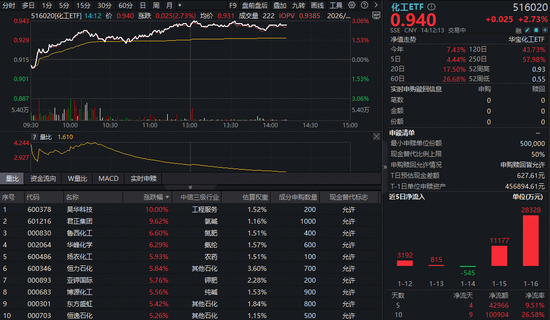
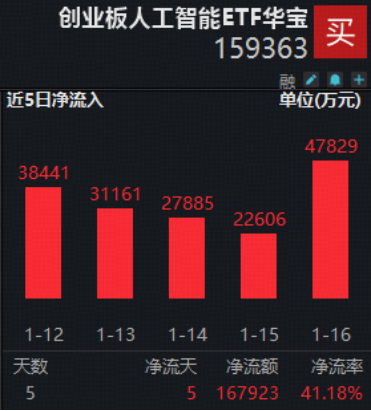
Group 1 - A-shares showed mixed performance on January 19, with the Shanghai Composite Index performing strongly while the ChiNext Index experienced a pullback, and total trading volume in Shanghai, Shenzhen, and Beijing reached 2.73 trillion yuan, a significant decrease of 324.3 billion yuan from the previous trading day [1][23] - The commercial aerospace sector received significant news with the successful validation of crewed spacecraft landing buffer technology, leading to a rise in the General Aviation ETF Huabao (159231) by 2.2% [1][10] - The chemical sector is entering an upward cycle as large-scale chemical products are at a dual turning point of capacity and inventory, with the Chemical ETF (516020) surging by 3.06%, reaching its highest closing price since August 2022 [1][5][30] Group 2 - The AI sector continues to attract substantial investment, with the ChiNext AI ETF Huabao (159363) seeing a net subscription of 322 million units on January 19, following a total of 1.679 billion yuan in net inflows over the previous five days [2][24] - The focus on the domestic AI industry chain is evident, as the Science and Technology Innovation AI ETF Huabao (589520) also experienced net inflows totaling 156 million yuan over the same period [2][24] Group 3 - The National Bureau of Statistics reported that China's GDP for 2025 is projected to be 14,018.79 billion yuan, with a year-on-year growth of 5%, marking the successful completion of the "14th Five-Year Plan" [4][26] - Analysts suggest that the market's risk appetite may improve following the release of macroeconomic data, with potential incremental policies expected to be introduced [4][26] - The chemical sector has shown strong performance since 2025, with the Chemical ETF (516020) index rising by 52.03%, significantly outperforming major A-share indices [5][29] Group 4 - The price of refrigerants has surged, with R507 and R404 reaching 46,000-49,000 yuan/ton and 43,000-45,000 yuan/ton respectively, reflecting increased overseas demand and tightened domestic supply [8][30] - The chemical industry is expected to experience a recovery in profitability and valuation in 2026, driven by supply-demand rebalancing and new production capabilities in AI computing and advanced manufacturing [8][30] Group 5 - The commercial aerospace sector is experiencing a rebound, supported by strong policy backing and improving industry trends, with significant investments in satellite technology and related fields [14][15] - The profitability of leading companies in the commercial aerospace index has shown improvement, with expected growth in earnings for 2026 [15]


13.31亿元资金今日流入基础化工股
Zheng Quan Shi Bao Wang· 2026-01-19 09:29
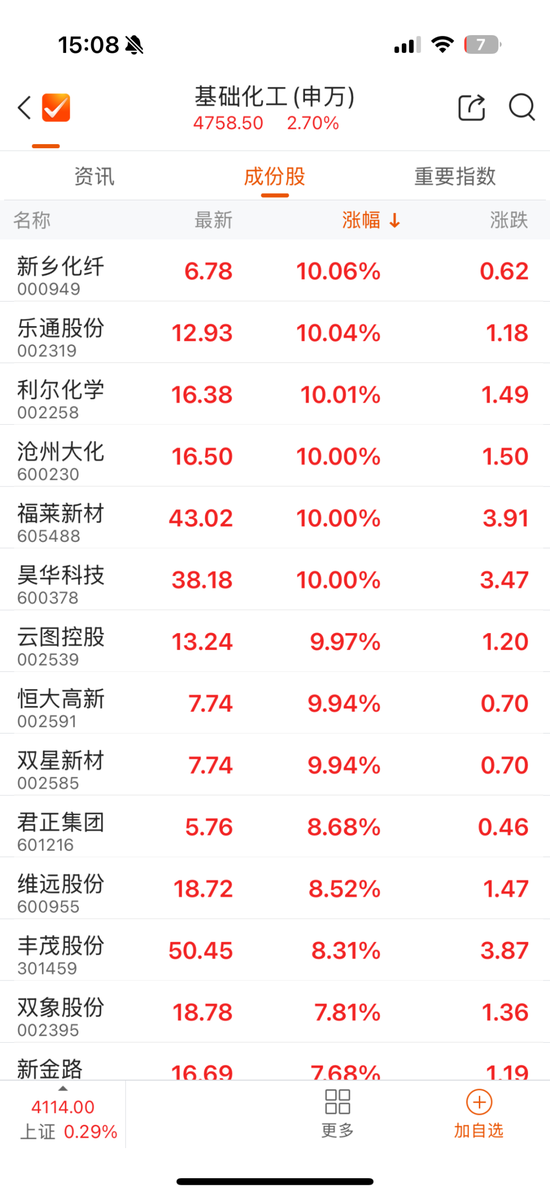
Market Overview - The Shanghai Composite Index rose by 0.29% on January 19, with 23 out of 28 sectors experiencing gains, led by the basic chemical and oil & gas sectors, which increased by 2.70% and 2.08% respectively [1] - The total net outflow of capital from the two markets was 35.714 billion yuan, with 13 sectors seeing net inflows, particularly the power equipment sector, which had a net inflow of 7.597 billion yuan and a daily increase of 1.84% [1] Basic Chemical Industry - The basic chemical industry saw a rise of 2.70%, with a total net inflow of 1.331 billion yuan. Out of 408 stocks in this sector, 341 stocks increased in value, with 10 hitting the daily limit up, while 63 stocks declined, with 3 hitting the daily limit down [2] - The top three stocks with the highest net inflow in the basic chemical sector were Wanhua Chemical, with a net inflow of 424 million yuan, followed by Junzheng Group and Weiyuan Co., with net inflows of 289 million yuan and 139 million yuan respectively [2] Capital Inflow and Outflow - The top stocks in terms of capital inflow in the basic chemical sector included: - Wanhua Chemical: +4.67%, turnover rate 1.62%, net inflow 424.26 million yuan - Junzheng Group: +8.68%, turnover rate 5.01%, net inflow 289.14 million yuan - Weiyuan Co.: +8.52%, turnover rate 6.08%, net inflow 138.90 million yuan [2] - The stocks with the highest capital outflow included: - Duofluor: +0.69%, turnover rate 6.82%, net outflow -154.91 million yuan - Kaimete Gas: -2.67%, turnover rate 8.18%, net outflow -118.74 million yuan - Shenjian Co.: -10.01%, turnover rate 15.04%, net outflow -115.00 million yuan [4]


午后异动!多股强势涨停
Xin Lang Cai Jing· 2026-01-19 09:13
Core Viewpoint - The chemical industry is experiencing a significant upward trend, driven by a combination of cost support, demand recovery, and supply optimization, leading to a tighter supply-demand balance [4][12]. Group 1: Industry Performance - As of January 19, the Shenwan Basic Chemical Index rose by 2.70%, reaching 4758.50 points, with leading stocks like Xinxiang Chemical Fiber and Letong Co. hitting the daily limit [1][8]. - Multiple chemical products have seen collective price increases, including propylene, ammonium sulfate, acetone, and lithium hydroxide, driven by upstream oil price stabilization and pre-holiday stocking demand [3][11]. Group 2: Market Dynamics - The current price increase in chemical products is attributed to three main factors: cost support from stable oil prices, reduced effective capacity due to pre-holiday maintenance, and concentrated demand from downstream sectors [4][12]. - The industry is witnessing a trend of mergers and acquisitions as companies seek to expand into high-value sectors, such as integrated circuit materials and high-end electronic chemicals [5][13]. Group 3: Policy and Future Outlook - The Ministry of Industry and Information Technology and other departments have issued a plan aiming for an annual growth of over 5% in the petrochemical industry from 2025 to 2026, focusing on technological innovation and high-quality development [5][14]. - The Shandong Provincial Government has set a target for the petrochemical industry to achieve over 5% year-on-year growth by 2026, emphasizing the importance of high-end chemical products [6][14]. - The industry is transitioning from chaotic expansion to a phase of stable growth and transformation, supported by both national and local policies [7][15].


化学原料板块1月19日涨3.05%,君正集团领涨,主力资金净流入1.17亿元
Zheng Xing Xing Ye Ri Bao· 2026-01-19 08:52
Market Overview - The chemical raw materials sector increased by 3.05% on January 19, with Junzheng Group leading the gains [1] - The Shanghai Composite Index closed at 4114.0, up 0.29%, while the Shenzhen Component Index closed at 14294.05, up 0.09% [1] Top Performers - Junzheng Group (601216) closed at 5.76, up 8.68%, with a trading volume of 4.2296 million shares and a transaction value of 2.373 billion [1] - Weiyuan Co., Ltd. (600955) closed at 18.72, up 8.52%, with a trading volume of 334,500 shares and a transaction value of 616 million [1] - New Jinlu (000510) closed at 16.69, up 7.68%, with a trading volume of 1.1245 million shares and a transaction value of 1.780 billion [1] Market Capital Flow - The chemical raw materials sector saw a net inflow of 117 million from institutional investors, while retail investors contributed a net inflow of 236 million [2] - However, there was a net outflow of 353 million from speculative funds [2] Individual Stock Capital Flow - Junzheng Group had a net inflow of 237 million from institutional investors, but a net outflow of 103 million from speculative funds [3] - Weiyuan Co., Ltd. experienced a net inflow of 106 million from institutional investors, with a net outflow of 90.63 million from speculative funds [3] - North Yuan Group (601568) had a net inflow of 37.92 million from institutional investors, but a net outflow of 16.12 million from speculative funds [3]

今日129只个股突破年线
Zheng Quan Shi Bao Wang· 2026-01-19 07:27
Market Overview - The Shanghai Composite Index closed at 4114.00 points, above the annual line, with a change of 0.29% [1] - The total trading volume of A-shares reached 27,322.16 million yuan [1] Stocks Breaking Annual Line - A total of 129 A-shares have surpassed the annual line today [1] - Notable stocks with significant deviation rates include: - Xinlicheng (8.92%) - Junzheng Group (8.59%) - Tiandi Online (7.60%) [1] Stock Performance Details - The following stocks showed notable performance: - Xinlicheng: Today's change of 9.83%, turnover rate of 9.53%, latest price at 2.57 yuan [1] - Junzheng Group: Today's change of 8.68%, turnover rate of 5.01%, latest price at 5.76 yuan [1] - Tiandi Online: Today's change of 9.99%, turnover rate of 7.71%, latest price at 20.26 yuan [1] - Other stocks with smaller deviation rates include: - Hemai Co., Ltd. - Wukuang Capital - Huadian Liaoning Energy [1]


ETF盘中资讯|氟化工龙头涨停,化工板块午后继续猛攻!机构:供需双底确立,2026年或迎“戴维斯双击”
Sou Hu Cai Jing· 2026-01-19 06:33
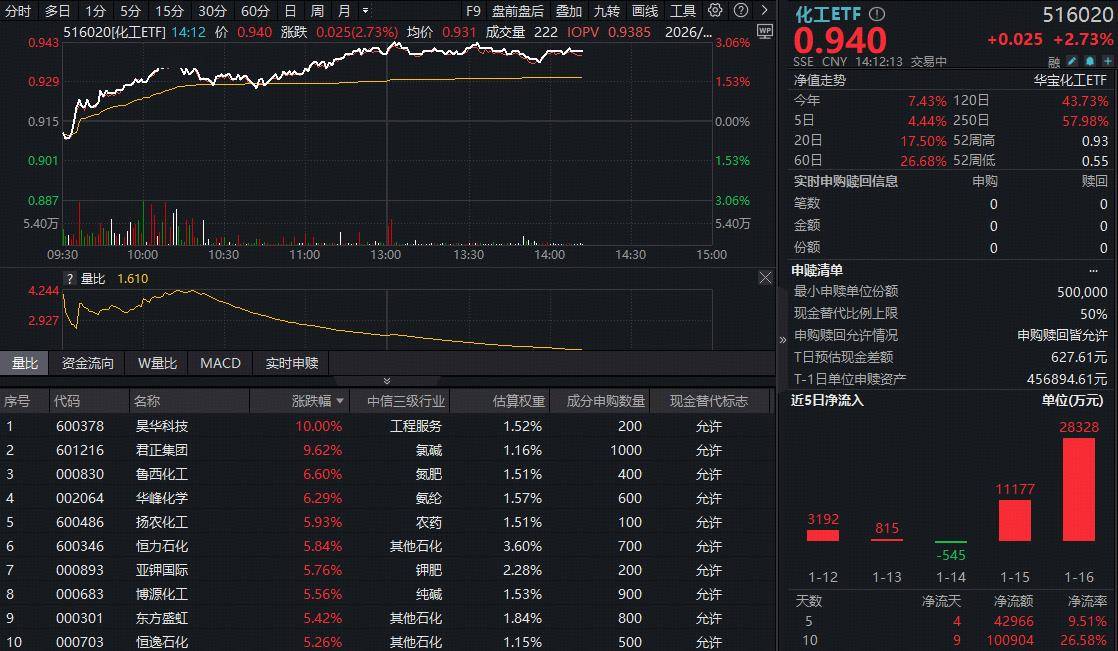
Group 1 - The chemical sector continues to show strength, with the Chemical ETF (516020) experiencing a price increase of 2.73% as of the latest update [1][2] - Key stocks in the sector include Haohua Technology, which reached the daily limit, and Junzheng Group, which surged over 9%, along with other notable gains from companies like Luxi Chemical and Huafeng Chemical [1][2] - Since 2025, the Chemical ETF has shown a cumulative increase of 47.53%, significantly outperforming major indices such as the Shanghai Composite Index (22.38%) and the CSI 300 Index (20.25%) [1][3] Group 2 - The chemical industry has seen negative growth in capital expenditure since 2024, but the "anti-involution" trend and the clearing of outdated overseas capacities are expected to lead to a contraction in supply [4] - The "14th Five-Year Plan" emphasizes expanding domestic demand, which is anticipated to drive growth in chemical product demand, especially with the onset of a U.S. interest rate cut cycle [4] - A potential turning point for the chemical industry is expected in 2026, with a shift from valuation recovery to earnings growth, referred to as the "Davis Double Play" [4] Group 3 - The Chemical ETF (516020) tracks the CSI Sub-Industry Chemical Theme Index, with nearly 50% of its holdings concentrated in large-cap leading stocks, including Wanhua Chemical and Salt Lake Co., allowing investors to capitalize on strong investment opportunities [5] - The ETF also includes exposure to various sub-sectors such as phosphate and nitrogen fertilizers, fluorochemicals, and others, providing a comprehensive investment approach within the chemical sector [5] - The fund does not charge a sales service fee, with specific subscription and redemption fee structures outlined for investors [5][6]


氟化工龙头涨停,化工板块午后继续猛攻!机构:供需双底确立,2026年或迎“戴维斯双击”
Xin Lang Cai Jing· 2026-01-19 06:24
Group 1 - The chemical sector continues to show strength, with the Chemical ETF (516020) experiencing a price increase of 2.73% as of the latest update [1][8] - Key stocks in the sector include Haohua Technology, which reached the daily limit, and Junzheng Group, which surged over 9%, along with other notable gains from companies like Luxi Chemical and Huafeng Chemical [1][8] - Since 2025, the Chemical ETF has shown a cumulative increase of 47.53%, significantly outperforming major indices such as the Shanghai Composite Index (22.38%) and the CSI 300 Index (20.25%) [10][11] Group 2 - The chemical industry has faced negative growth in capital expenditure since 2024, but the "anti-involution" trend and the accelerated elimination of outdated overseas capacity are expected to lead to a contraction in supply [12] - The "14th Five-Year Plan" emphasizes expanding domestic demand, which is anticipated to drive growth in chemical product demand, especially with the onset of a U.S. interest rate cut cycle [12] - The chemical industry may experience a cyclical turning point in 2026, transitioning from valuation recovery to earnings growth, referred to as the "Davis Double Play" [12] Group 3 - The Chemical ETF (516020) tracks the CSI Sub-Industry Chemical Theme Index, with nearly 50% of its holdings concentrated in large-cap leading stocks, including Wanhua Chemical and Salt Lake Co., allowing investors to capitalize on strong investment opportunities [13] - The ETF also diversifies its holdings across key sectors such as phosphate and nitrogen fertilizers, fluorine chemicals, and other leading stocks in the chemical sector [13] - Investors can also access the Chemical ETF through linked funds, which have specific subscription and redemption fee structures [5][14]