CZBANK(601916)

Search documents
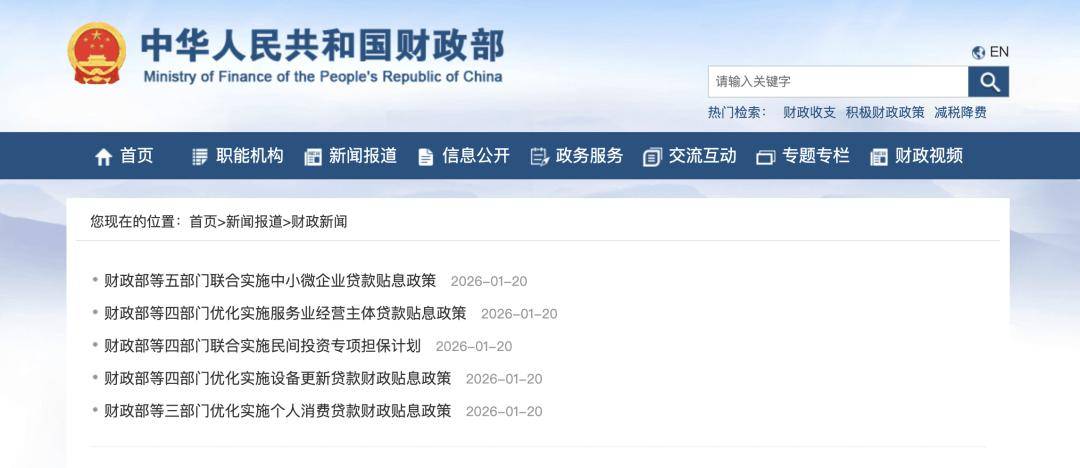
中小微企业贷款贴息、民间投资专项担保……财政部连发五项重要政策
Sou Hu Cai Jing· 2026-01-21 03:12
Group 1 - The Ministry of Finance and other departments have released five policy documents aimed at optimizing financial support for personal consumption loans, equipment updates, private investment guarantees, service industry loans, and small and micro enterprise loans [1][9][29] - The personal consumption loan subsidy policy has been extended until December 31, 2026, with adjustments to the subsidy standards and an expanded range of supported financial institutions [4][5][6] - The equipment update loan subsidy policy includes a 1.5% subsidy on fixed asset loans for equipment updates, applicable for up to two years, and has been expanded to include various sectors such as construction, aviation, and digital technology [10][11][12] Group 2 - The private investment guarantee plan has a total quota of 500 billion yuan, to be implemented over two years, focusing on supporting small and micro enterprises in various sectors including technology upgrades and service industry enhancements [17][18] - The plan includes a risk-sharing mechanism where banks will bear at least 20% of the loan risk, while the government guarantee fund will cover up to 80% [19] - The government will also reduce guarantee fees and increase the compensation limit for the guarantee fund to enhance support for private investments [20] Group 3 - The service industry loan subsidy policy has been extended to December 31, 2026, with an increased subsidy cap of 10 million yuan per loan and a 1% annual subsidy rate [23][24] - The policy now includes additional sectors such as digital, green, and retail industries, expanding the scope of financial support [24][25] - The implementation of these policies will involve streamlined processes for fund allocation and enhanced collaboration among financial institutions and regulatory bodies [26][28]








财政部连发多份重要文件,事关贷款贴息、民间投资贷款担保等 一揽子政策全文公布
Sou Hu Cai Jing· 2026-01-20 09:03
Group 1 - The core viewpoint of the news is the implementation of a financial subsidy policy for equipment renewal loans to support businesses in reducing financing costs and promoting effective investment [3][4][5] - The policy includes a 1.5% interest subsidy on fixed asset loans for equipment renewal projects, applicable for a maximum of two years, and is effective until December 31, 2026 [3][4] - The scope of support has been expanded to include various sectors such as construction, aviation, digital technology, and green energy, emphasizing high-end, intelligent, and digital equipment updates [4][6] Group 2 - A total of 26 banks are designated as eligible for processing the interest subsidy loans, including major national banks and several regional banks [4][5] - The subsidy process has been optimized to include a "pre-allocation + settlement" method, streamlining the application and approval process for banks and provincial financial departments [5][6] - The policy aims to enhance the experience of businesses by ensuring timely communication regarding subsidy payments through modern technology [6][7] Group 3 - The policy for small and micro enterprises includes a 1.5% interest subsidy on fixed asset loans, with a maximum loan amount of 50 million yuan, effective from January 1, 2026 [8][9] - The targeted sectors for this subsidy include new energy vehicles, medical equipment, and various service industries, aiming to stimulate investment and production [9][10] - The operational mechanism involves a "total-to-total" model for coordination between financial institutions and fiscal departments to ensure efficient processing of subsidy funds [11][12] Group 4 - The service industry loan subsidy policy has been extended until December 31, 2026, with an increased maximum loan amount of 10 million yuan and a 1% interest subsidy for one year [16][17] - New sectors such as digital, green, and retail have been added to the support scope, enhancing the policy's relevance to current economic trends [17][18] - The funding allocation process has been refined to improve efficiency and reduce redundancy in the approval process [18][19] Group 5 - A special guarantee plan for private investment has been introduced with a total quota of 500 billion yuan over two years, aimed at supporting small and micro enterprises [22][24] - The plan includes risk-sharing mechanisms where banks bear at least 20% of the loan risk, while the government guarantee fund covers up to 80% [24][25] - The initiative encourages innovative financing models and aims to enhance the capital strength of the government guarantee fund to support private investments effectively [26][27]
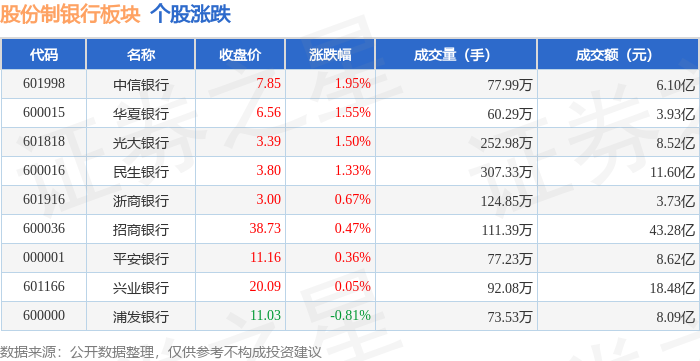
股份制银行板块1月20日涨0.54%,中信银行领涨,主力资金净流入3.9亿元
Zheng Xing Xing Ye Ri Bao· 2026-01-20 08:56
Core Viewpoint - The banking sector saw a slight increase of 0.54% on January 20, with CITIC Bank leading the gains, while the Shanghai Composite Index experienced a minor decline of 0.01% [1] Group 1: Stock Performance - CITIC Bank closed at 7.85, up by 1.95% with a trading volume of 779,900 shares and a transaction value of 610 million yuan [1] - Huaxia Bank closed at 6.56, up by 1.55% with a trading volume of 602,900 shares and a transaction value of 393 million yuan [1] - Everbright Bank closed at 3.39, up by 1.50% with a trading volume of 2,529,800 shares and a transaction value of 852 million yuan [1] - Minsheng Bank closed at 3.80, up by 1.33% with a trading volume of 3,073,300 shares and a transaction value of 1.16 billion yuan [1] - Zhejiang Commercial Bank closed at 3.00, up by 0.67% with a trading volume of 1,248,500 shares and a transaction value of 373 million yuan [1] - China Merchants Bank closed at 38.73, up by 0.47% with a trading volume of 1,113,900 shares and a transaction value of 4.33 billion yuan [1] - Ping An Bank closed at 11.16, up by 0.36% with a trading volume of 772,300 shares and a transaction value of 862 million yuan [1] - Industrial Bank closed at 20.09, up by 0.05% with a trading volume of 920,800 shares and a transaction value of 1.85 billion yuan [1] - Shanghai Pudong Development Bank closed at 11.03, down by 0.81% with a trading volume of 735,300 shares and a transaction value of 809 million yuan [1] Group 2: Capital Flow - The banking sector experienced a net inflow of 390 million yuan from institutional investors, while retail investors contributed a net inflow of 169 million yuan [1] - The sector saw a net outflow of 558 million yuan from speculative funds [1] - Specific capital flows for major banks include: - China Merchants Bank: 14.2 million yuan net inflow from institutional investors, 259 million yuan net inflow from retail investors [2] - Minsheng Bank: 11.2 million yuan net inflow from institutional investors, with net outflows from both speculative and retail investors [2] - Industrial Bank: 68.9 million yuan net inflow from institutional investors, with significant net outflows from speculative investors [2] - Everbright Bank: 38.9 million yuan net inflow from institutional investors, with net outflows from retail investors [2] - Huaxia Bank: 38.3 million yuan net inflow from institutional investors, with net outflows from retail investors [2] - Zhejiang Commercial Bank: 20.2 million yuan net inflow from institutional investors, with net outflows from retail investors [2] - CITIC Bank: 17.7 million yuan net inflow from institutional investors, with net outflows from both speculative and retail investors [2] - Ping An Bank: 4.9 million yuan net inflow from institutional investors, with net outflows from retail investors [2] - Shanghai Pudong Development Bank: 53.2 million yuan net outflow from institutional investors, with a net inflow from speculative investors [2]




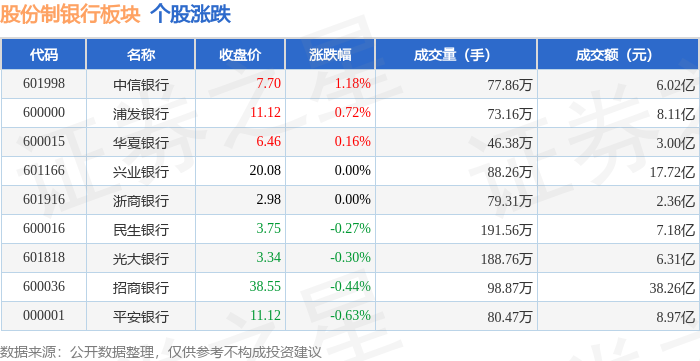
股份制银行板块1月19日涨0.03%,中信银行领涨,主力资金净流出4130.87万元
Zheng Xing Xing Ye Ri Bao· 2026-01-19 08:58
Market Performance - The banking sector saw a slight increase of 0.03% on January 19, with CITIC Bank leading the gains [1] - The Shanghai Composite Index closed at 4114.0, up by 0.29%, while the Shenzhen Component Index closed at 14294.05, up by 0.09% [1] Individual Bank Performance - CITIC Bank closed at 7.70, with a rise of 1.18%, and a trading volume of 778,600 shares, amounting to a transaction value of 602 million yuan [1] - Other notable banks include: - Shanghai Pudong Development Bank at 11.12, up by 0.72%, with a transaction value of 811 million yuan [1] - Huaxia Bank at 6.46, up by 0.16%, with a transaction value of 300 million yuan [1] - Industrial Bank remained unchanged at 20.08, with a transaction value of 1.772 billion yuan [1] - Minsheng Bank decreased by 0.27% to 3.75, with a transaction value of 718 million yuan [1] Fund Flow Analysis - The banking sector experienced a net outflow of 41.31 million yuan from institutional investors, while retail investors saw a net inflow of 408 million yuan [1] - Specific fund flows for individual banks include: - Shanghai Pudong Development Bank had a net inflow of 143 million yuan from institutional investors [2] - CITIC Bank saw a net inflow of 55.12 million yuan from institutional investors [2] - Minsheng Bank experienced a net outflow of 603,920 yuan from institutional investors [2]
陪伴硬科技 穿越新周期,浙商银行赋能浙商创新路
Zhong Guo Jing Ji Wang· 2026-01-19 06:29
Core Insights - The article highlights the significant advancements in key industries such as aerospace, semiconductors, and pharmaceuticals in Zhejiang, driven by innovative private enterprises and supported by financial institutions like Zheshang Bank [1][2][3][4][5][6]. Group 1: Aerospace Industry - Blue Arrow Aerospace's "Zhuque-3" rocket, China's first reusable rocket, successfully launched and entered orbit, marking a critical step in China's commercial space sector [2]. - Zheshang Bank has provided long-term financial support to Blue Arrow Aerospace since its establishment in 2018, facilitating the company's transition from research and development to large-scale production [2]. Group 2: Semiconductor Industry - ChipLink Integrated Circuit Manufacturing Co., Ltd. has emerged as a key player in the semiconductor sector, ranking among the top ten globally in wafer foundry revenue [3]. - Zheshang Bank has innovated financing solutions for ChipLink, including the issuance of a 500 million yuan technology innovation bond, supporting the company's market expansion and operational needs [3]. Group 3: Pharmaceutical Industry - Innovent Biologics, founded by Dr. Yu Dechao, has successfully launched 18 new drugs, with 12 included in the national medical insurance directory, benefiting over 600,000 patients [5][6]. - Zheshang Bank has provided cross-border financial solutions to Innovent Biologics, facilitating its global expansion and offering substantial credit lines to support its international operations [5][6]. Group 4: Financial Support and Strategy - Zheshang Bank has served over 35,000 technology-based enterprises, with a financing balance exceeding 460 billion yuan, demonstrating its commitment to supporting innovation in Zhejiang [6][7]. - The bank aims to enhance its technology finance services, aligning with national strategies to foster innovation and support the growth of private technology enterprises [7].
银行资负跟踪20260119:降准降息还有空间
GF SECURITIES· 2026-01-19 04:26
Investment Rating - The industry investment rating is "Buy" [3] Core Viewpoints - The report indicates that there is still room for further cuts in reserve requirement ratios and interest rates, with a focus on structural monetary policy support for high-quality economic development [15][19] - The central bank has implemented a reduction of 0.25 percentage points in various structural monetary policy tool rates, signaling a supportive monetary policy stance [15][19] - The report emphasizes the importance of timing for future policy implementations, particularly in relation to government bond issuance peaks and the maturity schedule of high-interest bank deposits [15] Summary by Sections 1. Monetary Policy Adjustments - The report notes a reduction of 0.25 percentage points in structural monetary policy tool rates, with a focus on supporting key areas through increased re-lending [15] - Future attention is directed towards December economic data and January LPR [22] 2. Central Bank Dynamics and Market Rates - The central bank conducted a total of 9,515 billion yuan in 7-day reverse repos at an interest rate of 1.40%, with a net injection of 9,741 billion yuan [16] - The report highlights that the funding rates remained stable, with expectations of slight increases due to tax payments and government bond net repayments [16] 3. Bank Financing Tracking - The report indicates that the total outstanding amount of interbank certificates of deposit (CDs) is 19.09 trillion yuan, with an average issuance rate of 1.65% [20] - The report also notes that there were no commercial bank bond issuances during the period, with a total outstanding commercial bank bond size of 3.38 trillion yuan [20]



激发新质生产力,浙商银行科技金融支持浙商创新
Jin Rong Jie· 2026-01-19 03:04
Core Insights - The article highlights the significant advancements in key industries such as aerospace, semiconductors, and pharmaceuticals in Zhejiang, driven by innovative private enterprises and supported by financial institutions like Zheshang Bank [1][2][3][4][5][6]. Group 1: Aerospace Industry - Blue Arrow Aerospace's "Zhuque-3" rocket, China's first reusable rocket, successfully launched in December 2025, marking a critical milestone in commercial space exploration [2]. - Zheshang Bank has provided long-term financial support to Blue Arrow Aerospace since its establishment in 2018, facilitating the transition from research and development to mass production [2]. - The bank's financial backing includes special interest rate discounts for high-level talent, enhancing support for the aerospace sector [2]. Group 2: Semiconductor Industry - ChipLink Integrated Circuit Manufacturing Co., based in Shaoxing, is a rising player in the semiconductor industry, ranking among the top ten globally in wafer foundry revenue [3]. - Zheshang Bank has been instrumental in providing comprehensive financial services, including a groundbreaking 500 million yuan technology innovation bond to support ChipLink's market expansion [3]. - The bank's innovative financing solutions aim to address the unique asset structures and funding needs of the semiconductor manufacturing sector [3]. Group 3: Pharmaceutical Industry - Innovent Biologics, founded by Dr. Yu Dechao, has successfully launched 18 new drugs, with 12 included in the national medical insurance directory, benefiting over 600 million patients [5][6]. - Zheshang Bank has facilitated cross-border financial solutions for Innovent Biologics, providing billions in credit to support its global expansion [5][6]. - The bank has evolved its role from merely providing financial support to actively participating in market promotion for Innovent's new products, exemplifying a "finance + ecosystem" collaboration model [6]. Group 4: Financial Support and Growth - By the end of 2025, Zheshang Bank had served over 35,000 technology enterprises, with a financing balance exceeding 460 billion yuan, demonstrating its commitment to supporting innovation in Zhejiang [6][7]. - The bank aims to enhance its technology finance services, aligning with national strategies to foster innovation and support the growth of private technology firms [7].
浙商银行将在3月1日起停止发行地下城与勇士联名信用卡产品
Jin Tou Wang· 2026-01-18 23:36
Core Points - Zhejiang Commercial Bank will stop issuing the Dungeon & Fighter co-branded credit cards effective March 1, 2026, due to business policy adjustments [1] - Existing cardholders can continue to use their cards until expiration, and standard credit card functions will remain unaffected [1] - After March 1, 2026, benefits provided by the co-branded partner will terminate, but cardholders can still enjoy standard credit card benefits until their cards expire [1] - Cardholders needing to replace or renew their cards can contact the bank's service hotline for assistance, and replacements will be issued as the same tier of Zhejiang Commercial Bank's Infinity Credit Card [1] - Annual fees for renewed cards will be charged according to new issuance standards, as detailed in the bank's service price manual [1] - Cardholders wishing to cancel their cards early can do so through bank branches or by calling the service hotline [1]
关于财通证券资产管理有限公司旗下部分基金在浙商银行股份有限公司新增定期定额投资业务和转换业务的公告
Shang Hai Zheng Quan Bao· 2026-01-18 18:44
Core Viewpoint - The announcement details a sales agreement between Caitong Securities Asset Management Co., Ltd. and Zhejiang Commercial Bank, effective from January 19, 2026, allowing certain funds to offer regular investment and fund conversion services through the bank [1]. Group 1: Fund Investment and Conversion Services - Starting January 19, 2026, certain funds managed by the company will be available for regular investment (定投) and fund conversion through Zhejiang Commercial Bank [1]. - Fund conversion allows investors to switch their holdings from one fund to another managed by the same fund manager and registered with the same registration agency [1]. Group 2: Fund Conversion Rules - Fund conversion must involve funds sold by the same sales institution and managed by the same fund manager, with both funds registered at the same registration agency [2]. - The conversion price is based on the net asset value of the funds on the day the conversion application is accepted [2]. - The conversion process follows a "first in, first out" rule, where older registered shares are converted first [2]. Group 3: Conversion Fees and Calculations - Conversion fees consist of the redemption fee from the outgoing fund and any difference in subscription fees between the incoming and outgoing funds [4]. - The redemption fee is calculated based on the number of shares being converted and the applicable redemption fee rate [5]. - The formula for calculating conversion amounts and shares is provided, ensuring transparency in the conversion process [6]. Group 4: Important Notes for Investors - Investors engaging in regular investment through Zhejiang Commercial Bank will adhere to the same fee rates as subscription fees, with minimum investment amounts matching those for subscriptions [7]. - Investors are encouraged to read the fund's contract and prospectus available on the company's website for detailed information on the funds and associated risks [7]. - Customer service contact information for both Zhejiang Commercial Bank and Caitong Securities is provided for further inquiries [8].

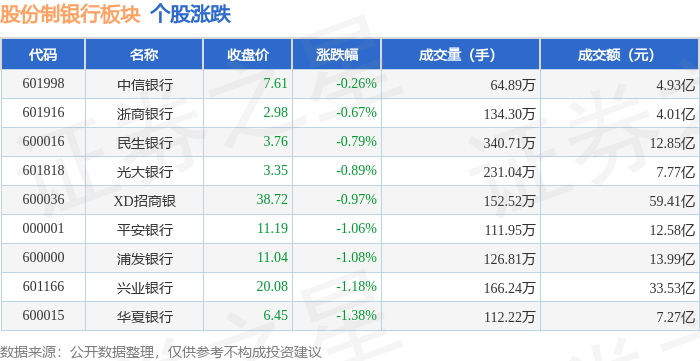
股份制银行板块1月16日跌1.73%,华夏银行领跌,主力资金净流出5.02亿元
Zheng Xing Xing Ye Ri Bao· 2026-01-16 08:56
Market Overview - The banking sector saw a decline of 1.73% on January 16, with Huaxia Bank leading the drop [1] - The Shanghai Composite Index closed at 4101.91, down 0.26%, while the Shenzhen Component Index closed at 14281.08, down 0.18% [1] Individual Bank Performance - CITIC Bank closed at 7.61, down 0.26% with a trading volume of 648,900 shares and a transaction value of 493 million [1] - Zheshang Bank closed at 2.98, down 0.67% with a trading volume of 1.34 million shares and a transaction value of 401 million [1] - Minsheng Bank closed at 3.76, down 0.79% with a trading volume of 3.41 million shares and a transaction value of 1.285 billion [1] - Everbright Bank closed at 3.35, down 0.89% with a trading volume of 2.31 million shares and a transaction value of 777 million [1] - China Merchants Bank (XD) closed at 38.72, down 0.97% with a trading volume of 1.52 million shares and a transaction value of 5.941 billion [1] - Ping An Bank closed at 11.19, down 1.06% with a trading volume of 1.12 million shares and a transaction value of 1.258 billion [1] - Pudong Development Bank closed at 11.04, down 1.08% with a trading volume of 1.27 million shares and a transaction value of 1.399 billion [1] - Industrial Bank closed at 20.08, down 1.18% with a trading volume of 1.66 million shares and a transaction value of 3.353 billion [1] - Huaxia Bank closed at 6.45, down 1.38% with a trading volume of 1.12 million shares and a transaction value of 727 million [1] Capital Flow Analysis - The banking sector experienced a net outflow of 502 million from institutional investors and 687 million from retail investors, while retail investors saw a net inflow of 1.189 billion [1] - Specific capital flows for individual banks indicate varying trends, with Shanghai Pudong Bank seeing a net inflow of 88.92 million from institutional investors [2] - CITIC Bank had a net inflow of 42.84 million from institutional investors, while retail investors experienced a net outflow of 53.64 million [2] - Everbright Bank had a net inflow of 13.72 million from institutional investors, but retail investors faced a net outflow of 53.07 million [2] - Minsheng Bank saw a net outflow of 51.56 million from institutional investors, while retail investors had a net inflow of 51.08 million [2] - Huaxia Bank experienced a significant net outflow of 114 million from institutional investors, with a smaller net inflow of 10.25 million from retail investors [2] - Ping An Bank had a net outflow of 139 million from institutional investors, but retail investors saw a net inflow of 95.90 million [2]