CCB(601939)

Search documents
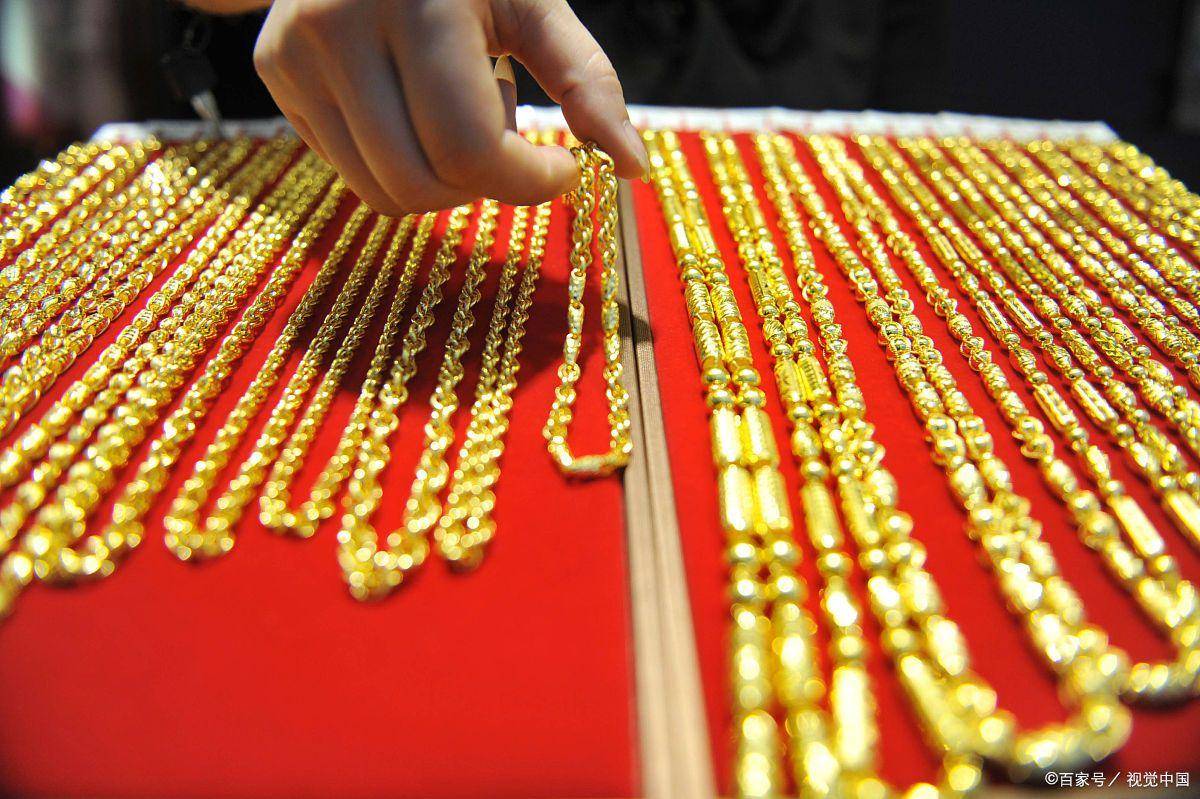
今日金价!2026年2月23日最新黄金价格!各大金店、黄金回收价格
Sou Hu Cai Jing· 2026-02-23 23:35
Core Insights - The domestic gold market is experiencing adjustments, with retail prices remaining strong while wholesale prices are more affordable [1] - The recovery price for gold is steadily increasing, indicating a stable demand for high-purity gold [6] Brand Gold Store Prices - Major brands' gold prices per gram are as follows: - Chow Tai Fook: 1545.00 CNY - Chow Sang Sang: 1562.00 CNY - King of Gold: 1545.00 CNY - Xie Ruilin: 1545.00 CNY - Lao Feng Xiang: 1518.00 CNY - Lao Miao Gold: 1598.00 CNY - Cai Bai Jewelry: 1505.00 CNY - China Gold: 1505.00 CNY [1][2][3][4] Regional Price Differences - In Shenzhen, wholesale prices are as follows: - Gold 999: 1298.00 CNY - High purity gold 999.9: 1299.00 CNY - Gold bars: 1298.00 CNY - Prices in first-tier cities like Beijing, Shanghai, and Guangzhou vary slightly, with Shanghai's Chow Tai Fook at 1545.00 CNY and Guangzhou's Lao Feng Xiang at 1518.00 CNY [4] Investment Gold Prices - Bank gold bars are priced at 1155.00 CNY per gram, with recovery prices around 1100.00 CNY depending on purity [5][9] Gold Recovery Prices - The current base recovery price for gold with a purity of 99.9% or higher is 1100.00 CNY per gram, with several brands also offering the same recovery price [6][8]





建设银行(00939.HK):2月23日南向资金增持1590.1万股
Sou Hu Cai Jing· 2026-02-23 19:29
中国建设银行股份有限公司是一家商业银行。该银行主营业务分为公司银行业务,包括企业存款、企业 信贷、资产托管、企业年金、贸易融资、国际结算、国际融资和增值服务等;个人银行业务,包括个人 储蓄、贷款、银行卡服务、私人银行服务、外汇买卖和黄金买卖等,以及资金业务。该银行在中国国内 及海外市场开展业务。 以上内容为证券之星据公开信息整理,由AI算法生成(网信算备310104345710301240019号),不构成 投资建议。 证券之星消息,2月23日南向资金增持1590.1万股建设银行(00939.HK)。近5个交易日中,获南向资金 增持的有5天,累计净增持5128.32万股。近20个交易日中,获南向资金增持的有16天,累计净增持2.7亿 股。截至目前,南向资金持有建设银行(00939.HK)347.79亿股,占公司已发行普通股的14.46%。 ...

银行积极响应“乐购新春”号召 助力春节消费“火”起来
Zheng Quan Ri Bao· 2026-02-23 16:45
今年1月份,商务部等9单位联合印发《2026"乐购新春"春节特别活动方案》,其中明确"加大金融支 持。鼓励金融机构与重点商户合作,策划春节专属活动,推出消费红包、消费立减等优惠,扩大活动覆 盖面。" 国家金融监督管理总局新闻发言人、政策研究司司长郭武平在2月11日召开的国新办新闻发布会上表 示,国家金融监督管理总局认真贯彻落实党中央、国务院决策部署,促进投资于物和投资于人紧密结 合,指导金融机构落实好促消费的各项举措,丰富金融产品,便利金融服务,营造良好的消费环境。具 体可以概括为降成本、优服务、惠民生、强保障四个方面。 多家银行积极行动,围绕"好吃、好住、好行、好游、好购、好玩"等新春消费六大场景,开展2026年春 节促消费专项活动,推出一系列暖心、实惠的金融服务。 据建设银行(601939)相关部门负责人介绍,建设银行以"福享舌尖、福暖新家、福行天下、福购到 家、福乐生活"为主题,精心策划开展15项惠民活动,并集中推出微信立减金、消费券、数字人民币智 能合约红包、支付满减、利率优惠等多重权益,助力实现马年消费"开门红"。 天津市一位消费者对记者表示,春节期间购买电影票时享受了减满优惠,一张电影票便宜了10 ...



银行股分红大比拼!谁才是真现金奶牛?
Sou Hu Cai Jing· 2026-02-22 08:54
现在的理财圈,简直比菜市场还卷。 存款利率一降再降,放一年利息少得可怜。 基金净值上蹿下跳,心脏不好根本扛不住。 理财产品打破刚兑,赚钱亏钱全看运气。 普通老百姓想找个稳当当、能长期拿的"钱生钱"路子,难上加难。 就在大家愁眉不展的时候,低调的银行股直接亮出王炸。 每年几百上千亿的现金分红,股息率碾压定期存款。 工行、建行、农行、中行轮番发红包,被股民亲切叫作"股市现金奶牛"。 银行股分红大比拼!谁才是真·现金奶牛? 农业银行、中国银行也不示弱,单年分红均超600亿元,红包拿到手软。 2025年中期分红更是加码,六大行合计派息超2000亿元。 工行单中期就分掉504亿元,创下上市银行中期分红纪录。 别人分红是发零花钱,大行分红直接是下红包雨。 再看分红比例,政策托底稳得很。 证监会《上市公司监管指引第3号》明确鼓励现金分红,新"国九条"更是强化要求。 国有大行常年把分红比例锁定在30%以上,雷打不动。 部分股份行如招行,分红率直接干到35%+,诚意拉满。 以前银行一年分一次,现在响应政策,中期+年度两次分红。 相当于一年领两次工资,现金流直接翻倍。 老百姓最关心的股息率,更是吊打传统理财。 国有大行A股股息率 ...

黄金跌价,金条降价,2026年02月19日,国内黄金最新价格,各大银行黄金金条最新价格
Sou Hu Cai Jing· 2026-02-21 06:02
2026年2月19日,国内黄金市场迎来一波小幅震荡,金价略有回落,金条价格也随之下调。对于关注黄 金市场的投资者和消费者来说,了解最新的金价信息至关重要。本文将详细解读当日各类黄金产品,包 括足金、千足金以及投资金条的最新价格,并汇总各大银行的金条报价,供您参考。 首先,让我们聚焦黄金纯度标准。根据国家标准,含金量大于990‰的黄金产品统称为足金。市场上常 见的足金产品纯度各异,包括含金量≥990‰、≥999‰、≥99.99%以及≥99.999%等多种规格。其中,含金 量达到99.99%和99.999%的黄金通常被誉为高纯度黄金,它们色泽赤黄,质地柔软,延展性极佳,是制 作高档首饰的理想选择。不同纯度的黄金用途也略有差异。例如,含金量不低于99.0%的足金 (AU999)常被用于制作日常佩戴的珠宝首饰;而纯度更高的足金9999(AU9999),含金量不低于 99.99%,除了制作首饰外,因其更高的保值性,也受到投资者的青睐。 当日,国内黄金市场各品类的具体价格如下: 国内黄金9995最新价格:1103.80元/克 国内黄金9999最新价格:1103.80元/克 国内9999千足金最新价格:1110.40元/克 ...
中国手机银行用户规模见顶,行业逻辑转向存量提升
Xin Lang Cai Jing· 2026-02-18 05:56
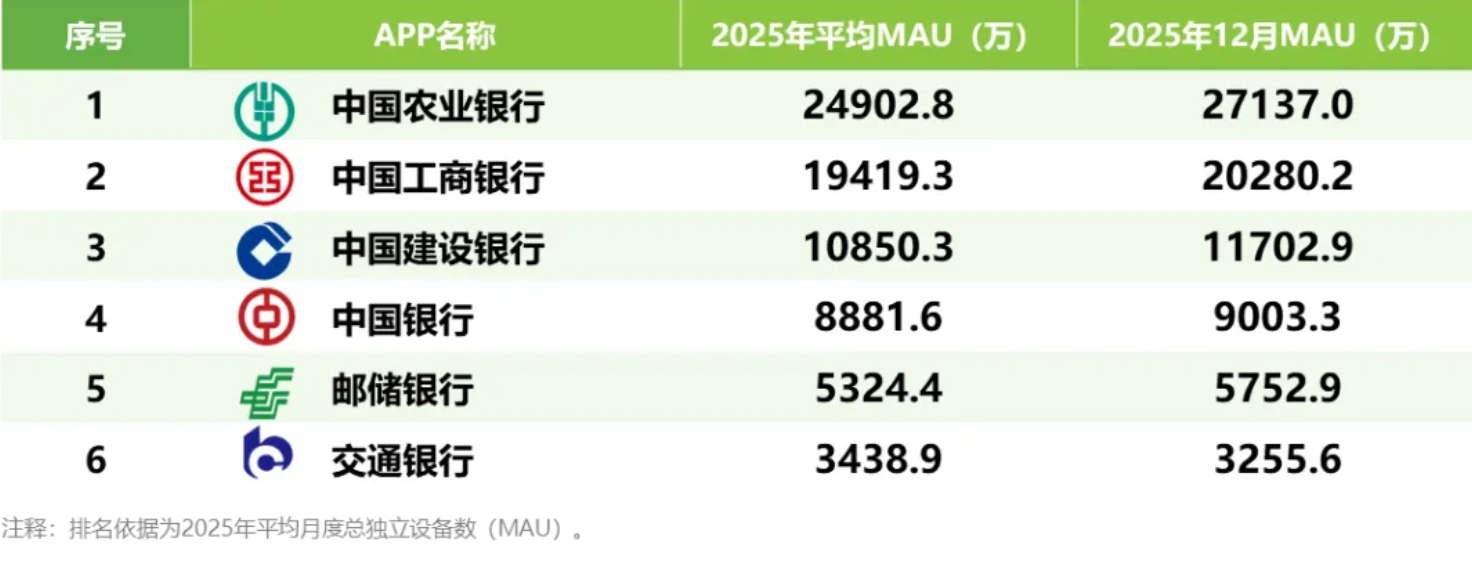
Core Insights - The report indicates that the average monthly active users (MAU) for major Chinese mobile banking apps in 2025 shows a significant user base, with the Agricultural Bank of China leading at approximately 24.9 million users [1]. Group 1: User Metrics - The average MAU for the top five mobile banking apps in 2025 are as follows: Agricultural Bank of China (24.9 million), Industrial and Commercial Bank of China (19.4 million), China Construction Bank (10.9 million), Bank of China (8.9 million), and Postal Savings Bank (5.3 million) [1]. - The total number of independent devices for mobile banking in China is projected to stabilize between 648 million and 739 million, indicating a plateau in user growth [1]. Group 2: Industry Trends - The report highlights a shift in industry dynamics from acquiring new users to enhancing existing user engagement, as the flow of new users has reached a ceiling [1]. - User behavior is changing structurally, with the effective daily usage time per device decreasing from 4.9 minutes in 2023 to around 2.7 minutes by mid-2025, stabilizing at approximately 3 minutes [1]. - The trend towards high-frequency, short-duration, and function-oriented usage is prompting financial institutions to streamline processes and focus on core transaction scenarios [1].

国有大行主导手机银行市场,生态嵌入构筑护城河
Jing Ji Guan Cha Wang· 2026-02-18 05:47
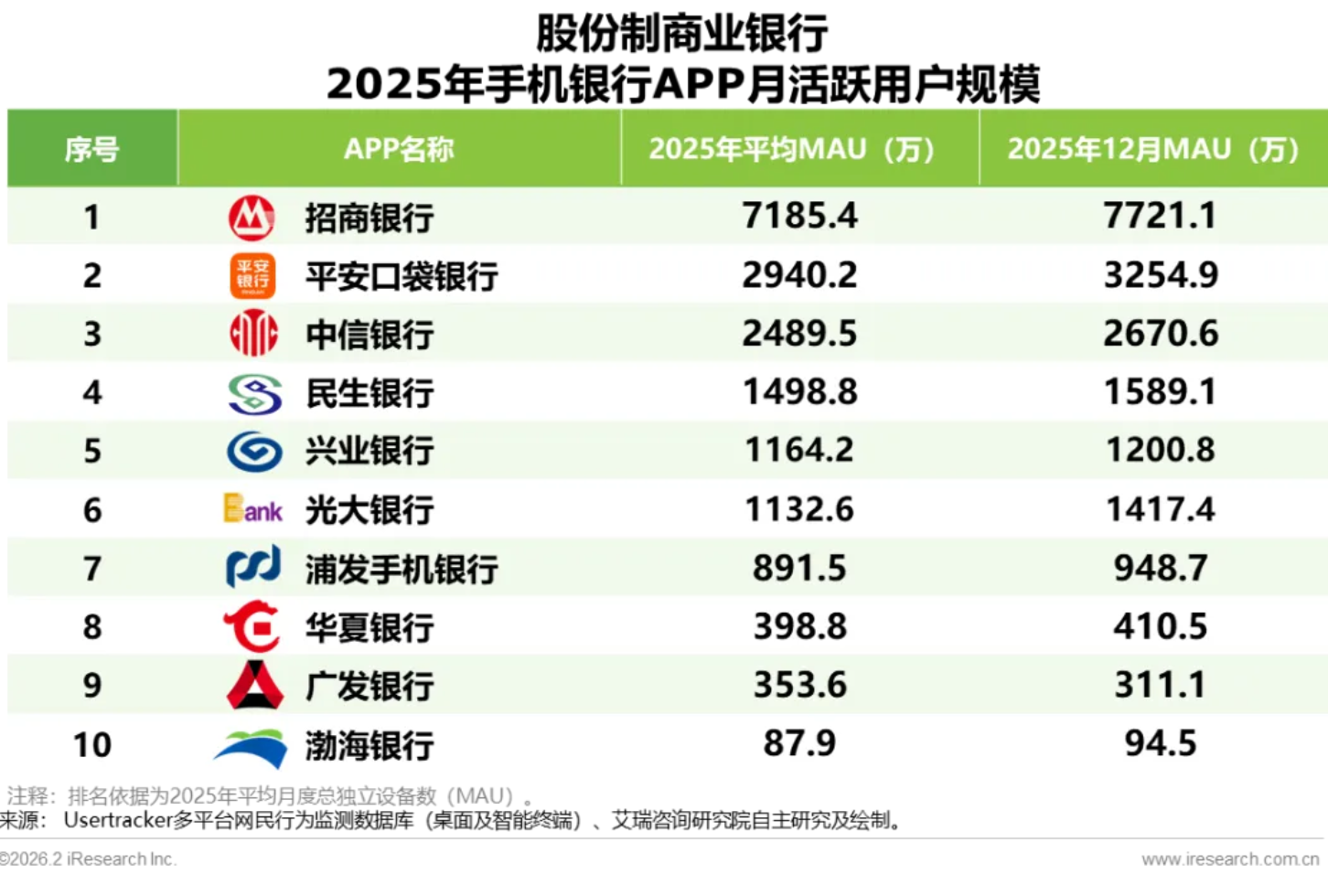
Core Insights - The Chinese mobile banking market is entering a stage of stock competition in 2025, with monthly active users (MAU) stabilizing between 648 million and 739 million [2] - State-owned commercial banks dominate the market due to their ecological embedding advantages, with Agricultural Bank of China leading at 249 million MAU, followed by Industrial and Commercial Bank of China (194 million) and China Construction Bank (109 million) [2] - Private banks are expected to collectively exit the top 50 MAU rankings in 2025 due to a lack of offline branch support and local living ecosystems [2] Group 1: Major Players - Agricultural Bank of China has the highest MAU at 249 million, followed by Industrial and Commercial Bank of China with 194 million and China Construction Bank with 109 million, forming the first tier of banks [2] - China Bank and Postal Savings Bank have MAUs exceeding 50 million, constituting the second tier [2] - China Merchants Bank leads the joint-stock banks with 71.85 million MAU, while Ping An Bank and CITIC Bank form the second tier, with other joint-stock banks generally below 20 million MAU [2] Group 2: Market Dynamics - The core advantage of state-owned banks lies in their "full-scenario integration" capabilities, embedding services deeply into high-frequency life scenarios such as government affairs, social security, healthcare, and education [2] - Agricultural Bank of China extends its services to rural areas through intelligent service matching and customer customization, while Industrial and Commercial Bank of China utilizes its "Gong Xiao Zhi" model for interactive service [2] - Regional banks like Jiangsu Bank, Beijing Bank, and Ningbo Bank show stable performance by focusing on local markets, with some rural commercial banks like Fujian Rural Credit exceeding 4.5 million MAU, indicating the sustainability of localized operations in the stock market [2]

手机银行TOP50再无民营 生态壁垒高筑草根绝迹
Jing Ji Guan Cha Wang· 2026-02-18 05:47
Core Insights - The monthly active users (MAU) of mobile banking apps in China have stabilized between 648 million and 739 million, indicating that user growth has reached a ceiling, marking the end of a decade-long traffic dividend period [2] - User behavior has shifted significantly, with average session duration decreasing from 4.9 minutes in 2023 to approximately 2.7 minutes by mid-2025, reflecting a preference for high-frequency, short-duration, and function-oriented usage [2] - Major state-owned banks have solidified their market dominance, with all six major state-owned banks ranking in the top ten for MAU, led by Agricultural Bank of China with 249 million MAU [2] Industry Dynamics - The core competitive advantage of state-owned banks lies in their "full-scenario integration" capabilities, providing financial services deeply embedded in public services such as government, social security, healthcare, and education [3] - Joint-stock banks are adopting specialized development strategies, with China Merchants Bank leading its peers with 71.85 million MAU, while Ping An Bank and Citic Bank are leveraging AI technology to enhance service processes and maintain user engagement [3] - Local banks are experiencing polarization, with some city commercial banks maintaining MAU above 3 million due to their deep understanding of local markets, while private banks like WeBank and MYbank have fallen out of the top 50 due to challenges in customer acquisition and retention [3] Future Trends - As the industry standard for single-session usage time becomes 3 minutes, banks must rethink their value creation strategies [4] - AI-driven service process optimization, real-time risk control systems, and multi-device collaboration within ecosystems are reshaping the competitive landscape [4] - Key factors for institutional success in the future will include precise user insights, prudent risk management, and robust ecosystem integration capabilities [4]

流量红利枯竭 存量博弈下银行APP被迫断臂求生
Jing Ji Guan Cha Wang· 2026-02-18 05:44
Core Insights - The Chinese mobile banking market is transitioning from "scale expansion" to "value cultivation," indicating a saturation of user growth and the end of the traffic dividend period [2] - Different types of banks are exhibiting varied development trends in this new landscape [2] State-Owned Commercial Banks - The six major state-owned banks dominate the mobile banking market, with Agricultural Bank of China leading with over 250 million monthly active users (MAUs) [2] - The top three banks, including Industrial and Commercial Bank of China and China Construction Bank, have MAUs of nearly 200 million and over 100 million, respectively [2] - All six major banks reported positive month-on-month growth in MAUs, with ICBC leading at a 6.1% growth rate [2] Joint-Stock Commercial Banks - Joint-stock banks are seeking to carve out a niche in the saturated market, with China Merchants Bank leading among them with over 70 million MAUs [3] - Some banks like Everbright Bank and CITIC Bank showed significant month-on-month growth rates of 11.0% and 9.2%, respectively [3] - The performance of joint-stock banks is mixed, with some experiencing negative growth [3] Urban Commercial Banks - Urban commercial banks are growing rapidly, with 17 banks making it to the top 50 list, led by Ningbo Bank with 3.644 million MAUs and a growth rate of 43.9% [3] - The growth is attributed to localized strategies that enhance customer engagement [3] Rural Commercial Banks and Credit Cooperatives - Rural commercial banks and credit cooperatives also performed well, with 17 banks in the top 50, led by Fujian Rural Credit with 781.6 thousand average MAUs [4] - 12 out of these 17 banks reported positive month-on-month growth [4] Private Banks - Private banks are facing significant challenges, with only WeBank making it to the top 50 list in the first half of 2025, experiencing a 27.3% decline in MAUs [4] - The competitive landscape has shifted, making it difficult for online-only private banks to maintain their initial advantages [4] Conclusion - State-owned banks leverage "ecosystem" advantages to solidify their market position, while joint-stock banks focus on "professional" opportunities [5] - Urban commercial banks establish a strong local presence, whereas private banks struggle to survive in the competitive environment [5] - The future of banking will require a focus on creating irreplaceable value for users through technology and insights into user behavior [5]

2.7分钟定生死 手机银行存量厮杀谁在“断臂”,谁在“吃肉”?
Jing Ji Guan Cha Wang· 2026-02-18 04:57
Core Insights - The report by iResearch indicates that the monthly active users (MAU) of mobile banking apps in China have stabilized after fluctuating between 648 million and 739 million, signaling a ceiling in user growth and a shift from acquiring new users to enhancing existing user engagement [2] - User behavior is undergoing a structural reversal, with the effective daily usage time per device dropping from 4.9 minutes in 2023 to around 2.7 minutes by mid-2025, leading to a focus on high-frequency, short-duration, and functional usage [2] - Financial institutions are compelled to streamline operations and focus resources on core transaction scenarios to survive in this competitive landscape, where efficiency and precision are paramount [2] Mobile Banking Market Overview - The top three banks in terms of MAU are Agricultural Bank of China (2.49 billion), Industrial and Commercial Bank of China (1.94 billion), and China Construction Bank (1.09 billion), with all six major state-owned banks ranking in the top ten [3][5][6] - Private banks, represented by WeBank and MYbank, have faced significant setbacks, with many dropping out of the top 50 MAU rankings by 2025 [4] Competitive Landscape - State-owned banks are solidifying their dominance through extensive customer bases and integrated ecosystems, leveraging services embedded in high-frequency life scenarios such as government services and healthcare [7] - Joint-stock commercial banks are adopting a "specialized and precise" survival strategy, with China Merchants Bank leading among them with 71.85 million MAU, focusing on wealth management and intelligent interaction [8][10] - Regional banks are thriving by deeply engaging with local markets, while private banks struggle due to high customer acquisition costs and lack of local ecosystem support [13][14] Future Outlook - The mobile banking market is transitioning from a phase of scale expansion to one of value cultivation, with state-owned banks building moats through ecosystems, joint-stock banks seeking niches through specialization, and regional banks solidifying their local roots [14] - The ability to create irreplaceable value in a limited user engagement environment will be crucial, with technology applications such as AI reshaping service processes and enhancing risk management [15][16]